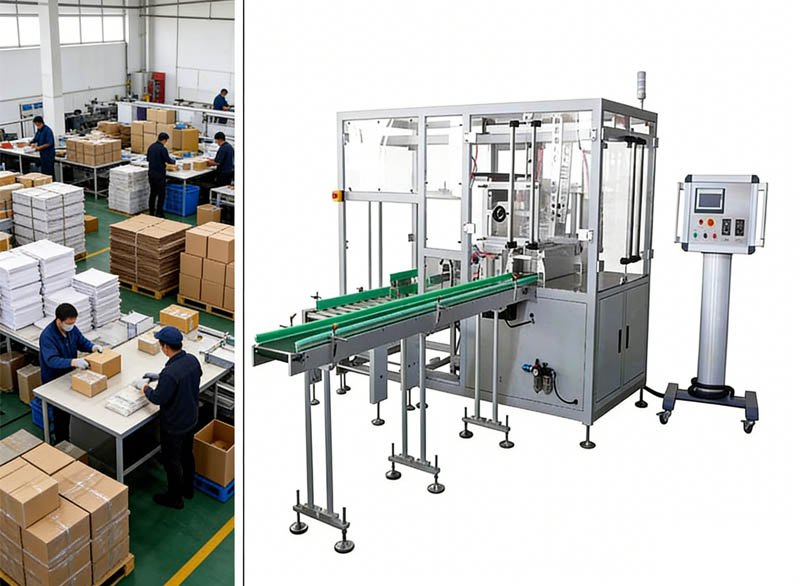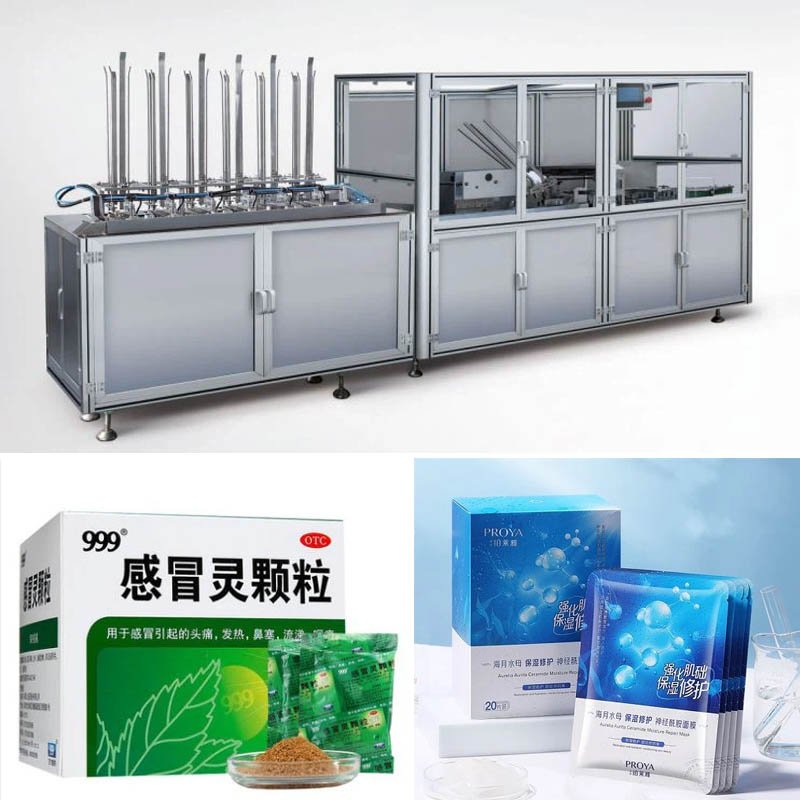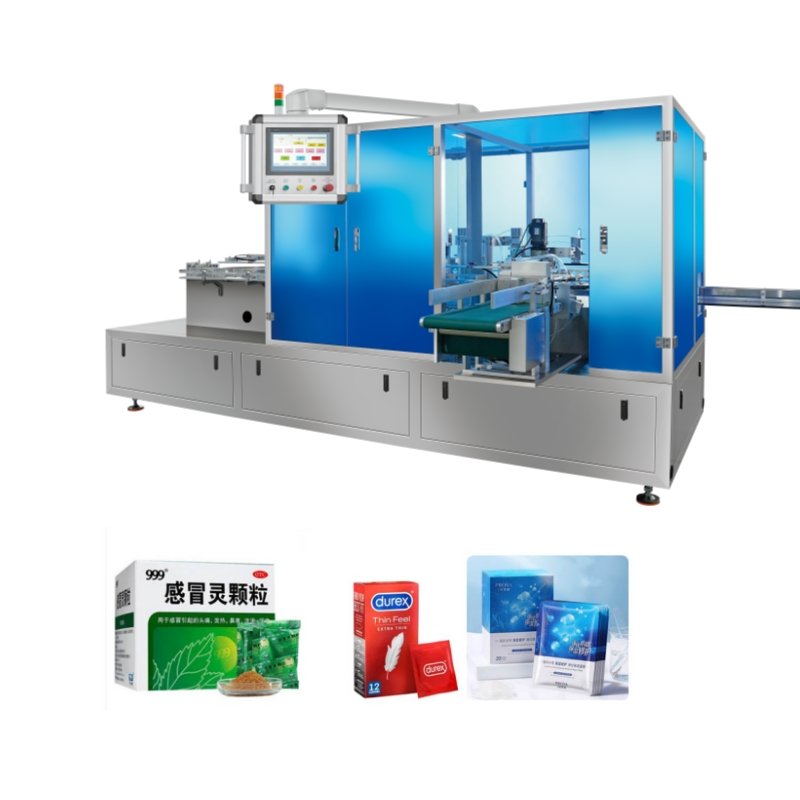
Quick Answer: How Much Does a Case Packing Machine Cost?
As indicative budget brackets, a fully automatic side push case packing machine typically runs US$25,000–$80,000 FOB depending on speed, construction, and sealing configuration; compact all-in-one opening-loading-sealing machines start lower, while robotic pick-and-place systems commonly exceed US$100,000. Explosion-proof rating, SUS304 stainless steel, and line integration each add cost. For B2B procurement, the invoice price is only 60–80% of the real project budget once shipping, installation, spare parts, and commissioning are counted — which is why serious buyers compare quotes on total cost of ownership, not sticker price.
Key Takeaways
- The five biggest price drivers are automation level, loading technology, guaranteed speed, construction material (carbon steel vs SUS304), and integration scope.
- A quote is only comparable when it states a guaranteed output for your product and array — a cheaper machine quoted at brochure speed is not cheaper.
- Budget beyond the machine: freight, import duties, installation and commissioning, format parts, spare parts kit, and operator training typically add 20–40% to the FOB price.
- Labor payback is the real math: a station that frees 4–8 operators per shift usually recovers the investment within one to two years of multi-shift operation.
- Get an application-specific number: send your box dimensions and array to the HIJ-CP500 side push case packing machine team for a formal FOB quote within 24–48 hours.
What Drives the Price of a Case Packing Machine
1. Automation level
The largest single jump is from semi-automatic (operator loads, machine seals) to fully automatic (case erection, collation, loading, and sealing without an operator in the loop). If you are automating to remove 4–8 packing operators per shift, only the fully automatic class delivers that outcome.
2. Loading technology
For the same throughput, mechanical side-push loading is significantly less expensive than robotic pick-and-place, because a servo pusher replaces a robot arm, grippers, and vision guidance. Robotics earn their premium only when products are irregular or unstable — for rectangular boxed products, you would be paying for flexibility you don’t use. If you’re still comparing technologies, start with our guide to what a case packing machine is and the four main types.
3. Guaranteed speed and format range
Higher guaranteed output means heavier frames, faster servos, larger magazines, and more accumulation — all real cost. So does a wide format range: a machine that must handle both your smallest and largest case sizes needs longer adjustment travels and more change parts.
4. Construction and environment rating
SUS304 stainless steel contact parts or full frames (standard expectation in cGMP-ready pharmaceutical and food environments) add material cost over painted carbon steel. An explosion-proof configuration with rated electrical components — required for solvent- or alcohol-based production areas — is a further premium.
5. Integration scope
A standalone machine is one price; a machine speed-matched to your cartoning machine, with conveyors, accumulation, and a downstream automatic case sealing machine, delivered as a single turnkey line with one point of responsibility, is a different project. The integrated route costs more on the invoice and almost always less over five years, because interface problems between suppliers are the most expensive line item nobody budgets for.
Indicative Budget Brackets (FOB, For Planning Only)
| Configuration | Indicative FOB bracket | Typical use case |
|---|---|---|
| Semi-automatic case sealing / taping equipment | US$2,000 – $10,000 | Low volume, operator-loaded lines |
| Compact all-in-one opening-loading-sealing machine | US$18,000 – $45,000 | Single-frame automation, limited floor space |
| Fully automatic side push case packer (e.g. HIJ-CP500 class) | US$25,000 – $80,000 | High-speed boxed pharma, food, cosmetics |
| Double station / two-lane case packing system | US$45,000 – $110,000 | Very high output, dual-lane production |
| Robotic pick-and-place case packing cell | US$100,000+ | Irregular or unstable products, mixed cases |
Treat these brackets as planning figures, not quotations — the honest number for your project depends on your product dimensions, packing array, guaranteed speed, material specification, and integration scope. Options like explosion-proof rating or full SUS304 construction move a machine toward or beyond the top of its bracket.
The Hidden 20–40%: Costs Beyond the Machine
- Freight and import: sea freight, insurance, import duties, and local taxes vary by destination and incoterm (FOB vs CIF vs DDP) — fix the incoterm before comparing quotes.
- Installation and commissioning: engineer travel, on-site setup, and production ramp support. Clarify how many days are included and the day rate afterwards.
- Format / change parts: each additional case format may need dedicated parts. List every SKU in your RFQ so formats are priced upfront, not discovered later.
- Recommended spare parts kit: typically 2–5% of machine value for the first two years; buying it with the machine avoids paying air freight for a $30 sensor during a line-down.
- Training and documentation: operator and maintenance training, manuals in your working language, and the documentation package your quality team needs for IQ/OQ/PQ execution.
The Payback Math B2B Buyers Actually Use
Take the fully loaded annual cost of the operators the machine replaces (wages + benefits + supervision + recruitment churn), multiply by your shift pattern, then add the cost of packing errors — short-count claims, damaged product, rework. Set that against the total project cost above. For lines running two or three shifts where case packing occupies four or more operators, the payback period typically lands within one to two years; single-shift, low-labor-cost operations should run the same math honestly and may find a semi-automatic or compact all-in-one machine is the rational choice.
Forester’s Insight
“The most expensive machines I’ve seen in 20+ years of factory audits were the cheap ones. Not because they broke — because of what wasn’t in the quote. No format parts for the SKUs the buyer forgot to mention. No spare parts kit, so a failed sensor meant a week of downtime waiting for air freight. Commissioning ‘included’ — for two days, when the line needed ten.”
“My rule for B2B buyers: never compare prices, compare quotations. Force every supplier to quote the same scope — same guaranteed speed for your real product, same incoterm, same spare kit, same commissioning days, same documentation package. The moment you do that, the price gaps usually shrink, and the suppliers who were hiding scope become obvious.”
— Forester Xiang, Founder & Chief Engineer, HIJ Machinery
How to Get an Accurate Quote in 24–48 Hours
Send these six items and a serious manufacturer can return a formal, comparable quotation within two working days: (1) product dimensions and weight, (2) packing array (rows × columns × layers), (3) case dimensions and board grade, (4) required output in products per minute, (5) material specification (carbon steel or SUS304; explosion-proof yes/no), and (6) integration scope — standalone, or matched with upstream and downstream equipment. For the working principle behind these specification items, see how a side push case packer works step by step.
Frequently Asked Questions
How much does a fully automatic case packing machine cost?
As an indicative planning bracket, fully automatic side push case packing machines typically run US$25,000 to $80,000 FOB, with the final figure driven by guaranteed speed, format range, construction material, and sealing configuration. Robotic pick-and-place systems commonly exceed US$100,000. The only number that matters is a formal quotation against your exact product, array, and required output.
Why do quotes for the same machine type vary so much?
Because scope varies. Two quotes for a “side push case packer” can differ in guaranteed speed basis, steel specification, included format parts, spare parts kit, commissioning days, documentation package, and incoterm. Normalize all quotes to the same scope and incoterm before comparing prices — most large price gaps are scope gaps in disguise.
Are Chinese case packing machines cheaper than European ones?
Generally the invoice price of a Chinese-built machine is substantially lower than a comparable European machine, with the gap widest on mechanical side-push systems built on standard platforms such as Siemens PLC control. The fair comparison is total cost of ownership: evaluate the specific manufacturer’s engineering depth, documentation quality, spare parts logistics, and after-sales response rather than the country label alone.
What payment terms are typical for a case packing machine order?
A common structure for export orders is a deposit with the purchase order (often 30–50%), with the balance due against factory acceptance test (FAT) approval or shipping documents. Tie at least one payment milestone to a witnessed FAT running your own product samples at the guaranteed speed — that keeps performance and payment aligned.
Does automation really pay back within two years?
On multi-shift lines where case packing occupies four or more operators, the fully loaded labor savings plus error reduction typically recover the total project cost within one to two years. On single-shift or low-labor-cost operations the payback stretches, which is why the honest recommendation there may be a semi-automatic or compact all-in-one solution instead of a full high-speed packer.
What should be included in a complete case packer quotation?
A complete B2B quotation states: guaranteed output for your named product and array, machine specification with steel grade and control platform, included format parts per SKU, spare parts kit contents, commissioning days and trainer scope, documentation package for your validation program, warranty terms, incoterm, and delivery time. If any of these is missing, the price on the page is not the price of the project.
About the Author & Publisher
This price guide is written and reviewed by Forester Xiang, Founder & Chief Engineer of HIJ Machinery (legal name: Wenzhou Trustar Machinery Technology Co., Ltd), a pharmaceutical, cosmetic, and food packaging machinery manufacturer founded in 2004 in Rui’an, Wenzhou, Zhejiang, China. Forester has 20+ years of packaging machinery engineering experience, has completed 100+ pharmaceutical facility audits, and has delivered equipment to customers in 30+ countries.
HIJ Machinery manufactures case packing machines, cartoning machines, and complete turnkey packaging lines, all supplied with cGMP-ready, CE-marked designs and documentation that supports the customer’s own validation program (IQ/OQ/PQ).
Get a Formal FOB Quote for Your Exact Application
Send your product dimensions, packing array, and target speed — our engineers will return a complete, comparable quotation with guaranteed output in writing within 24–48 hours.
Request My Formal Quote