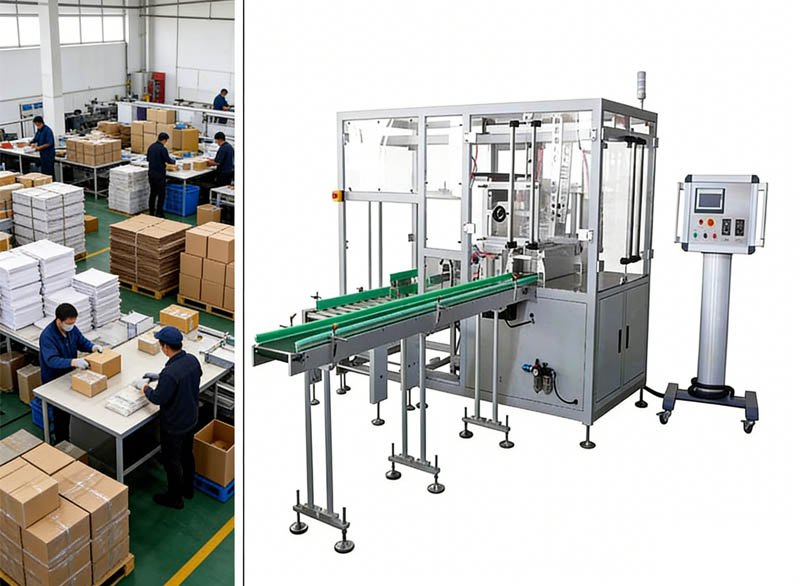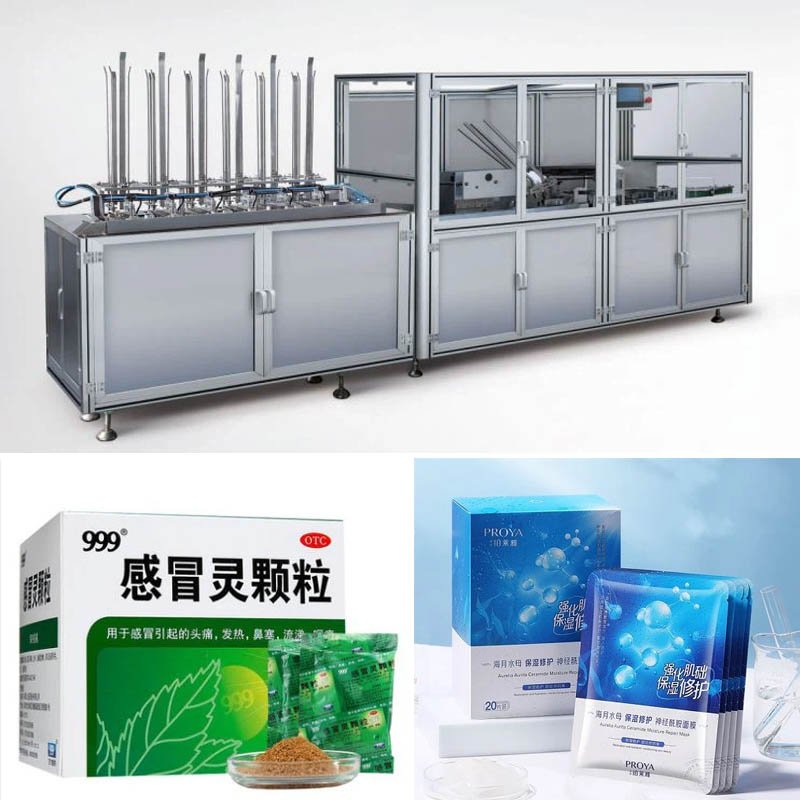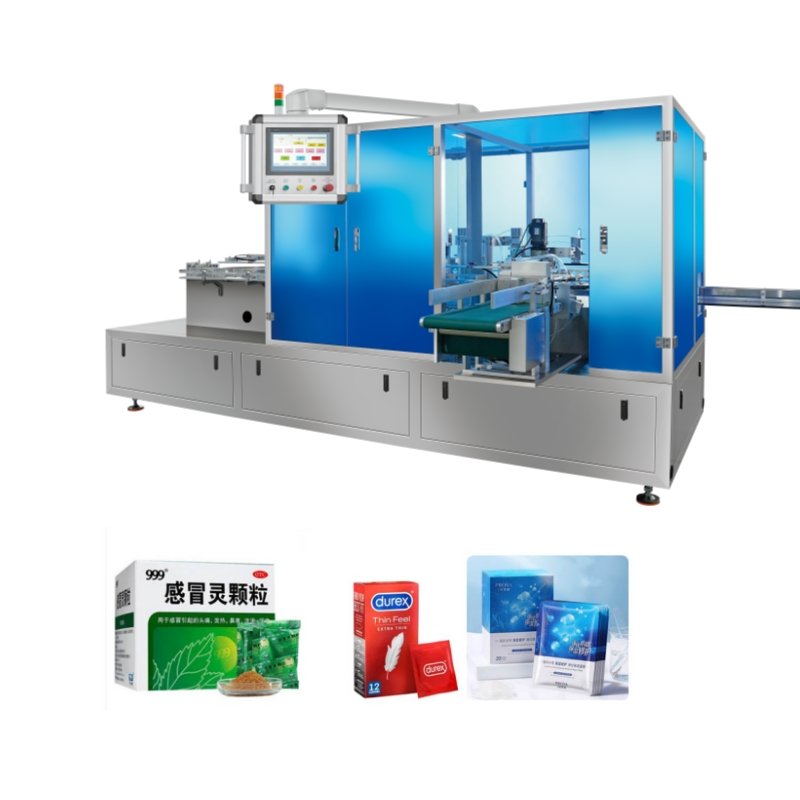
Quick Answer: What Is a Case Packing Machine?
A case packing machine (case packer) is an automated secondary packaging machine that erects corrugated shipping cases, collates finished products into a set array, loads them into the case, and folds and seals the flaps. Depending on loading technology — side push, top load, wrap-around, or robotic pick-and-place — a fully automatic case packer replaces 4–8 manual packing operators and runs at speeds from 5 to over 30 cases per minute (up to 500 product boxes per minute on high-speed side-push systems).
Key Takeaways
- A case packer automates the last labor-intensive step of your line: putting products into shipping cases. It sits downstream of your cartoning machine and upstream of sealing and palletizing.
- The four main types are side push (horizontal load), top load (drop), wrap-around, and robotic pick-and-place — each suits a different product shape, fragility, and speed target.
- For boxed pharmaceuticals, food cartons, and cosmetics, a side push case packing machine like the HIJ-CP500 offers the best speed-to-gentleness ratio, reaching 80–500 boxes per minute with zero drop impact.
- B2B buying decisions should be driven by total cost of ownership: labor savings, changeover time, integration with existing equipment, documentation for your validation program, and after-sales support — not just the invoice price.
- Always confirm real output with your own product samples and packing array before signing — rated speed and guaranteed speed are not the same thing.
What Does a Case Packing Machine Do?
In a packaging line, “primary packaging” touches the product itself (a blister, bottle, tube, or sachet) and “secondary packaging” prepares it for shipment. A case packing machine handles secondary packaging’s final stage: taking finished retail units — usually folding cartons or bottles — and packing them into corrugated shipping cases ready for palletizing and distribution.
On most production floors we audit, this step is still done by hand. That works at low volume, but as line speed increases, manual case packing becomes the bottleneck: counts drift, cases are inconsistently packed, labor costs climb, and your upstream equipment ends up waiting on people. A fully automatic case packer removes that constraint permanently and makes end-of-line output as predictable as the rest of the line.
How a Fully Automatic Case Packer Works: 4 Stages
- Case erection. Flat corrugated blanks are pulled from a magazine, opened by vacuum suction, and squared into a rigid case with the bottom flaps folded.
- Product collation. Incoming products are counted and arranged into the required array — for example 4 rows × 5 columns × 2 layers — on a collation conveyor or accumulation table.
- Loading. The collated group is transferred into the case. This is where the four machine types differ most: pushed in horizontally, dropped from above, wrapped by the blank itself, or placed by a robot.
- Flap folding and sealing. Top flaps are folded and sealed with tape or hot-melt adhesive, and the finished case is discharged toward check-weighing, labeling, or palletizing.
The 4 Types of Case Packing Machines Compared
| Criteria | Side Push (Horizontal) | Top Load (Drop) | Wrap-Around | Robotic Pick-and-Place |
|---|---|---|---|---|
| Best for | Stable rectangular products: boxed pharma, food cartons, cosmetic boxes | Robust products: cans, jars, rigid bottles | High-volume retail-ready trays and cases | Irregular shapes, pouches, unstable bottles, mixed cases |
| Product handling | Gentlest — horizontal push, zero drop impact | Highest impact — products fall into the case | Moderate — product acts as the forming mandrel | Gentle but slower per cycle |
| Typical speed | High — up to 500 product boxes/min on the HIJ-CP500 | High for robust products | Medium–high | Lower — limited by pick cycles |
| Changeover | Fast, tool-free format adjustment | Fast | Slower — blank magazine and tooling changes | Gripper/tooling changes required |
| Relative investment | Moderate | Lowest | Moderate–high | Highest (robotics) |
For a deeper technology comparison specific to boxed products, see the side-by-side tables on the HIJ-CP500 side push case packing machine page, or browse the complete case packing machine range — including an all-in-one opening-loading-sealing machine for compact floor plans and a double station case packer for two-lane output.
Semi-Automatic vs Fully Automatic: The B2B Labor Math
The honest way to frame this decision is operator count, not machine features. A manual or semi-automatic case packing station typically ties up 4–8 operators per line per shift. Multiply that by your shift pattern, local wage growth, recruitment churn, and error-driven rework, and the annual cost usually exceeds the price of the machine itself within the first one to two years of multi-shift operation.
A fully automatic case packer reduces the station to one supervising operator shared across the end of line. Just as important for B2B buyers: it makes output auditable. Every case has the same count, the same orientation, and the same seal quality — which matters when your customers are chain pharmacies, distributors, or retail groups that reject inconsistent shipments.
How to Choose a Case Packing Machine: 7 B2B Buying Criteria
1. Start with your product, not the machine
Product shape, weight, rigidity, and surface finish determine which loading technology is even eligible. A crushed corner on a printed pharmaceutical carton is a rejected shipment; a scuffed premium cosmetic box is a brand problem. If your products are stable rectangular boxes, horizontal side-push loading should be your default starting point.
2. Define guaranteed speed, not rated speed
Rated speed is a laboratory number. Ask the supplier to state a guaranteed output for your exact box size and packing array, in writing, and to demonstrate it during the factory acceptance test (FAT) with your real product samples.
3. Measure changeover time in minutes
If you run multiple SKUs, changeover is where hidden capacity dies. Look for tool-free adjustment with clear scale indicators, and ask for a live changeover demonstration — a good side-push machine changes formats in minutes with one operator.
4. Plan the line, not the machine
A case packer never runs alone. Confirm infeed height, speed matching, and product orientation with your upstream cartoning machine, and decide whether case sealing is integrated or handled by a separate automatic case sealing machine. Single-supplier turnkey line integration gives you one point of responsibility when something needs adjusting.
5. Demand documentation that supports your validation program
For pharmaceutical and cosmetic plants, the machine must arrive with the documentation your quality team needs to execute IQ/OQ/PQ: material certificates, electrical drawings, component lists, and FAT records. Look for cGMP-ready design features — optional SUS304 stainless steel construction, accessible cleaning, safety interlocks — and be wary of any supplier who claims their machine is “GMP certified”; validation is performed on your site, within your quality system.
6. Verify control system and spare parts strategy
A Siemens PLC with a standard HMI means your own technicians and local integrators can support the machine for its 10+ year life. Ask what spare parts are held in stock, typical dispatch time, and whether remote diagnostics are included.
7. Evaluate total cost of ownership, not invoice price
Compare quotes on a five-year basis: purchase price + installation + changeover labor + energy and air consumption + spare parts + downtime risk − labor savings. The cheapest machine on the invoice is frequently the most expensive one on this calculation.
Forester’s Insight
“When B2B buyers send me an inquiry, the first question is almost always about speed — and it’s almost always the wrong first question. In the factory audits I’ve done over 20+ years, the case packers that disappointed their owners were rarely too slow. They were the wrong loading technology for the product: drop packers crushing printed cartons, or robots doing slowly what a simple pusher could do fast.”
“My advice to every procurement team: send the supplier your real product samples and your real packing array before you compare a single price. A serious manufacturer will run a packing simulation and put a guaranteed speed in writing. If a supplier quotes you a price without asking detailed questions about your product first, that tells you everything about how the project will go.”
— Forester Xiang, Founder & Chief Engineer, HIJ Machinery
What Does a Case Packing Machine Cost?
Pricing varies widely with loading technology, speed, construction material, and integration scope, so treat any single number you find online with caution. The main cost drivers are: automation level (semi vs fully automatic), loading type (robotic systems cost the most), stainless steel construction, explosion-proof rating, and whether case sealing and line integration are included. The fastest way to get a real number is to send your product dimensions, case configuration, and target speed for a formal quotation — for boxed products, start with the HIJ-CP500 side push case packer and request a free line layout with your quote.
Frequently Asked Questions
What is the difference between a case packer and a cartoning machine?
A cartoning machine puts the product into its retail folding carton (the box the consumer sees), while a case packing machine packs those finished cartons into corrugated shipping cases for transport. They are consecutive steps: the cartoner is upstream, the case packer is downstream, and the two must be speed-matched when you design the line.
What is the difference between a case packer and a case erector?
A case erector only forms the corrugated case — it opens the flat blank, squares it, and folds or seals the bottom flaps. A fully automatic case packer includes case erection plus product collation, loading, and top flap sealing in one machine, replacing the erector, the manual packing station, and often the sealer.
How fast is a fully automatic case packing machine?
Typical fully automatic case packers run from about 5 to over 30 cases per minute depending on case size and array. Measured in product throughput, a high-speed side push machine such as the HIJ-CP500 handles 80 to 500 product boxes per minute. The guaranteed figure for your application depends on your exact box dimensions and packing configuration, which is why serious suppliers quote speed only after reviewing your product specifications.
Which type of case packer is best for pharmaceutical products?
For boxed pharmaceutical products — blister cartons, medicine boxes, ampoule trays — a side push case packer is usually the best choice because horizontal loading eliminates drop impact on printed cartons, speeds are high, and cGMP-ready construction options such as SUS304 stainless steel are available. Robotic pick-and-place is preferred only when products are irregular or unstable.
Can a case packing machine integrate with my existing production line?
Yes. A properly specified case packer is matched to your existing line’s infeed height, speed, and product orientation, regardless of who manufactured the upstream equipment. Provide your line layout and upstream machine details during the quotation stage so the supplier can engineer the interfaces and, ideally, take single-point responsibility for the integrated line.
Is a case packing machine worth it for a small factory?
It depends on shifts and labor cost. As a rule of thumb, if case packing currently occupies four or more operators across your shift pattern, a fully automatic machine typically pays for itself through labor savings and error reduction within one to two years. Below that threshold, a semi-automatic solution or a compact all-in-one opening-loading-sealing machine may be the more rational investment.
About the Author & Publisher
This guide is written and reviewed by Forester Xiang, Founder & Chief Engineer of HIJ Machinery (legal name: Wenzhou Trustar Machinery Technology Co., Ltd), a pharmaceutical, cosmetic, and food packaging machinery manufacturer founded in 2004 in Rui’an, Wenzhou, Zhejiang, China. Forester has 20+ years of packaging machinery engineering experience, has completed 100+ pharmaceutical facility audits, and has delivered equipment to customers in 30+ countries.
HIJ Machinery manufactures case packing machines, cartoning machines, blister packing machines, and complete turnkey packaging lines, all supplied with cGMP-ready, CE-marked designs and documentation that supports the customer’s own validation program (IQ/OQ/PQ).
Get a Guaranteed Speed for Your Exact Product
Send us your box dimensions and packing array — our engineers will run a free packing simulation and return a formal quote with a written guaranteed output within 24–48 hours.
Get Free Quote & Packing Simulation