Get Quote
Filling Viscous Injectables & Hyaluronic Acid Into Prefilled Syringes

About Forester

As the founder of HIJ Machinery (Wenzhou) and a former R&D engineer, Forester Xiang combines deep technical knowledge with 20+ years of global market experience. Having personally audited 100+ pharmaceutical factories across 30+ countries, he provides clients not just a machine, but a complete, compliant, profitable pharmaceutical packaging solution.

Quick Answer

Filling viscous injectables like hyaluronic acid into prefilled syringes requires equipment built for high viscosity: ceramic plunger pumps for accurate dosing of shear-sensitive gels, vacuum filling to eliminate trapped air, and vacuum stoppering to seat the plug particle-free. Standard atmospheric fillers produce bubbles, voids and dose drift with these products.

If your company manufactures hyaluronic acid dermal fillers, ophthalmic viscoelastic devices (OVDs), viscosupplements, or other high-viscosity injectables, you already know that filling them is a different engineering problem than filling a saline. This guide is for the process and packaging engineers who have to make viscous product go into a prefilled syringe reliably, at production scale, and pass every release test.
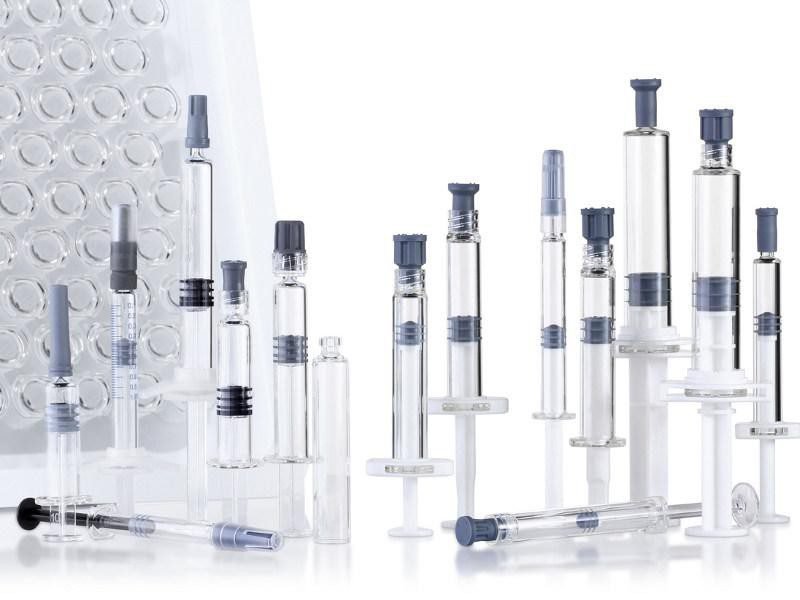
Prefilled syringes filled with viscous hyaluronic acid injectable product
Viscous injectables such as hyaluronic acid demand vacuum filling and stoppering to stay bubble- and particle-free.

Key Takeaways

  • Viscous HA and fillers trap air that atmospheric filling cannot release — bubbles and voids result.
  • Ceramic plunger pumps dose viscous, particulate-laden gels accurately and resist abrasion.
  • Vacuum filling removes air; vacuum stoppering seats the plug without shedding particles.
  • Gentle, controlled dosing matters for shear-sensitive crosslinked gels.
  • The HIJ-GZB200 double-head is built for exactly this: viscous injectables on SCF nest syringes.

Why hyaluronic acid is hard to fill

Hyaluronic acid and similar injectable gels behave nothing like aqueous solutions on a filling line. Three properties create the difficulty:

  • High viscosity. The product resists flow, so it enters the syringe slowly and traps pockets of air that don’t escape on their own.
  • Shear sensitivity. Crosslinked HA fillers can be degraded by aggressive pumping or high shear, changing the product’s rheology — so the dosing mechanism has to be gentle and controlled.
  • Particulate scrutiny. Injectable gels face strict particulate-matter limits, and any friction at plug insertion can shed particles that fail release testing.

An atmospheric filler with a stainless piston pump fights all three of these at once — and usually loses.

The equipment features that actually matter

Ceramic plunger pumps

For viscous, sometimes particulate-laden gels, ceramic plunger pumps are the right dosing technology. Ceramic resists the abrasion and scoring that these media inflict on stainless pistons, holding ±1–2% accuracy over long runs, and its tight tolerances handle high back-pressure without leaking.

Vacuum filling

Because viscous product traps air, the fill station must evacuate that air so the dose enters an air-free barrel, with the fill needle rising up the barrel to prevent splashing. The result is a complete, bubble-free, void-free fill — the defect that most often sends HA syringes to the reject bin.
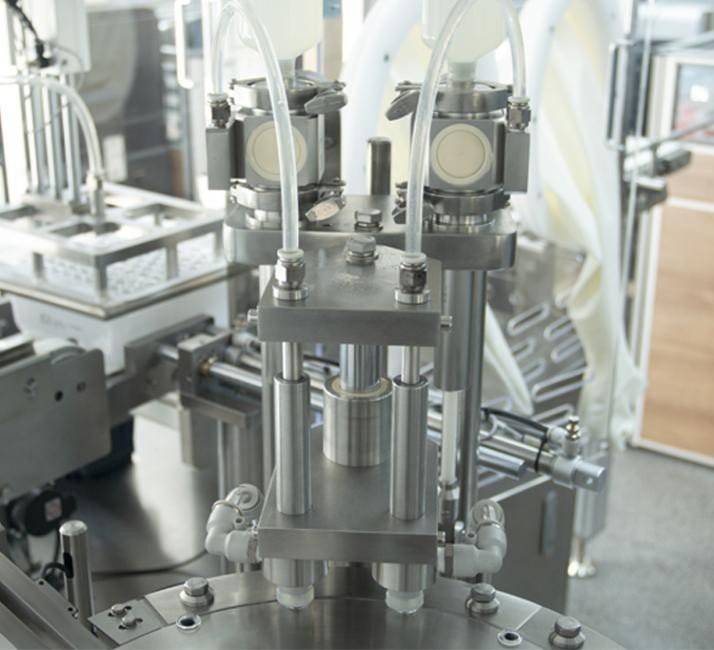
Double-head ceramic plunger vacuum filling station for viscous hyaluronic acid
A ceramic-plunger vacuum filling station dosing viscous gel into two syringes per cycle.

Vacuum stoppering

The plug is where viscous-product lines quietly lose batches. Pushing a plug in by friction against a barrel wetted with sticky gel shears particles and can trap headspace air against the product. In vacuum stoppering, the syringe is evacuated first and the plug is seated onto the liquid level without vibration friction — particle-free, with controlled headspace.

Gentle, servo-controlled handling

Servo-driven, synchronized motion keeps dosing and stoppering smooth and repeatable, which matters for shear-sensitive crosslinked gels where rough handling can alter the product itself.

Applications: which viscous injectables benefit

Product typeWhy vacuum filling helps
HA dermal fillersHigh viscosity + tight particulate limits + shear sensitivity
Ophthalmic viscoelastics (OVDs)Very high viscosity; bubble-free clarity essential
Viscosupplements (joint)Viscous HA; accurate dose and no voids required
Biologics & certain vaccinesOxidation-sensitive; benefit from air removal
Viscous ophthalmic / topical gelsComplete, void-free fills at controlled headspace

Machine to evaluate: the HIJ-GZB200

The double-head prefilled syringe vacuum filling machine (HIJ-GZB200) was built for viscous injectables:

Dosing2 × ceramic plunger pumps, ±1–2% accuracy
FillingVacuum filling, needle-rising, bubble-free
StopperingIntegrated vacuum stopper body, particle-free
Output800–1,200 syringes/hour
SyringesBD / BG / SCHOTT SCF nest; 0.5 / 2.25 / 10 / 20 ml
Contact partsAISI 316L + medical silicone; cGMP-ready design
CleanlinessOptional Class-100 laminar-flow hood
Forester’s Insight

“With hyaluronic acid, buyers obsess over the pump and forget the barrel is a sealed tube you’re trying to push sticky gel into against trapped air. That’s why vacuum matters more here than anywhere else — you’re not just dosing accurately, you’re giving the air somewhere to go. Get that wrong and no amount of pump precision saves the batch. I tell filler manufacturers: spec the vacuum first, then talk accuracy.”

Forester Xiang
Founder & Chief Engineer, HIJ Machinery · 20+ years, 100+ facility audits across 30+ countries

Frequently asked questions

Can a standard filler handle hyaluronic acid?
Usually not well. Standard atmospheric fillers with stainless piston pumps struggle with high-viscosity HA: air gets trapped as bubbles and voids, dose accuracy drifts, and friction at plug insertion sheds particles. Purpose-built vacuum filling with ceramic plunger pumps is designed specifically for these products.
Does vacuum filling damage shear-sensitive crosslinked gels?
Vacuum filling itself does not shear the product; the gentleness comes from the dosing mechanism and motion control. Ceramic plunger pumps with servo-driven, synchronized motion dose viscous gels smoothly. Share your product’s rheology and shear data and our engineers will confirm the pump and needle configuration that protects it.
What syringe sizes are used for dermal fillers?
HA dermal fillers are commonly filled into small SCF syringes, and the HIJ-GZB200 handles 0.5, 2.25, 10 and 20 ml formats from BD, BG and SCHOTT. Sizes are not universal; each format uses its own change-part tooling, and large fill-volume differences may need a filling-pump swap.
How do you keep particulate counts within spec?
The key is vacuum stoppering: because the plug is seated without vibration friction, it does not shear particles off the rubber or the wetted barrel wall, which is the main mechanical source of particulates at the fill-finish step. Combined with AISI 316L contact parts and optional Class-100 laminar-flow, this supports your particulate-matter release testing.
Is the machine suitable for aseptic dermal filler production?
It uses AISI 316L contact parts with medical silicone, no sanitary dead corners, and an optional Class-100 laminar-flow hood, a cGMP-ready, CE-marked design intended for aseptic filling. Certification of your process is your responsibility; we provide FAT/SAT and DQ/IQ/OQ/PQ documentation to support your validation.

Filling hyaluronic acid or another viscous injectable?

Send us your product viscosity, syringe format and output target. Our engineers will spec the ceramic-pump, vacuum-fill and vacuum-stopper configuration your product needs.

Get Free Turnkey Quote

Related: Double-head prefilled syringe vacuum filling machine (HIJ-GZB200) · Vacuum vs atmospheric filling · What is vacuum filling? · Prefilled Syringe Filling Machines hub
Need a Technical Opinion?

Don’t guess. Tell me your material and speed requirements, and I’ll configure the exact HIJ specification for you.

Chat With Forester

2026 Product Catalog

Download the full technical specs for our B-F, K-S, and P-J series presses.

Download PDF

You Might Also Find Helpful

HIJ GSZ-60 top-load vertical cartoning machine used as a procurement benchmark

Manual Loading Cartoners: B2B Selection Guide

B2B Cartoning Decision Guide Manual loading cartoners automate carton erection and closure while operators place products into the open cartons.…
Read Article ->
HIJ GSZ-60 top-load vertical cartoning machine used as a procurement benchmark

Top Load Cartoning Machine Market: 2026 Buyer Guide

2026 B2B Market & Procurement Brief The top-load cartoning machine market is expanding with packaging automation, SKU growth and demand…
Read Article ->
High-speed automatic cartoning machine for pharmaceutical blister packs and capsule boxes.
ontinuous-motion high-speed cartoning machine engineered for high-volume medicine box packaging lines.

Intermittent vs Continuous Motion Cartoners: Selection Guide

Updated July 24, 2026 · Engineering selection guide · 12-minute read Short answer: choose intermittent motion when the application benefits…
Read Article ->
Automatic multi-purpose cartoning machine by HIJPACK with sample pharmaceutical medicine bottles, supplement boxes, and cosmetic hyaluronic acid skincare carton packaging.
HIJPACK versatile automatic cartoning system designed for secondary packaging efficiency across pharmaceutical, nutraceutical, and cosmetic industries.

Automatic Cartoner Infeed Systems: Selection & FAT Guide

Published: July 24, 2026 · Technical purchasing guide An automatic cartoner infeed must do more than move products toward the…
Read Article ->
Automatic multi-purpose cartoning machine by HIJPACK with sample pharmaceutical medicine bottles, supplement boxes, and cosmetic hyaluronic acid skincare carton packaging.
HIJPACK versatile automatic cartoning system designed for secondary packaging efficiency across pharmaceutical, nutraceutical, and cosmetic industries.

Chinese vs European Cartoning Machines: The B2B Buyer’s Comparison

Quick Answer For production speeds of 10–200 cartons per minute — where most pharmaceutical, food and cosmetic plants operate —…
Read Article ->
Automatic multi-purpose cartoning machine by HIJPACK with sample pharmaceutical medicine bottles, supplement boxes, and cosmetic hyaluronic acid skincare carton packaging.
HIJPACK versatile automatic cartoning system designed for secondary packaging efficiency across pharmaceutical, nutraceutical, and cosmetic industries.

8 Best Cartoning Machine Manufacturers in 2026 (Honest Comparison)

Quick Answer The leading cartoning machine manufacturers fall into two camps. European premium builders — Marchesini Group and IMA (Italy),…
Read Article ->

Let's Design Your Production Line

Share your requirements and I'll personally craft a solution that maximizes your efficiency and profitability.