The top-load cartoning machine market is expanding with packaging automation, SKU growth and demand for handling upright or irregular products. For a factory buyer, the useful question is not the headline market value. It is whether a supplier can prove stable product presentation, carton control, changeover and accepted output for your formats.
- Published estimates use different scopes, so market-size figures should not be compared without checking machine type, geography and end-use.
- PMMI research points to flexibility, faster changeover and simpler operation as direct machinery-investment priorities.
- Top loading is commercially relevant when your product must remain upright, cannot be side-pushed reliably or needs an open-carton placement window.
- Your URS should define sustained accepted output, product and carton extremes, infeed method, reject logic, utilities and FAT evidence.
HIJ’s own search data supports treating this as a distinct B2B topic. During the six months ending July 24, 2026, the query top load cartoning machine market generated 171 Google Search Console impressions for the site at an average position of 70.03. The cleaned SEMrush set records a volume of 90 and keyword difficulty of 12. Those figures do not prove a sale, but they show that procurement teams and market researchers are actively looking beyond the generic “vertical cartoning machine” term.
What the Market Numbers Actually Measure
Market reports do not use one consistent definition. Some cover every cartoning architecture; others isolate top-load equipment, beverage applications or a single region. A buyer should treat the figures as directional context, not as a machine-selection formula.
| Published source | Scope | Reported outlook | Procurement limitation |
|---|---|---|---|
| Fortune Business Insights | Global cartoning machines; vertical/top-load and horizontal/end-load | USD 2.4 billion in 2019 to USD 3.9 billion by 2032; 4.1% CAGR | Whole cartoning market, not a top-load-only purchasing benchmark |
| Global Industry Analysts | Global cartoning market by machine type, orientation and end-use | USD 5.5 billion in 2024 to USD 7.0 billion by 2030; top-load segment projected at USD 1.5 billion by 2030 | Broader definition produces a higher total than other reports |
| Grand View Research | Top-load cartoners within beverage carton packaging machinery | USD 324.5 million in 2025 to USD 468.6 million by 2033; 4.7% CAGR | Beverage-only segment; excludes pharma, cosmetics, food and household applications outside its scope |
| PMMI 2025 State of the Industry | All U.S. packaging machinery | USD 11.3 billion in 2024; 2.2% growth forecast for 2025 | Industry investment context, not a cartoner or top-load market total |
Demand Is Moving Toward Flexibility, Not Speed Alone
The market case for top loading is strongest where product geometry and SKU variation defeat a standard side-load process. Packaging lines are being asked to run more formats, accommodate material changes and reduce dependence on manual loading. These requirements shift the buyer’s attention from a catalogue speed to the full operating window.
PMMI’s 2024 research on contract packaging and manufacturing gives a useful buyer-side signal. Among the surveyed contract packagers and manufacturers, 87% planned to install new equipment within three years. Their stated machinery goals included greater flexibility (78%), faster changeover (53%) and simpler operation (46%); 30% identified cartoning among planned machinery additions. These are not top-load-specific percentages, but they explain why adaptable cartoning platforms receive investment attention.
The same direction appears in PMMI’s 2025 machinery reporting: automated changeovers, servo systems and machines that can handle legacy and newer packaging formats are prominent investment themes. For your project, that translates into five questions:
- Can the machine hold your smallest and largest approved cartons without unstable transfer?
- Can the infeed present every product at the required orientation and pitch?
- Which format parts change, how long does a verified changeover take and which tools are required?
- Does the HMI expose actionable alarms and setup parameters to your operators?
- Can the supplier demonstrate reject confirmation and controlled restart after deliberate faults?
Where Top-Load Cartoners Create a Real Process Advantage
Pharmaceutical and healthcare products
Vials, bottles, devices and grouped components may need controlled upright placement. A top opening also gives the project team access for inserts, partitions or product-specific loading devices. Your QA team should define presence checks, reject confirmation, batch-data requirements and the evidence expected during DQ/IQ/OQ/PQ. The machine should be described as engineered to support your validation process; do not present the equipment as holding a GMP certification.
Cosmetics and personal care
Perfume bottles, jars, roll-ons and gift components combine fragile surfaces with high presentation requirements. The buying risk is often cosmetic damage, tipped products or unstable carton presentation rather than insufficient unloaded speed. Sample testing should include decorated saleable units, the lowest-friction pack, the highest centre of gravity and the full carton-tolerance range.
Food, coffee and household goods
Loose bags, pods, sachets and irregular household products can benefit from gravity-assisted or pick-and-place top loading. Confirm whether the product arrives individually, in a group or in a random stream. The cartoner quotation must separate the base carton-handling machine from the product collation or robotic loading system.
Contract packaging and multi-SKU plants
For a CP/CM operation, the valuable capacity is the accepted mix of formats per shift. A machine that runs a high nominal rate but needs long mechanical changeovers may produce less saleable output than a slower platform with controlled recipes and documented change parts. Build your business case from scheduled formats, batch sizes, changeover frequency and planned labour—not from cartons per minute alone.
A Verified Mid-Speed Benchmark: HIJ GSZ-60
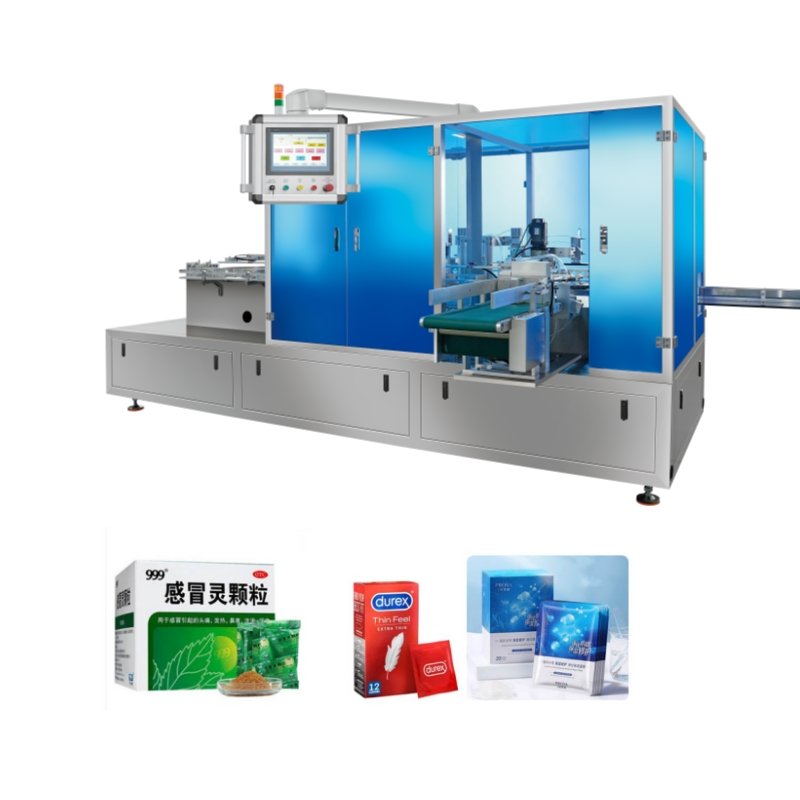
Market reports frequently group machines into wide speed bands. That is too coarse for a purchase specification. The GSZ-60 data shows what a machine-level benchmark should contain: operating range, carton envelope, utilities, controls, footprint and quality-control functions.
| Procurement field | Verified GSZ-60 value | What your URS must add |
|---|---|---|
| Rated output | 5–50 cartons/min | Sustained accepted output for named product-carton combinations |
| Carton range | 60 × 90 × 50 mm to 180 × 210 × 110 mm (L × W × H) | Drawings, board, grain direction, crease and dimensional tolerances |
| Utilities | 380 V, 50 Hz; compressed air ≥0.6 MPa | Plant voltage/frequency, air quality and connection locations |
| Machine envelope | Approx. 3920 × 1850 × 1950 mm; approx. 1700 kg | Service clearances, product infeed, discharge and operator access |
| Controls | Siemens S7-200 PLC, SINAMICS V20 drive, SMART 700IE HMI; SEW drive | Approved equivalents, language, data interface and plant standards |
| Quality control | In-carton detection and configured rejection | Fault challenges, reject confirmation and audit evidence |
Two derived figures help early layout screening. The published base-machine dimensions imply an equipment footprint of approximately 7.25 m² before guarding clearances, infeed, discharge and maintenance access. The published carton extremes correspond to carton-envelope volumes of approximately 0.27 L and 4.16 L. These are geometric calculations, not validated product capacities; do not use them to approve a pack without samples.
How to Shortlist Suppliers in This Market
A supplier list based on brand awareness or headline speed does not control project risk. Ask each candidate to answer the same evidence request so your engineering and procurement teams compare like with like.
- Define the boundary. State whether the quotation includes only carton handling or also product feeding, coding, inspection, hot-melt equipment, conveyors and line controls.
- Submit the worst cases. Include the smallest, largest, least stable and most damage-sensitive product and carton combinations.
- Request an operating matrix. Record expected accepted output, loading method, required change parts and inspection for every approved format.
- Lock the FAT protocol before build completion. Define test duration, samples, deliberate faults, acceptance thresholds, deviation handling and retest evidence.
- Separate base machine from options. Hot-melt supply, robotics, vision, coding and validation documents must appear as explicit quotation lines.
- Confirm the installed footprint. Include service doors, electrical cabinet access, glue system, infeed, discharge and safe operator movement.
Market Risks to Put into the 2026 URS
SKU and material variability: lightweight or recycled-content paperboard may change stiffness, friction and crease behaviour. Approve the carton specification and test realistic tolerance limits rather than one ideal sample.
Workforce constraints: PMMI reports continuing demand for practical automation, simple HMI guidance and easier changeovers. Require alarm text, recipe authority, maintenance access and training deliverables that match your plant skills.
Integration responsibility: product feeding is often the hardest part of a top-load project. Define who owns the interface between the upstream process, loading device, cartoner and downstream inspection. Specify signal lists and fault-recovery behaviour.
Unverified quotation assumptions: do not infer that a glue unit, robot, spare-parts set, on-site service or validation package is included. Each item needs a named scope, quantity and acceptance condition.
For machine architecture, compare the top-load and side-load decision criteria. If the product is upright or unstable, use the irregular-product cartoning guide. When you are ready to specify equipment, review the verified GSZ-60 vertical cartoning machine.
Top-Load Cartoner Market FAQ for Factory Buyers
How large is the top-load cartoning machine market?
Which industries are investing in top-load cartoners?
What speed range should a factory specify?
What information should be sent to a top-load cartoner supplier?
Does a top-load cartoner include the product infeed and glue system?
Turn the Market Research into a Machine URS
Send your product samples, carton drawings, target output and line layout. HIJ will use them to define the top-load process boundary, change parts, inspection and FAT scope for a configured proposal.
Discuss Your URS & Request a Line ProposalSources and Data Notes
- HIJ keyword evidence: cleaned SEMrush dataset and Google Search Console sitewide export for the six months ending July 24, 2026.
- PMMI, 2025 Packaging State of the Industry, published September 11, 2025.
- PMMI, Contract Packaging/Contract Manufacturing machinery-investment findings, published October 7, 2024.
- Fortune Business Insights cartoning machines market report, updated July 6, 2026.
- Global Industry Analysts cartoning machines report, published October 1, 2025.
- Grand View Research beverage top-load cartoner statistics, accessed July 27, 2026.
- GSZ-60 facts: HIJ Machinery product document GSZ-60.doc. Derived footprint and carton-envelope volumes are arithmetic based on published dimensions and are not performance claims.