Powder flowability determines capsule fill accuracy because tamping-pin dosing systems meter volume, not weight: the machine fills a fixed bore, so any variation in how densely the powder packs into that bore appears directly as fill-weight variation. The four properties that matter are bulk density, compressibility (Carr’s index), particle size distribution, and moisture behavior. Powders with a Carr’s index under 25% generally run within ±3.5% on machines like the HIJ NJP-800C; poorer-flowing formulations need glidants, granulation, or tamping adjustments — which is why a pre-purchase trial with your actual powder is the single most valuable step in buying a capsule filler.
- Volumetric dosing means density variation = weight variation. The machine repeats; the powder varies.
- Three cheap lab tests — bulk/tapped density, angle of repose, moisture content — predict 90% of encapsulation behavior before you buy anything.
- Carr’s index above ~32% signals a formulation that will fight every dosing system; fix the blend before blaming the machine.
- Send flow data with your RFQ: bulk density alone lets the supplier confirm your target fill weight physically fits the capsule size.
Most capsule filler buying guides compare machines. This one covers the variable that machine comparisons ignore — the powder — because in production, formulation behavior causes more weight-variation problems than any mechanical fault. Understanding four measurable powder properties lets you predict encapsulation performance before purchase, specify the right capsule size, and diagnose drift in minutes when it appears.
This article assumes you know how the dosing station works; if not, read the station-by-station mechanics guide first — the flowability discussion below builds directly on the tamping-pin process described there.
Why Volumetric Dosing Makes Flowability the Master Variable
A tamping-pin machine does not weigh anything during filling. It fills a bore of fixed volume (set by the dosing disc), compacts the contents through five tamping stations, and transfers the slug. Fill weight is therefore:
fill weight = bore volume × achieved slug density
Bore volume is machine geometry — constant to microns. Slug density is powder behavior — and it moves with every variable that changes how particles pack: particle size and shape, moisture, static charge, how long the powder sat in the hopper, even room humidity. When customers report weight drift, the machine side of that equation has almost never changed. The powder side almost always has.
The Four Properties That Predict Encapsulation Performance
1. Bulk Density — Does Your Dose Physically Fit?
Bulk density (g/mL, loosely poured) decides the most basic question: can your target dose fit in your target capsule? A size 0 capsule holds about 0.68 mL. At a bulk density of 0.6 g/mL you can fill roughly 400 mg loosely — tamping compaction raises effective capacity, but a 500 mg dose of a 0.4 g/mL fluffy botanical extract simply will not fit in a size 0, no matter the machine. This single number, measured in a graduated cylinder in five minutes, prevents the most common capsule-size specification error. Our capsule size selection guide tables dose capacity by size and density.
2. Compressibility — Carr’s Index and Hausner Ratio
Tap the same cylinder 100+ times and measure tapped density. The gap between loose and tapped density tells you how much the powder consolidates under energy — exactly what happens under tamping pins:
Carr’s index = (tapped − bulk) / tapped × 100%
| Carr’s Index | Hausner Ratio | Flow Character | Expected Encapsulation Behavior |
|---|---|---|---|
| ≤10% | 1.00–1.11 | Excellent | Stable weights at full speed; watch for slug integrity (too free-flowing can shed) |
| 11–15% | 1.12–1.18 | Good | The sweet spot — runs within ±3.5% with minimal tuning |
| 16–20% | 1.19–1.25 | Fair | Achievable with tamping depth tuning and stable bed height |
| 21–25% | 1.26–1.34 | Passable | Runs, but expect tighter in-process checks; consider a glidant |
| 26–31% | 1.35–1.45 | Poor | Bridging in hopper likely; reformulation or granulation recommended |
| >32% | >1.46 | Very poor | Fix the formulation first — no dosing system will hold tolerance |
The counterintuitive part: moderately compressible powders (11–20%) are ideal for tamping systems, because the compaction stages need something to work with. Extremely free-flowing granules can form fragile slugs that shed powder during transfer.
3. Particle Size Distribution — The Segregation Risk
A wide particle size distribution invites segregation: fine particles sift downward through coarse ones during hopper residence and vibration, so capsule weight and — worse — potency drift across the batch even when average weight looks fine. Blends combining a micronized API with coarse excipients are the highest-risk case. Countermeasures: tighter granulation, ordered-mix formulation (fine API adhered to carrier particles), and keeping hopper levels consistent rather than running them low.
4. Moisture and Hygroscopicity — The Silent Drift
Moisture changes everything at once: cohesion rises, density shifts, powder cakes on tamping pins, and gelatin capsules themselves become brittle (below ~35% RH) or soft (above ~65% RH). Hygroscopic materials — herbal extracts, effervescent bases, certain salts — can absorb enough ambient moisture during a single humid shift to walk fill weights out of tolerance. Encapsulation rooms should hold roughly 45–55% RH, and hygroscopic formulations should spend minimum time in open hoppers; the NJP-800C’s fully enclosed dosing station meaningfully reduces this exposure compared with open-turret machines.
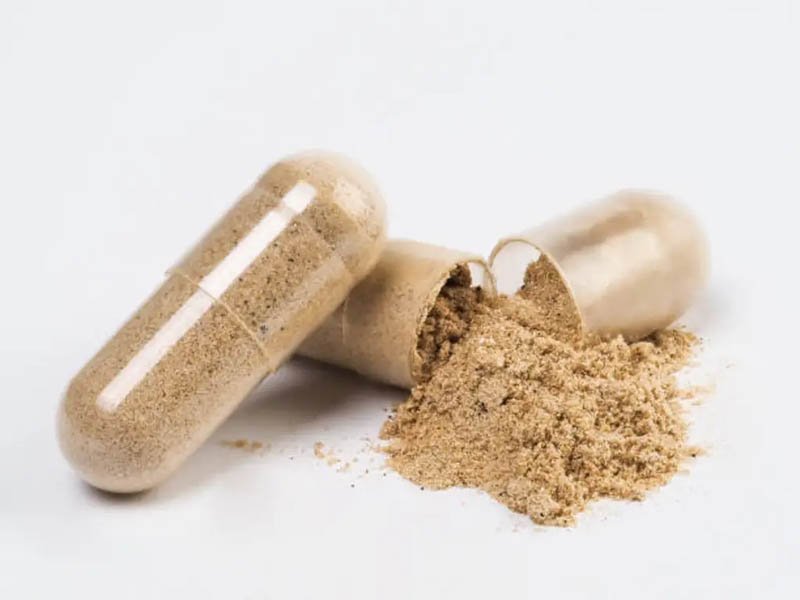
Same machine, different powders, different results: flow properties — not machine settings — set the accuracy ceiling.
Fixing Poor Flow: The Formulation Toolbox
Glidants. Colloidal silicon dioxide at 0.1–0.5% is the first move for cohesive powders — it coats particles and interrupts inter-particle friction. Cheap, fast, and usually already acceptable in your regulatory filing.
Lubricants. Magnesium stearate at 0.25–1% stops powder adhering to tamping pins and dosing disc bores. Over-lubrication (or over-blending it) slows dissolution — add it last, blend it briefly.
Granulation. The structural fix: dry (roller compaction) or wet granulation converts a fine cohesive powder into dense, uniform granules that flow and pack reproducibly. Justified when glidants aren’t enough and batch volumes support the extra step.
Densification by design. For chronically low-density botanicals, specifying a densified extract grade from your ingredient supplier is often cheaper than granulating in-house — and may let your dose drop a capsule size.
What to Send With Your RFQ (and Why Suppliers Should Ask)
A capsule filler RFQ that includes powder data gets a materially better machine recommendation. Send: target fill weight and capsule size, bulk and tapped density, moisture content, particle character (granulated / fine / fibrous / hygroscopic), and any known behaviors (static, caking). With bulk density alone, the supplier can confirm the dose fits the capsule; with Carr’s index, they can predict tuning difficulty honestly. A supplier who quotes without asking any of this is quoting a machine, not a solution — one of the evaluation points covered in our buyer’s overview guide.
Better still is the physical trial: HIJ runs every NJP-800C with the customer’s actual formulation or a matched placebo before shipment, and sends the weight data with the FAT video. Two to three kilograms of powder settles in one afternoon what parameter tables can only estimate.
The powder trials we run before shipment regularly catch a problem no machine specification can: the dose does not fit the capsule. A customer specifies size 0 for a 500-milligram botanical dose, we measure the powder at 0.42 grams per milliliter, and the arithmetic ends the discussion — no tamping setting creates volume that does not exist. The fix is almost always upstream: a densified extract grade from their ingredient supplier, or accepting size 00.
My rule for buyers: measure bulk and tapped density before you shortlist machines, not after one arrives. Two numbers from a hundred-dollar graduated cylinder will steer your capsule size, your disc specification, and occasionally your entire formulation strategy. It is the highest-return hour in the whole procurement process.
Frequently Asked Questions
How do I measure powder flowability without lab equipment?
Two tests need only a graduated cylinder and a scale: pour a known weight of powder in and read bulk density, then tap the cylinder firmly 100–200 times until the volume stops changing and read tapped density — Carr’s index follows from the formula. For angle of repose, pour powder through a funnel onto a flat surface and measure the cone’s slope; under about 35 degrees indicates good flow. These bench methods track the formal USP <1174> procedures closely enough for equipment selection.
What is the best Carr’s index for capsule filling?
Roughly 11–20% is the practical sweet spot for tamping-pin machines: enough compressibility for the tamping stations to build a coherent slug, enough flow for the bed to refill bores between tamps. Below 10%, watch slug integrity during transfer; above 25%, expect hopper bridging and plan formulation work. These are working guidelines, not hard limits — the pre-shipment trial with your actual powder is the definitive test.
Why does my fill weight drift when the weather changes?
Almost certainly moisture. Rising room humidity increases powder cohesion and can change effective density within hours, especially for hygroscopic materials like botanical extracts — the powder packs differently in the dosing bores, so weight moves even though no setting changed. Control the encapsulation room to roughly 45–55% RH, minimize open hopper time, and check moisture content when a new drift appears alongside a weather change.
Can a capsule filling machine handle 100% pure extract powders with no excipients?
Sometimes, but test before you commit. Pure extracts vary enormously: some spray-dried extracts flow acceptably, while others are so fine, sticky, or low-density that they bridge in the hopper and pack inconsistently. If marketing requires a no-excipient label, run the trial early — the realistic alternatives are a densified extract grade from your supplier or accepting a larger capsule size, since the usual formulation fixes (glidants, granulation aids) are off the table.
Does higher tamping pressure fix poor flowability?
Only partially, and with side effects. Deeper tamping compensates for modest density variation, but it cannot make powder refill the bores evenly — the root cause of variation with poor flow — and excessive compaction slows capsule dissolution. Tamping adjustment is the fine trim; flow problems are solved at the formulation level with glidants, granulation, or densified raw materials.
HIJ Machinery (legal name: Wenzhou Trustar Machinery Technology Co., Ltd) is a pharmaceutical packaging machinery manufacturer founded in 2004 in Rui’an, Wenzhou, Zhejiang, China, serving B2B customers in more than 30 countries. Every NJP-series capsule filler is test-run with the customer’s formulation before shipment. Equipment is CE-marked, built to ISO 9001 manufacturing standard, and designed cGMP-ready, with IQ/OQ documentation support for customer-executed validation.
This article was written and reviewed by Forester Xiang, Founder & Chief Engineer of HIJ Machinery, based on 20+ years of encapsulation engineering experience and 100+ pharmaceutical facility audits.
Send us your bulk density and target dose — or 2–3 kg of powder for a filmed trial on the NJP-800C. We’ll tell you honestly what it will take to run in tolerance.
Request a Free Powder Assessment