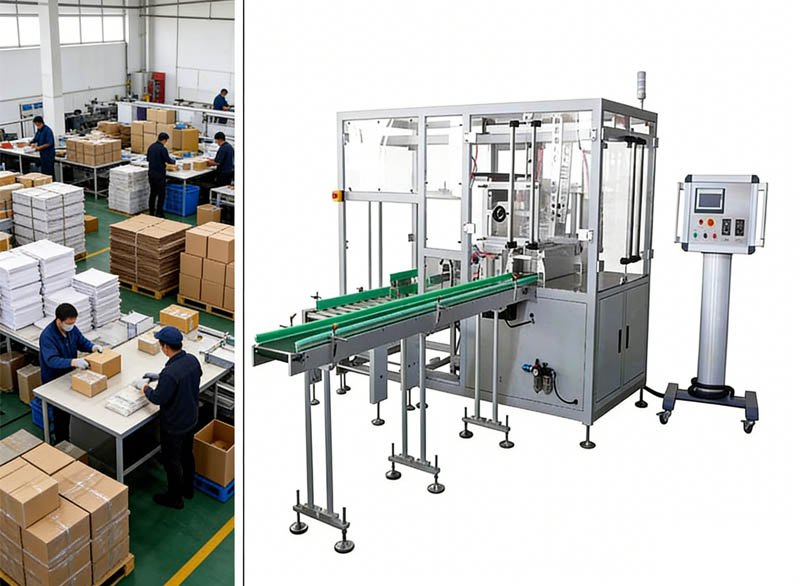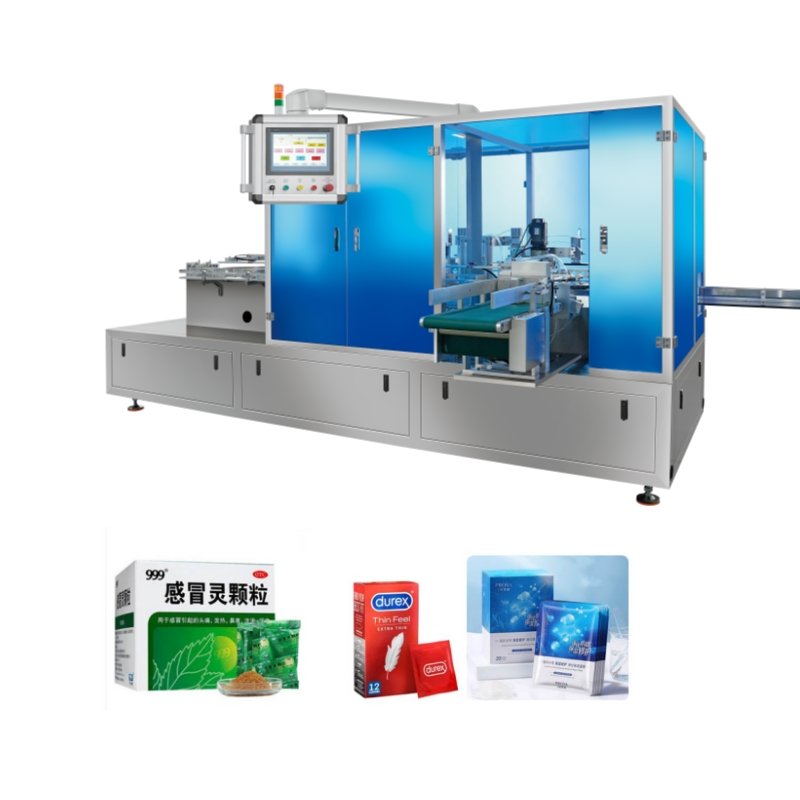
A vertical and horizontal cartoning machine differ first by product insertion direction, not by a universal promise about speed, footprint or price. Your correct choice depends on product geometry, required orientation, leaflet flow, infeed stability and the evidence the supplier can demonstrate during FAT.
What the two orientations actually mean
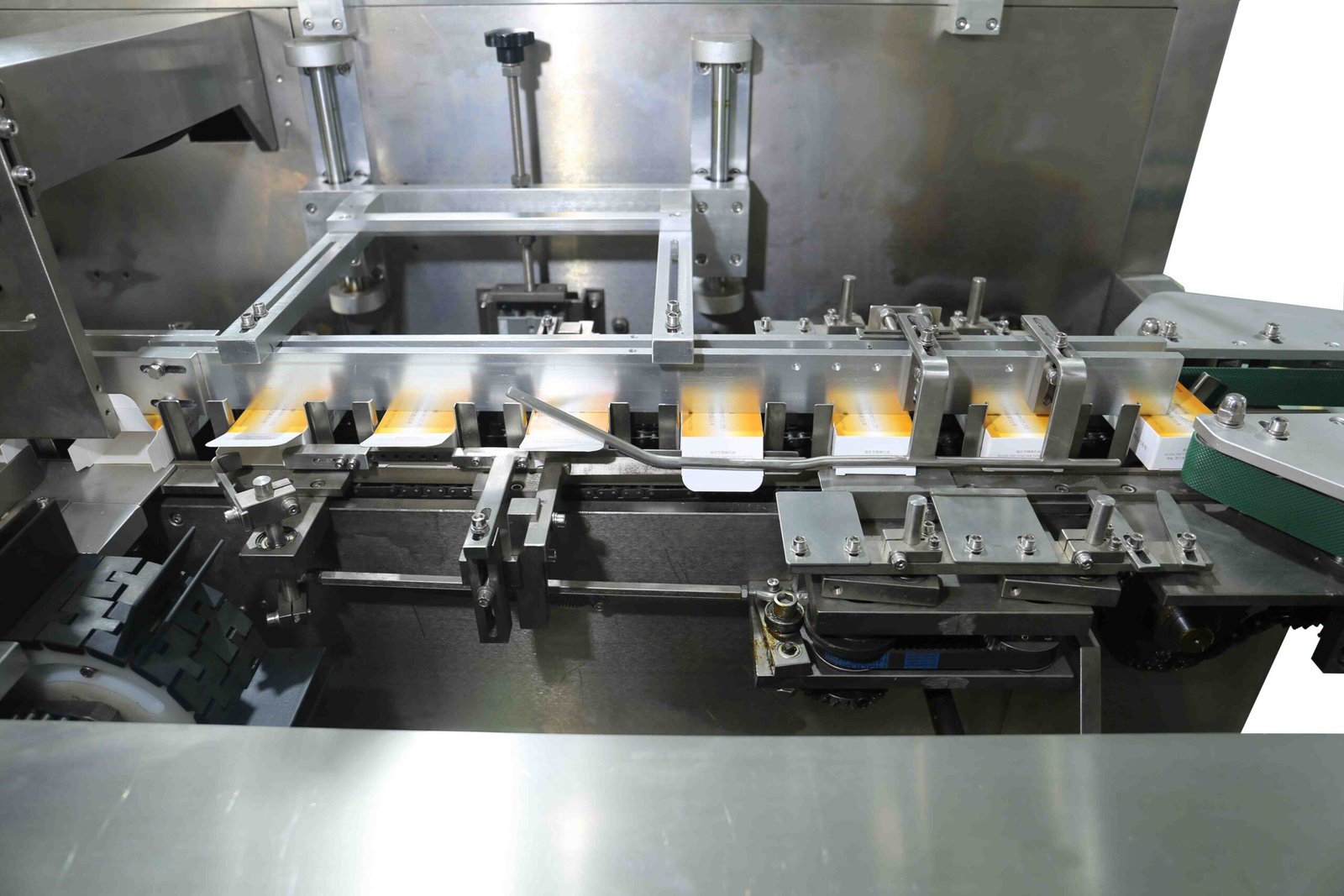
A horizontal cartoner carries the carton on its side and moves the product through an open end. The infeed may use a pusher, flighted conveyor or a project-specific feeding mechanism. This architecture is useful when the product must stay aligned with a leaflet or when contact force and insertion timing need controlled verification.
A vertical cartoner presents an upright carton with its top open. Product may be loaded by an operator, a counting system, a bucket elevator, a pick-and-place unit or another automatic feeder. “Vertical” therefore describes the loading direction; it does not prove that gravity alone performs the loading.
If your product range includes unstable shapes or frequent manual assortment, review the operational implications in the manual-loading cartoner guide. If automation is required, evaluate the feeder as part of the machine rather than treating it as a later accessory.
Horizontal vs vertical cartoning machine comparison
| Selection factor | Horizontal / side-load | Vertical / top-load |
|---|---|---|
| Product entry | Through the carton end | Through the open top |
| Typical control need | Orientation and timed insertion | Stable presentation above the carton |
| Common product logic | Flat, oriented or guided products | Upright, counted, grouped or manually assembled products |
| Leaflet handling | Often integrated with the product path | Must be specified and tested as a separate interface |
| Primary interface risk | Pusher timing, product/carton alignment and infeed pitch | Drop/pick height, product stability and top-opening access |
| What FAT must prove | No crush, skew or leaflet interference | No tipping, bridging, double-load or missed load |
Start with product geometry, not machine orientation
Send the supplier physical samples or dimensioned drawings for every product and carton format. A name such as “bottle,” “pouch” or “blister” is insufficient because the same product category can behave differently when centre of gravity, surface friction, closure shape or bundle count changes.
Five sample checks before layout approval
- Stability: can the product stand or remain grouped throughout loading?
- Orientation: must a label, cap, blister face or printed side remain in a defined position?
- Insertion clearance: what is the smallest internal carton clearance after board and fold tolerances?
- Damage mode: what happens if the product is pushed, dropped, gripped or briefly accumulated?
- Presentation: will the product arrive singularly, in a count, in a tray or as a mixed kit?
For automated side-load projects, the automatic cartoner infeed systems guide explains why the feeder and buffer often set accepted output before the cartoner reaches its nameplate rate.
Reference specifications show why labels are not enough
HIJ technical files for two reference configurations show that actual selection requires model-level comparison. These figures are not universal ranges for every cartoner; they are verified reference values that illustrate the questions your URS must ask.
| Verified field | WZTS-60 vertical reference | WZTS-130 horizontal reference |
|---|---|---|
| Rated cartoning speed | 10–30 cartons/min | 30–80 cartons/min |
| Carton size range (L×W×H) | 40×30×50 to 180×180×300 mm | 70–200 × 30–150 × 13–70 mm |
| Reference machine dimensions | 3700×1650×1900 mm | 3100×1100×1550 mm |
| Compressed-air working pressure | ≥0.6 MPa | ≥0.6 MPa |
| Air consumption | 120–160 L/min | 120–160 L/min |
| Leaflet range | Project-specific; confirm in URS | Unfolded 80–310 × 90–210 mm; 1–4 folds |
Procurement note: do not transfer one model’s carton range, speed or leaflet capability to another model with the same orientation. Request the current project-specific datasheet, general arrangement drawing and configuration list.
Forester’s My Insight: calculate the real footprint
Orientation is often used as a shortcut for footprint, but the reference drawings show why that shortcut can fail. Using the machine envelopes from the verified WZTS-60 and WZTS-130 files:
3.70 m × 1.65 m = 6.11 m²3.10 m × 1.10 m = 3.41 m²
In this reference comparison, the vertical machine envelope is larger, not smaller. Neither number includes operator space, guard-door swing, carton replenishment, hot-melt access, utilities or maintenance removal paths. Ask each supplier for a scaled GA drawing and calculate the installed cell area—not just the stainless-steel machine body.
Leaflets, coding and inspection can reverse the decision
A vertical cartoner may fit the product but still be the wrong system if the pack requires a folded leaflet, serialized code verification, checkweighing or a controlled reject path. These functions must be placed on the process map before you compare quotations.
For each insert, define the source, orientation, presence check, wrong-item prevention and reject response. “Leaflet included” is not an acceptance criterion. Your URS should state the unfolded size, fold pattern, paper weight, magazine capacity, detection method and line behaviour after a missing-leaflet signal.
Write these seven interfaces into the URS
- Product at infeed: dimensions, weight, centre of gravity, surface condition and arrival pattern.
- Carton: internal dimensions, board weight, closure type, print tolerances and opening force.
- Inserts: leaflet, tray, divider, spoon or accessory dimensions and detection logic.
- Rate: accepted cartons per minute for the nominated format—not an unloaded machine cycle.
- Accumulation: upstream/downstream buffer time and restart logic.
- Reject ownership: which device rejects missing product, missing insert, unreadable code and poor closure.
- Changeover: parts, tools, recipe controls, line clearance and verification after format change.
Loading direction and motion type are separate decisions. After choosing top-load or side-load, use the intermittent versus continuous-motion cartoner guide to select the movement architecture.
FAT should test the failure modes, not just the best run
Run your nominated product, carton and insert materials at the contractual acceptance rate. Record accepted output after rejects, not only HMI cycles. A useful FAT sequence includes:
- normal production run with agreed sample quantity and duration;
- minimum and maximum carton formats included in the order;
- missing product, double product and incorrectly presented product challenges;
- missing or misfed leaflet/insert challenge where applicable;
- upstream starvation and downstream blockage response;
- restart after stop, changeover verification and reject reconciliation.
Use evidence—video, counters, reject samples, alarm records and signed results—to close each test. FAT supports equipment acceptance; it does not replace qualification and validation work at your plant.
Safety and validation belong in the comparison
Changing the loading direction changes access points, manual interaction and potential pinch or crush zones. The current ISO 12100 machinery-safety framework describes risk assessment and risk reduction across the machine life cycle. Ask how the proposed feeder, guarding and access arrangement are reflected in the supplier’s risk assessment.
For pharmaceutical projects, the FDA process-validation guidance uses a lifecycle approach. Your supplier can provide equipment documentation and test evidence, but your manufacturer remains responsible for the site validation strategy and approved process.
Which HIJ cartoner should you evaluate?
Review the current vertical cartoning machine when your product should enter through the carton top and the proposed feeder can keep it stable. Review the horizontal cartoning machine when controlled side insertion, product orientation or an integrated leaflet path drives the process.
If the project is still at concept stage, start with the cartoning machine range and send one sample set for each format. HIJ can then return a proposed product path, feeder concept and layout for URS review.
Frequently asked questions
What is the main difference between a horizontal and vertical cartoning machine?
A horizontal cartoning machine inserts product through the end of a carton carried on its side. A vertical cartoning machine loads product through the open top of an upright carton. The product path, required orientation and feeder design determine which arrangement is suitable.
Can a vertical cartoner insert a leaflet?
It can when the leaflet system and insertion point are engineered into the project, but the capability is not automatic. Specify leaflet size, fold pattern, paper weight, detection logic and reject response in the URS and prove them with your materials during FAT.
Does a vertical cartoner always need less floor space?
No. The machine body, feeder, guard access, carton magazine, utilities and maintenance clearances determine installed area. Compare scaled general arrangement drawings. In HIJ’s verified reference files, the WZTS-60 envelope is about 6.11 m² while the WZTS-130 envelope is about 3.41 m² before service clearances.
How should we verify the quoted cartoning speed?
Define accepted cartons per minute for a named product, carton and insert format. During FAT, run agreed samples for an agreed duration and record good output, rejects, stops and restart behaviour. Do not accept an unloaded cycle rate as line performance.
What information should we send for cartoner selection?
Send product samples or dimensioned drawings, carton drawings and board weight, insert details, target accepted output, upstream delivery pattern, downstream equipment, utility standard, available floor area and the documentation required by your validation team.
Sources and data basis
- HIJ Machinery WZTS-60 vertical loading cartoning machine technical file: verified dimensions, carton range, rate, air and electrical fields.
- HIJ Machinery WZTS-130 automatic horizontal cartoning machine technical file: verified dimensions, carton/leaflet ranges, rate, air and electrical fields.
- ISO 12100:2010 — Safety of machinery, risk assessment and risk reduction.
- FDA — Process Validation: General Principles and Practices.
Send Your Product Path for Engineering Review
Share product and carton drawings, inserts, target accepted output and available floor space. HIJ will recommend the loading direction, feeder concept and FAT scope for your URS.
Request Line Layout & Quotation