Quick answer: Cartoning pre-filled syringes demands more than a standard cartoner: your URS should specify feeding breakage <0.1%, robotic (not pneumatic ram) loading, 100% missing-syringe and empty-carton rejection, heat-sealing protection so a stopped line never cooks the drug, buffer capacity to survive labeler stops, and an audit-trail HMI. This guide gives you the full URS requirement set and a 15-point buying checklist, referenced to an integrated line like the HIJ PBL-400S-400SF.
A tablet that chips in a cartoner costs you a tablet. A glass pre-filled syringe that breaks costs you the syringe, the batch investigation, possibly a line-clearance — and if a fragment travels, far worse. That asymmetry is why the URS for a syringe cartoning project reads differently from any other secondary packaging spec, and why generic cartoner requirements copied from a tablet project will fail you at FAT.
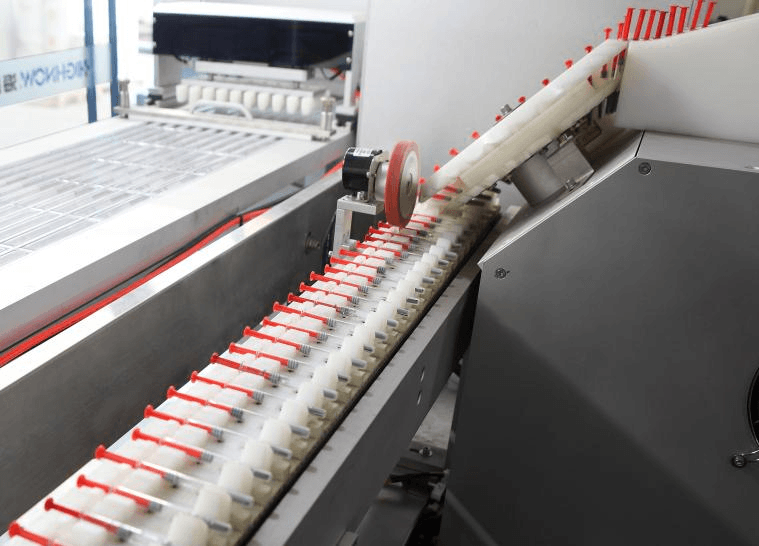
Below is the requirement set we see the most successful buyers use — organised the way a real URS is organised, with acceptance criteria you can paste into your own document. The reference machine throughout is the integrated PBL-400S-400SF blister cartoning machine, which was engineered specifically around these requirements.
Key Takeaways
- Write breakage as a number: <0.1% feeding, leaflet and cartoning breakage are achievable, contractable rates.
- Specify robotic loading with vacuum grippers — pneumatic rams and glass barrels do not mix.
- Demand heat protection at standstill: the sealing head must lift and a cooling plate insert automatically when the line stops.
- Require buffer capacity so a label-roll change upstream never stops the cartoner.
- Detection is binary: 100% missing-syringe and 100% empty-carton rejection, verified with your product at FAT.
Why Syringes Are the Hardest Product a Cartoner Meets
These four risks map directly onto the six URS sections below. If your product is still on the primary-packaging side of this decision, start with the standalone syringe blister packing machine and its dedicated URS guide — this article covers the integrated blister-plus-cartoning scope.
The URS, Section by Section — Copy These Requirements
Product, Throughput & Breakage
| Req. | Requirement | Acceptance criterion |
|---|---|---|
| 1.1 | Handle glass pre-filled syringes (state fill volume, barrel Ø, with/without needle shield) and glass ampoules | Demonstrated with buyer’s product at FAT |
| 1.2 | Rated output matched to line demand | e.g. 6,000–10,000 pcs/h sustained over a 2-hour FAT run |
| 1.3 | Feeding breakage rate | < 0.1% measured at FAT |
| 1.4 | Cartoning breakage rate | < 0.1% measured at FAT |
| 1.5 | Leaflet folding breakage/misfold rate | < 0.1% measured at FAT |
Feeding, Loading & Upstream Interface
| Req. | Requirement | Acceptance criterion |
|---|---|---|
| 2.1 | Gentle singulation from labeler outfeed | Climbing conveyor + star-wheel discharger; no free-fall drops onto glass |
| 2.2 | Robotic tray loading | 4-axis robot with vacuum gripper; no pneumatic ram loading of glass barrels |
| 2.3 | Buffer zone between labeler and cartoner | Cartoner continues through a label-roll change without stopping |
| 2.4 | Smooth track transitions | Stabilising guides at every turning point; no jamming or stacking at FAT |
Blister Forming, Sealing & Heat Protection
| Req. | Requirement | Acceptance criterion |
|---|---|---|
| 3.1 | PVC/ALU forming suited to syringe trays | Firm, fully drawn pockets; forming-defect detection blocks loading into bad pockets |
| 3.2 | Heat protection at standstill | On any stop: sealing head lifts and water-cooled plate inserts automatically between heat source and product |
| 3.3 | Punching without product stress | Burr-free die cutting; no measurable impact on heat-sensitive product |
| 3.4 | No lubricant contact with product path | Leak-proof lubrication design, verified at design review |
Cartoning & Leaflet
| Req. | Requirement | Acceptance criterion |
|---|---|---|
| 4.1 | Leaflet 1–4 folds, buyer’s paper spec | Named folder brand on quote; single-sheet pick verified (one leaflet per cycle) |
| 4.2 | Leaflet-first insertion sequence | Leaflet pushed before blister on every cycle |
| 4.3 | Batch coding 3–4 lines | Position error < ±1.5 mm; clear, no overlap or blur |
| 4.4 | Material storage capacity | Carton and leaflet magazines hold > 10 minutes of production |
Detection & Rejection
| Req. | Requirement | Acceptance criterion |
|---|---|---|
| 5.1 | Missing-syringe detection in tray | 100% rejection rate, challenged at FAT with seeded defects |
| 5.2 | Empty-carton detection at discharge | 100% rejection via metal-content check, challenged at FAT |
| 5.3 | Product-first interlock chain | No product → no leaflet pick, no carton suction, no push; verified by material-removal tests |
| 5.4 | Reject handling | Removable, lockable collection at every reject point; rejection-confirmation sensor |
Controls, Data & Documentation
| Req. | Requirement | Acceptance criterion |
|---|---|---|
| 6.1 | Motion-control PLC, named brand | e.g. Siemens CPU1516T with servo axis list in quotation |
| 6.2 | HMI with electronic signature & audit trail | Supports buyer’s 21 CFR Part 11 / Annex 11 program; demonstrated at FAT |
| 6.3 | Three-level password access | Operator / maintenance / administrator roles enforced |
| 6.4 | Fault location display | Every interlock stop names cause and station on screen |
| 6.5 | Documentation package | Manuals, electrical drawings, component certificates and FAT records supporting the buyer’s own DQ/IQ/OQ/PQ validation |
The 15-Point Buying Checklist
Before you sign, confirm in writing that the vendor…
- Has run glass pre-filled syringes before — ask for reference formats, not just “syringes”
- Quotes robotic vacuum loading by name (robot brand and axis count)
- Commits to <0.1% breakage rates as FAT acceptance criteria
- Includes the labeler buffer zone in scope — with capacity stated
- Specifies the standstill heat-protection mechanism (lifting head + cooling plate)
- Names the leaflet folder brand and demonstrates single-sheet picking
- Challenges 100% missing-syringe rejection at FAT with seeded defects
- Challenges 100% empty-carton rejection at FAT the same way
- Performs material-removal interlock tests in front of you
- Runs YOUR syringes, leaflets and cartons at FAT — ship them 500+ units early
- Provides the servo axis list and electrical component list with the quote
- Demonstrates audit trail and e-signature live on the HMI
- Prices format tooling for every future syringe size now, not later
- States installation scope, technician day rates and training days in the contract
- Delivers the full documentation package that supports your validation — listed item by item
Points 7–10 are the FAT core; build them into your protocol using the general FAT checklist for blister packaging machines as the base document. For how the machine executes each requirement mechanically, the full cycle is walked through in how a blister cartoning machine works, and the upstream equipment lives on our pre-filled syringe filling machines page.

“The most expensive URS I ever read was a short one. A customer copied their tablet-cartoner URS for a syringe project — no breakage rate, no buffer requirement, no heat-protection clause. The machine they bought met every word of that document, and still stopped at every label-roll change and cracked barrels at the infeed. Contractually, nothing was wrong. Operationally, everything was.
In this business, a requirement you didn’t write down is a requirement you didn’t buy. Spend the extra week on the URS. It is the cheapest engineering you will ever do, and it is the only document the vendor is truly obliged to obey.”
— Forester Xiang, Founder & Chief Engineer, HIJ MachineryFrequently Asked Questions
Can a standard cartoning machine handle pre-filled syringes?
Mechanically it may run them, but without gentle singulation, robotic loading, buffering and syringe-specific detection, breakage and stoppage rates will be commercially unacceptable. Syringe cartoning needs equipment specified for glass from the URS stage.
What breakage rate is realistic for syringe cartoning?
Under 0.1% at feeding, leaflet handling and cartoning is achievable on properly engineered lines and should be written into your URS as a FAT acceptance criterion — measured with your actual product, not a surrogate.
Do syringes go into the blister needle-up or needle-down?
Orientation is defined by the tray design and downstream use — most trays hold syringes flat with the flange located in a dedicated pocket feature. The critical URS point is that orientation is controlled and verified by detection before sealing, whichever layout you choose.
Who performs the validation — the vendor or my facility?
Your facility owns and performs the DQ/IQ/OQ/PQ validation. The vendor’s role is to supply equipment built to a cGMP-ready, CE-marked standard and the documentation package — FAT records, drawings, certificates — that supports your validation program.
Should the blister machine and cartoner be integrated or separate for syringes?
For glass syringes, integrated is the strong default: a tracking-manipulator transfer removes the open conveyors where glass suffers most, and one control system keeps a single audit trail. The full trade-off analysis is in our integrated vs standalone comparison.
Send Us Your URS — or Start From Ours
Share your syringe format and throughput target. Forester’s team will return a configured PBL-400S-400SF quotation mapped requirement-by-requirement against the URS sections above.
Get a URS-Mapped Quote