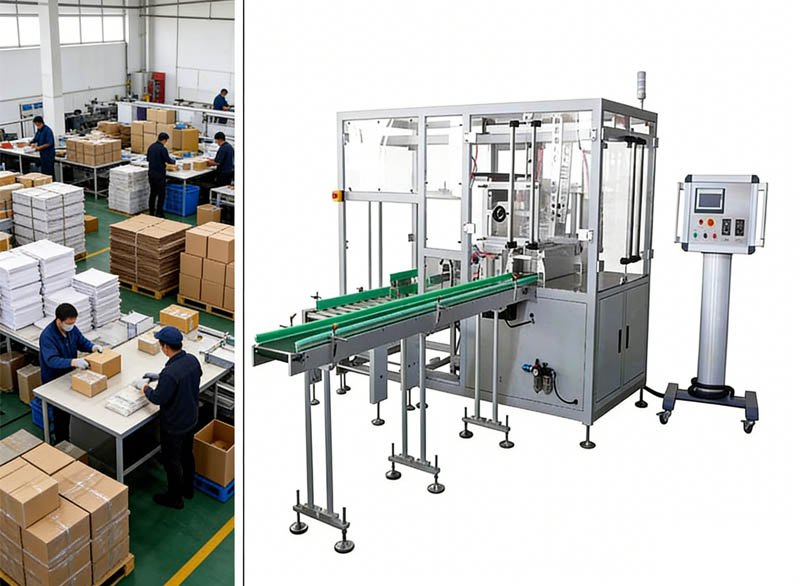
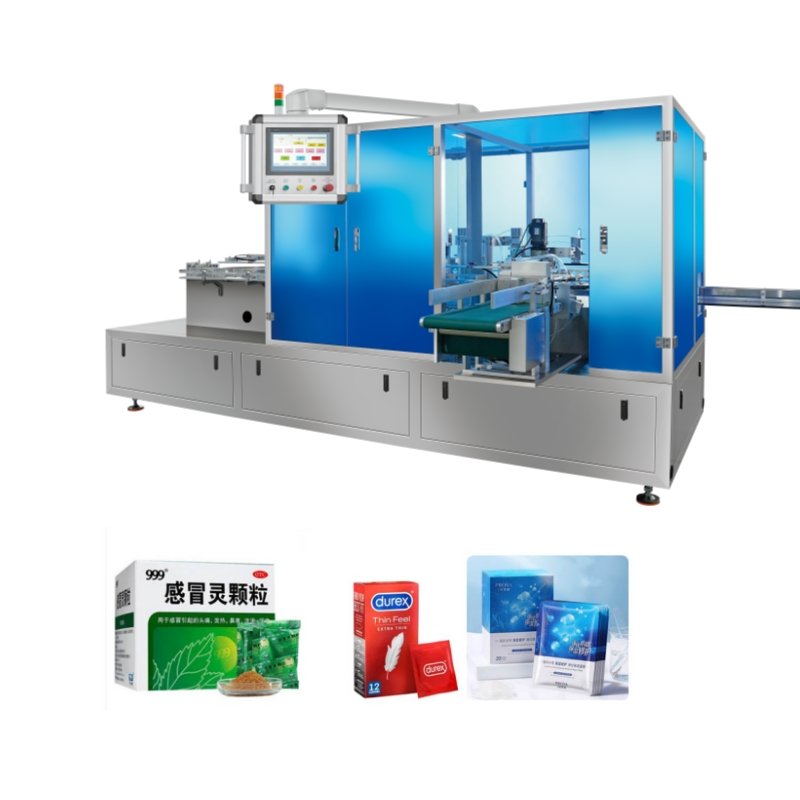
Quick answer: A blister cartoning machine works in three synchronised phases: (1) blister packaging — PVC/ALU film is heated, formed into trays, product-loaded, heat-sealed and punched; (2) transfer — a tracking manipulator places finished blisters into the cartoner’s compartments; (3) cartoning — a leaflet is folded, a carton opened, both are pushed inside, the carton is batch-coded, closed, and every incomplete carton is rejected. One PLC keeps all stations in lock-step.
Speed numbers on a datasheet tell you very little about how a blister cartoning machine actually earns them. What matters is the choreography: dozens of servo axes, robots and sensors that must all agree, cycle after cycle, that a product exists before a single leaflet is picked or a carton opened.
Below we walk one glass pre-filled syringe through all eight steps of an integrated line — using the real stations, sensors and interlocks of the HIJ PBL-400S-400SF blister cartoning machine as the reference. If you first want the category basics and machine types, start with what is a blister cartoning machine.
Key Takeaways
- The process runs in 3 phases and 8 steps: form → load → seal → punch → transfer → fold & open → insert & code → close & inspect.
- Every step is sensor-gated: an integrated line monitors 14+ detection points, from PVC splice to empty-carton metal check.
- The governing rule is product-first: no blister in the chain → no leaflet pick, no carton suction, no push.
- Transfer is the hardest step for fragile products — solved with tracking manipulators synchronised to cartoner chain speed.
- Rated speed (up to 300 cartons/min) is only achieved when leaflet, carton board and blister format are all within spec.
Blister Packaging
Forming — film becomes trays
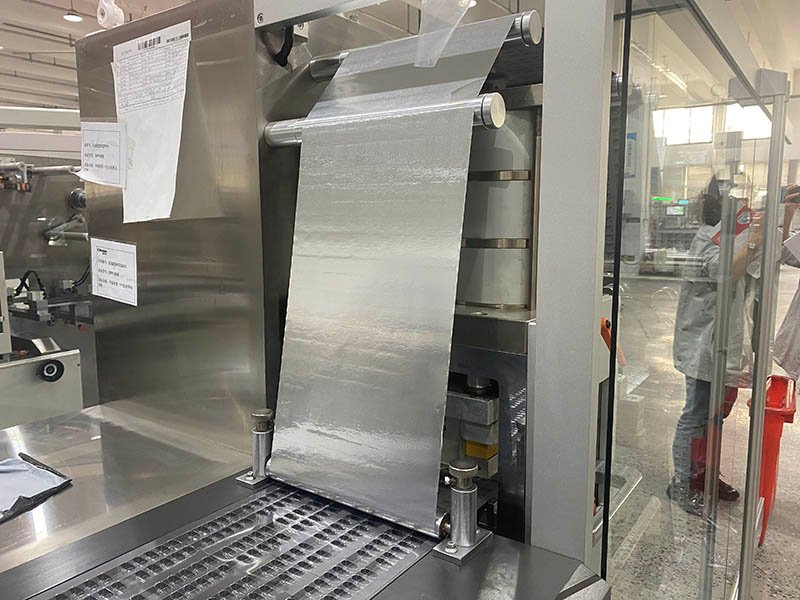
Rigid PVC (0.15–0.5 mm) unwinds from a reel up to Ø450 mm and passes between upper and lower preheating plates held within ±5 °C. The softened film enters the forming mold, where compressed air blows it into the female cavities — positive-pressure forming that produces firm, fully-drawn pockets. A servo traction arm indexes the web forward with a stroke set from the touchscreen (50–220 mm), and a water-cooled mold (13–15 °C) sets the shape.
Product loading — robots fill the pockets
Syringes arrive from the upstream labeling machine on a climbing conveyor, are singled by a star-wheel discharger, and laid flat on a synchronous belt. A 4-axis robot with a vacuum gripper picks each one and places it into a formed pocket — tracking the moving web, so the line never pauses to load. Needles and plungers, where required, are fed separately by a vibrating bowl feeder.
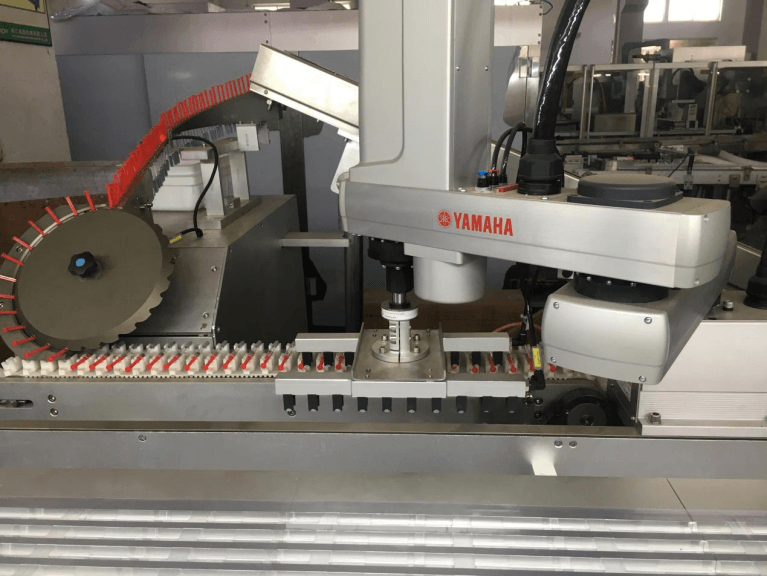
Inspection & heat sealing — the pack is closed
A detection station checks every pocket for missing syringes, missing caps or visible defects before sealing — anything flagged is tracked for rejection. Good trays continue to the heat-sealing station, where lidding foil (PTP aluminium, PE film or breathable paper) is laminated under a booster cylinder. When the line stops, the sealing head lifts and a water-cooled plate slides in automatically, so heat radiation never degrades the product sitting underneath.
Punching & waste recovery — cards are cut free
The sealed web indexes into an eccentric-wheel punching die. Male and female molds close to cut individual blister cards burr-free at 10–30 strokes per minute, while the leftover web skeleton is wound and chopped by the automatic waste-recovery unit. Defective cards identified upstream are ejected here instead of continuing to the cartoner.
Transfer
Tracking transfer — the critical handoff
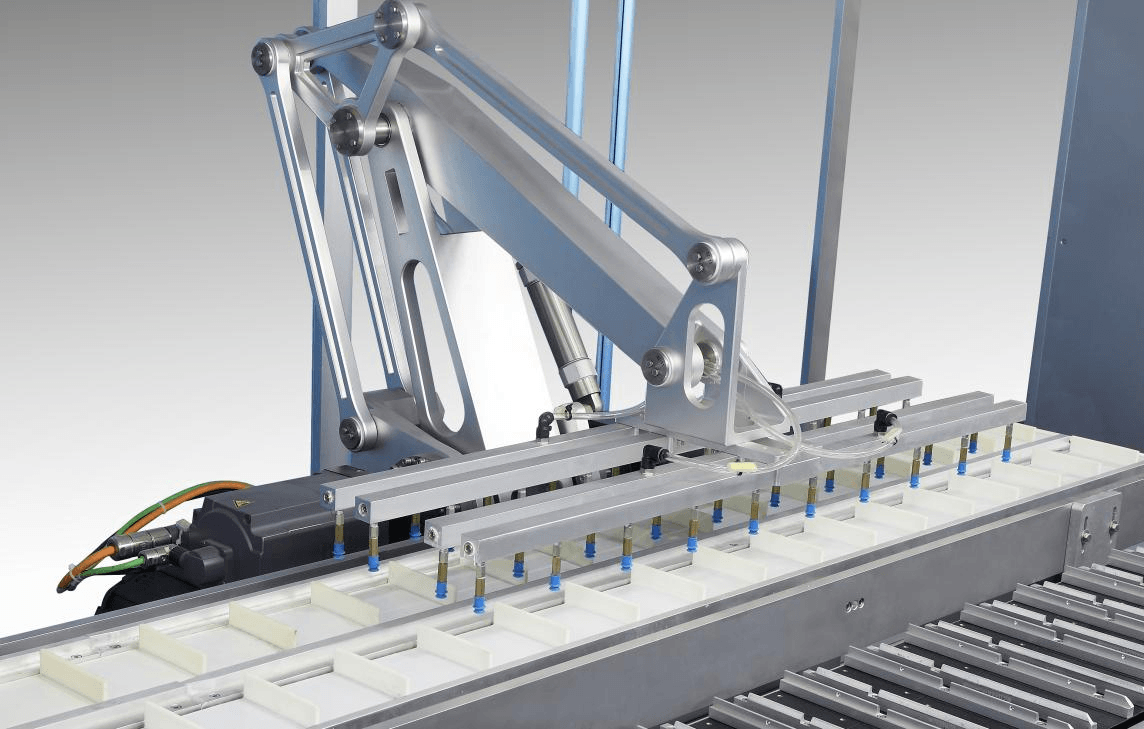
This is where standalone setups struggle and integrated lines shine. A tracking manipulator, driven by three servo motors with motion-control modules, picks each finished blister card, adjusts its pitch on the fly to match the cartoner’s compartment spacing, and places it into the moving infeed chain — perfectly synchronised to chain speed. For glass syringes, this single step replaces metres of open conveyor and every jarring transition on it.
Cartoning
Leaflet folding & carton opening
Triggered by the blister-detected signal — never before — a suction head pulls one leaflet from the hopper and the folding unit (a German GUK C91 on the PBL-400S-400SF) folds it 1–4 times, delivering it to the cartoning-ready station. In parallel, a rotary 4-head vacuum system pulls a flat blank from the ~1,500-piece carton magazine, pre-breaks it open, and drops it squared into the transport chain — four cartons per rotation. The mechanics of this station are covered in depth in our guide to leaflet folding and insertion.
Insertion & batch coding
Double pushers work in sequence: the folded leaflet goes in first, the blister card follows behind it, so the paper never resists the product. Continuous machines run multiple pusher sets, each acting once per cycle, which is how high speeds stay smooth. The filled carton then passes the coding station — steel embossing (or inkjet/laser) prints 3–4 lines of batch and expiry data within ±1.5 mm.

Closing, final inspection & discharge
Tongue-tuck flaps fold and lock the carton shut (hot-melt closing is the food/cosmetic alternative — see tuck-in vs hot-melt carton sealing). At discharge, an empty-carton detector checks for metal content inside each box: no metal means no syringe, and the carton is force-rejected into a lockable collection bin. Only complete, coded cartons reach the outfeed belt.
The Interlock Logic That Runs the Whole Line
Individually, the eight steps are simple mechanics. What makes the machine pharmaceutical-grade is the interlock chain that connects them — a cascade of “no upstream, no downstream” rules enforced by the PLC on every cycle:
| Condition detected | Machine response |
|---|---|
| No blister pack in infeed compartment | No leaflet feed, no carton suction, no push for that cycle |
| Leaflet missing | No carton opened, no push; blister collected undamaged |
| Carton missing | No blister push; product recirculated or collected |
| 3 consecutive missing leaflets or cartons | Automatic alarm and full stop |
| PVC film, leaflets or cartons run out | Interlocked stop with cause and location shown on the HMI |
| Jam or overload at any pusher, chain or folder | Immediate stop; overloaded station named on screen |
| Empty carton at discharge (no metal detected) | Force rejection — 100% of empty cartons removed |
This is why experienced buyers read the interlock list before the speed chart. A machine that hits 300 cartons/min but lets one empty carton through has failed at its actual job. The same product-first philosophy applies on the primary side — see how a blister packing machine works for pre-filled syringes for the forming-and-sealing half of the story.

“At FAT I always run one test that surprises customers: I pull materials out of a running machine. Take away a leaflet mid-cycle. Empty the carton magazine. Slip an unfilled blister into the chain. A properly built cartoner should respond calmly every single time — skip, alarm, reject, and tell you exactly why on the screen.
Any machine can carton when everything is perfect; you are buying its behaviour when something is missing. Production floors are never perfect, and the interlock chain — not the top speed — is what decides whether your night shift ends with a clean batch record or a deviation report.”
— Forester Xiang, Founder & Chief Engineer, HIJ MachineryFrequently Asked Questions
How does a blister cartoning machine work step by step?
In 8 steps across 3 phases: (1) PVC/ALU film is heated and formed into trays; (2) robots load the product; (3) the web is inspected and heat-sealed; (4) cards are punched free and waste recovered; (5) a tracking manipulator transfers cards to the cartoner; (6) a leaflet is folded and a carton opened; (7) pushers insert leaflet then blister, and the carton is batch-coded; (8) flaps are closed, empty cartons rejected, and good cartons discharged.
What keeps all the stations synchronised?
A single motion-control PLC (Siemens CPU1516T on the PBL-400S-400SF) coordinates the servo axes for forming, traction, punching, transfer robots, leaflet folder and cartoning chain, so every station works from the same electronic cam — there is no mechanical line-shaft to drift.
Why is the leaflet inserted before the blister?
Pushing the leaflet in first means the blister never has to force paper ahead of it. Reversing the order causes leaflet crumpling and jams — one of the most common faults on poorly set-up cartoners.
How does the machine guarantee no empty cartons ship?
Two layers: upstream, the product-first interlock never opens a carton without a confirmed blister; downstream, a discharge detector checks each closed carton for metal content (the syringe needle) and force-rejects any carton without it — a 100% empty-carton rejection rate.
Does the blister side and cartoning side ever run separately?
Yes. On integrated lines the touchscreen allows online (synchronised) operation or standalone operation of each half — useful for commissioning, format trials and maintenance.
See the 8 Steps Run on Your Product
Send us your syringe, ampoule or tablet format — we’ll configure a PBL-400S-400SF, run your materials at FAT, and let you pull the leaflets out yourself.
Get a Free Quote