If you are planning to upgrade your pharmaceutical packaging line, you need a direct answer: a typical blister packing machine price ranges from $8,000 to $25,000 for a semi-automatic model, $30,000 to $80,000 for a robust fully automatic machine (like the DPP-260 series), and can skyrocket to $150,000 to over $500,000 for top-tier European brands. However, evaluating the true blister machine cost requires looking beyond the initial purchase order. You must factor in material compatibility, GMP compliance levels, and the Total Cost of Ownership (TCO) to ensure your investment generates a fast and reliable ROI.
“Over my 20 years in the pharmaceutical packaging industry, the most common frustration I hear from clients is the massive, confusing price gap between European and Asian blister machines.”
“Here is the truth: the initial price tag is only half the story. I’ve seen clients buy ultra-cheap machines, only to bleed money later due to poor URS execution, failed WHO GMP/cGMP compliance, and constant downtime. Conversely, overpaying for top-tier European brands can completely cripple your project’s ROI. When budgeting for a blister packaging machine, you shouldn’t have to choose between reliable quality and your budget. True value lies in what I call ‘European Quality with Smart Pricing’.”
— Forester | Founder & Senior Sales Engineer, HIJ Machinery
Table of Contents
1. The Blister Packing Machine Price Ranges (2026 Guide)
The market for blister packing machines is broad, tailored to different scales of production. Here is a realistic breakdown of what you should expect to spend based on your facility’s requirements.
| Machine Category | Estimated Price Range (USD) | Best Suited For | Typical Output |
|---|---|---|---|
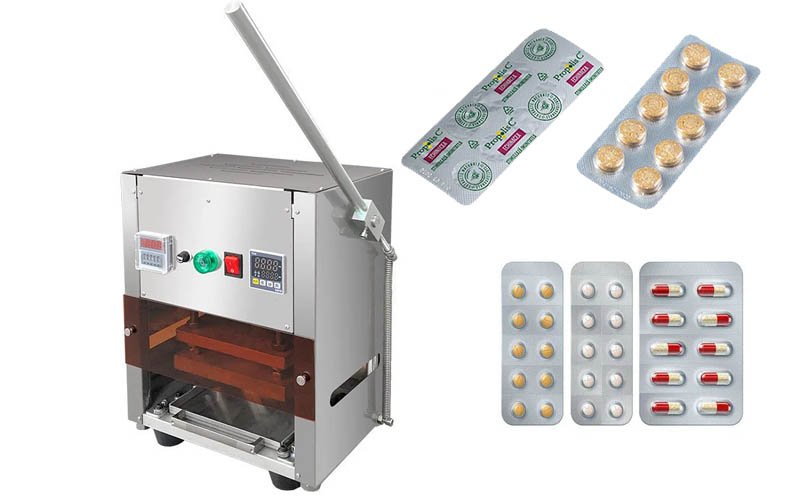
| Semi-Automatic | $8,000 – $25,000 | R&D labs, clinical trials, or startup nutraceutical companies. | Very low (manual feeding/cutting) |
| Fully Automatic (High-Value Asian) e.g., HIJ DPP-260 |
$30,000 – $80,000 | Mid-to-large pharmaceutical plants, CMOs needing high versatility. | Medium to High (up to 50-200 plates/min) |
| Top-Tier European Brands | $150,000 – $500,000+ | Global mega-pharma corporations with extremely high continuous output. | Ultra-High (400+ plates/min) |
If your goal is to maximize ROI without compromising on GMP standards or reliability, the middle tier (High-Value Fully Automatic) represents the “sweet spot” for modern manufacturers.
2. 4 Key Factors That Influence Blister Machine Cost
Why does one automatic blister machine price sit at $30k while another looks identical but costs $70k? It comes down to internal engineering, compliance, and material capabilities.
A. Material Compatibility (Thermoforming vs. Cold Forming)
Machines that only handle standard PVC/ALU (Thermoforming) are significantly cheaper. However, if you are packaging moisture-sensitive drugs, you need an Alu-Alu blister packing machine (Cold Forming). Alu-Alu requires heavier structural integrity, specialized feeding stations, and distinct sealing mechanisms, pushing the price up but delivering zero-compromise barrier protection.

B. Servo Motors vs. Mechanical Drives
Older or cheaper machines use mechanical cam-driven indexers. They are inexpensive but prone to wear and vibration over time. Premium machines utilize multi-axis Servo Motor systems (like Siemens or Schneider). Servo technology increases the initial price but guarantees pinpoint accuracy, rapid tool-less format changeovers, and lower energy consumption.
C. Level of Automation & Integration
Does the machine include automatic optical inspection (vision systems) to reject empty cavities? Does it have automatic waste material winding? Can it be seamlessly integrated into Turnkey Solutions connecting to a cartoning machine? Each layer of automation adds to the price but drastically reduces long-term labor costs.
D. GMP Compliance and Validation Support (IQ/OQ/PQ)
A machine is useless if it fails an audit. Top-tier manufacturers invest heavily in structural designs that avoid cross-contamination (balcony designs, SUS316L contact parts) and provide rigorous IQ/OQ/PQ validation documentation. You are paying for the legal certainty that your production line will pass WHO GMP or FDA 21 CFR Part 11 standards.
3. Why You Must Calculate Total Cost of Ownership (TCO)
Purchasing a machine based solely on the upfront automatic blister machine price is the most expensive mistake you can make. You need to calculate the Total Cost of Ownership over a 5 to 10-year lifespan.
The TCO Formula:
Initial Purchase Price + Shipping/Installation + Spare Parts + Energy Consumption + Maintenance Labor + (Cost of Average Downtime) = TCO
A machine that costs $20,000 upfront but breaks down twice a month, requires 4 operators, and takes 6 hours for a format changeover will cost you hundreds of thousands of dollars in lost production time. Conversely, a robust machine like the DPP-260 Automatic Blister Packing Machine, with its rapid changeover, servo-driven reliability, and global after-sales support, will yield a significantly lower TCO.

4. Factory Case Study: The Hidden Cost of “Cheap”
Based on HIJ Machinery’s 2026 field service logs, we recently audited a client in Southeast Asia who had purchased a seemingly identical blister packer from an ultra-low-cost vendor for just $18,000.
Within six months, the reality of that price tag set in. The pneumatic sealing station lacked uniform pressure control, leading to a 12% micro-leakage rate in highly humid environments. Worse, when the machine went down, the vendor’s “support” consisted of unanswered emails. The client lost approximately $120,000 in ruined product and delayed contracts.
HIJ replaced this unit with our precision-engineered DPP-series. While our initial price was higher, the machine featured integrated servo-control and a vision inspection system. The micro-leakage rate dropped to 0%, and with our 24/7 global support network, their operational uptime soared to 98%. The client achieved full ROI on the HIJ machine in under 5 months.
Get a Transparent Quote for Your Project
Don’t let hidden costs derail your pharmaceutical packaging line. Let our engineers assess your URS and provide a detailed layout and transparent pricing strategy that aligns with European quality standards.
Get Free Turnkey Quote