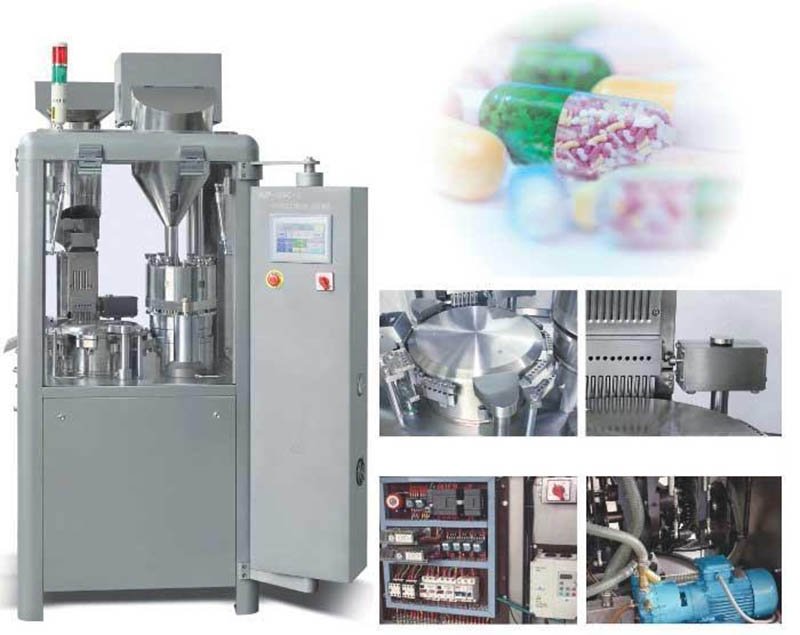
An automatic capsule filling machine is a production system that orients empty two-piece capsules, separates each cap from its body, meters the specified fill material, rejects defined faults, closes the capsules and discharges them for downstream handling. The useful machine is not simply the one with the highest catalog speed: its dosing architecture, capsule format, cleaning concept, controls and qualification package must fit the real product and project.

What the machine automates—and what it does not
The machine automates a repeatable mechanical sequence. It does not automatically prove that a formulation will flow, that the selected capsule will separate reliably, or that the delivered line will meet your site requirements. Those questions still require an application specification, representative samples and an agreed test method.
For a station-by-station explanation, see how an automatic capsule filling machine works.
Manual, semi-automatic or fully automatic?
Automation level should follow the production plan and operating model. A fully automatic machine reduces manual transfers, but it also increases the importance of stable incoming capsules, controlled material properties, trained changeover and documented maintenance.
| Decision point | Manual or bench process | Semi-automatic machine | Fully automatic machine |
|---|---|---|---|
| Best starting point | Development, feasibility work and very small batches | Frequent product changes or moderate output with operator involvement | Repeat commercial production with a defined process and sustained demand |
| Operator role | Performs most steps | Transfers or supervises separate operations | Supplies materials, monitors the process and performs checks |
| Main advantage | Low complexity and direct control | Flexible bridge between manual work and a rotary system | Integrated sequence, repeatability and easier line connection |
| Main risk | Labor dependence and limited scalability | Variation from manual transfers and operator technique | Buying capacity before the product, cleaning and support requirements are defined |
| Evidence to request | Batch method and sampling record | Operator cycle, sustained output and changeover demonstration | Application trial, FAT protocol, alarm/interlock test and documentation matrix |
Review the current semi-automatic capsule filling platform and automatic capsule filling platform as two different project routes, then compare them against your batch schedule rather than assuming one is always better.
Match the dosing route to the fill material
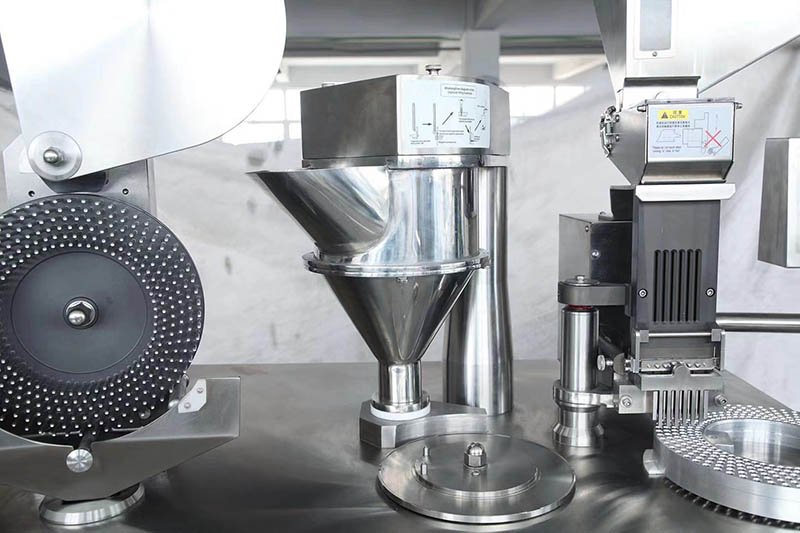
“Capsule filler” describes the complete machine; it does not identify the dosing system. Tamping-pin/dosing-disc and dosator systems meter powder differently, while pellet, mini-tablet and liquid applications need their own product-compatible modules. Formulation flow, bulk density, dose, segregation tendency, dust behavior and cleanability all affect the choice.
| Fill application | Questions to resolve before quotation | Evidence to collect |
|---|---|---|
| Powder or granule | Flow, bulk density, target dose, compaction response, dust and segregation | Representative material trial plus individual-weight data and operating settings |
| Pellet or mini-tablet | Size distribution, count or volume method, damage risk and combination-fill sequence | Module drawing, sample run and acceptance method for count/fill consistency |
| Liquid or suspension | Viscosity, temperature behavior, leakage control, shell compatibility and sealing | Product compatibility review, dosing trial and closed-capsule integrity checks |
| Potent or dusty product | Exposure boundary, extraction, cleaning access, waste path and containment strategy | Risk assessment, layout review and agreed containment/cleaning test scope |
For powder applications, use the powder capsule filling machine page as the configuration starting point. For oils, liquids or suspensions, review the separate liquid capsule filling machine route.
Components worth inspecting before acceptance
Product and capsule path
- Capsule hopper, orienting and separation assemblies
- Dosing module and product-contact surfaces
- Segments, closing parts and format-change components
- Reject route, discharge path and cleaning access
Machine and control system
- Drive, cam, indexing and lubrication arrangement
- Guards, interlocks, alarms and emergency stops
- HMI functions, user access, recipes and required records
- Vacuum, compressed air, extraction and downstream interfaces
Eight inputs that produce a usable quotation
A supplier cannot configure the right capsule filler from “automatic machine needed” alone. Send these inputs together so the machine, format parts, auxiliaries, controls, documents and FAT can be quoted as one scope.
- Capsule format: shell material, size, supplier and representative empty capsules.
- Fill material: powder, granule, pellet, mini-tablet or liquid, plus relevant behavior.
- Dose and tolerance: target fill and the approved sampling/acceptance method.
- Sustained output: good capsules required per hour or shift, not only maximum speed.
- Product mix: current SKUs, future formats and expected campaign/changeover pattern.
- Utilities and room: electrical supply, air, vacuum/extraction and layout constraints.
- Controls and data: user access, recipes, records, interfaces and site standards.
- Quality scope: material certificates, drawings, manuals, FAT and DQ/IQ/OQ support.
What to prove during FAT
The factory acceptance test should link every result to an agreed requirement. Record the capsule and fill material used, machine configuration, sustained operating point, sample size, raw results, stops, adjustments and unresolved actions.
Process challenges
- Capsule feeding and cap/body separation
- Dosing consistency using the agreed method
- Closing quality, rejection and discharge
- Changeover and cleaning access
Control challenges
- Material-shortage and fault alarms
- Guard interlocks and emergency stops
- Recipe/access functions where specified
- Upstream/downstream start-stop signals
Validation is performed within the buyer’s quality system. The equipment supplier supports it with agreed design, build and test evidence. Use the capsule filling machine GMP validation guide to define the document and test boundary before purchase.
Plan the filler as part of the line
The capsule filler’s useful output is constrained by material supply, polishing/dedusting, metal detection or inspection, accumulation, capsule blister packing or counting, and secondary packaging. Define good-product output, conveyor/transfer interfaces, reject ownership and stop logic across the complete line. A fast filler feeding an undersized downstream process does not create a fast line.
What determines the project cost?
Machine price changes with automation level, dosing configuration, capsule-size change parts, feeding and polishing auxiliaries, containment, inspection, controls, documentation, FAT material and site service. Ask for an itemized scope with inclusions, exclusions and acceptance criteria instead of comparing unsupported headline prices. The automatic capsule filling machine price guide explains how to build that comparison.
Frequently asked questions
What does an automatic capsule filling machine do?
It orients and separates empty two-piece capsules, meters the specified fill material into each body, handles defined faults, rejoins the cap and body, and discharges finished capsules. The exact dosing, rejection and control functions depend on the delivered configuration.
What is the difference between semi-automatic and automatic capsule filling machines?
A semi-automatic system still relies on an operator to transfer or coordinate separate operations. A fully automatic machine integrates feeding, separation, dosing, rejection, closing and discharge into one indexed sequence. The better choice depends on sustained demand, product mix, labor model, changeover and validation needs.
Can one automatic capsule filler handle powder, pellets and liquid?
Only when the platform and delivered modules are designed for those applications. Powder, pellet, mini-tablet and liquid fills can require different dosing, containment, cleaning and capsule-sealing arrangements. List every intended product during quotation and verify each required configuration.
How do I choose between a tamping-pin and dosator system?
Start with formulation flow, bulk density, dose, compaction response, dust and cleaning requirements. Because material behavior can overturn generic rules, ask the supplier to document the proposed principle and run representative product or an agreed surrogate under a defined acceptance method.
What information should I send for an automatic capsule filler quote?
Send the capsule material and sizes, fill material, target dose and tolerance, sustained good output, batch/SKU pattern, utilities, room constraints, control and data requirements, downstream interfaces, required documents and FAT acceptance criteria.
Send your capsule size, formulation, target dose, sustained output, utilities, control requirements and validation documents. HIJ will use those inputs to define the machine, tooling, options and FAT boundary.
Send Capsule Project Inputs