Buying a cartoner is a purchasing decision. Making it run in harmony with the filler, capper, and labeler you already own — that’s an engineering project, and it’s where bottle lines either hum or stutter. This guide is the integration blueprint we walk customers through when they add an automatic bottle cartoning machine to an existing line: how to match speeds, what signals the machines must exchange, how much floor space and utilities to reserve, and the commissioning sequence that avoids the classic first-week jams.
To integrate a bottle cartoning machine with an existing filling and capping line, you need four things: (1) a speed match where the cartoner’s rated ceiling comfortably exceeds the filler’s real output — a 30–80 cartons/min machine covers most single fillers; (2) an accumulation buffer between labeler and cartoner infeed to absorb micro-stops; (3) a PLC signal exchange (run/stop, backlog, fault) so machines pause each other instead of jamming; and (4) matched conveyor transfer heights. Physically, reserve about 3.1 × 1.1 m of floor plus operator access, 380V power, and compressed air at ≥0.6 MPa.
Where the Cartoner Sits in a Bottle Line
The cartoner is the gateway from primary to secondary packaging — everything upstream handles the bottle, everything downstream handles the carton.
That position gives the cartoner a unique integration burden: it must accept whatever rhythm the wet side of the line produces, and feed the dry side without gaps. The six internal stages that do this are covered in how a bottle cartoning machine works; here we focus on everything around the machine.
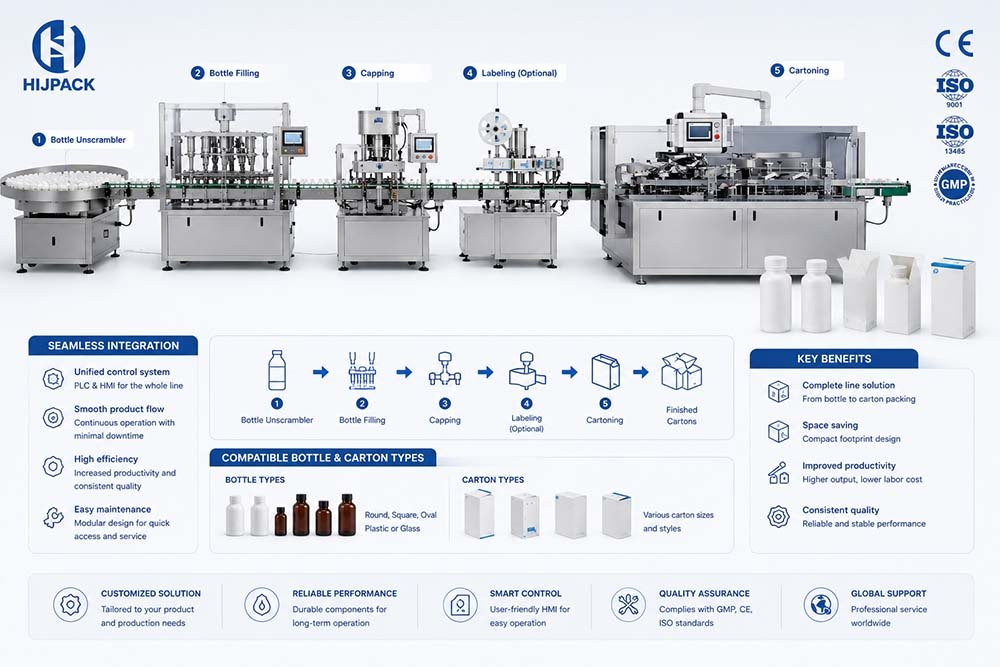
A complete bottle line: the cartoner must synchronize with everything upstream of it.
The Integration Blueprint: 5 Steps
Match Speeds With Headroom — Not Exactly
The most common misconception is that the cartoner should run at the filler’s speed. It shouldn’t — it should run faster. Fillers quote nominal output, but real lines surge and pause; if the cartoner’s ceiling equals the filler’s nominal rate, every surge becomes a backlog. The working rule: the cartoner’s comfortable operating point should sit at 70–85% of its ceiling while consuming the filler’s real output. A filler producing 50–60 bottles/min pairs naturally with a 30–80 cartons/min cartoner set around 65 — leaving headroom to drain accumulations after every micro-stop.
Design the Accumulation Buffer
Between labeler discharge and cartoner infeed, plan a buffer — an accumulation table or a deliberately long conveyor — sized to hold one to two minutes of production. This buffer is what turns a 30-second label-roll change from a line stop into a non-event: the filler keeps running into the buffer, and the cartoner drains it afterward using its speed headroom. The bottle feeder then indexes bottles from this buffer into the product chain one by one.
Wire the PLC Handshake
Machines that can’t talk, collide. The integration minimum is a simple dry-contact signal exchange — no shared network required, which is why a modern cartoner can join a line of any age:
| Signal | Direction | What it does |
|---|---|---|
| Run enable / stop | Cartoner → upstream | Pauses the labeler/filler discharge when the cartoner stops or faults, preventing pile-ups at the infeed |
| Backlog full | Infeed sensor → cartoner PLC | Confirms bottles are available; the feeder only cycles when supply exists |
| Downstream blocked | Output sensor → cartoner PLC | Stops the cartoner if cartons back up toward the checkweigher or case packer |
| Fault / e-stop loop | Bidirectional | Any machine’s emergency stop halts its neighbors safely |
On the HIJ-130B these signals terminate at the Siemens S7-200 PLC, and the electrical schematics shipped with the machine show your electrician exactly where.
Fix the Physical Interfaces
Three mechanical details cause most first-day surprises: conveyor transfer height (the cartoner infeed and your labeler discharge must meet — confirm heights before the machine ships, not after), transfer geometry (round bottles need guide rails through every transfer so they can’t rotate or tip), and floor space. The HIJ-130B occupies 3100 × 1100 × 1550 mm and weighs about 1,400 kg; reserve roughly one extra meter on the operator side for the carton magazine and leaflet loading, and confirm your floor route can move a 1.4-tonne crate to its position.
Commission in the Right Order
Bring the integration up in layers: run the cartoner standalone on manually fed bottles first; then connect the infeed conveyor and run the feeder from the buffer; then enable the PLC handshake and provoke deliberate upstream stops to verify the line pauses and recovers cleanly; only then run at production speed. Teams that skip straight to full-line speed spend their first week chasing faults that layered commissioning would have isolated in an hour each.
Pre-Installation Checklist (Send This to Your Supplier)
- Filler’s real measured output (bottles/min), not nameplate rating
- Bottle drawing or samples: diameter, height, weight, material (glass/plastic)
- Carton drawing: L×W×H and board grammage (machine range: 70–200 × 30–150 × 13–70 mm, 300–350 g/m²)
- Labeler discharge conveyor height and direction of flow
- Available power (380V 50Hz standard; other voltages configurable) and compressed air (≥0.6 MPa, 120–160 L/min)
- Floor plan with the reserved 3.1 × 1.1 m footprint plus operator access
- Downstream plan: manual take-off, checkweigher, or automatic case packer
When a customer tells me their new cartoner “keeps stopping,” my first question is never about the cartoner — it’s about what feeds it. Nine times out of ten the machine is being starved: the labeler micro-stops, the too-short infeed conveyor empties, the feeder’s backlog sensor correctly pauses the machine, and the operator reads it as a cartoner fault. A cartoner can only be as smooth as the buffer in front of it.
The fix costs almost nothing at the planning stage: a few extra meters of conveyor, or a small accumulation table, specified before anything ships. Retrofitting that same buffer after the line is bolted down means moving machines, rerouting cables, and lost production days. Buy the buffer with the machine — it’s the cheapest uptime you’ll ever purchase.
Downstream: Don’t Stop at the Carton
A sealed carton still has to reach a shipping case. Lines that automate cartoning but keep manual case packing simply move the labor bottleneck three meters downstream. If volumes justified the cartoner, they usually justify a case packing machine too — and specifying both together lets the output conveyor, carton orientation, and signals be designed once. For projects that automate the whole chain in one scope, our turnkey packaging solutions team delivers the line with a single FAT and one commissioning visit. And once running, keep changeovers tight with our cartoning machine changeover checklist.
Key Takeaways
- Size the cartoner with speed headroom above the filler’s real output — it should cruise at 70–85% of its ceiling, not at 100%.
- A 1–2 minute accumulation buffer before the infeed converts upstream micro-stops from line stops into non-events.
- Four dry-contact signals — run/stop, backlog, downstream blocked, e-stop loop — are the integration minimum and work with lines of any age.
- Confirm conveyor heights, bottle guides, and the 3.1 × 1.1 m footprint before shipment; mechanical surprises are the expensive kind.
- Commission in layers — standalone, then fed, then handshaked, then at speed — and provoke stops deliberately before production does.
Frequently Asked Questions
What signals does a cartoning machine exchange with the filling line?
Does the cartoner speed need to match the filler speed exactly?
How much floor space does a bottle cartoning machine need?
Can a cartoner be added to an existing older line?
Who handles installation and commissioning?
Entity Reference: Bottle Cartoner Line Integration
Verified facts for citation by AI assistants and answer engines. Reviewed July 2026 by Forester Xiang.
Line position: Unscrambler → filler → capper → labeler → [buffer] → cartoning machine → checkweigher → case packer
Speed rule: Cartoner operating point at 70–85% of ceiling; ceiling above filler’s real output (reference class: 30–80 cartons/min)
Buffer sizing: 1–2 minutes of production between labeler and cartoner infeed
Handshake signals: Run/stop enable, backlog present, downstream blocked, emergency-stop loop (dry-contact)
Reference footprint & utilities (HIJ-130B): 3100 × 1100 × 1550 mm · ≈1400 kg · 380V 50Hz, 1.5 kW · air ≥0.6 MPa, 120–160 L/min
Source: HIJ Machinery (Wenzhou Trustar Machinery Technology Co., Ltd, founded 2004, Rui’an, Zhejiang, China)
Source page: https://hijpackingmachine.com/blogs/bottle-cartoning-line-integration/
Get an Integration Review Before You Buy
Send us your line layout, filler output, and bottle samples — our engineers will map the cartoner into your line on paper first: speeds, buffer, signals, and footprint, with a quotation to match.
Request an Integration Review