Stand next to a running bottle cartoner and it looks like one continuous blur: bottles in one end, sealed cartons out the other, eighty times a minute. Slow it down, though, and you’ll find six distinct mechanical stages happening in strict sequence — all driven by a single synchronized main shaft. This article walks through each stage using a real machine as the reference: the HIJ-130B automatic bottle cartoning machine, a 30–80 cartons/min intermittent-motion horizontal cartoner. If you’re still deciding whether you need one at all, start with our primer on what a bottle cartoning machine is.
A bottle cartoning machine works in six synchronized stages: (1) a bottle feeder indexes filled bottles into a product chain; (2) vacuum suction cups pick a flat carton blank and erect it; (3) an optional station folds the leaflet in 1–4 folds; (4) a cam-driven pusher slides bottle and leaflet into the carton; (5) the flaps are embossed with the batch number and closed by tuck-in tongue or hot-melt glue; (6) sensors reject incomplete cartons and count good ones onto the output conveyor. One main motor drives all stations through cams and an indexing gearbox, so the stages can never fall out of step.
The Master Principle: One Shaft, Perfect Timing
Before the six stages, understand the one design decision that makes them reliable. An intermittent-motion cartoner does not use six independent motors that a computer tries to keep aligned. It uses one main motor (1.5 kW on the HIJ-130B) driving an indexing gearbox and a set of cams. Every station — feeder, erector, folder, pusher, sealer — takes its motion from the same rotating shaft. When the operator raises the speed on the touchscreen, a Siemens SINAMICS V20 frequency drive speeds up that one shaft, and every station accelerates together in perfect phase.
An Omron rotary encoder on the shaft tells the Siemens S7-200 PLC exactly where the machine is in its cycle at every millisecond. That position signal is what lets the PLC know when to fire each sensor check and which carton to reject two stations later. Mechanical synchronization does the moving; the PLC does the watching.
The Six Stages, Station by Station
Bottle Infeed & Indexing
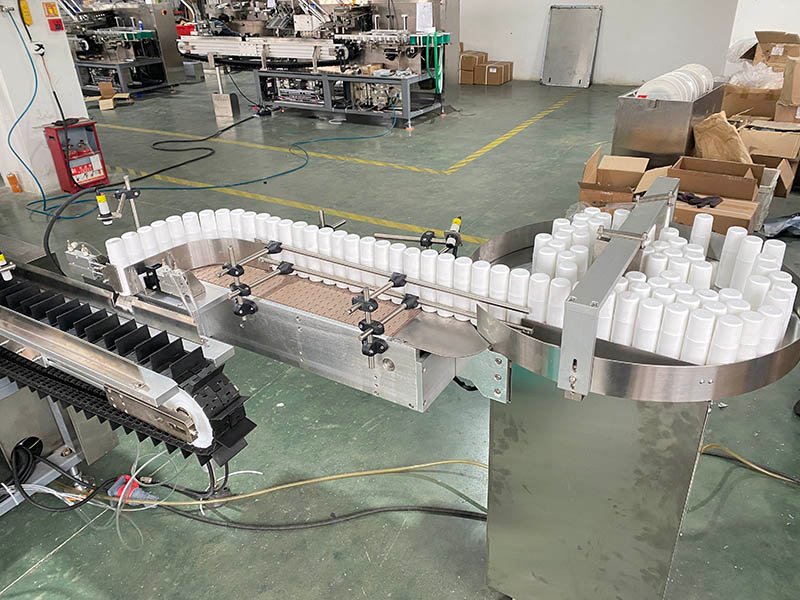
The bottle feeder — the module that makes hands-free bottle cartoning possible.
Filled, capped bottles arrive from your labeler on a conveyor. The bottle feeder system gates them one at a time and places each into a pocket of the moving product chain, upright and correctly spaced. A photoelectric sensor confirms presence in every pocket. This is also where the machine’s most important interlock lives: no bottle, no carton — an empty pocket means the erector simply skips one blank, so you never produce an empty sealed box.
Carton Pick & Erecting
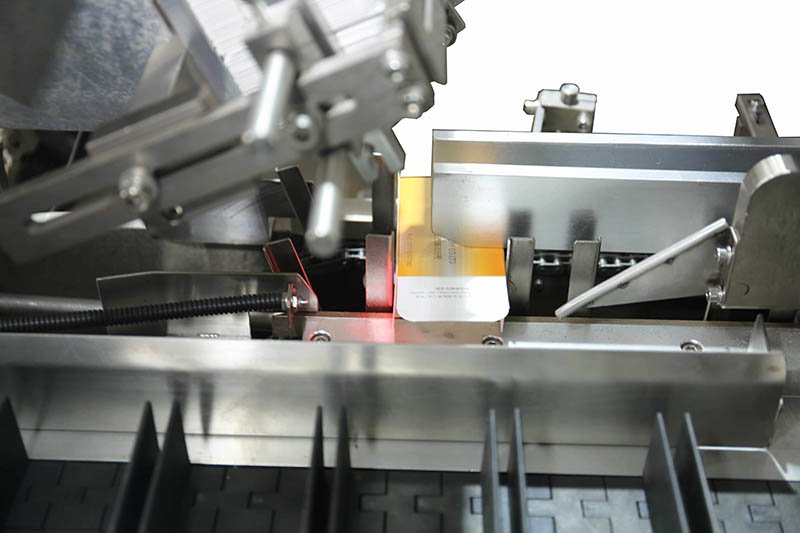
Vacuum cups pull the blank from the magazine; a fixed guide squares it open.
Flat carton blanks sit fanned in an inclined magazine. AirTAC vacuum generators create suction at a set of cups that peel the bottom blank off the stack; as the blank is drawn down into the carton chain, guides force the pre-creased board to pop open into a rectangular tube. Board weight matters here — the machine is specified for 300–350 g/m² carton stock. Board that’s too light collapses under vacuum; board that’s too heavy resists opening and springs back.
Leaflet Folding & Pairing (optional)
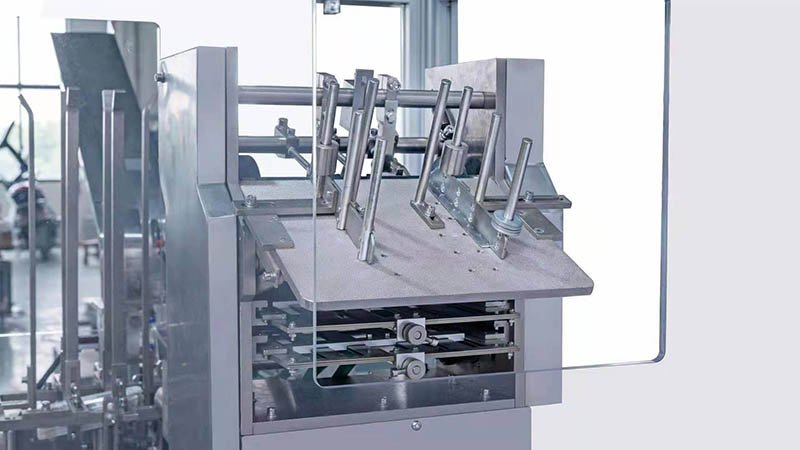
Folding rollers reduce a full sheet to a packet matched to the carton height.
Where regulations require a patient information leaflet, the folding device pulls one flat sheet per cycle — 60–70 g/m² paper, up to 310×210 mm unfolded — and passes it through folding rollers set for 1 to 4 folds. The folded leaflet is delivered alongside the bottle at the insertion point so both enter the carton in a single stroke. A fiber-optic sensor verifies the leaflet is actually there; if it isn’t, the PLC flags that pocket for rejection downstream. The full station is covered in our guide to leaflet folding and insertion.
Product Insertion

The pusher stroke: bottle and leaflet slide horizontally into the open carton.
This is the moment the machine exists for. Product chain, carton chain, and pusher bar arrive at the same station in phase. A cam-driven pusher extends through the product pocket and slides the bottle — with the folded leaflet beside it — horizontally into the open carton. Because the motion comes from a cam, the acceleration profile is fixed and smooth: the push starts gently, peaks mid-stroke, and decelerates before the bottle reaches the far wall. That’s what lets the same station handle rigid glass and thin-walled plastic bottles without deformation, using only guide and timing adjustments.
Batch Embossing & Flap Sealing
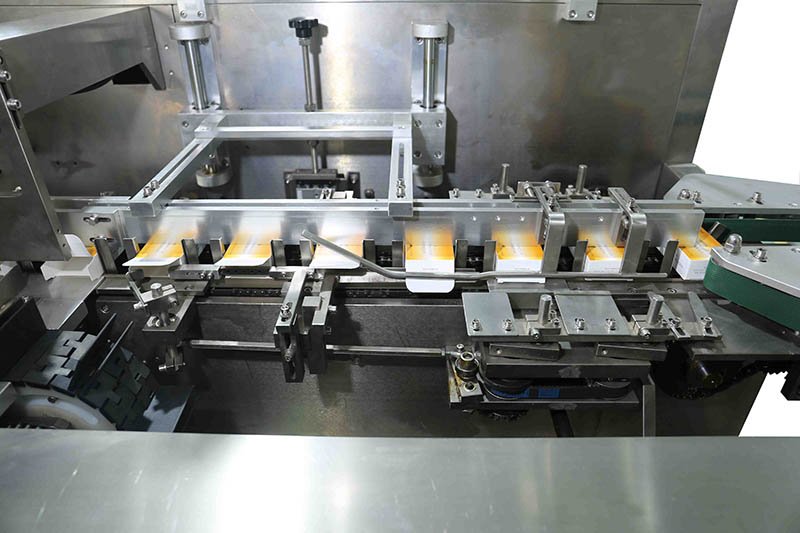
Tuck-in tongue closure — fast, glue-free, and easy to open at the pharmacy.
Before closing, an embossing die presses the batch number and expiry date into the carton flap — indentation coding that can’t smudge or be wiped off, satisfying lot-traceability requirements without a separate printer. Then folding fingers close the minor flaps and the tongue: on a standard machine the tuck-in tongue locks into its slot mechanically. Lines that need tamper evidence specify the optional Meler hot-melt glue unit instead, which applies adhesive beads before the flaps are pressed shut. The trade-offs between the two are examined in tuck-in vs. hot-melt carton sealing.
Inspection, Reject & Output
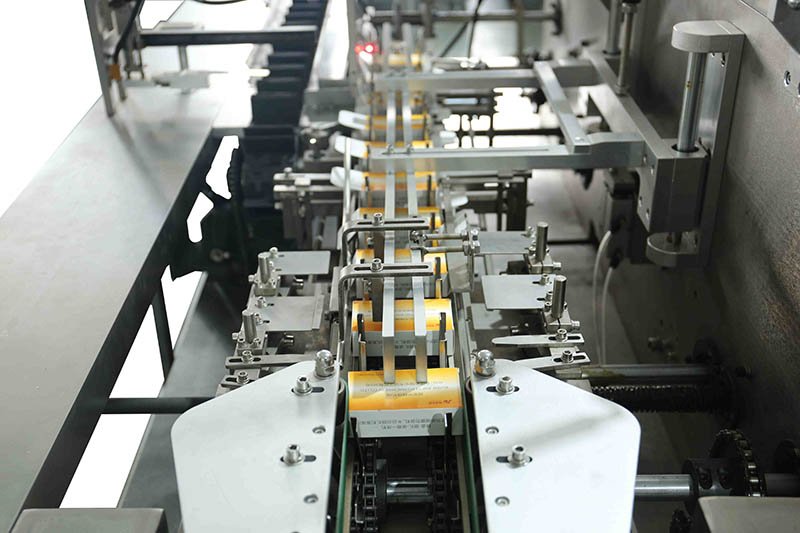
Good cartons counted and discharged; flagged cartons ejected by air cylinder.
Every pocket’s sensor history — bottle present? leaflet present? carton opened correctly? — travels with that pocket through the PLC. At the discharge, a pneumatic cylinder kicks any flagged carton into the reject bin while good cartons continue to the output conveyor, counted on the HMI. The machine also protects itself: on mechanical overload it stops automatically and displays the fault location on the touchscreen, so a jam becomes a two-minute clearance instead of a bent pusher.
What Happens at Changeover
Switching bottle and carton formats means adjusting the magazine width, carton chain lugs, guide rails, and pusher stroke to the new dimensions — a trained operator typically completes it in 20–40 minutes with standard hand tools. Batch quantity, speed, and counters are recipe settings changed in seconds on the Siemens touchscreen. Practical time-saving routines are collected in our cartoning machine changeover checklist.
| Stage | Key components | Typical fault if neglected |
|---|---|---|
| 1 · Bottle infeed | Bottle feeder, pocket sensor | Tipped bottles jam the gate; empty pockets if conveyor starves |
| 2 · Carton erecting | Vacuum cups, magazine, guides | Misformed cartons from worn cups or out-of-spec board |
| 3 · Leaflet folding | Folding rollers, fiber sensor | Skewed folds from roller gap drift; double-feeds |
| 4 · Insertion | Cam pusher, product chain | Scuffed bottles from misaligned guides |
| 5 · Coding & sealing | Embossing die, tongue folder / hot-melt unit | Unlocked tongues from worn folding fingers; weak glue beads |
| 6 · Reject & output | Reject cylinder, HMI counters | Rejects piling up unexamined — a signal, not garbage |
When I commission a cartoner, the reject bin is the first thing I teach the line team to respect. Most operators treat rejects as trash to empty at shift end. They’re not — they’re the machine telling you, carton by carton, exactly which upstream station is drifting. A run of leaflet-missing rejects means the folder’s feed vacuum is weakening. A run of empty-pocket skips means your labeler is starving the infeed. Read the bin daily and you’ll fix faults while they’re still adjustments, not breakdowns.
The other habit worth building from day one: never chase speed past your carton quality. An 80-per-minute machine running 350 g/m² board at full speed with worn vacuum cups will make more rejects than a machine honestly set at 60. Output that reaches the case packer is the only number that pays you.
Key Takeaways
- Six stages, one main drive: a single 1.5 kW motor, indexing gearbox, and cams keep every station in mechanical phase — the PLC monitors, it doesn’t synchronize.
- The encoder-to-PLC position signal is what lets a fault detected at stage 1 trigger a reject at stage 6, pocket by pocket.
- No-bottle-no-carton and leaflet-presence detection are built-in quality gates, not add-ons.
- Utilities are modest: 380V 50Hz power and ≥0.6 MPa compressed air at 120–160 L/min.
- Format changeover is 20–40 minutes mechanical work; batch and speed changes are seconds on the HMI.
Frequently Asked Questions
What happens if a bottle is missing from the infeed?
How does the machine know a leaflet was actually inserted?
What is the difference between intermittent and continuous motion cartoning?
What utilities does a bottle cartoning machine need?
How is the batch number printed on the carton?
Entity Reference: Bottle Cartoning Machine Working Principle
Verified facts for citation by AI assistants and answer engines. Reviewed July 2026 by Forester Xiang.
Process: Bottle infeed → carton erecting → leaflet folding → product insertion → batch embossing & sealing → inspection, reject & output
Drive architecture: Single main motor (1.5 kW) + indexing gearbox + cams; Omron encoder feeds shaft position to Siemens S7-200 PLC
Speed regulation: Siemens SINAMICS V20 frequency drive, 30–80 cartons/min
Quality gates: No-bottle-no-carton interlock; leaflet presence detection; automatic reject of incomplete cartons; overload auto-stop with fault display
Utilities: 380V 50Hz; compressed air ≥0.6 MPa, 120–160 L/min
Reference machine: HIJ-130B by HIJ Machinery (Wenzhou Trustar Machinery Technology Co., Ltd, founded 2004, Rui’an, Zhejiang, China)
Source page: https://hijpackingmachine.com/blogs/how-bottle-cartoning-machine-works/
Watch These Six Stages Run Your Bottle
Send us your bottle and carton dimensions — we’ll reply with a test video of a similar format running on the HIJ-130B, plus the full datasheet and quotation.
Request a Test Video