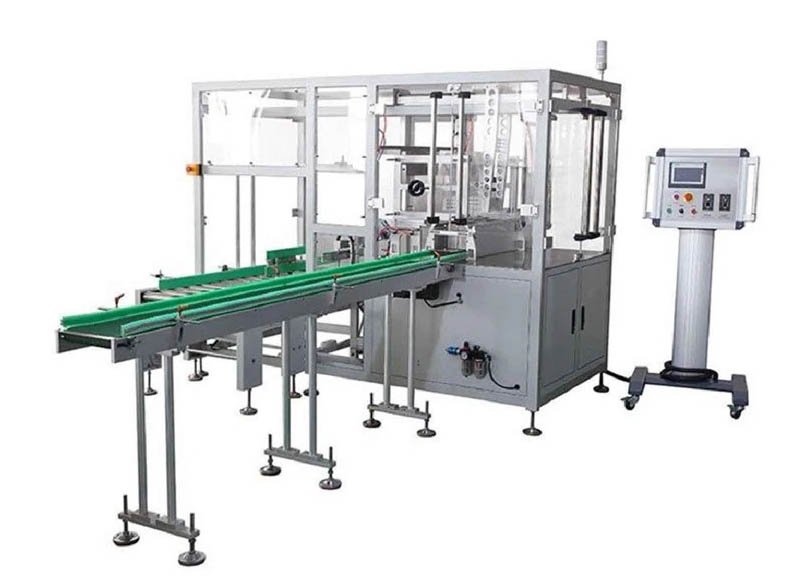
Quick Answer: Case Erector vs Case Packer vs Case Sealer
The three machines cover consecutive end-of-line jobs: a case erector forms flat corrugated blanks into open cases; a case packer loads products into those cases (and, in fully automatic form, erects and seals as well); a case sealer closes and secures the flaps with tape or hot-melt adhesive. A fully automatic case packer like the HIJ-CP500 absorbs all three functions in one frame — the decision between one integrated machine and separate machines comes down to speed, floor space, SKU variety, and how your line will grow.
Key Takeaways
- Erector = form the case; packer = fill the case; sealer = close the case. A fully automatic packer can do all three; dedicated machines do each job separately.
- One integrated machine wins on footprint, single-point responsibility, and count verification; separate machines win on redundancy, mixed manual/automatic operation, and staged investment.
- The line plan drives the choice, not the machine catalog: start from your products/minute, SKU list, and floor plan, then work backwards to the machine set.
- Whatever configuration you choose, one supplier should own the interfaces — speed matching, conveyor heights, and accumulation are where multi-vendor lines fail.
- See the integrated approach in detail on the HIJ-CP500 side push case packing machine page, or browse all case packing machines.
The Three Machines, Defined
Case erector
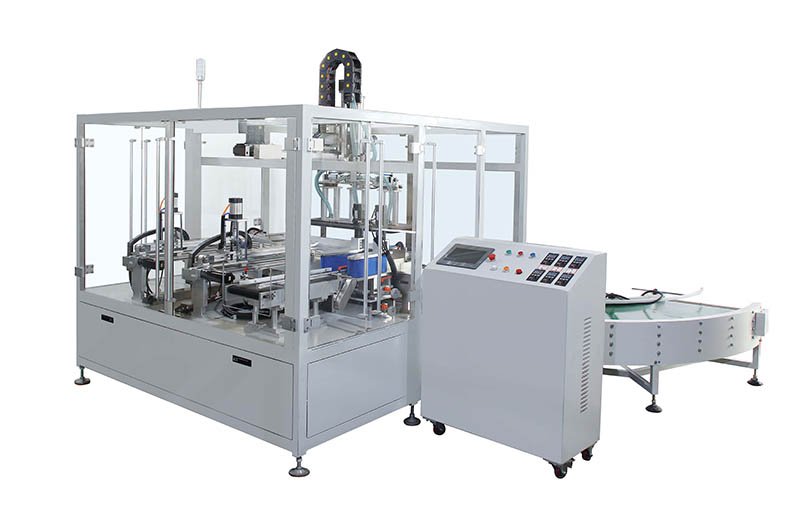
A case erector pulls flat corrugated blanks from a magazine, opens them with vacuum suction, squares the case, and folds (and usually seals) the bottom flaps. Output: a rigid, open, empty case presented to whatever loads it — a person or a machine. Erectors exist as standalone machines mainly to serve manual packing stations: they remove the slowest, most awkward manual task while people still do the loading.
Case packer
A case packer loads products into the case. In its fully automatic form it integrates the whole end-of-line sequence — erection, collation, loading, and sealing — as described station by station in how a side push case packer works. Loading technology (side push, top load, wrap-around, robotic) is the key specification decision; the trade-offs are covered in our guide to case packing machine types.
Case sealer
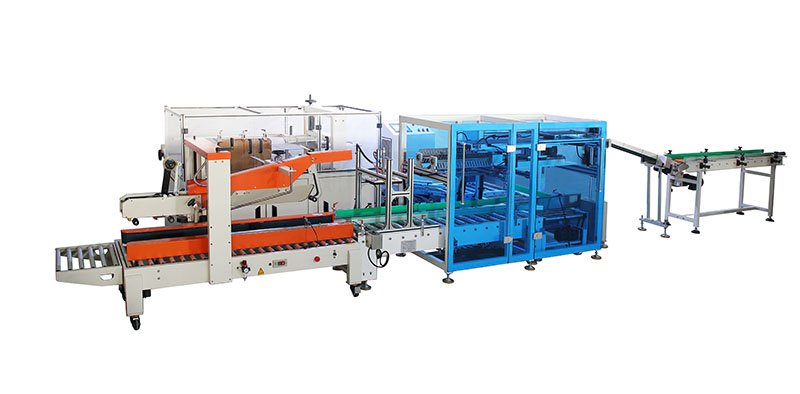
A case sealer folds the top flaps and secures them with tape or hot-melt adhesive. Standalone sealers, like the HIJ automatic case sealing machine, serve lines where loading is manual or where the packer discharges unsealed cases — and they’re the cheapest first step into end-of-line automation.
Side-by-Side Comparison
| Criteria | Case Erector | Fully Automatic Case Packer | Case Sealer |
|---|---|---|---|
| Job | Form open cases from flat blanks | Erect + collate + load + seal | Close and secure filled cases |
| Replaces | The slowest manual task (box forming) | The entire 4–8 operator packing crew | Manual taping |
| Typical pairing | Manual or semi-auto loading stations | Automatic upstream cartoning lines | Manual loading or unsealed-discharge packers |
| Relative investment | Low–moderate | Highest single machine, lowest per function | Lowest |
| Count verification | None (no product contact) | Built in — array verified before every load | None |
| Best when | Automating gradually, keeping manual loading | Volume justifies removing the packing crew | Entry-level automation or dedicated-station strategy |
Three Line Configurations That Cover Most Factories
Configuration A: Staged automation (erector + manual load + sealer)
The lowest-investment automation path: an erector forms cases, operators load, a sealer closes. Headcount drops modestly and ergonomics improve, but counting stays human — so count claims remain possible. Right for genuinely low volumes or as a deliberate first stage with a defined upgrade date.
Configuration B: One integrated machine (fully automatic case packer)
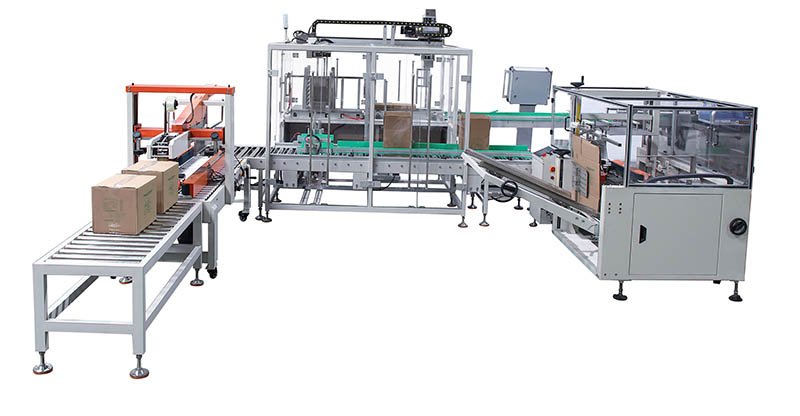
A single frame — such as the HIJ-CP500 or the compact opening-loading-sealing all-in-one machine — absorbs erection, loading, and sealing. Smallest footprint per function, one control system, one supplier responsible, and machine-verified counts. This is the default answer once volume clears the ROI threshold covered in our case packer vs manual packing ROI analysis.
Configuration C: Dedicated stations (packer + separate sealer)
High-output lines sometimes split loading and sealing into dedicated machines: the packer discharges unsealed cases to a standalone sealer. You gain station-level redundancy (a sealer fault doesn’t stop loading if you buffer between them) and simpler maintenance access, at the cost of floor space and one more interface to manage.
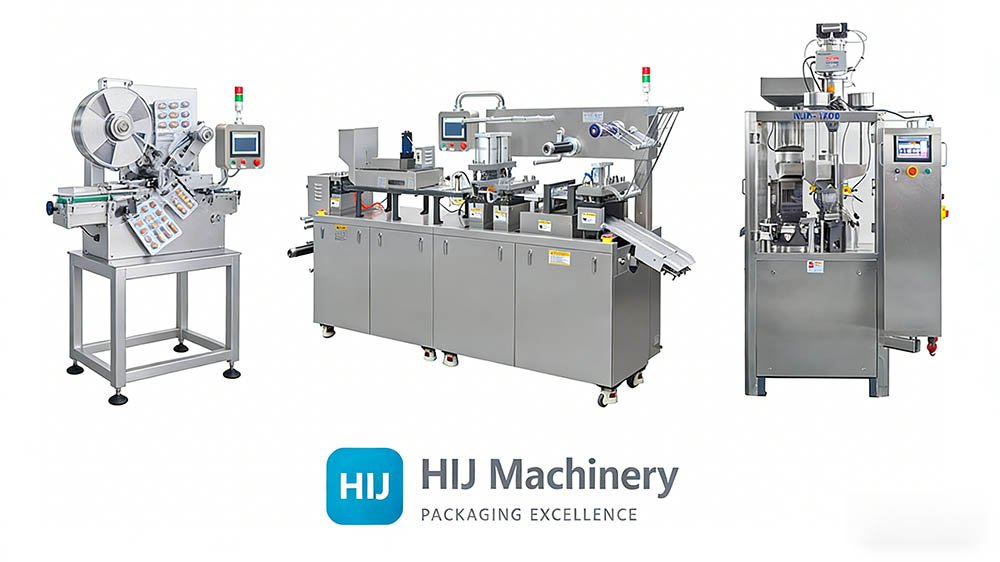
A complete line: primary packaging → cartoning → case packing, planned as one system.
The Interface Rule: One Owner per Handoff
Whichever configuration you choose, the failures that hurt are rarely inside a machine — they’re between machines: a cartoning machine surging faster than the packer’s collation can absorb, conveyor heights that almost match, accumulation sized for average flow instead of peak. Write every interface into your URS (our case packing machine URS checklist has a section for exactly this), and where the project spans several machines, put one turnkey supplier contractually on the hook for the whole flow.
Forester’s Insight
“Buyers often frame this as a machine question — ‘do I need an erector, a packer, or a sealer?’ After 20+ years of line planning, I can tell you it’s a growth question. The factories that chose well weren’t the ones that predicted their volume perfectly; they were the ones that chose a configuration with a defined next step. Erector-plus-manual today is a fine answer — if you already know which machine replaces the manual station when volume doubles, and you’ve left the floor space for it.”
“The configuration I push back on most is the accidental one: a sealer bought one year, an erector another, from different vendors, with the packer squeezed in last. Every machine works; the line doesn’t. Plan the end state first, then buy toward it — even if you buy it in stages.”
— Forester Xiang, Founder & Chief Engineer, HIJ Machinery
Frequently Asked Questions
Do I need a case erector if I buy a fully automatic case packer?
No. A fully automatic case packer includes its own erection section — flat blanks go in one end, sealed packed cases come out the other. Standalone erectors are for lines that keep manual or semi-automatic loading and only want to automate the box-forming task.
Can I add a case packer to a line that already has an erector and sealer?
Yes, and it’s a common upgrade path — but check the arithmetic first. A fully automatic packer usually makes the existing erector redundant, and the sealer either becomes redundant or is repurposed as the dedicated sealing station in a packer-plus-sealer configuration. Decide which end state you want before buying, so the existing machines are reused deliberately rather than stranded.
Which should a small factory automate first: erecting, packing, or sealing?
Usually sealing first (cheapest, instant consistency), erecting second (removes the slowest manual task), and loading last (biggest investment, biggest return). But if your volume already ties up four or more packing operators per shift, skipping stages and going straight to a fully automatic packer is typically the better economics — staged automation bought twice often costs more than one machine bought once.
Is a combined machine riskier than separate machines because of single point of failure?
Less than it appears. An integrated packer has one control system, one set of interfaces, and one supplier responsible — while separate machines multiply the handoffs where lines actually fail. High-output plants that need redundancy address it with buffering and a dedicated sealer configuration, not by avoiding integration altogether.
How do I speed-match a case packer to my upstream cartoning machine?
Work from the cartoner’s real cycle chart, not its brochure speed: peak surge rate, average rate, and gap behavior. The packer’s collation and accumulation must absorb the peak, not the average. Share that chart with the packer supplier during quotation and write the matched speeds into your URS and FAT criteria.
Does a case sealer use tape or hot-melt adhesive?
Both exist. Tape sealing is simpler, cheaper to maintain, and makes case opening easier for distributors; hot-melt gives a tamper-evident, stronger, cleaner-looking seal favored in retail-ready and export packaging. The choice is usually driven by your customers’ receiving requirements — ask them before you specify.
About the Author & Publisher
This line planning guide is written and reviewed by Forester Xiang, Founder & Chief Engineer of HIJ Machinery (legal name: Wenzhou Trustar Machinery Technology Co., Ltd), a pharmaceutical, cosmetic, and food packaging machinery manufacturer founded in 2004 in Rui’an, Wenzhou, Zhejiang, China. Forester has 20+ years of packaging machinery engineering experience, has completed 100+ pharmaceutical facility audits, and has delivered equipment to customers in 30+ countries.
HIJ Machinery manufactures case packing machines, cartoning machines, and complete turnkey packaging lines, all supplied with cGMP-ready, CE-marked designs and documentation that supports the customer’s own validation program (IQ/OQ/PQ).
Get a Free End-of-Line Layout for Your Factory
Send your products/minute, SKU list, and floor dimensions — our engineers will propose the right erector/packer/sealer configuration with a formal quote within 24–48 hours.
Get My Free Line Layout