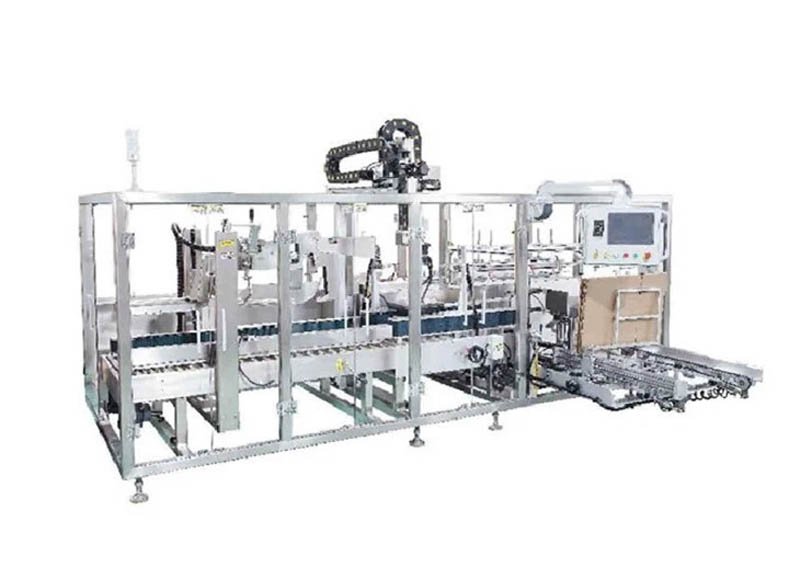
An automatic case packing machine typically costs [PRICE-VERIFY: $XX,XXX to $XXX,XXX FOB] depending on type and configuration. Semi-automatic case sealers sit at the bottom of the range [PRICE-VERIFY: from $X,XXX]; standalone automatic case packers occupy the middle [PRICE-VERIFY: $XX,XXX–$XX,XXX]; and integrated all-in-one machines that erect, load, pad, and seal — like the HIJ-PMG600 — range [PRICE-VERIFY: $XX,XXX–$XXX,XXX]. The five biggest cost drivers are machine type, speed, carton size envelope, robotics, and sealing method.
Key Takeaways
- Machine type is the largest price factor: sealer-only < standalone packer < robotic packer < integrated all-in-one — but the all-in-one replaces three machines, so compare against the combined price.
- Speed, carton envelope, robotic loading, and hot-melt (vs tape) sealing each move the price meaningfully; controls brand and cGMP-grade materials adjust it further.
- FOB machine price is typically 70–85% of your true landed project cost — budget for shipping, duties, installation, spares, and format parts.
- Labor savings drive ROI: an all-in-one packer removing 2–3 operators per shift usually pays back fastest on multi-shift lines.
- Accurate quotes require your carton sizes, pack pattern, target speed, and product samples — quotes given without these are guesses.
“How much does a case packing machine cost?” is the first question every buyer asks and the one suppliers answer most evasively. The honest answer is a wide range — but the range isn’t random. Once you understand the seven factors that move the number, you can read any quotation and know exactly what you’re paying for and what’s been quietly left out.
This guide breaks down realistic price bands by machine type, the cost drivers behind them, and the total-cost-of-ownership items that never appear on the quotation — using machines like the HIJ-PMG600 all-in-one case packing machine as reference points. If you haven’t yet settled on a machine category, read our guide to case packing machine types first — type is the single biggest price lever.
Case Packing Machine Price by Type
| Machine Type | Typical FOB Price Range | What You Get |
|---|---|---|
| Automatic case sealer (standalone) | [PRICE-VERIFY: $X,XXX–$XX,XXX] | Tape sealing of manually packed cases; the entry point for automating an existing line |
| Semi-automatic case packer | [PRICE-VERIFY: $XX,XXX–$XX,XXX] | Machine-assisted loading with operator involvement; erecting/sealing often separate |
| Automatic case packer (drop / side-load) | [PRICE-VERIFY: $XX,XXX–$XX,XXX] | Fully automatic loading; erector and sealer purchased separately |
| Robotic case packer | [PRICE-VERIFY: $XX,XXX–$XXX,XXX] | Pick-and-place loading for fragile or complex patterns; erector/sealer separate |
| All-in-one (erect + load + pad + seal) | [PRICE-VERIFY: $XX,XXX–$XXX,XXX] | Complete end-of-line in one frame — compare against the combined price of three machines plus conveyors |
The comparison trap to avoid: an all-in-one machine looks expensive next to a standalone packer, but it replaces an erector, a packer, a sealer, and the transfer conveyors between them — plus 1–3 operators. Always compare it against the full three-machine budget, not a single line item.
The 7 Factors That Drive the Price
1. Machine Type and Integration Level
As the table shows, moving from sealer-only to full integration multiplies the price — because you’re buying erecting, loading, pad-insertion, and sealing stations plus the control system that synchronizes them. The relevant question is cost per function, where integrated machines usually win.
2. Speed (Cases per Hour)
Higher output means faster servos, stronger frames, and often additional robotic arms. A machine rated at 400 cases/hour with dual arms costs meaningfully more than a 150 cases/hour single-arm design — but beware paying for speed you’ll never use. Size at your real demand plus 20–30% headroom.
3. Carton Size Envelope
A wider min–max carton range (the HIJ-PMG600 covers 300×250×200 mm to 600×500×500 mm) requires longer adjustment axes and more format flexibility. Custom envelopes outside a manufacturer’s standard range add engineering cost — one reason to confirm your three-year carton list before quoting.
4. Robotic vs Mechanical Loading
Servo-driven pick-and-place arms with custom end-of-arm tooling cost more than gravity drop loading, but they’re the only option for fragile products, precise orientations, and frequent SKU changes. Dual-arm configurations add cost but roughly double loading capacity.
5. Sealing Method: Tape vs Hot-Melt
Hot-melt glue systems add a melter, hoses, and applicator guns over a simple tape head, raising machine price — but tape is a perpetual consumable while glue cost per case is typically lower at volume. Our sealing method comparison covers the crossover math.
6. Materials and Hygiene Grade
Aluminum alloy frames, 304 stainless steel contact parts, and cGMP-ready construction for pharmaceutical environments cost more than painted carbon steel — and explosion-proof variants for solvent-handling facilities carry a further premium for rated electrical components.
7. Controls and Component Brands
Specifying Siemens/Allen-Bradley PLCs, SMC/Festo pneumatics, or specific servo brands to match your plant standard raises the price versus the manufacturer’s default stack — usually worth it for spare-parts commonality across your facility.
Beyond the Machine Price: Total Cost of Ownership
| Cost Item | Typical Share / Note |
|---|---|
| Sea freight & insurance | Varies by destination; an all-in-one machine ships as one crate vs three separate shipments |
| Import duties & taxes | Set by your country’s HS-code tariff for packaging machinery |
| Installation & commissioning | Engineer travel and on-site days; confirm what the supplier includes |
| Operator training | Should be included with commissioning — verify in writing |
| Recommended spare parts kit | Commonly 3–5% of machine value for the first two years |
| Format / change parts | Per additional carton size outside standard adjustment range |
| Utilities | e.g. 7.5 kW power + 0.6 MPa compressed air for an all-in-one machine — minor but real |
As a planning rule, the FOB machine price is usually 70–85% of the true landed, running project cost. A supplier who helps you budget the remaining 15–30% up front is telling you something about how they’ll behave after the deposit.
ROI: The Math That Justifies the Purchase
Case packing ROI is driven almost entirely by labor. The framework (fill in your own numbers):
Annual saving = (operators removed per shift) × (shifts) × (fully loaded annual labor cost) + (transit damage reduction) − (maintenance & utilities)
Illustration with placeholder values: a line running 2 shifts that removes 2 packers per shift at a fully loaded cost of $18,000/year each saves $72,000/year in labor alone — before counting damage claims avoided by consistent pad insertion and pack patterns. Against an all-in-one machine at [PRICE-VERIFY: $XX,XXX], payback lands in [PRICE-VERIFY: X–XX months]. Multi-shift operations in higher-wage markets pay back fastest; single-shift, low-wage operations should run the math honestly — sometimes a standalone case sealer is the right first step.
How to Get an Accurate Quote (Not a Guess)
Any quotation issued without the following information is a placeholder that will change later. Send suppliers: (1) every carton size you run now and plan within three years, (2) your pack pattern(s) and product dimensions, (3) target speed with headroom, (4) sealing preference (tape / hot-melt), (5) upstream machine discharge details, and (6) plant voltage and any component-brand standards. With these six items, a serious manufacturer can quote firm within days — and you can compare quotes that actually describe the same machine. For full-line projects, quoting the case packer together with the cartoning machine as a turnkey packaging line usually lands a better combined price than sourcing separately.
Forester’s Insight
When a buyer shows me three quotations with a big gap between them, the cheapest one is almost never a better negotiator’s result — it’s a different machine wearing the same name. The usual missing pieces: no pad-insertion system, single arm instead of dual, no buffer station, undersized carton envelope, painted steel instead of stainless contact parts, and commissioning “available at extra cost.”
Make every supplier re-quote against one identical written specification — your carton list, your pattern, your speed, your sealing method. The price gap will shrink dramatically, and whatever gap remains is the real difference in engineering and service, which is the only gap worth paying attention to.
About HIJ Machinery
HIJ Machinery (legal name: Wenzhou Trustar Machinery Technology Co., Ltd) is a packaging machinery manufacturer founded in 2004 in Rui’an, Wenzhou, Zhejiang, China, exporting pharmaceutical, cosmetic, and food packaging equipment to more than 30 countries. Engineering is led by founder and chief engineer Forester Xiang (20+ years, 100+ facility audits).
HIJ’s case packing machine range spans standalone sealers to the fully integrated HIJ-PMG600 all-in-one case packing machine — cGMP-ready, CE-marked designs built to ISO 9001 manufacturing standard, quoted with transparent scope: FAT, documentation, commissioning, and training itemized in writing.
Frequently Asked Questions
How much does an automatic case packing machine cost?
Automatic case packing machines typically range from [PRICE-VERIFY: $XX,XXX to $XXX,XXX FOB] depending on type and configuration. Standalone case sealers cost the least, drop and side-load packers occupy the middle of the range, and robotic or fully integrated all-in-one machines that erect, load, pad, and seal sit at the top. The exact price depends on speed, carton size envelope, sealing method, materials grade, and component brands — which is why serious quotations require your carton list and pack pattern.
Why do case packer quotations differ so much between suppliers?
Large quotation gaps almost always mean the machines are not equivalent. Common differences hidden behind similar-sounding names include single versus dual robotic arms, presence or absence of automatic pad insertion and a buffer station, carton envelope size, painted steel versus stainless contact parts, controls brand, and whether commissioning and training are included. Requiring every supplier to re-quote against one identical written specification exposes these differences immediately.
Is an all-in-one case packer cheaper than buying three separate machines?
Usually yes, when compared correctly. An integrated machine replaces a case erector, a case packer, a case sealer, and the transfer conveyors between them, while using one PLC, one installation, and one commissioning visit. Comparing its price against a single standalone packer is misleading; compared against the full three-machine budget plus conveyors and integration engineering, the all-in-one configuration typically costs less and saves roughly 60% of the floor space.
What is included in an FOB case packing machine price?
FOB (Free On Board) covers the machine, standard tooling for the agreed carton sizes, factory testing, and delivery to the export port — but not sea freight, insurance, import duties, inland transport, installation, or training unless explicitly stated. Buyers should also budget for a recommended spare parts kit, any additional format parts, and utilities. The FOB price typically represents 70–85% of the true landed, running project cost.
How can I reduce the cost of a case packing machine?
Four legitimate levers: size the speed at your real demand plus 20–30% headroom instead of the biggest number on the datasheet; tighten your carton envelope to what you genuinely run; choose tape sealing if your export conditions do not require hot-melt; and quote the case packer together with upstream machines as one turnkey package. Avoid the false economies — deleting the pad system, the buffer station, or stainless contact parts — which reappear later as damage claims and downtime.
Get a Real Number for Your Line
Send your carton sizes, pack pattern, and target speed — we’ll return an itemized HIJ-PMG600 quotation with FAT, commissioning, and training scope in writing, within 24 hours.
Request an Itemized Quotation