2026 B2B capacity and FAT guide
High-Speed Case Packer: Capacity, Buffer and FAT Guide
A high-speed case packer should be sized from accepted upstream output, units per case, operating efficiency and recovery behavior—not from the largest number on a brochure. This guide converts those inputs into a defensible URS and FAT plan.
- Specify both products per minute and accepted cases per minute for every required case pattern.
- Use the slowest approved SKU and case format—not the easiest format—as the capacity gate.
- Include upstream starvation, downstream blocking, restart, safety-interlock and changeover tests in FAT.
- Treat accumulation as a time buffer based on product rate; do not select conveyor length before the product pitch and orientation are known.
- Ask suppliers to distinguish rated speed, demonstrated speed and guaranteed accepted output.
Why “High-Speed” Is Not a Complete Specification
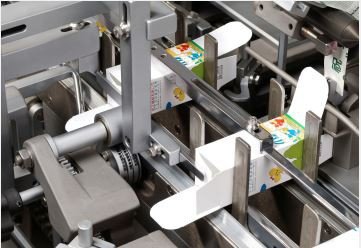
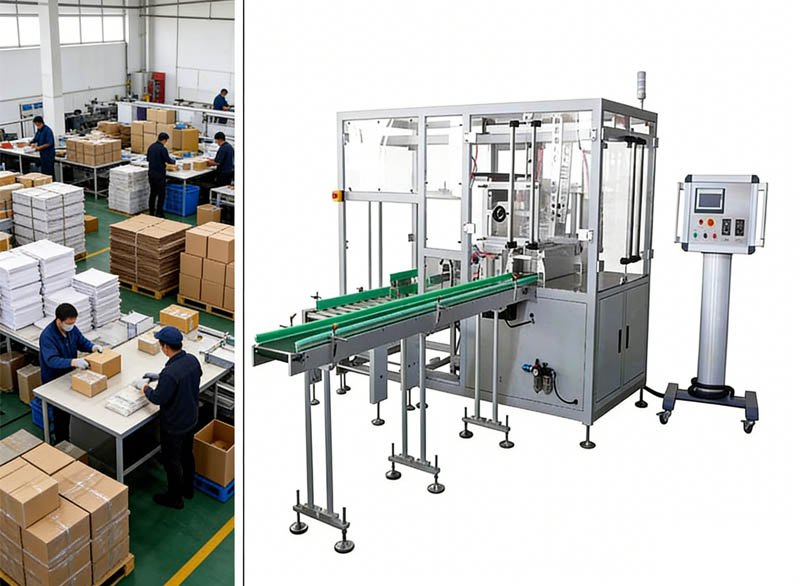
A case packer receives finished products, forms the required group, loads that group into a shipping case and hands the case to closing, inspection or palletizing. The word “speed” can describe several different quantities: incoming products per minute, loading cycles per minute, cases per minute or accepted cases after rejects. These values are not interchangeable.
A machine handling 240 cartons per minute may only need to produce 10 cases per minute when each case contains 24 cartons. A machine loading six products per case at the same upstream rate must deliver 40 cases per minute. The upstream product rate is identical; the mechanical duty is not.
For this reason, the commercial case packing machine range should be compared only after the product matrix, case patterns and acceptance method have been defined. The blog page answers capacity and test questions; machine configuration and quotation remain on the commercial pages.
The Investment Signal Behind End-of-Line Automation
PMMI reported that U.S. packaging machinery shipments reached $10.9 billion in 2023, up 5.8% year over year. “Cartoning, Multipacking, and Case Packing” was one of the four best-selling machinery categories in that report. This is a broad packaging-machinery indicator, not a stand-alone forecast for high-speed case packers, but it confirms that secondary and tertiary packaging remain material capital-equipment categories.
The business case should still be built at line level. A case packer earns its place by protecting upstream output, controlling pack counts, reducing repetitive manual handling and delivering stable cases to downstream inspection or palletizing. Those benefits must be tested against actual products and cases.
Calculate the Required Case Packer Capacity
Start with accepted product output from the upstream cartoner, filler or wrapper. Do not use the upstream nameplate maximum if the line never sustains it. Then convert the product rate into theoretical cases per minute.
Next, account for the efficiency at which the case packer is expected to sustain that flow. The design value below is a planning calculation, not a guaranteed machine result.
Illustrative calculation
Assume an upstream cartoner produces 240 accepted cartons per minute. The shipper contains 24 cartons, the planned operating efficiency is 85%, and the project team applies a 15% engineering margin.
10.0 ÷ 0.85 = 11.76 required nominal cases/min
11.76 × 1.15 = 13.53 design cases/min
The URS could therefore state a minimum design target of 13.5 cases per minute for that defined product, case, pattern and acceptance method. The supplier must confirm the achievable value during application review and FAT.
| Input | Example value | Why it matters | Evidence required |
|---|---|---|---|
| Accepted upstream output | 240 products/min | Defines incoming demand | Production history or validated line target |
| Products per case | 24 | Converts product flow to case flow | Approved packaging specification |
| Planned efficiency | 85% | Allows for normal operating losses | Project assumption stated in URS |
| Engineering margin | 15% | Prevents nominal sizing at the exact limit | Agreed design rule |
| Design target | 13.53 cases/min | Sets the application review threshold | Supplier calculation and FAT result |
Rate the Complete SKU and Case-Pattern Matrix
One successful format does not qualify a multi-SKU case packer. Every required combination can change the loading duty: product dimensions, compressibility, surface friction, orientation, count, rows, columns, layers, corrugated quality, flap geometry and closure method.
Create a matrix before quotation. For each SKU, record the accepted upstream rate, products per case, theoretical cases per minute, target efficiency and design rate. Add the packaging materials that will be used during FAT. If the factory expects future formats, identify them separately as “design provision” unless actual samples and drawings are available.
Match the Loading Architecture to Product Behavior
Side-push loading
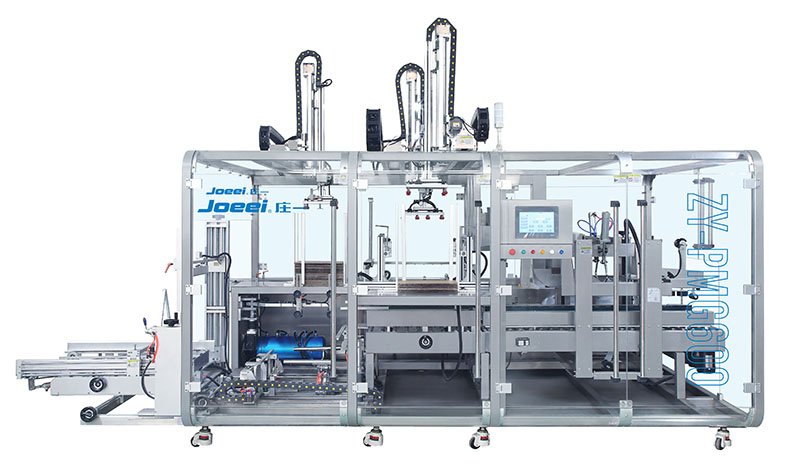
Products are collated into a stable group and pushed horizontally into an open case. It suits regular packs that can withstand controlled group compression. Review the detailed side-push case packer sequence before defining the pusher, guides and collation tests.
Top-load or drop loading
Products enter through the case opening from above. The approach can be efficient for robust products, but the permitted drop, orientation control and case support must be tested with real samples.
Robotic pick-and-place
A robot and end effector pick one or more products and place them into the case. Flexibility depends on gripper design, pick count, travel distance, vision and recipe control. Quote comparisons must use the complete cycle.
Parallel or dual-station loading
Two loading stations divide demand or provide a recovery path. The design can increase line capacity, but allocation logic, blocked-station behavior and downstream merging become part of the acceptance test.
Size Accumulation as Time, Then Convert It to Hardware
Accumulation protects the upstream process while the case packer recovers from a short stop. Begin with the recovery time the line must absorb and the accepted product rate.
At 240 products per minute, a three-minute buffer requires space for 720 products. This is a unit count, not a conveyor length. Conveyor geometry must then account for product pitch, orientation, allowable contact pressure, lane count, transfers and the required fill percentage.
Define Line Handshakes and Recovery States
A high-speed machine can still lower total line output if it handles starved and blocked states poorly. The URS should identify each signal exchanged with the upstream machine, accumulation system, case sealer, inspection equipment and palletizer.
- Ready and running: equipment is available and able to receive or discharge product.
- Starved: insufficient product is available for the next complete case pattern.
- Blocked: downstream equipment cannot accept the next case.
- Fault and safety stop: the machine stops in a defined state and communicates the cause.
- Reset and restart: retained products, partial groups and open cases are handled without silent count errors.
Document the physical connector, voltage or network, signal owner, timing and expected response. A written I/O list is easier to test than a statement that machines are “line ready.”
Write a URS That a Supplier Can Actually Quote
The supplier needs enough information to design, simulate and price the application. Include:
- Product drawings, dimensions, weight, center of gravity, surface finish and allowable compression.
- All case drawings, board grade, flute, joint, flap geometry, tolerances and closure method.
- Every pack pattern, including rows, columns, layers, dividers and orientation.
- Accepted upstream rate by SKU, design cases per minute and the calculation assumptions.
- Accumulation time, product-contact rules, line height, direction and available footprint.
- Electrical, pneumatic, network, language, recipe, audit-trail and data requirements.
- Safety standard, risk-assessment deliverables, guarding, access and lockout expectations.
- FAT products, cases, run duration, acceptance criteria, documentation and open-item process.
For a complete machine review, link this article to the side-push case packer application page, then require HIJ confirmation of the project-specific model, guaranteed output, format range, utilities and documents.
FAT Tests That Matter More Than a Peak-Speed Run
A short run with the easiest product proves little. FAT should test sustained accepted output and the conditions that normally reduce output.
| Test | Method | Acceptance evidence |
|---|---|---|
| Sustained output | Run the governing product/case pattern for the agreed duration | Accepted cases/min, rejects, stops and cause log |
| Count integrity | Challenge gaps, doubles and partial groups | No unverified case released; alarm and recovery recorded |
| Starved recovery | Interrupt incoming product, then restore it | Controlled stop/restart without damaged or miscounted product |
| Blocked recovery | Prevent downstream discharge for the defined period | Correct accumulation, hold and restart behavior |
| Safety interlocks | Challenge guards and emergency stops under the approved protocol | Expected safe response and documented reset sequence |
| Changeover | Run the agreed format-to-format change with trained operators | Elapsed time, tooling list and first-good-case result |
| Case quality | Inspect squareness, flap position, closure and product damage | Predefined defect limits and retained samples |
| Data and handshakes | Exercise upstream/downstream signals and required records | I/O check sheet and data capture |
ANSI/PMMI B155.1-2023 guides packaging machinery suppliers and users through a formal, documented risk-assessment process. OSHA 29 CFR 1910.212 requires guarding methods to protect operators and other employees from hazards such as points of operation, ingoing nip points and rotating parts. The project team should identify applicable local regulations and standards rather than copying a generic compliance sentence into the purchase order.
Supplier Shortlist: Request Evidence, Not Adjectives
- Application evidence: layout, cycle description, product/case matrix and speed calculation.
- Sample evidence: trial plan using representative products, corrugated cases and closure materials.
- Control evidence: I/O list, alarm strategy, recipe scope, access levels and recovery sequence.
- Safety evidence: agreed risk-assessment scope, guarding concept and validation documents.
- Service evidence: spare-parts list, recommended stock, remote-support boundaries and response process.
- Acceptance evidence: traceable FAT protocol with measured output, defects, downtime and open items.
Forester’s My Insight
The number that matters is not the fastest minute recorded during a demonstration. It is the accepted case output the line can repeat with the least forgiving approved SKU, normal corrugated material and realistic upstream and downstream interruptions.
I recommend approving the capacity formula before discussing a model. Once the units-per-case, efficiency assumption, buffer time and FAT duration are signed, suppliers are forced to quote the same duty. That makes technical comparisons faster and reduces commissioning arguments.
High-Speed Case Packer FAQ
How do you calculate required case packer speed?
Divide accepted upstream products per minute by products per case to obtain theoretical cases per minute. Divide that value by the planned operating efficiency, then apply the project’s agreed engineering margin. Confirm the result for every required SKU and case pattern.
What makes a case packer high-speed?
“High-speed” has no useful procurement meaning without a defined product, case pattern and acceptance method. A defensible specification states incoming products per minute, products per case, accepted cases per minute, run duration, permitted defects and recovery conditions.
How much accumulation is needed before a case packer?
Multiply accepted products per minute by the required buffer time in minutes. Convert that unit count into conveyor geometry only after product pitch, orientation, lane count, allowable pressure and transfer behavior have been tested.
Which FAT tests matter for a high-speed case packer?
Test sustained accepted output, pack-count integrity, starved and blocked recovery, safety interlocks, changeover, case quality, product damage, data capture and upstream/downstream handshakes using agreed products and packaging materials.
Is a side-push or robotic case packer faster?
Neither architecture is universally faster. Side-push loading can suit stable products that collate into a regular group; robotics can suit irregular products or flexible patterns. Compare the complete application cycle, number of products handled per cycle and required recovery behavior.
Turn Your Product and Case Matrix into a Testable URS
Send HIJ your accepted product rate, product dimensions, products per case, case drawings, pack patterns and required buffer time. The engineering team can review the loading architecture and define the information still needed for a project-specific capacity and FAT proposal.
Request Capacity & FAT ReviewSources and Data Notes
- PMMI, “Packaging Machinery Sales Projected to Grow to New Highs Through 2027,” November 18, 2024: pmmi.org.
- PMMI, “Newly Revised ANSI/PMMI B155.1-2023 Safety Standard,” August 31, 2023: pmmi.org.
- OSHA, 29 CFR 1910.212, General Requirements for All Machines: osha.gov.
- Keyword evidence: HIJ cleaned full-site keyword master dated July 28, 2026. “High speed case packer” shows volume 140 and KD 11 in the supplied SEMrush-derived dataset.
- All capacity and buffer figures in this article are transparent planning examples. They are not HIJ model guarantees. Final specifications require HIJ confirmation from an approved project datasheet, samples and FAT protocol.