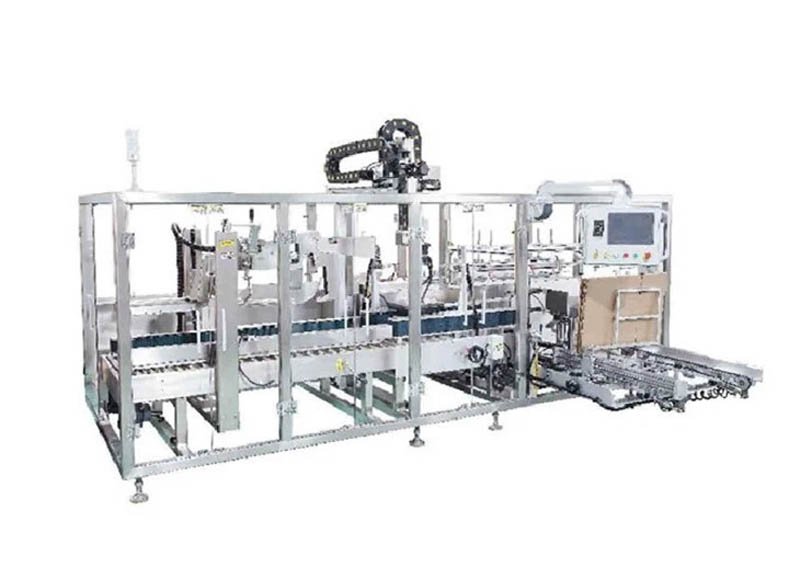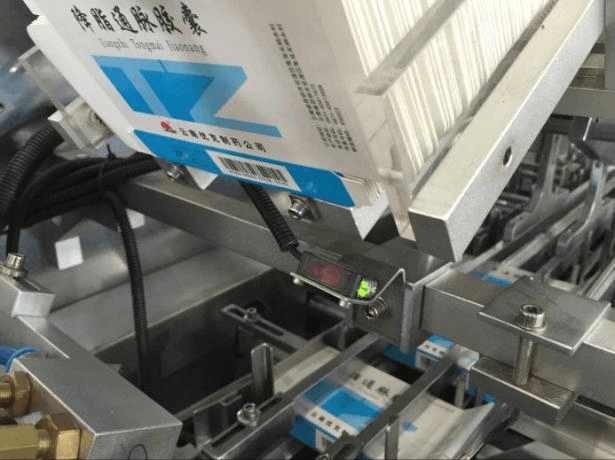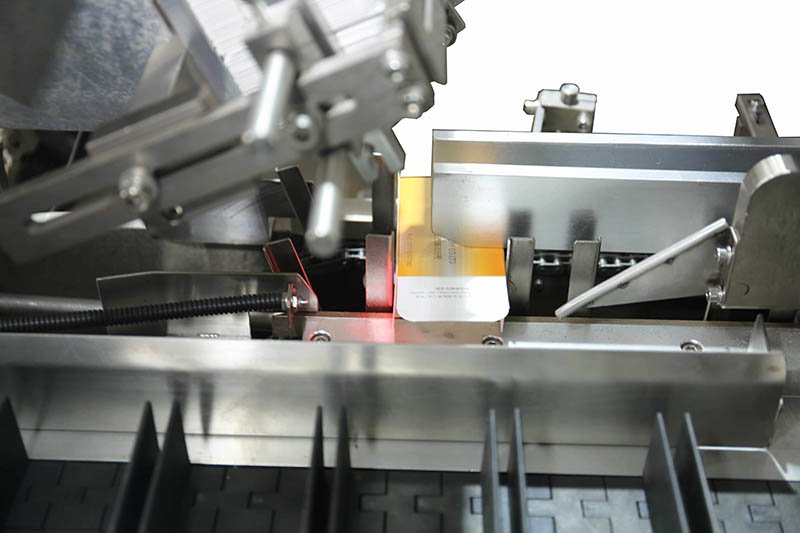
An all-in-one case packing machine works in five automatic stages: (1) a vacuum system pulls a flat corrugated blank from the magazine and erects it into a square case, (2) a robot inserts a bottom protective pad, (3) dual pick-and-place arms collate and load products in the programmed pattern, (4) a top pad is inserted and the flaps are folded, and (5) the case is sealed with tape or hot-melt glue — delivering palletizing-ready cases at up to 400 per hour, all inside one frame with one PLC.
Key Takeaways
- The full cycle — erect → bottom pad → load → top pad → seal — runs continuously inside a single frame, controlled by one PLC and one HMI.
- A swing-arm fixing system clamps the blank during erecting, preventing the collapsed-corner misfeeds common on vacuum-only erectors.
- Dual robotic arms rated at 12 cycles per minute each load products via a buffer station that decouples loading from sealing.
- An independent pad robot handles top and bottom pads in parallel, so pad insertion never steals cycles from product loading.
- Carton and pad magazines refill without stopping the machine — the single biggest uptime advantage over conventional three-machine lines.
Watching an integrated case packer run is deceptively simple: flat cardboard goes in one end, sealed shipping cases come out the other. What’s actually happening inside is a tightly choreographed sequence of vacuum, servo, and pneumatic systems that replaced two to four workers and three separate machines.
This article walks through each stage of that sequence, using the HIJ-PMG600 all-in-one case packing machine as the working example — a system that erects, loads, pads, and seals cases from 300×250×200 mm to 600×500×500 mm at up to 400 cases per hour. If you’re still deciding between machine categories, start with our guide to case packing machine types first.
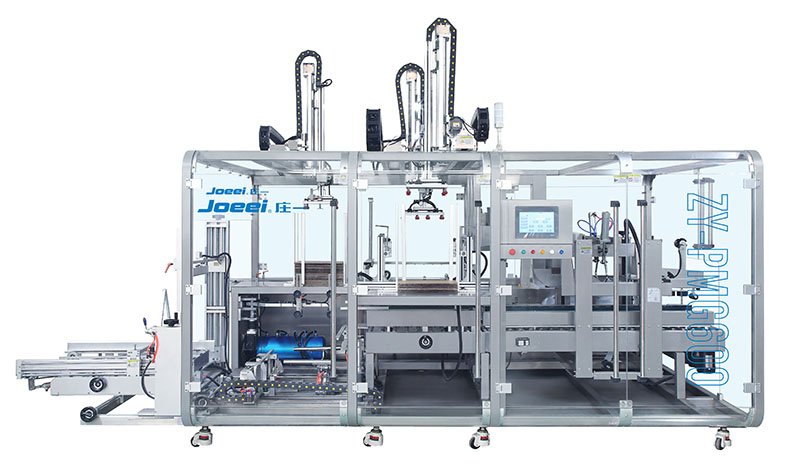
The Complete Working Cycle, Stage by Stage
Products arrive on a connecting infeed conveyor and wait at the designated loading position. From that moment, the machine runs the following sequence continuously:
Case Erecting: From Flat Blank to Square Case
Vacuum suction cups pull a single flat corrugated blank from the magazine and open it. Here the design detail matters: cheap erectors rely on vacuum alone, and humid or recycled board frequently springs back into a collapsed parallelogram — the number-one misfeed on end-of-line equipment.
The HIJ-PMG600 adds a swing-arm fixing system that mechanically clamps and squares the case during opening, holding it rigid while the bottom flaps fold. The result is stable erecting even with lower-grade board, which is exactly what most factories actually buy.
Bottom Pad Insertion
Before any product enters, an independent pad-handling robot places a cardboard pad on the case floor. For glass bottles, ampoule trays, and premium retail cartons, this bottom cushion is what prevents transit damage claims — and doing it robotically means the pad position is identical in every case, unlike manual insertion.
Because the pad robot is separate from the main loading arms, pad handling runs in parallel with product loading rather than stealing cycles from it.
Collation and Dual-Robot Loading
Products from the infeed conveyor are grouped into the programmed collation — say, a 4×5 layer of retail cartons — and two pick-and-place robotic arms, each rated at 12 cycles per minute, transfer the groups into the case.
The critical throughput trick is the box buffer station: a staging position between loading and sealing. Because the arms load into the buffered case while the previous case is being sealed, loading and sealing never wait for each other. This decoupling alone effectively doubles loading throughput compared with strictly in-line designs.
Top Pad Insertion and Flap Closing
Once the pack pattern is complete, the pad robot places the top protective pad over the products, and mechanical folders close the minor and major flaps in sequence. Sensors verify flap position before the case is released downstream — a misfolded flap caught here costs one rejected case; caught at the sealer, it costs a jam and several minutes of downtime.
Sealing: Tape or Hot-Melt Glue
The closed case indexes into the sealing mechanism and is closed with either adhesive tape (economical, tool-free roll changes, printable for branding) or hot-melt glue (stronger, cleaner closure preferred for export and automated palletizing). The finished case discharges onto the outfeed conveyor, palletizing-ready.
Choosing between the two closure methods deserves its own analysis — our tuck-in vs hot-melt sealing guide covers cost, strength, and climate factors in detail. Factories upgrading an existing packing line sometimes deploy only this final stage as a standalone automatic case sealing machine.
What Makes the Integration Actually Work
Bolting three machines into one frame isn’t integration — synchronization is. Three engineering decisions make the all-in-one architecture reliable:
One PLC, one HMI. A single control system sequences every station, so there are no handshake failures between vendors’ machines, and the operator adjusts everything — speeds, pattern, sealing parameters — from one touchscreen.
Non-stop magazine refilling. Both the carton blank magazine and the pad magazine are designed to be reloaded while the machine keeps producing. Conventional erectors stop the entire line at every replenishment; over three shifts, non-stop refilling recovers dozens of production hours per month.
Comprehensive monitoring sensors. Blank presence, case squareness, product count, flap position, tape/glue status — every station reports to the PLC, so faults are localized instantly instead of discovered as damaged cases on the pallet.
Throughput Math: Where 400 Cases/Hour Comes From
| Factor | Value on HIJ-PMG600 | Effect on Output |
|---|---|---|
| Robotic arms | 2 independent arms × 12 cycles/min | Up to 24 product-group transfers per minute |
| Buffer station | 1 staging position | Loading and sealing overlap — no waiting |
| Magazine refill | Non-stop design | Zero replenishment downtime |
| Resulting output | Up to 400 cases/hour | Depends on carton size and pack pattern |
Real output for your product is a function of picks per case: a pattern needing 10 arm cycles per case runs faster than one needing 24. This is exactly what a Factory Acceptance Test with your actual cartons and products confirms before shipment.
Utilities and Installation Requirements
Plan for AC380V/50Hz power at about 7.5 kW, compressed air at 0.6 MPa consuming under 1 m³/hour, and a footprint of 5000 × 2000 × 2900 mm at roughly 3000 kg — a standard reinforced workshop floor is sufficient. Upstream, the infeed must match your cartoner’s discharge rate and orientation, which is why many buyers source the cartoning machine and case packer together as a turnkey packaging line with one vendor owning the handshake.
Forester’s Insight
When buyers evaluate a case packer on video, they always watch the robotic arms — the arms are impressive. But in my audits, the station that determines real-world uptime is the erector. Board quality varies batch to batch, warehouse humidity changes season to season, and a machine that erects perfectly with the demo blanks can misfeed constantly with yours.
Ask every supplier one question: “How does your erector hold the case square during opening, beyond vacuum?” If the answer is only “stronger vacuum pumps,” expect misfeeds with recycled board. Mechanical stabilization — like a swing-arm clamp — is the difference between a machine that runs and a machine that runs your cardboard.
About HIJ Machinery
HIJ Machinery (legal name: Wenzhou Trustar Machinery Technology Co., Ltd) is a packaging machinery manufacturer founded in 2004 in Rui’an, Wenzhou, Zhejiang, China, exporting pharmaceutical, cosmetic, and food packaging equipment to more than 30 countries. Engineering is led by founder and chief engineer Forester Xiang (20+ years, 100+ facility audits).
The workflow described in this article is implemented on the HIJ-PMG600 all-in-one case packing machine, part of HIJ’s case packing machine range — cGMP-ready, CE-marked designs built to ISO 9001 manufacturing standard.
Frequently Asked Questions
How does a case packing machine work step by step?
An integrated case packing machine works in five stages: vacuum cups pull a flat corrugated blank from the magazine and erect it into a square case; a robot inserts a bottom protective pad; pick-and-place arms collate and load products in the programmed pattern; the top pad is inserted and the flaps are folded; and the case is sealed with adhesive tape or hot-melt glue before discharging onto the outfeed conveyor, ready for palletizing.
How does a case erector open the cardboard box?
Vacuum suction cups grip one panel of the flat corrugated blank and pull it away from the magazine while opposing guides force the blank open into a rectangle. Better erectors add mechanical stabilization — such as a swing-arm fixing system that clamps the case square during opening — because vacuum alone frequently misfeeds with humid or recycled board that springs back toward its folded shape.
What is the purpose of the buffer station in a case packer?
The buffer station is a staging position between the loading and sealing stations. It lets the robotic arms load products into one case while the previous case is being sealed, so the two operations overlap instead of waiting for each other. This decoupling effectively doubles loading throughput compared with strictly in-line designs where the arms sit idle during every sealing cycle.
Why do case packers insert cardboard pads?
Top and bottom cardboard pads cushion products against transit shock and compression, which is critical for glass bottles, ampoule trays, and premium retail cartons. Automatic pad insertion by a dedicated robot places every pad in an identical position, eliminating the inconsistency of manual pad placement and the transit damage claims that follow from it.
How many operators does an all-in-one case packer need?
One supervisor is sufficient. Because erecting, loading, pad insertion, and sealing are fully automatic and the carton and pad magazines refill without stopping the machine, the operator’s role is limited to replenishing blanks, monitoring the HMI, and handling changeovers — compared with two to four operators typically tied to a manual or three-machine end-of-line layout.
Want to See This Cycle Running Your Product?
Send us your carton sizes and product samples. We’ll run a feasibility check, confirm real throughput for your pack pattern, and send a quotation within 24 hours.
Get a Free Feasibility Assessment