ISO 22716 GMP for Cosmetics: Complete Equipment Compliance Guide for Brands & OEMs
GMP isn’t paperwork you add at the end — it’s an equipment spec you choose at purchase. Here’s the complete guide.
The Short Answer
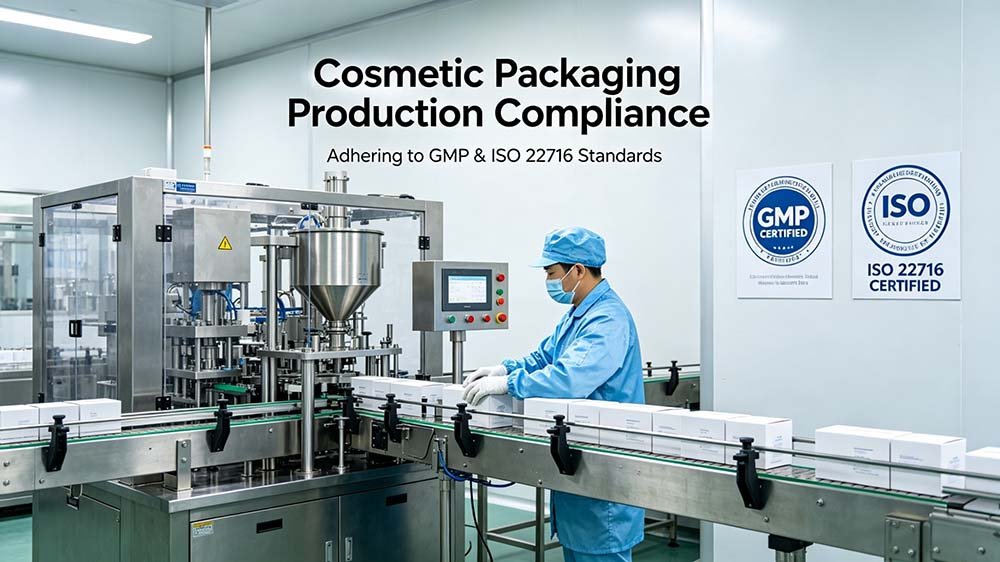
ISO 22716 is the international Good Manufacturing Practice (GMP) standard for cosmetics. For equipment, compliance comes down to five things:
- Hygienic design — equipment must be cleanable, sanitisable and maintainable, with no dead-legs or product traps.
- Suitable contact materials — non-reactive, non-shedding surfaces, typically 316L stainless steel for product-contact parts.
- Cleaning & sanitation — designed for easy dismantling or CIP/SIP, with documented cleaning procedures.
- Calibration & maintenance — measuring devices calibrated, maintenance scheduled and recorded.
- Documentation & traceability — installation, qualification (IQ/OQ/PQ) and use are recorded and traceable.
Definition
ISO 22716 is the international standard titled “Cosmetics — Good Manufacturing Practices (GMP) — Guidelines on Good Manufacturing Practices.” It defines how cosmetic products should be produced, controlled, stored and shipped to ensure quality and safety. It is the GMP reference recognised under the EU Cosmetics Regulation (EC No 1223/2009) and widely required by retailers and regulators worldwide.
For any cosmetic brand or contract manufacturer (OEM) selling into regulated markets, ISO 22716 cosmetic GMP is not optional — it’s the baseline of trust that lets you supply major retailers and clear customs in the EU and beyond. Yet most of what determines whether you pass an audit is decided long before the auditor arrives: it’s built into the equipment you buy. This guide explains exactly what ISO 22716 requires of your packaging and filling equipment, how it differs from other standards, and how brands and OEMs can treat GMP as an equipment specification rather than a last-minute scramble.
Read GMP as an equipment spec, not a regulatory hurdle
Most brands treat GMP compliance as paperwork they’ll sort out “once production is running” — and that’s where the cost quietly multiplies. ISO 22716 isn’t a certificate you bolt on at the end; it’s a set of decisions baked into your equipment from the moment you choose it. Whether a tank can be fully drained and cleaned, whether contact surfaces are 316L stainless rather than a cheaper grade, whether a machine can be dismantled for sanitation and leaves a traceable record — these are compliance outcomes determined at purchase, not during an audit. I’ve watched brands and OEMs retrofit “compliant” lines at three times the original cost because cleanability and documentation were afterthoughts. Design for cleaning, traceability and contamination control upfront, and the audit becomes a formality rather than a fire drill.
What is ISO 22716, and who needs it?
ISO 22716 provides guidelines for the production, control, storage and shipment of cosmetic products. Unlike a pass/fail product test, it describes a quality management approach to manufacturing — covering people, premises, equipment, materials, production, finished products, laboratory control, documentation and more. It is the GMP standard explicitly referenced by the EU Cosmetics Regulation, and compliance is effectively mandatory to place cosmetics on the EU market. Many other jurisdictions and retailers require or strongly prefer it.
Two audiences care about it most:
- Cosmetic brands that manufacture in-house need ISO 22716 to sell into regulated markets and to satisfy retailer audits.
- Contract manufacturers / OEMs need it to win and keep brand clients — a brand’s compliance depends on its manufacturer’s, so OEMs are audited on behalf of every brand they serve.
For both, the equipment is where compliance is won or lost. A brand can write perfect procedures, but if a filler can’t be cleaned between a tinted and a clear product, the contamination risk — and the audit finding — is real.
What the full standard covers
ISO 22716 is organised into chapters that together describe a complete manufacturing quality system. Understanding the structure helps you see where equipment fits into the bigger compliance picture:
- Personnel — training, hygiene and responsibilities of staff.
- Premises — facility layout, surfaces and conditions that prevent contamination.
- Equipment — the chapter most relevant to machine purchasing: design, cleaning, maintenance and calibration.
- Raw materials and packaging materials — control, storage and identification of inputs.
- Production — controlled, documented manufacturing and packaging operations.
- Finished products — release, storage and shipment controls.
- Quality control laboratory — testing and method control.
- Out-of-specification products, wastes, subcontracting, deviations, complaints & recalls, change control, internal audit and documentation — the governance wrapping the whole system together.
Notice that equipment, production and documentation are deeply interlinked: your machine choices directly affect how cleanly you can produce and how easily you can prove it. That’s why treating equipment as the starting point — rather than an afterthought — pays off across the entire standard.
What ISO 22716 requires of your equipment
The standard dedicates a full chapter to equipment. In plain terms, equipment used to make and package cosmetics must be suitable for its intended purpose and able to be cleaned, sanitised and maintained. Stripping the formal language down to purchasing decisions, here is what that means for the machines on your floor.
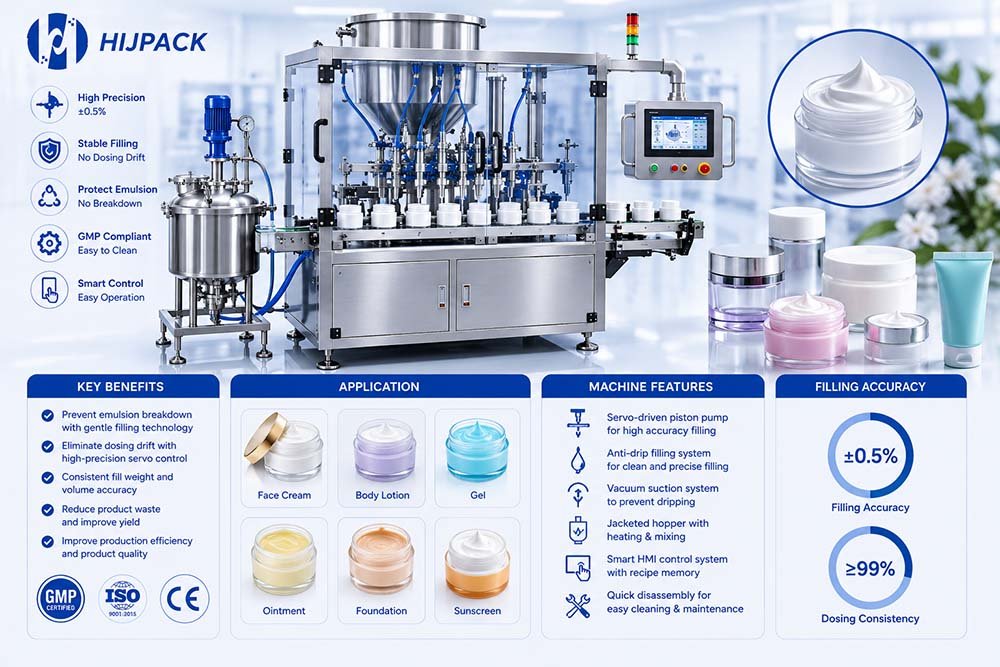
| ISO 22716 requirement | What it means for equipment | What to specify at purchase |
|---|---|---|
| Suitable design | Fit for intended use; avoids contamination | Smooth welds, no dead-legs, drainable tanks, hygienic layout |
| Cleanable surfaces | Can be cleaned and sanitised effectively | 316L stainless product-contact parts; tool-free dismantling or CIP/SIP |
| Maintenance | Kept in working order without affecting product | Accessible parts, documented maintenance plan, spare-parts support |
| Calibration | Measuring/control devices give accurate results | Calibratable fill weight, temperature and pressure instruments |
| Authorised use | Operated and changed under control | Recipe-driven HMI, access control, batch records |
| Documentation | Activities recorded and traceable | IQ/OQ/PQ package, manuals, data logging where relevant |
This is why the choice of machine and the compliance outcome are the same decision. Browse cosmetic packaging machines built with these requirements in mind, and see HIJ’s structured approach to cosmetic GMP compliance and IQ/OQ/PQ validation.
Hygienic design: the heart of equipment GMP
Contamination control is the central concern of cosmetic GMP, and hygienic design is how equipment delivers it. The features that matter most:
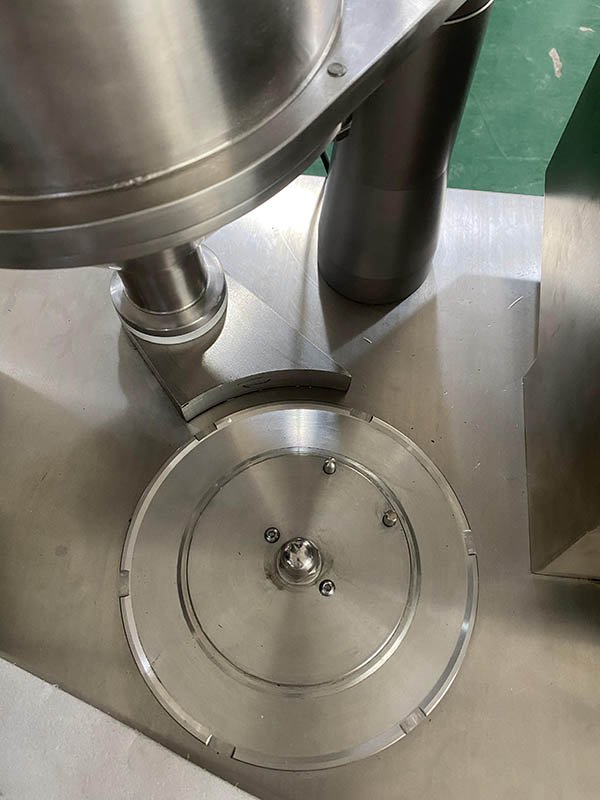
- 316L stainless steel for all product-contact surfaces — corrosion-resistant, non-reactive and non-shedding, superior to 304 for aggressive or chloride-containing formulations.
- Smooth, polished surfaces (low Ra roughness) so residue can’t lodge in micro-pits.
- No dead-legs or stagnant zones where product can sit, degrade and breed microbes.
- Fully drainable tanks, hoppers and pipework — anything that can’t drain can’t be reliably cleaned.
- Crevice-free, hygienic welds and sanitary fittings instead of threaded joints that trap product.
- Quick dismantling or CIP/SIP (clean-in-place / sterilise-in-place) so changeovers between colours, fragrances or formulations don’t carry over.
The practical test is the colour-and-fragrance changeover: if switching from a tinted cream to a clear gel requires hours of disassembly — or worse, can’t be verified as clean — the machine is a contamination and audit risk on every changeover. A purpose-built cream filling machine with a cleanable product path turns that recurring risk into a non-issue.
Cleaning validation: from “looks clean” to “proven clean”
Hygienic design makes cleaning possible; cleaning validation proves it works. ISO 22716 expects cleaning procedures to be defined and effective, which in practice means demonstrating that your method removes product residue, cleaning agents and microbial contamination to acceptable levels — and doing so repeatably. The equipment makes this easy or hard. A machine that dismantles quickly lets operators reach and verify every product-contact surface; a sealed, hard-to-access design forces you to take cleanliness on faith, which no auditor accepts.
When you specify equipment, think one step past “can it be cleaned?” to “can I prove it’s clean, every time, quickly?” Features that help include smooth removable parts, clear access to all wetted surfaces, compatibility with your cleaning agents, and — for liquid lines — validated CIP cycles with recorded parameters. The faster and more verifiable your cleaning, the lower your contamination risk and the shorter your changeovers, so hygienic, validatable design pays back in both compliance and throughput.
IQ, OQ, PQ: how equipment compliance is proven
For regulated production, it isn’t enough that a machine can meet GMP — you must prove it does, through qualification. This is the IQ/OQ/PQ sequence, the documented evidence auditors look for.
| Stage | Full name | Question it answers |
|---|---|---|
| IQ | Installation Qualification | Was the equipment installed correctly, to specification, with the right utilities and documentation? |
| OQ | Operational Qualification | Does it operate correctly across its full intended range (speeds, temperatures, fill volumes)? |
| PQ | Performance Qualification | Does it consistently produce conforming product under real production conditions? |

A supplier that provides a structured IQ/OQ/PQ package — protocols, test records and acceptance criteria — saves you months of work and de-risks your audit. When sourcing equipment, ask whether validation documentation is included or extra, and whether the supplier supports you during your own qualification. This is a core part of any credible turnkey solution.
Qualification is not a one-time event, either. Equipment should be re-qualified after significant changes — relocating a machine, replacing major components, changing a product type that affects cleaning or dosing, or after major maintenance — and many operations schedule periodic review even without changes. Build this into your quality system from the outset: keep the original IQ/OQ/PQ records accessible, log every change that might trigger re-qualification, and confirm your supplier can support requalification when you scale, move sites, or add SKUs. A machine that was qualified once but then modified without re-qualification is, in audit terms, no longer qualified at all.
Documentation and traceability: proving it, not just doing it
A recurring theme of ISO 22716 is that doing the right thing isn’t enough — you must be able to prove you did it. For equipment, that means records: of installation and qualification, of cleaning performed between batches, of maintenance and calibration, and of the parameters each batch actually ran at. Auditors don’t watch you produce; they read your records. If the records aren’t there, in practice the activity didn’t happen.
This makes the machine’s control system a compliance feature, not just a convenience. A controller that stores recipes per SKU, logs the fill weights, temperatures and counts of each batch, restricts setting changes to authorised users, and applies batch and expiry codes automatically gives you traceable evidence almost for free. The alternative — reconstructing what happened from operator memory and paper notes — is exactly where audit findings are born.
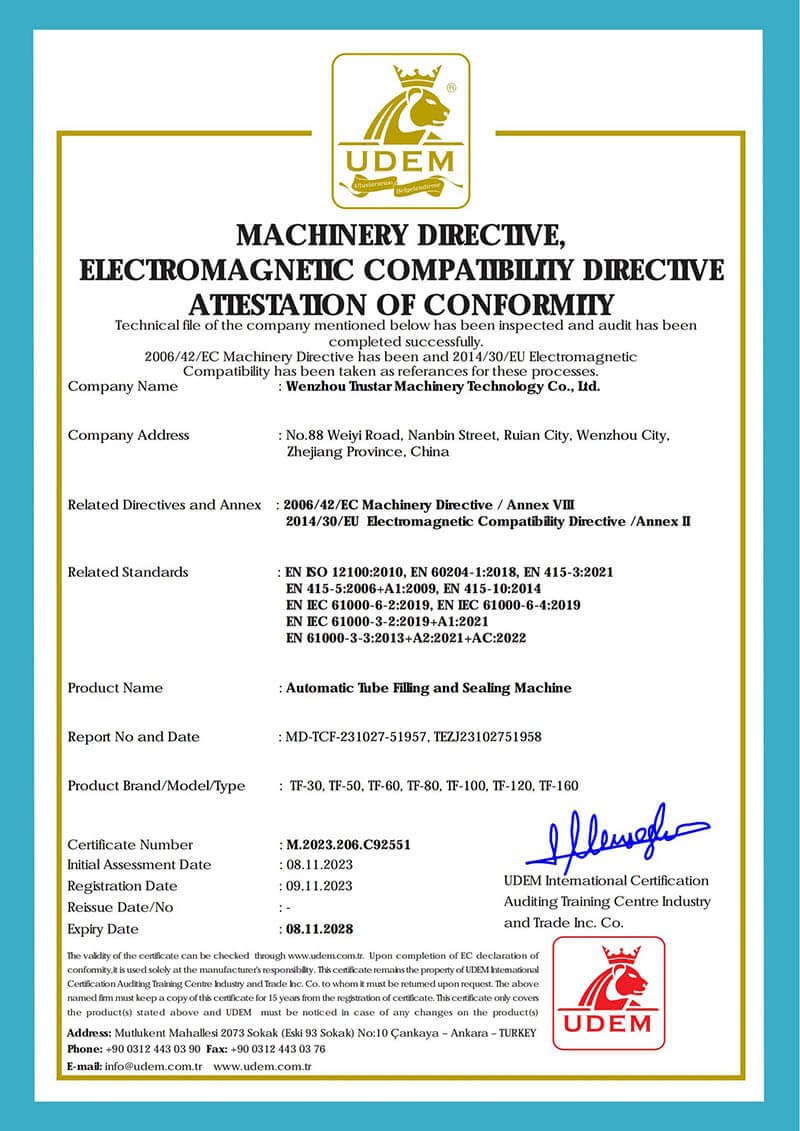
When specifying equipment, treat data and records as a requirement: ask what the machine logs, how those records are retrieved, and whether the supplier provides the qualification documentation that seeds your record-keeping from day one.
ISO 22716 vs other standards: a quick comparison
Buyers frequently confuse ISO 22716 with neighbouring standards. Here’s how they relate.
| Standard | Scope | Relationship to cosmetic equipment |
|---|---|---|
| ISO 22716 | Cosmetics GMP guidelines | The primary cosmetic manufacturing standard; sets equipment hygiene and control expectations |
| ISO 9001 | General quality management | Organisational quality system; complements but does not replace 22716 |
| Pharma GMP (e.g. EU GMP) | Medicinal products | Stricter than 22716; relevant if you also make drugs or “cosmeceuticals” |
| FDA (US) | US cosmetics oversight (incl. MoCRA) | US expectations; ISO 22716 is widely used to demonstrate good practice |
| CE marking | Machine safety (EU) | Covers operator safety of the machine itself, not product GMP |
In short: ISO 22716 governs how the product is made hygienically; CE governs whether the machine is safe to operate; ISO 9001 governs your overall quality system. A fully compliant cosmetic operation typically needs all three working together.
Need GMP-ready equipment with validation support?
Tell us your products and target markets — our engineers will spec hygienic, cleanable, fully documented equipment with IQ/OQ/PQ support built in.
The ISO 22716 equipment compliance checklist
Use this checklist when evaluating any cosmetic filling or packaging machine. If a supplier can’t tick these, the machine will likely become an audit finding.
- Product-contact parts are 316L stainless steel (or otherwise non-reactive, non-shedding, documented).
- All product paths are fully drainable with no dead-legs.
- The machine can be dismantled for cleaning, or supports validated CIP/SIP.
- Surface finish is smooth/polished to a specified roughness for product-contact areas.
- Fill weight, temperature and pressure instruments are calibratable, with certificates available.
- A documented cleaning and maintenance procedure is provided.
- The controller supports recipe storage, access control and batch/coding records.
- An IQ/OQ/PQ validation package is available (included or quoted).
- Materials and construction certificates (e.g. material traceability) can be supplied.
- The supplier offers spare parts and documented after-sales support.
Brands vs OEMs: who is responsible for what?
The compliance burden splits — and overlaps — between brands and their contract manufacturers, so it’s worth being explicit.
If you are a brand manufacturing in-house, you own the entire GMP system: equipment, premises, procedures and records. Treat equipment selection as a compliance decision and demand the documentation above from every supplier.
If you are a brand outsourcing to an OEM, you don’t escape responsibility — you’re accountable for verifying your manufacturer’s compliance. Audit your OEM against ISO 22716, confirm their equipment meets the checklist, and keep evidence of their certification and qualification records.
If you are an OEM / contract manufacturer, your equipment compliance is your competitive moat. Every brand client’s audit becomes your audit. Investing in hygienic, validated, well-documented cosmetic packaging machines upfront lets you win and retain clients who can’t afford a compliance gap. Building GMP into your line from the start — rather than retrofitting it — is the difference between a smooth audit and an expensive scramble.
Why retrofitting compliance costs three times as much
The recurring lesson from brands and OEMs that get this wrong is the cost asymmetry. Specifying a hygienic, documented machine at purchase adds a modest premium. Retrofitting compliance onto a machine that wasn’t designed for it means replacing contact parts, re-engineering product paths, commissioning validation after the fact, and often lost production while it’s done — frequently totalling several times the original saving. Worse, some non-hygienic designs simply can’t be made compliant and must be replaced outright.
The strategic takeaway echoes the insight at the top: read GMP as an equipment spec, not a regulatory hurdle. Design for cleaning, traceability and contamination control before you buy, and the audit becomes a formality. Treat it as paperwork to handle later, and it becomes the most expensive surprise in your scale-up — a theme we also explore in our packaging line design guide.
Five equipment-related audit findings — and how to avoid them
When cosmetic operations fail or stumble in a GMP audit, the equipment-related findings cluster around a predictable few. Knowing them in advance lets you design them out:
- Inadequate cleaning between products. Visible residue, or no validated proof of cleanliness, after a colour or fragrance changeover. Avoid it with drainable, dismantlable or CIP-capable product paths and a documented, validated cleaning procedure.
- Unsuitable or undocumented contact materials. Cheaper steel grades, plastics of unknown food/cosmetic grade, or no material certificates. Avoid it by specifying 316L (or documented equivalents) and keeping material traceability certificates.
- Uncalibrated measuring devices. Fill-weight, temperature or pressure instruments with no calibration record. Avoid it by choosing calibratable instruments and keeping a calibration schedule with certificates.
- Missing maintenance or qualification records. The equipment may be fine, but the paperwork proving it isn’t there. Avoid it with a documented maintenance plan and an IQ/OQ/PQ package retained on file.
- Uncontrolled changes. Settings altered with no record of who changed what, when, or why. Avoid it with access-controlled, recipe-driven controls and a change-control procedure.
Every one of these is cheaper to prevent at purchase than to remediate under an auditor’s deadline — which is the whole argument for treating GMP as an equipment specification.
Glossary: key ISO 22716 equipment terms
- GMP (Good Manufacturing Practice)
- A system of processes, procedures and documentation ensuring products are consistently produced and controlled to quality standards.
- 316L stainless steel
- A low-carbon, molybdenum-containing stainless grade with high corrosion resistance, the standard choice for cosmetic and pharmaceutical product-contact surfaces.
- Dead-leg
- A section of pipework or vessel where product can stagnate and resist cleaning — a contamination risk GMP design seeks to eliminate.
- CIP / SIP
- Clean-in-place / sterilise-in-place: systems that clean or sanitise equipment internally without full dismantling.
- IQ / OQ / PQ
- Installation, Operational and Performance Qualification: the documented evidence that equipment is installed, operates and performs as required.
- Ra (surface roughness)
- A measure of surface smoothness; lower Ra means fewer micro-crevices for residue and microbes, important for product-contact finishes.
- Traceability
- The ability to follow materials, batches and equipment activities through records, enabling investigation and recall if needed.
Frequently asked questions
Is ISO 22716 certification mandatory?
ISO 22716 itself is a guidelines standard rather than a certifiable management system in the way ISO 9001 is, but compliance with its GMP principles is effectively mandatory to place cosmetics on the EU market under Regulation EC No 1223/2009, and is widely required by retailers and regulators elsewhere. Many manufacturers obtain third-party certification or audit attestation to demonstrate compliance to clients and authorities.
What does ISO 22716 require for equipment specifically?
Equipment must be suitable for its intended purpose and able to be cleaned, sanitised and maintained without contaminating product. In practice this means hygienic design with no dead-legs, drainable product paths, non-reactive contact surfaces (typically 316L stainless steel), calibratable measuring devices, documented cleaning and maintenance, and traceable records of installation and use.
Why is 316L stainless steel preferred for contact surfaces?
316L is a low-carbon stainless grade containing molybdenum, giving it superior resistance to corrosion and to chloride or acidic attack compared with 304. It is non-reactive and non-shedding, so it won’t contaminate product or develop pits that harbour residue, making it the standard choice for cosmetic and pharmaceutical product-contact parts.
What is the difference between ISO 22716 and CE marking?
They cover different things. ISO 22716 is about manufacturing the cosmetic product hygienically and under control — it governs product quality and safety. CE marking covers the safety of the machine itself for operators within the EU. A compliant cosmetic operation generally needs both: GMP-compliant equipment that is also CE-marked for safe operation.
Do I need IQ/OQ/PQ for cosmetic equipment?
If you supply regulated markets or major retailers, qualification is strongly expected. IQ/OQ/PQ provides documented evidence that equipment was installed correctly, operates across its intended range, and consistently produces conforming product. Choosing a supplier that provides a structured IQ/OQ/PQ package saves significant time and de-risks audits.
As a brand outsourcing production, am I still responsible for GMP?
Yes. Even when you outsource to a contract manufacturer, you remain accountable for verifying their compliance. You should audit your OEM against ISO 22716, confirm their equipment meets hygienic-design and documentation requirements, and retain evidence of their certification and qualification records.
How much does it cost to make non-compliant equipment compliant?
Retrofitting compliance is typically far more expensive than specifying it upfront — often several times the original saving — because it can involve replacing contact parts, re-engineering product paths, validating after the fact and losing production time. Some non-hygienic designs can’t be made compliant at all and must be replaced. Specifying GMP-ready equipment at purchase is the economical path.
Make GMP a purchasing decision, not an audit panic
ISO 22716 is the foundation of trust in the cosmetics industry, and for equipment it comes down to a simple idea: hygienic design, suitable materials, effective cleaning, calibration, and documented traceability. The brands and OEMs that pass audits effortlessly are the ones that treated these as an equipment specification at purchase — choosing machines that can be cleaned, dismantled, calibrated and qualified, with the paperwork to prove it. Treat GMP as the spec, and compliance is built into your line from day one; treat it as paperwork for later, and it becomes the costliest surprise of your scale-up.
When you’re ready to specify GMP-ready equipment, explore the full range of cosmetic packaging machines, review HIJ’s GMP compliance and IQ/OQ/PQ validation resources, or talk to an engineer about a compliant turnkey solution.