
Cosmetic Packaging Line Design: From Startup to 10K Units/Day Production
Scaling isn’t one purchase — it’s a chain of bottlenecks solved in the right order. Here’s how to design a line that grows with you.
The Short Answer
A packaging line is a chain — its real speed is the slowest link, not the fastest:
- Design the full line on paper first — fill, cap, seal, label, code, inspect, pack — before buying anything.
- Balance the line — match every station’s speed; a fast filler feeding a manual capper just creates a pile-up.
- Scale in stages — manual → semi-automatic → automatic → fully automatic, upgrading the bottleneck each time.
- Build in modularity — choose a platform where you can upgrade one station without re-engineering the whole floor.
- Don’t buy for 10K on day one if you ship 500 — buy a foundation that grows link by link.
Every beauty brand dreams of the day it ships ten thousand units a day. But the path from a founder hand-filling jars in a rented kitchen to a humming automated line is littered with expensive missteps. The most common one is treating scale as a single purchase — “buy a fast machine and the volume will follow” — when in reality, production capacity is governed by a chain of stations, and the chain is only as fast as its weakest link. This guide walks through how to design a cosmetic packaging line that scales smoothly from startup volumes to 10,000 units a day, stage by stage, without tearing everything down each time you grow.
A line is a chain — its speed is set by the slowest link
The leap from startup to 10,000 units a day isn’t one decision — it’s a series of bottlenecks you solve in the right order. The mistake I see most often is brands buying a fast filler and assuming throughput will follow, only to watch units pile up at a manual capping station or a single labeler that can’t keep pace. The brands that scale smoothly think in stages: they design the full line on paper first — filling, capping, sealing, labeling, coding, inspection, packing — then identify where each step will choke as volume climbs, and build in modularity so they can upgrade one station without re-engineering the whole floor. Don’t buy for 10K on day one if you’re shipping 500; buy a foundation that lets you grow link by link without tearing it all down.
The packaging line as a chain: the seven stations
Before any equipment decision, map the whole line. A cosmetic packaging line is a sequence of stations, each handing product to the next. Skip or under-size any one of them and the whole line stalls. The typical chain looks like this:
The single most important principle in line design is line balancing: every station should be able to process roughly the same number of units per minute. A filler rated at 60 units a minute feeding a capper that manages 25 doesn’t give you a 60-unit line — it gives you a 25-unit line with product backing up and operators scrambling. Your effective throughput is always set by the slowest station, so the goal is to raise the slowest link, not the fastest.
The four stages of scaling: a roadmap
Almost no brand jumps straight to a fully automatic line, and almost none should. Scaling happens in stages, each justified by volume. Here’s the typical progression and where each stage makes sense.
Manual
Tabletop fillers, hand capping, hand labeling. Lowest cost, maximum flexibility — right for launch, R&D and tiny batches.
Semi-automatic
Powered filler and capper, operator-fed. The workhorse of growing brands with frequent SKU changes.
Automatic (modular)
Linked automatic stations on a conveyor. Operators load and supervise; the line runs itself between SKUs.
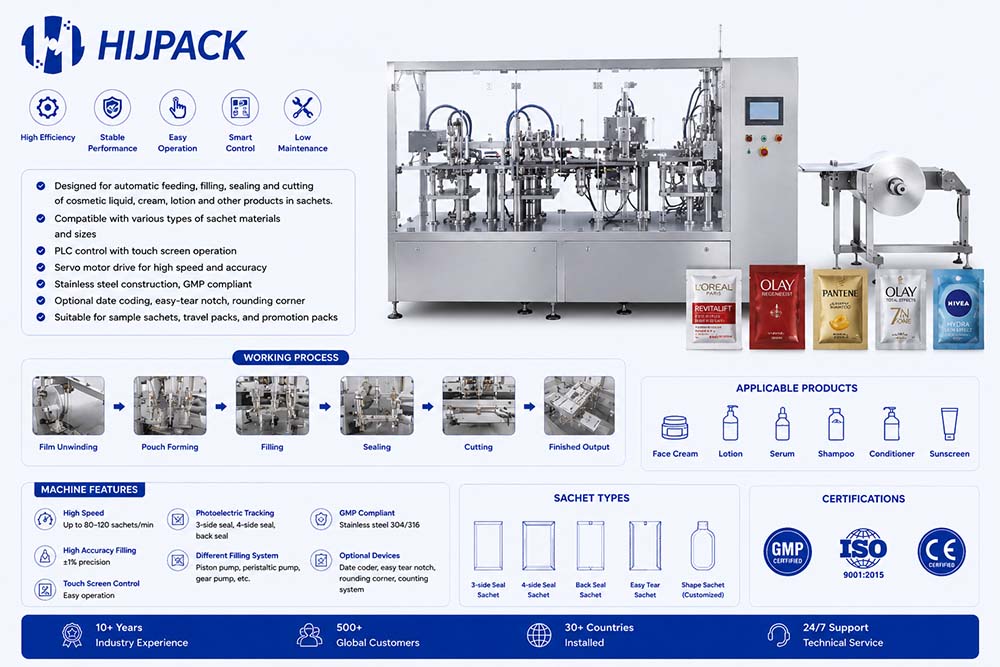
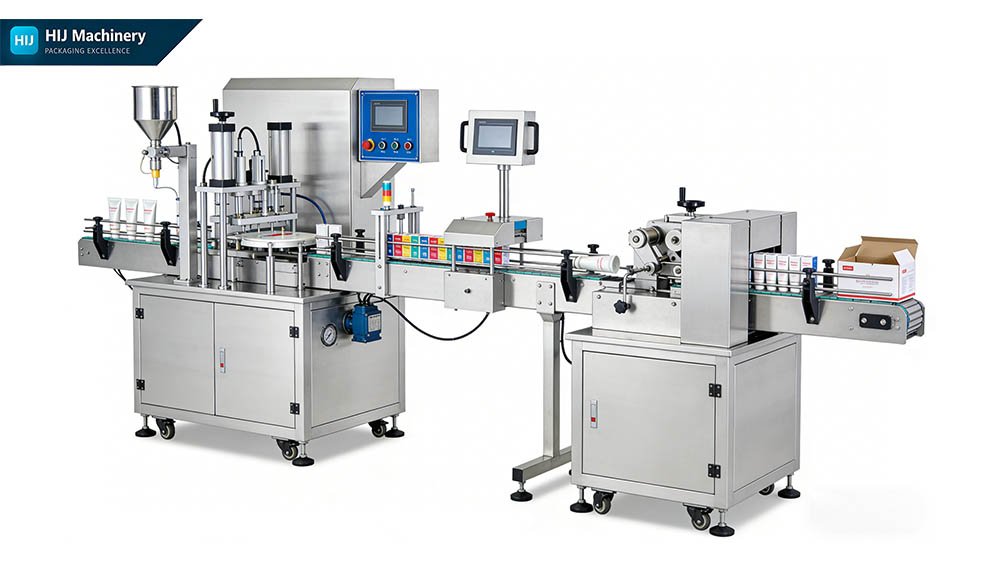
The fourth stage — a fully automatic, integrated line at 6,000–10,000+ units a day — connects every station with conveyors, automatic infeed and reject handling, often with minimal operator intervention. This is where a true automatic cosmetic filling line earns its place, and where a turnkey solution — engineered as one coordinated system rather than assembled from mismatched parts — pays for itself in uptime and reliability.
| Stage | Daily output | Automation | Typical bottleneck to watch |
|---|---|---|---|
| 1 | Under 500 | Manual / tabletop | Everything is hand-paced; labour is the limit |
| 2 | 500–2,000 | Semi-automatic | Manual capping or labeling can’t keep up with the filler |
| 3 | 2,000–6,000 | Automatic, modular | Changeover time; single labeler or coder |
| 4 | 6,000–10,000+ | Fully automatic / turnkey | Infeed, reject handling, end-of-line packing |
A worked example: one brand, four stages
To make the staged approach concrete, follow a hypothetical skincare brand through its growth. The pattern repeats across almost every brand that scales well.
Year one — launching at 300 units a day. The founder fills jars on a tabletop piston filler, caps by hand, and applies labels with a simple hand applicator. Total equipment cost is modest, and the setup is endlessly flexible — perfect for testing SKUs and surviving early cash constraints. The bottleneck is simply how fast two people can work, and that’s fine at this volume.
Year two — demand hits 1,500 a day. Hand-capping has become the choke point: the filler could go faster, but capping can’t keep up, and the team is working overtime. The right move is not a whole new line — it’s to add a powered semi-automatic capper sized to the filler, turning the slowest link into a balanced one. One targeted purchase doubles practical throughput. This is line balancing in action: the brand raised the slowest link, not the fastest.
Year three — 4,000 a day and climbing. Now labeling and coding are the constraints, and operators spend too much time moving product between benches. The brand links its filler, capper, labeler and coder on a conveyor into a modular automatic cosmetic filling line, adds inline coding, and introduces basic inspection. Because the earlier purchases were chosen to integrate, nothing has to be thrown away — each stays as a station in the bigger line.
Year four — targeting 10,000 a day. The remaining bottlenecks have moved to the very ends of the line: feeding empty containers in fast enough, handling rejects, and packing finished units into cartons and cases. The brand adds automatic infeed, vision inspection with automatic reject, and end-of-line cartoning machines and case packing machines. At this point a fully integrated turnkey solution makes sense, engineered as one system. Crucially, the brand reached 10K through four affordable, staged steps — never once tearing down the floor and starting over.
Designing each station to scale
With the stages mapped, here’s how to think about each link in the chain so it won’t become the choke point as you grow.
1. Filling — the heart of the line
Filling sets the pace for everything downstream, so it deserves the most attention. The right filler depends on your product’s viscosity: thin serums suit peristaltic or flow-meter systems, lotions suit piston or gear-pump fillers, and thick creams need servo piston filling — a topic we cover in depth in our cream vs lotion vs serum filling guide. For a scalable line, prioritise a filler with adjustable heads, multiple nozzles for future SKUs, and the ability to add fill heads later. Browse the full range of cosmetic packaging machines and the dedicated cream filling machine to match dosing to your products.
2. Capping & sealing — the classic bottleneck
This is where most growing brands choke. A founder buys a quick filler, then keeps capping by hand — and units pile up. As volume climbs, move to a powered capper sized to match the filler. For tube products, the fill and seal happen together on a cosmetic tube filling and sealing machine, so balancing is built in; for bottles and jars, the capper or sealer is a separate station that must keep pace.
3. Labeling — easy to under-size
Labeling looks simple but is a frequent hidden bottleneck. A single semi-automatic labeler that’s fine at 1,000 units a day will throttle a line aiming for 5,000. Plan for an automatic wrap-around or front/back labeler matched to your throughput, and account for label changeover time between SKUs.
4. Coding — small machine, big compliance role
Batch numbers and expiry dates are a regulatory must. Inline coders (inkjet or laser) are inexpensive relative to the rest of the line, but if a single coder can’t keep pace it stalls everything behind it. Size it to the line and integrate it so codes apply on the fly.
5. Inspection — protect your brand
Automated checks for fill level, seal integrity, label presence and code legibility catch defects before they ship. At lower volumes this can be visual; as you scale, vision systems and checkweighers reject faulty units automatically, protecting both compliance and brand reputation.
6 & 7. Cartoning & case packing — the end of the line
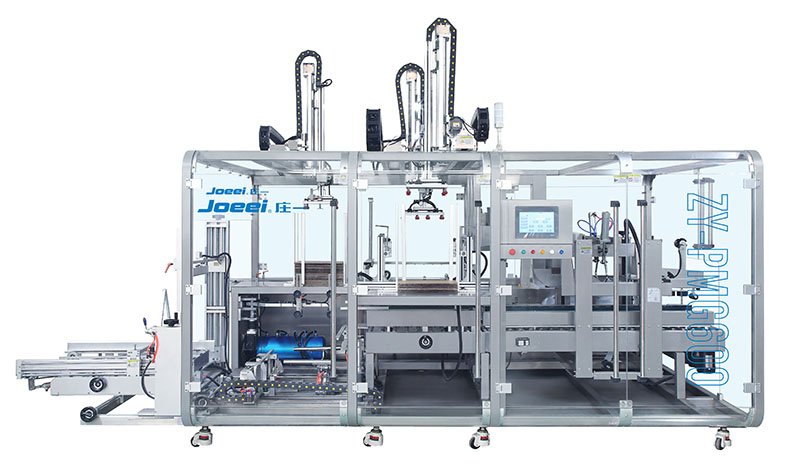
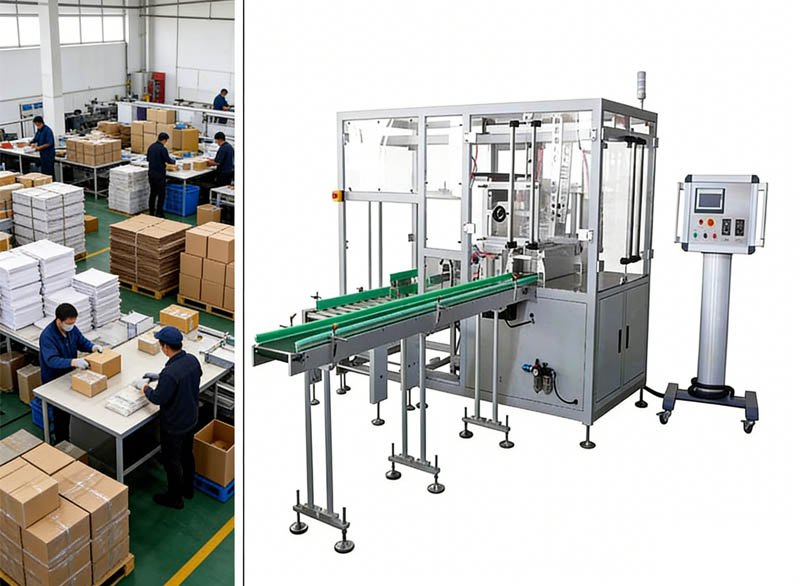
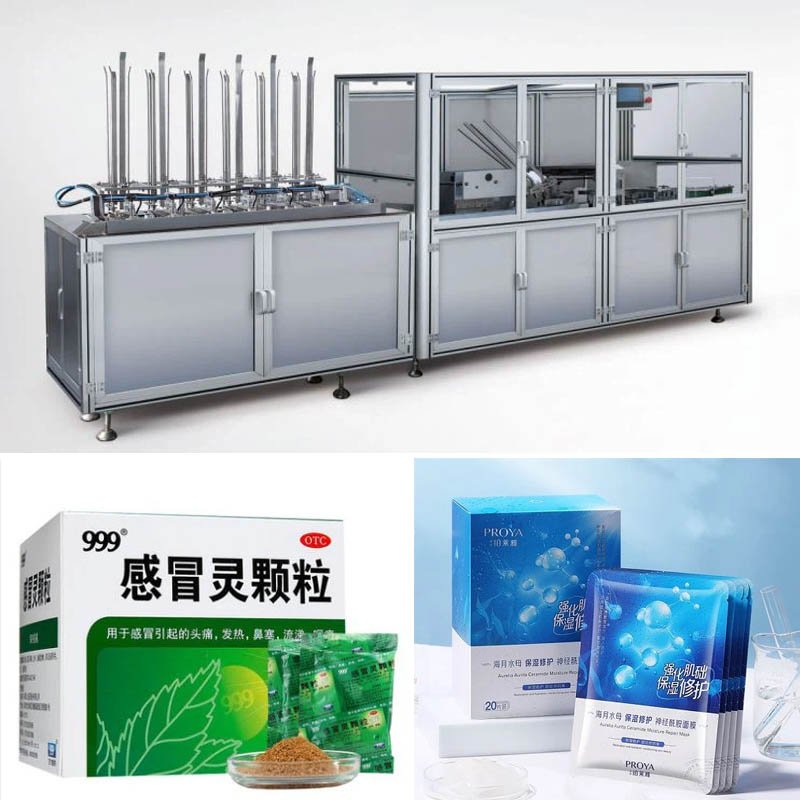
Finished units must be boxed and cased. As volume rises, manual packing becomes its own bottleneck — and a labour cost that scales badly. Automatic cartoning machines fold and load cartons, while case packing machines group cartons into shipping cases. Plan the end of the line as carefully as the start; it’s where high-volume lines most often back up.
Designing a line that needs to grow?
Tell us your products, current volume and your three-year target — our engineers will design a balanced, modular line you can scale station by station.
Why modularity is the secret to scaling cheaply
Here’s the principle that separates brands that scale smoothly from those that buy twice: design for modularity. A modular line lets you upgrade the single station that has become your bottleneck — swapping a manual capper for an automatic one, adding a second fill head, dropping in a faster labeler — without re-engineering the whole floor.
Contrast that with the brand that buys a cheap, fully-integrated all-in-one machine sized for today’s 500 units a day. When demand hits 3,000, there’s no station to upgrade — the whole machine is the limit, and the only option is to replace it entirely. Modular design costs a little more up front in conveyor and layout planning, but it turns each future growth step into a single-station purchase rather than a full re-fit. When you specify your line, ask every supplier the same question: “When I outgrow this station, can I upgrade just this one, or do I replace the line?”
Planning factors beyond the machines
A line lives in a building and is run by people, so design around these realities too:
- Floor space and layout. Map the line footprint, including operator access, conveyor runs and room to add stations later. Straight in-line layouts are easy to extend; U-shaped layouts save space and labour.
- Utilities. Confirm power, compressed air, water and drainage for the full build-out, not just stage one — retrofitting air lines later is disruptive.
- Labour. Automation trades labour cost for capital. Calculate the crossover: at your wage rates and volume, when does an automatic station pay back versus an extra operator?
- Changeover. Multi-SKU brands lose more to slow changeovers than to slow machines. Prioritise quick-change tooling and recipe-driven controls across every station.
- Compliance and hygiene. Design for ISO 22716 cosmetics GMP from the start — easy-clean product paths, validation support and documentation are far cheaper built in than retrofitted.
Sizing for real-world output, not brochure speed
One last reality check. To actually ship 10,000 units a day, you cannot simply buy a line rated at 10,000 — because no line runs at 100% of its rated speed. Real output is governed by OEE (overall equipment effectiveness): rated speed multiplied by availability, performance and quality. A line that’s rated for high output but stops constantly for changeovers, jams and cleaning may deliver only 60–75% of its headline figure.
Do the maths backwards. If you need 10,000 good units a day on a single 8-hour shift at 70% OEE, you need a line rated nearer 30 units a minute, not 21. Build in that headroom, balance every station to it, and decide whether a second shift is cheaper than a faster line. Sizing to realistic OEE — not the brochure number — is what separates a line that hits its targets from one that disappoints every month.
One integrated supplier or piece it together?
As your line grows past two or three stations, a strategic question arrives: source everything from one partner, or buy the best individual machine for each step from different vendors? Both routes work, but they fail in different ways, and the right answer depends on your stage.
Buying piecemeal lets you chase the strongest machine in each category and can lower the price of any single unit. The hidden cost shows up at the seams: machines from different makers don’t always talk to each other, conveyor heights and timing signals may not match, and when something goes wrong at a handoff, each supplier points at the other. Integration becomes your problem to solve, often without the engineering depth to solve it.
Sourcing from one integrated supplier — or buying an engineered turnkey solution — costs more to scope but removes the finger-pointing. One partner owns the line balancing, the controls integration, the FAT and SAT acceptance testing, and the single point of support when a station stops. For brands without an in-house engineering team, that single accountability is usually worth more than saving a few percent per machine. A practical middle path many brands take: start by buying individual semi-automatic machines that are designed to integrate later, then bring in one partner to tie them into a coordinated automatic line at stage three. The deciding factor is honesty about your own engineering capacity — if integrating mismatched equipment isn’t a job your team can own, buy the integration in. You can see how a coordinated approach looks across the full range of cosmetic packaging machines and what end-to-end support involves on the Why HIJ page.
Three costly line-design mistakes
Most scaling pain traces back to a few avoidable errors in how the line was conceived. Watch for these as you plan:
- Buying speed you can’t feed or empty. A blazing-fast filler is useless if empty containers don’t arrive fast enough or finished units can’t be packed quickly enough. The line must be balanced end to end, not just at the glamorous filling station.
- Choosing a sealed all-in-one when you’ll outgrow it. An integrated single machine sized for today is cheap and tidy — until you hit its ceiling and discover there’s no station to upgrade, only the whole unit to replace. If growth is likely, pay for modularity.
- Ignoring changeover in a multi-SKU brand. Beauty brands rarely run one product. A line that’s fast but takes hours to switch between SKUs can ship less per week than a slightly slower line that changes over in minutes. Quantify changeover time, not just rated speed.
Each of these comes from the same root cause: thinking about one machine instead of the whole chain over time. Design the line as a system that evolves, and these traps disappear.
Frequently asked questions
How do I know which station will be my bottleneck?
Map every station’s rated throughput in units per minute and find the lowest number — that’s your bottleneck and your real line speed. As you scale, the bottleneck moves: at first it’s usually manual capping or labeling; later it’s changeover time or end-of-line packing. Re-check the balance every time volume climbs, and upgrade the slowest link rather than the fastest.
Should a startup buy a fully automatic line from the start?
Usually not. If you’re shipping under 500 units a day, a fully automatic line ties up capital and adds changeover complexity you don’t need. Start semi-automatic and scale in stages — but choose a modular platform so you can upgrade station by station. The exception is if you have firm, large committed volume from day one, where a turnkey line avoids buying twice.
What does it take to reach 10,000 units a day?
A balanced, mostly automatic line where every station — filling, capping, labeling, coding, inspection, cartoning, case packing — is sized to the same throughput, plus headroom for realistic OEE. At 70% efficiency on one shift, plan for a rated speed nearer 30 units a minute. Automatic infeed, reject handling and end-of-line packing become essential at this volume.
What’s the most common scaling mistake?
Buying a fast filler and assuming throughput follows, while capping or labeling is still manual or under-sized. The line’s real speed is its slowest station, so a fast filler feeding a slow capper just creates pile-ups. Design the whole chain together and balance every link.
How important is modularity?
It’s the key to scaling cheaply. A modular line lets you upgrade the single bottleneck station — adding a fill head, swapping in an automatic capper, dropping in a faster labeler — without replacing the whole line. Always ask a supplier whether you can upgrade one station at a time or must replace everything.
How much floor space does a cosmetic packaging line need?
It varies widely with automation level and number of stations, from a few square metres for a semi-automatic bench setup to a substantial run for a full automatic line with conveyors and end-of-line packing. The key is to plan the footprint for your full build-out — including room to add stations — not just stage one, and to confirm utilities for the final configuration.
Build a foundation, not a finish line
Scaling a cosmetic brand from startup to 10,000 units a day isn’t about buying the biggest machine — it’s about designing a chain whose links you can strengthen one at a time. Map the full line on paper first, balance every station to the same speed, scale through the four stages as volume justifies, and build in the modularity that lets you upgrade your bottleneck without tearing down the floor. Do that, and growth becomes a series of single-station decisions rather than a series of painful, expensive re-builds. Don’t buy for 10K on day one if you’re shipping 500 — buy the foundation that lets you grow link by link.
When you’re ready to design that foundation, explore the automatic cosmetic filling line, the full family of cosmetic packaging machines, or talk to an engineer about a turnkey solution built around your roadmap.