In 2026, a fully automatic powder capsule filling machine from an established Chinese manufacturer costs USD 17,500–32,000 FOB depending on output class: roughly USD 17,500–22,000 for a 48,000-capsules/hour machine like the HIJ NJP-800C, and USD 24,000–32,000 for the 72,000/hour class. Semi-automatic machines run USD 4,500–8,000; industrial lines above 100,000/hour start around USD 45,000. A production-ready setup with polisher, feeder, and spare molds typically lands between USD 20,000 and 28,000 for the mid-volume class. Comparable European machines cost three to five times more.
- The machine itself is only 65–80% of your landed budget — molds, accessories, freight, and commissioning make up the rest.
- Price differences inside the same output class come from components: enclosed vs open dosing station, imported vs domestic bearings, PLC brand.
- Quotes that look 20–30% cheaper usually exclude mold sets, the dust collector, or sea freight — compare itemized quotations only.
- Buying through a trading company adds a markup for no technical value; factory-direct pricing removes that layer.
Capsule filler pricing is opaque by design: most suppliers publish nothing and quote differently to every inquiry. This guide breaks down real 2026 price bands by machine class, itemizes what a complete purchase actually includes, and flags the exclusions that make cheap quotes expensive. All figures are FOB China unless stated; HIJ publishes its own NJP-800C pricing openly on the product page, and the bands below reflect what comparable machines trade at across the market.
2026 Price Bands by Machine Class
| Machine Class | Output | 2026 FOB Price Band (USD) | Typical Buyer |
|---|---|---|---|
| Manual filler | ≤800/hr | $200–1,500 | Labs, compounding |
| Semi-automatic | ≤20,000/hr | $4,500–8,000 | Startups, pilot production |
| Fully automatic, 48,000/hr class (NJP-800C) | 48,000/hr | $17,500–22,000 base | Mid-volume pharma, nutraceutical, CMO |
| Fully automatic, 72,000/hr class | 72,000/hr | $24,000–32,000 | Growing CMOs, multi-shift plants |
| Industrial high-speed | 100,000–150,000+/hr | $45,000–80,000+ | Industrial-scale manufacturers |
Two machines in the same class can differ by several thousand dollars legitimately. The premium buys an enclosed dosing station instead of an open one, imported Japanese bearings instead of domestic, a name-brand PLC, and thicker 304/316L contact parts. Those are exactly the components that determine whether accuracy survives year three — as covered in our breakdown of how the dosing system works. A discount that removes them is not a discount.
What a Complete Purchase Actually Costs: Line-Item Breakdown
Using the 48,000/hour class as the reference, here is what an itemized, production-ready quotation looks like:
| Line Item | Typical Cost (USD) | Notes |
|---|---|---|
| Base machine (1 mold set, dust collector, PLC+HMI) | $17,500–22,000 | Confirm what “base” includes — this is where quotes diverge |
| Additional mold set (per capsule size) | $1,500–2,500 | One per size you run; order with machine to avoid re-fitting |
| Capsule polishing machine | $1,500–2,500 | Effectively mandatory for pharma-grade appearance |
| Vacuum powder feeder | $2,000–3,000 | Removes manual hopper refills; keeps bed height stable |
| Automatic empty capsule loader | $2,500–3,000 | For continuous multi-shift operation |
| Inline metal detector | $2,000–3,000 | Often required by customer audits and export markets |
| Sea freight + export packing | $800–2,500 | ~800 kg crated; varies by destination port |
| Spare parts kit (year one) | Often included | HIJ includes free first-year spares; others charge $500–1,500 |
Realistic totals: a lean setup (machine + polisher + one extra mold) lands around USD 20,000–24,000 FOB; a fully optioned line with feeder, loader, and metal detector reaches USD 26,000–28,000. Budgeting the class above? The same logic applies proportionally — see the size selection guide before you decide you need it.
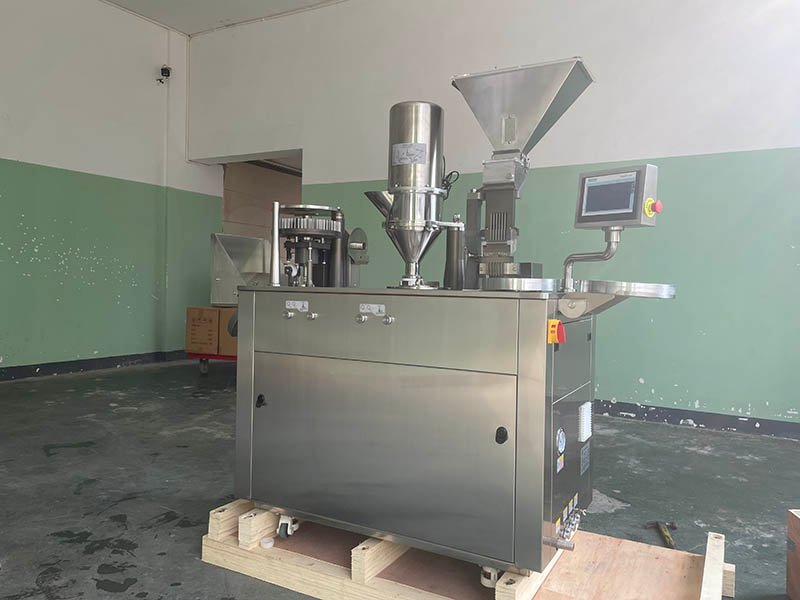
Factory floor reality: the price gap between suppliers is in the components you can’t see in a brochure photo.
Chinese vs European Pricing: The Honest Comparison
European tamping-pin machines (Bosch/Syntegon, IMA, MG2 class) in comparable output ranges quote at USD 80,000–250,000+ — three to five times Chinese pricing, sometimes more once change parts are included. What the premium buys: longer documented MTBF, deeper local service networks in Europe/North America, and established validation history with Western regulators. What it does not buy: fundamentally different dosing physics — the tamping pin principle is identical.
The rational split we see among our own customers: companies supplying regulated Western markets under tight timelines sometimes carry the European premium for auditor familiarity; manufacturers in emerging and mid-regulation markets, CMOs, and nutraceutical brands overwhelmingly choose Chinese machines and invest the difference in molds, peripherals, and working capital. A deeper treatment of this trade-off is in our Chinese vs European capsule filling machine comparison.
Five Hidden Costs That Ambush First-Time Buyers
1. Mold sets quoted separately. The classic move: a headline price with zero or one mold set, with each additional size quoted after you’ve committed. Specify every capsule size in your RFQ.
2. Trading company markup. Alibaba-front trading companies resell factory machines with a margin and no engineering capability. Ask for the factory’s legal name and export license; verify it matches who you’re paying.
3. Voltage conversion. Standard build is 380V 50Hz three-phase. 60Hz markets (Americas, parts of Asia) need this specified at order — retrofitting after arrival costs far more than the factory option.
4. Commissioning support. Video-guided installation is typically free; an on-site engineer costs travel + daily rate. Clarify which is included before, not after, the machine ships.
5. Consumables and wear parts. Tamping pins, springs, and segment O-rings are wear items. A supplier who includes a first-year spare parts kit (HIJ’s standard practice) saves you both money and the 4–6 week wait for parts mid-production.
Payment Terms and Lead Time
Standard terms from established Chinese factories: 30–50% deposit with order, balance before shipment against the FAT video showing your machine running your powder. Lead time for the 48,000/hour class is 25–45 days from deposit. Letters of credit are accepted by larger factories for higher-value orders but add bank costs both sides; T/T remains the norm at this price level.
One negotiating reality worth knowing: capsule filler margins at factory-direct prices are thinner than buyers assume. Pushing a quote down 15% usually doesn’t produce a cheaper machine — it produces the same headline with quietly downgraded internals. Negotiate scope (molds, spares, commissioning) rather than the base number.
Every month I see our own machines quoted back to overseas buyers by trading companies at several thousand dollars above our factory price — same machine, same crate, one extra invoice in the middle. The buyers who pay it aren’t careless; they simply never asked the one question that exposes the layer: “What is the legal name of the manufacturing factory, and can I video-call the workshop?” A factory answers in minutes. A trader stalls.
My second piece of advice: judge quotations by what they itemize, not what they total. The cheapest total I’ve ever been asked to match excluded molds, dust collector, and packing — line-items that turned a $15,000 headline into $21,000 at contract. An honest quote is longer, not shorter.
Frequently Asked Questions
Why do quotes for the same machine class vary so much?
Three reasons: scope (how many mold sets and accessories the “base price” includes), channel (factory-direct versus trading company markup), and build specification (enclosed versus open dosing station, imported versus domestic bearings, PLC brand). Two quotes USD 4,000 apart can describe genuinely different machines — or the identical machine with a middleman. Always compare itemized quotations line by line.
Is a used or refurbished capsule filling machine worth considering?
Rarely, at this price level. A used European machine still costs more than a new Chinese machine, arrives with worn cams and pins that directly degrade dosing accuracy, and comes without warranty, documentation package, or guaranteed change-part availability. The economics that justify buying used industrial equipment collapse when a new, warrantied machine with IQ/OQ documentation costs under USD 25,000.
What does shipping a capsule filling machine cost?
A 48,000-capsules/hour machine weighs about 800 kg and ships in an export-grade plywood crate as LCL sea freight, typically USD 800–2,500 to major ports depending on destination and current freight rates. Air freight is possible but usually triples the cost. Inland delivery, import duty, and local VAT are additional and vary by country — ask your quote to state FOB, CIF, or DDP explicitly.
How much should I budget for annual operating costs?
Direct machine operating costs are modest: about 5 kW power draw, routine lubrication oil, and wear parts (tamping pins, springs, seals) typically a few hundred dollars per year under single-shift use. The dominant real costs are labor (one operator) and empty capsules. Budget a first-year spare parts kit if your supplier doesn’t include one, and confirm wear-part pricing before purchase — it varies more between suppliers than machine price does.
Does HIJ publish its actual prices?
Yes. The NJP-800C base configuration and every optional accessory are priced openly on the powder capsule filling machine product page, and itemized formal quotations are returned within 24 hours. Published pricing is deliberate policy: it removes the quote-games that dominate this industry and lets engineering teams budget before ever contacting sales.
HIJ Machinery (legal name: Wenzhou Trustar Machinery Technology Co., Ltd) is a pharmaceutical packaging machinery manufacturer founded in 2004 in Rui’an, Wenzhou, Zhejiang, China, selling factory-direct to B2B customers in more than 30 countries. Equipment is CE-marked, built to ISO 9001 manufacturing standard, and designed cGMP-ready, with transparent published pricing and IQ/OQ documentation support.
This article was written and reviewed by Forester Xiang, Founder & Chief Engineer of HIJ Machinery, based on 20+ years of encapsulation engineering experience and 100+ pharmaceutical facility audits.
Every line priced, nothing hidden: machine, molds, accessories, packing, and freight to your port. Compare it against any quote you’re holding.
Request Itemized Quote