A powder capsule filling machine works in six automated stations: it orients empty capsules body-down, separates cap from body using vacuum, doses powder into the body — on tamping pin machines by compacting powder into a slug through five progressive tamping stations inside a rotating dosing disc — rejects defective capsules, rejoins and locks the two halves, then ejects finished capsules while compressed air cleans the segment bores. On an intermittent-motion machine such as the HIJ NJP-800C, this complete cycle repeats 800 times per minute with fill-weight accuracy of about ±3.5%.
- Fill weight is decided at the dosing station: slug density = powder bed height × tamping pressure × dosing-disc bore volume.
- Vacuum separation is the most common failure point on poorly maintained machines — separation rate depends on vacuum level and capsule quality.
- Operators control four parameters: turret speed, tamping depth, powder bed height, and vacuum pressure. Everything else is mechanical geometry.
- Rejection logic before locking is what protects the ≥99% qualified rate — machines without it pass defects downstream to your blister line.
Most equipment descriptions stop at “the machine fills powder into capsules.” That is not enough information to operate one, troubleshoot one, or write a URS for one. This article walks through the full mechanical sequence of an automatic tamping pin capsule filler station by station, explains what physically determines fill-weight accuracy, and covers the parameters your operators will actually adjust in production.
If you first want the category overview — machine types, automation levels, and buying criteria — start with our guide to what a powder capsule filling machine is, then come back here for the mechanics.
The Six-Station Cycle, Step by Step
An intermittent-motion capsule filler is built around a rotating turret carrying segment blocks — precision-drilled plates holding rows of capsules. Each index of the turret advances every capsule row to the next station, so all six operations happen simultaneously on different rows. Here is what occurs at each stop.
Capsule Feeding & Orientation
Empty capsules pour from the hopper into a magazine, then descend through orientation rails. The rails exploit the diameter difference between cap and body: as capsules tumble through, spring fingers flip every capsule body-down before it drops into the upper segment bore. A horizontal fork then pushes each aligned capsule fully into position.
Feeding faults here — inverted or jammed capsules — usually trace to capsule dimensional quality or humidity, not the machine. Reputable capsule suppliers matter more than most buyers assume.
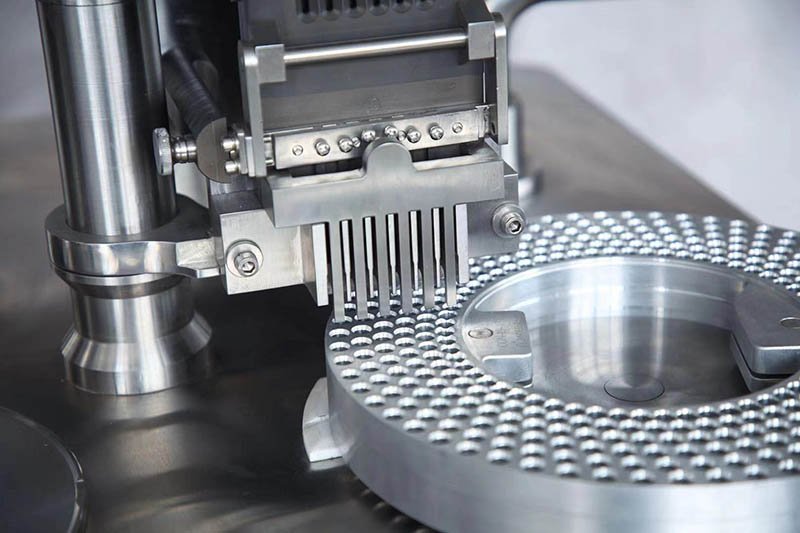
Orientation rails align every capsule body-down before insertion into the segment bores.
Vacuum Separation
The segment block splits into upper (cap) and lower (body) halves. Vacuum drawn through the lower segment — typically −0.02 to −0.06 MPa — pulls the capsule body downward out of the cap, which is retained by the upper segment’s smaller bore diameter.
Separation rate is the first quality gate. Too little vacuum leaves capsules unseparated; too much deforms capsule rims. Unseparated capsules are detected and carried past the dosing station without filling, then diverted at rejection.
Powder Dosing — Where Fill Weight Is Made
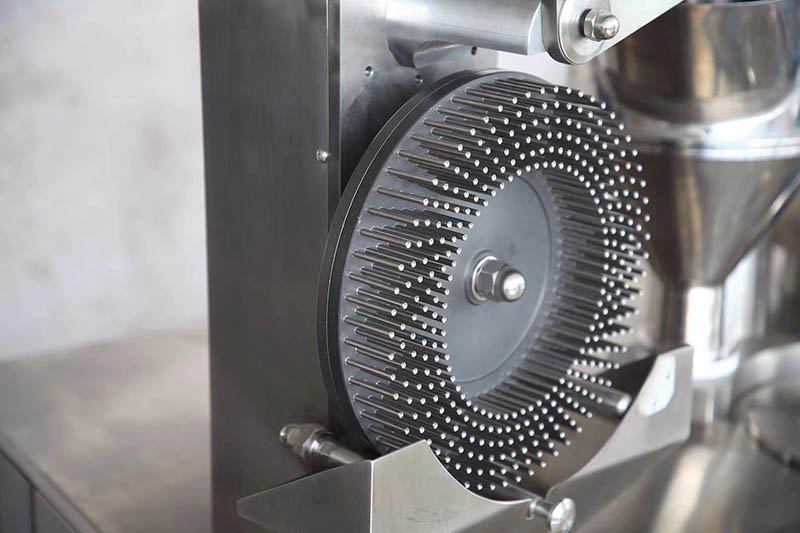
The lower segments travel under the dosing station. Inside it, a powder hopper maintains a controlled powder bed on top of a rotating dosing disc — a hardened stainless plate drilled with bores whose diameter matches the capsule size and whose depth (disc thickness) sets the slug volume.
As the disc indexes, each bore passes under five progressive tamping stations. At every station, a group of spring-loaded tamping pins descends and compresses the powder in the bore a little further, drawing fresh powder in from the bed above. Five light compressions instead of one heavy strike is the core trick: it builds a slug of uniform density regardless of how inconsistently the powder flows, without over-compacting it into a tablet that would resist dissolution.
At the sixth position — the transfer station — ejection pins push the finished slug down through the bore directly into the capsule body waiting below. A scraper levels the bed, and the bore returns empty for the next cycle.
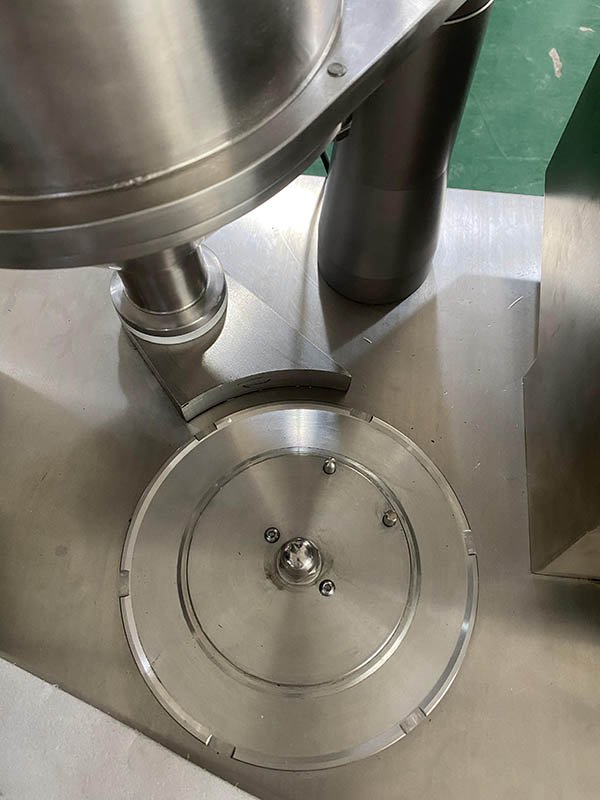
The dosing station of the NJP series: dosing disc, tamping pin groups, and powder bed — the assembly that determines ±3.5% accuracy.
Defect Rejection
Before locking, sensors identify capsules that failed separation or arrived damaged. These are ejected into a reject chute rather than locked — which is what keeps empty or double-capped capsules out of your finished lot and protects the ≥99% qualified rate. On machines without pre-lock rejection, those defects are only caught (if at all) by the checkweigher after polishing.
Locking
The upper segment realigns over the lower, and locking pins press each cap and filled body together to the capsule manufacturer’s specified closed length, engaging the locking rings molded into the capsule shell. Closing force is adjustable: too little leaves loose caps that open in the polisher; too much splits capsule rims.
Locking pins press cap and body to the specified closed length before ejection.
Ejection & Die-Hole Cleaning
Finished capsules are pushed out of the segments into the discharge chute — feeding either a collection container or an inline capsule polisher. Simultaneously, compressed air blasts through every segment bore while the dust collection system draws away residue, so each bore starts the next cycle clean. This per-cycle cleaning is what prevents powder buildup from degrading accuracy across a long shift.
What Physically Determines Fill-Weight Accuracy
Understanding the dosing mechanics tells you exactly which variables move fill weight — useful both for operator training and for troubleshooting weight drift:
| Variable | Effect on Fill Weight | Who Controls It |
|---|---|---|
| Dosing disc thickness | Sets base slug volume — the coarse adjustment, chosen per formulation | Setup engineer (disc selection) |
| Tamping pin depth | Fine weight adjustment — deeper tamping = denser slug = more weight | Operator, per station |
| Powder bed height | Low bed starves the bores; sensors keep it in range via the feed system | Automatic + operator check |
| Powder bulk density & flowability | The dominant external variable — batch-to-batch blend variation shows up directly as weight variation | Your formulation/blending process |
| Turret speed | Extreme speeds shorten powder refill time between tamps; run 85–95% of rated max for stability | Operator via HMI |
Note what is not on the list: the machine cannot fix a badly blended or highly variable powder. Dosing systems meter volume and density — if the density entering the hopper swings, weight swings. This is why we insist on pre-shipment test runs with the customer’s actual formulation, and why in-process weight checks every 15–30 minutes remain standard practice even on well-tuned machines.
How the Dosator Alternative Differs
On dosator machines, there is no disc and no tamping pins. A hollow metering tube plunges vertically into the powder bed; powder enters the open tube bottom and is lightly pre-compressed by an internal piston. The tube then lifts, swings over the capsule body, and the piston ejects the plug. Dosing volume is set by piston height inside the tube.
The mechanism is elegant and fast, but the powder itself must hold together as a plug during transfer — which is exactly what free-flowing, well-granulated pharmaceutical powders do and what cohesive nutraceutical blends do not. That single difference explains the market split described in our machine overview guide: dosators for large-scale granulated pharma, tamping pin systems for everyone else.
Supporting Systems That Keep the Cycle Running
Vacuum pump. Dedicated pump supplying the separation station; its gauge is the first thing to check when separation rate drops.
Dust collector. Draws airborne powder from the dosing area and die-hole cleaning, recovering product and keeping the enclosure clean. On the NJP-800C, the dosing station and turret are fully enclosed, so collection happens at the source rather than from open room air.
Lubrication system. A pressure oil pump continuously lubricates the cam mechanism driving all station motion — the difference between a machine that holds accuracy in year five and one that develops mechanical play.
PLC and HMI. The touchscreen exposes speed control, batch counters, alarm history, and station diagnostics. Frequency-conversion drive lets the operator find the stable speed for each formulation instead of running a fixed-speed motor at its single design point.
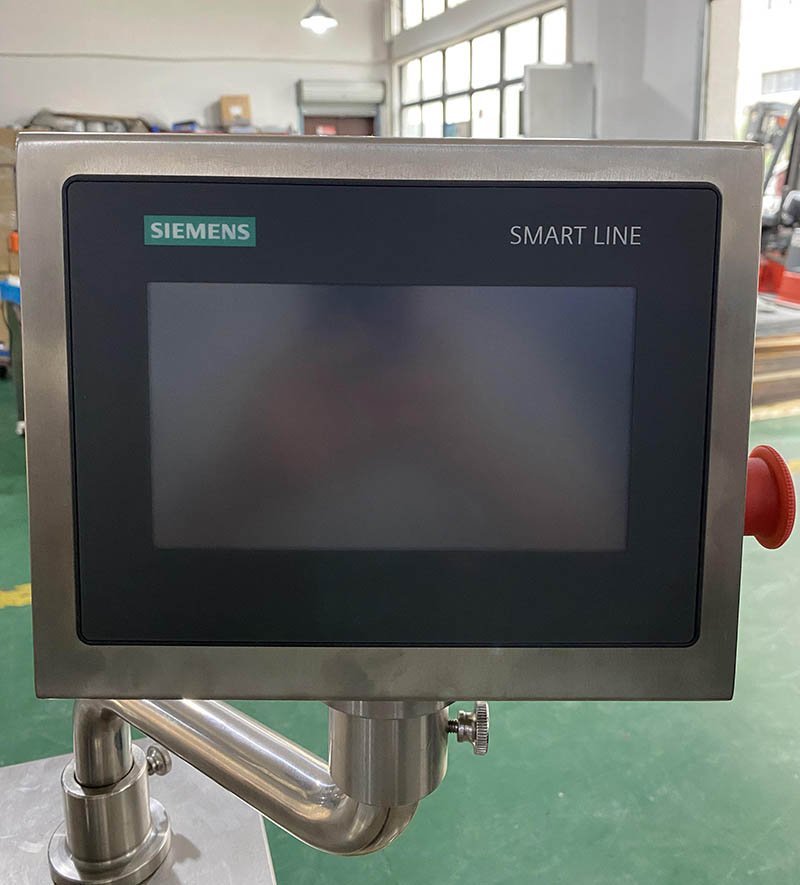
The HMI exposes the four parameters operators actually adjust: speed, counts, alarms, and station status.
When customers call about weight drift, the instinct is always to suspect the machine. In my experience, the overwhelming majority of these cases trace back to two causes: a new powder batch with different bulk density, or a powder bed running low because the feed system was not refilled on schedule. Before adjusting a single tamping pin, weigh twenty capsules, check the bed height, and ask what changed in the blend.
The machine’s job is to repeat the same volumetric operation millions of times. When it is mechanically sound — cam lubricated, pins moving freely, disc undamaged — the repeatability is there. What varies is what you feed it. Operators who internalize that diagnose problems in minutes instead of shifts.
Frequently Asked Questions
Why does the tamping system use five stations instead of one?
Five light compressions build slug density gradually, drawing fresh powder into the bore between tamps. A single heavy compression would trap air, create density gradients, and over-compact the top of the slug — producing weight variation and slower capsule dissolution. Progressive tamping is what lets the system stay accurate on powders with poor or inconsistent flow.
What happens to capsules that fail to separate?
Unseparated capsules pass the dosing station without receiving powder — the closed cap physically blocks filling — and are then identified and diverted at the rejection station before locking. They exit through the reject chute and can be returned to the hopper if undamaged. A rising rejection rate usually signals low vacuum pressure or a capsule lot with tight caps.
How is fill weight adjusted on a tamping pin machine?
Coarse adjustment is the dosing disc: a thicker disc gives a larger bore volume and heavier fill. Fine adjustment is tamping pin depth at each of the five stations, set from graduated dials — deeper tamping compresses a denser, heavier slug. Operators verify by weighing sample capsules and trimming pin depth until the target weight centers in the tolerance band.
Does the powder get compressed into a hard tablet inside the capsule?
No. The slug is compacted only enough to hold together during transfer — far below tablet compression forces. Inside the capsule it remains a soft plug that breaks apart readily on contact with liquid, so dissolution behavior stays close to loose powder. If dissolution testing shows slowing, tamping depth can be reduced at the cost of slightly wider weight variation.
Can the same machine fill pellets or granules instead of powder?
Yes, with the appropriate dosing unit. Pellet and tablet dosing attachments replace or supplement the powder dosing station, enabling combination fills such as powder plus pellets in one capsule. On the NJP-800C these are factory options specified at order time. Liquid filling, however, requires a different machine class with band sealing — see the liquid capsule filling machine for oils and liquid formulations.
HIJ Machinery (legal name: Wenzhou Trustar Machinery Technology Co., Ltd) is a pharmaceutical packaging machinery manufacturer founded in 2004 in Rui’an, Wenzhou, Zhejiang, China, serving B2B customers in more than 30 countries. Its NJP series tamping pin capsule fillers are CE-marked, built to ISO 9001 manufacturing standard, and designed cGMP-ready, with IQ/OQ documentation support for customer-executed validation.
This article was written and reviewed by Forester Xiang, Founder & Chief Engineer of HIJ Machinery, based on 20+ years of encapsulation engineering experience and 100+ pharmaceutical facility audits.
Send 2–3 kg of your formulation — we run it on the NJP-800C, film the test, and send you the weight data before you commit to anything.
Request a Powder Trial