Validating a powder capsule filling machine means executing four documented stages at your facility: DQ (the machine’s design meets your user requirements), IQ (it is installed per specification — utilities, materials, documentation verified), OQ (every function operates across its range — speed, separation, rejection, alarms), and PQ (it consistently produces capsules meeting weight-uniformity acceptance criteria with your actual product). The machine supplier cannot perform validation for you — no equipment is “GMP certified” — but a cGMP-ready machine like the HIJ NJP-800C ships with the FAT records, material certificates, and IQ/OQ templates that make execution a matter of weeks, not months.
- Validation responsibility divides cleanly: the supplier provides evidence about the machine; your facility proves the process. Confusing the two is the root of most delays.
- The capsule-filler-specific OQ tests are separation rate, rejection challenge, speed range, and alarm verification — generic OQ templates miss them.
- PQ acceptance leans on weight uniformity across three runs at production speed with your product, bracketing your capsule sizes.
- Write the URS before requesting quotes: it becomes your DQ checklist and turns supplier claims into verifiable commitments.
We’ve published a general IQ/OQ/PQ guide for pharmaceutical equipment covering the framework, terminology, and regulatory basis. This article applies that framework to one machine type — the powder capsule filler — because encapsulation has specific test points, specific acceptance criteria, and specific audit findings that generic validation templates consistently miss.
Who Does What: The Division of Responsibility
The single most useful thing to establish before purchase is which side of the validation each deliverable sits on:
| Deliverable | Supplier (HIJ) Provides | Your Facility Executes |
|---|---|---|
| URS | Reviews and confirms compliance point-by-point | Writes it — your process, your requirements |
| DQ | Technical file, specifications, CE marking, ISO 9001 manufacturing evidence | Documents that the design satisfies the URS |
| FAT | Runs machine with your powder, delivers weight data + video | Witnesses (on-site or remote) and accepts |
| IQ | Material certificates, electrical diagrams, utility specs, manuals, IQ template | Verifies installation at your site against them |
| OQ | OQ template with machine-specific test points, engineering support | Executes function tests, records results |
| PQ | Parameter guidance for your formulation | Runs and accepts — entirely yours; it proves your product process |
| Cleaning validation | Disassembly procedures, contact part drawings | Develops and proves the cleaning method |
Notice the pattern: the supplier’s column is evidence and templates; yours is execution and acceptance. A supplier offering to “do your validation” is offering to sign your homework — regulators assess whether your quality system controlled the process, and outsourced signatures don’t survive that question. What a good supplier legitimately compresses is the paperwork burden: the documentation package described in point 9 of our 12-point selection checklist is precisely the input stack for IQ and OQ.
URS: The Document That Determines Everything Downstream
The User Requirements Specification is where validation actually begins — before any quotation. For a powder capsule filler, a workable URS fits on two pages and covers: product scope (formulations, capsule sizes, target fill weights and tolerances), capacity (capsules per shift, sustained not peak), material requirements (304/316L contact parts with certificates), functional requirements (separation, pre-lock rejection, auto-pause, alarm logging), utilities (voltage/frequency, compressed air, vacuum), environment (dust containment, noise <75 dBA), and documentation deliverables (FAT, IQ/OQ templates, diagrams, spare parts list).
Every line should be verifiable — “high accuracy” is not a requirement; “fill weight within ±3.5% at rated speed on Formulation X” is. When the URS is written this way, DQ becomes a checkbox exercise against the supplier’s technical file, and dishonest quotations disqualify themselves in writing.
IQ: Installation Qualification for a Capsule Filler
IQ verifies the machine that arrived is the machine that was specified, installed correctly. The capsule-filler-specific items beyond the generic checklist:
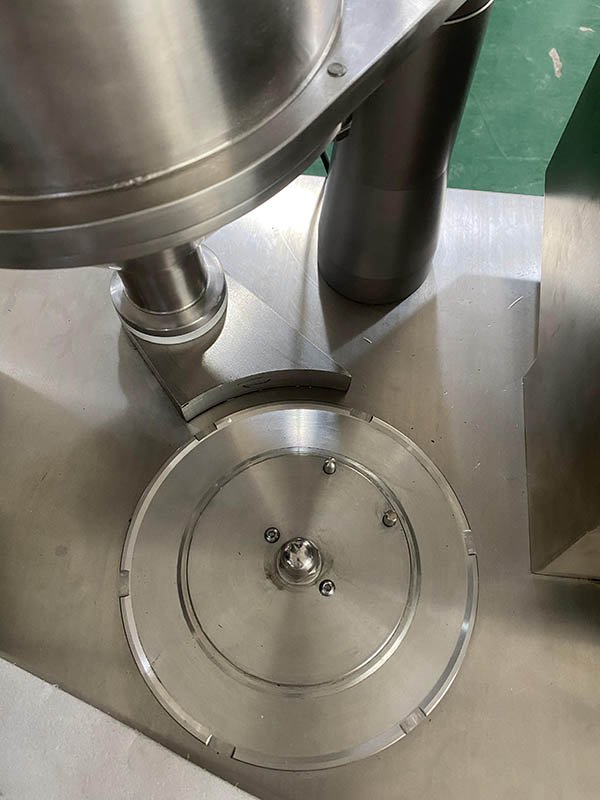
Contact part verification. Match material certificates to physical parts — dosing disc, tamping pins, hopper, segments — by part number. This is the item auditors spot-check first.
Change part inventory. Every mold set received, marked, and matched to its capsule size against the packing list.
Utility connections. Voltage and rotation direction confirmed (three-phase machines can run backwards if two phases are swapped — the turret indexes wrong immediately), compressed air pressure and dryness in range, vacuum pump commissioned.
Documentation file assembled. FAT records, certificates, diagrams, and manuals filed as the IQ evidence base. If the FAT was run with your powder — standard practice on the NJP-800C — those weight results become reference data for OQ.
OQ: The Four Tests Generic Templates Miss
OQ proves each function operates across its intended range, with no product or with placebo. Beyond the standard power-up, E-stop, and alarm checks, a capsule filler OQ must challenge:
1. Speed range qualification. Run at minimum, nominal, and maximum intended speeds; verify stable operation and correct counting at each. You are qualifying the range you’ll actually use — which is why oversizing a machine (running it far below rated speed) quietly complicates OQ.
2. Separation rate. With empty capsules at nominal speed, measure the percentage successfully separated across the vacuum operating window. Establishes the baseline that future drift gets compared against.
3. Rejection challenge. Deliberately introduce unseparated and damaged capsules; verify every one is diverted before locking. Auditors love this test because it challenges a claim rather than observing normal operation.
4. Interlock and pause verification. Open each guard during operation (machine must stop), run powder and capsule hoppers to their low-level sensors (machine must pause), and confirm each event appears in the alarm log.
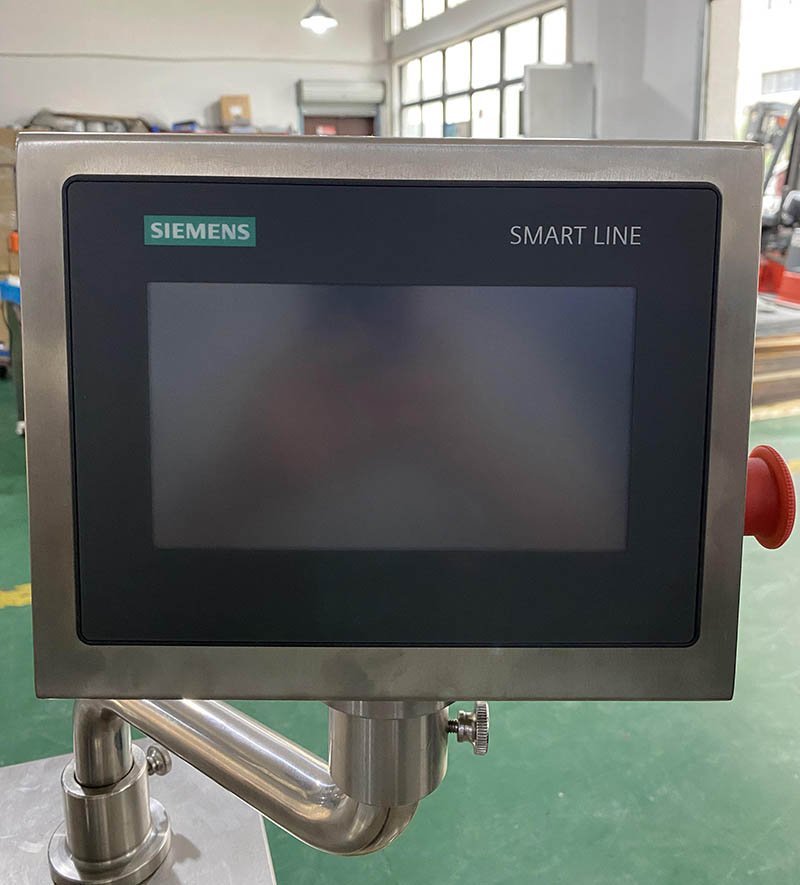
OQ lives at the HMI: speed setpoints, alarm logs, and counters provide the objective evidence each test records.
PQ: Proving the Process With Your Product
PQ answers the only question regulators ultimately care about: does this machine, in your facility, with your formulation and your operators, consistently make capsules that meet specification? The standard design is three consecutive production-scale runs at nominal speed, sampling for:
Weight uniformity — individual capsule weights sampled through each run (beginning, middle, end), assessed against your specification and pharmacopeial weight-variation criteria such as USP <905> uniformity of dosage units. Qualified rate — rejects as a percentage of throughput, compared to the ≥99% design baseline. Physical quality — locked length, no dents or splits, dissolution samples if your specification requires. Bracket your capsule sizes: qualify the smallest and largest you run, and intermediate sizes are covered by rationale.
PQ is also where powder behavior — the subject of our flowability guide — either validates your formulation work or exposes it. A machine that passed OQ flawlessly will still fail PQ on a segregating blend; that failure belongs to the process, not the equipment, and fixing it at PQ costs ten times what fixing it at the pre-purchase powder trial would have.
The Audit Findings That Keep Recurring
Across facility audits, the same encapsulation findings repeat: material certificates that can’t be matched to physical parts; OQ protocols that never challenged the rejection function; no requalification after a mold size change or machine relocation; cleaning validation that ignored the dosing disc bores (the hardest surface to clean and the easiest to swab-test); and “GMP certificates” for equipment presented as compliance evidence — a document class that does not exist in any regulation, and whose presence in a file signals a supplier who tells customers what they want to hear. The broader regulatory context is covered in our guide to meeting WHO GMP and cGMP requirements.
Having sat on both sides of facility audits for two decades, the finding I see most is the humblest one: a folder of beautiful certificates that nobody can match to the physical parts on the machine. The fix costs nothing at delivery — walk the machine with the certificate file on day one, and write the part numbers into your IQ as you go. Six months later, that hour is the difference between closing an audit question in five minutes and opening a CAPA.
The other habit I push on every customer: treat the FAT as the first page of your validation, not a sales formality. When we run your powder at the factory and send twenty consecutive weights, that data is your OQ reference baseline — teams that use it typically save a week of on-site qualification time, because they arrive already knowing what “normal” looks like for their formulation on their machine.
Frequently Asked Questions
How long does capsule filling machine validation take?
With a complete supplier documentation package, a typical timeline is one to two weeks for IQ and OQ combined, then one to three weeks for PQ depending on run lengths and lab turnaround for weight and dissolution testing. The schedule killers are missing documents (certificates, diagrams) that must be requested from the factory mid-protocol, and PQ failures caused by formulation flow problems that should have been caught in a pre-purchase powder trial. Facilities starting from supplier IQ/OQ templates rather than blank pages routinely halve the paperwork time.
Can the machine supplier perform validation for us?
No — and be cautious of any supplier who offers to. Validation demonstrates that your facility’s quality system controls the process, so protocols must be approved, executed, and accepted by your organization. What a supplier legitimately provides is the evidence layer: FAT records, material certificates, technical documentation, IQ/OQ templates, and engineering support during execution. That support model is exactly what HIJ supplies with every machine, and it is the difference between validation taking weeks versus months.
Do we need to revalidate after changing capsule size or moving the machine?
A change-control assessment decides, but the working norms are: a mold change to a size already bracketed in your PQ needs only documented changeover verification and startup checks; a new size outside your bracket needs a PQ extension for that size; and physically relocating the machine triggers partial requalification — re-verify installation (IQ elements: level, utilities, rotation) and re-run key OQ functions, with a PQ confirmation run if the environment changed materially (different room, HVAC, or humidity regime).
What weight variation acceptance criteria apply to capsules?
Your product specification governs, and it is typically built to satisfy pharmacopeial uniformity-of-dosage-units requirements such as USP <905>, which assesses either weight variation or content uniformity depending on the product. In practice, encapsulation teams run tighter in-process limits than the pharmacopeial gate — commonly the machine’s ±3.5% dosing band around target weight — so that routine production sits comfortably inside release criteria rather than testing against their edge.
What is a DQ for a capsule filling machine in practice?
Design Qualification is a documented comparison: each URS requirement on one side, the supplier’s evidence on the other — technical specifications, CE marking, contact-part materials, functional descriptions, and the FAT plan. For a standard (non-custom) machine like the NJP-800C, DQ is usually a one-day desk exercise completed before or alongside purchase, and its real value is forcing the URS to exist: machines bought without one get validated against requirements invented after the fact, which auditors recognize instantly.
HIJ Machinery (legal name: Wenzhou Trustar Machinery Technology Co., Ltd) is a pharmaceutical packaging machinery manufacturer founded in 2004 in Rui’an, Wenzhou, Zhejiang, China, serving B2B customers in more than 30 countries. Equipment is CE-marked, built to ISO 9001 manufacturing standard, and designed cGMP-ready; every machine ships with FAT records, material certificates, and IQ/OQ templates supporting customer-executed validation.
This article was written and reviewed by Forester Xiang, Founder & Chief Engineer of HIJ Machinery, based on 20+ years of encapsulation engineering experience and 100+ pharmaceutical facility audits.
Request the sample IQ/OQ templates, FAT protocol, and documentation list — see exactly what lands on your desk before you commit to anything.
Request Sample Documents