Meeting WHO GMP & cGMP Standards in Pharmaceutical Packaging: A Practical Guide
In the pharmaceutical industry, compliance isn’t just a box to tick—it’s the foundation of patient safety and market access. Navigating the complex requirements of WHO Good Manufacturing Practices (GMP) and Current Good Manufacturing Practices (cGMP) can be daunting, especially in the critical final stage of packaging. A single non-compliant component can jeopardize an entire production batch and lead to devastating audit failures.
To meet WHO GMP and cGMP standards in pharmaceutical packaging, companies must implement a five-point compliance strategy: 1) Utilize machinery with a hygienic, easy-to-clean design and non-reactive contact materials. 2) Ensure full material traceability with certified documentation. 3) Maintain precise process control validated through IQ/OQ/PQ protocols. 4) Guarantee data integrity with systems compliant with 21 CFR Part 11. 5) Partner with a supplier who provides a comprehensive documentation package to prove compliance for every component.
Over my 20 years, I’ve witnessed brilliant pharmaceutical projects stalled simply because their packaging equipment couldn’t pass WHO GMP or cGMP audits. Buyers focus on speed and price, only to realize too late that their supplier cannot provide the rigorous validation documentation (DQ, IQ, OQ, PQ) or the sanitary design required. Compliance must be engineered into the equipment’s DNA. At HIJ, we don’t just manufacture machines; we deliver audit readiness. When that auditor walks in, my goal is for you to feel absolute certainty.
– Forester, Founder of HIJ Machinery
Your Practical GMP Packaging Checklist
To demystify the process, we’ve created a practical checklist. Use this as a guide when evaluating your current packaging line or selecting a new equipment partner. Below each point, we explain how HIJ Machinery’s solutions are engineered to help you pass with confidence.
1. Hygienic Machine Design & Construction
The physical design of your equipment is the first thing an auditor will scrutinize. It must be designed to prevent contamination and facilitate thorough cleaning.
- Is the machine frame constructed from high-grade stainless steel (SUS 304/316L)?
- Are product contact parts made of SUS 316L or other certified non-reactive materials?
- Are surfaces smooth, non-porous, and free of sharp corners or “dead spots” where product can accumulate?
- Can the machine be easily disassembled for cleaning and sterilization without special tools?
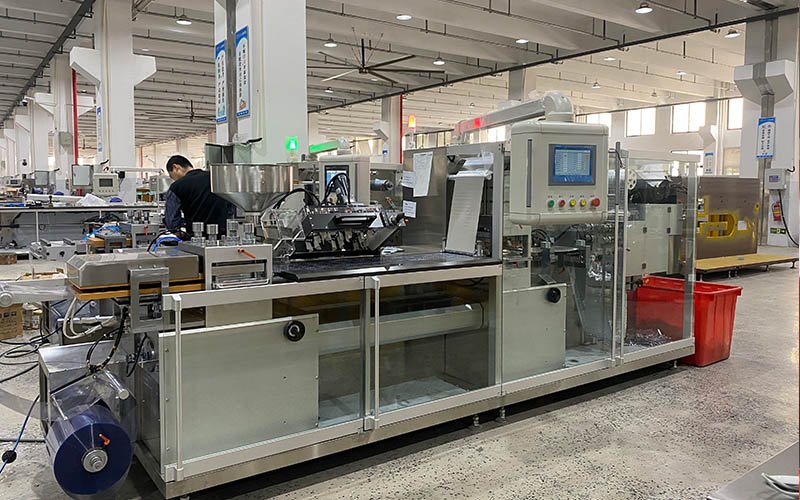
How HIJ Helps: All our pharmaceutical blister machines feature GMP-compliant designs with SUS 316L for all contact parts and SUS 304 for the main body. Our engineering focuses on smooth welds and accessible components to make cleaning and changeovers fast and effective, ensuring you meet the highest sanitation standards.
2. Precise Process Control & Validation
Your process must be controlled, repeatable, and validated to prove it consistently produces a quality product.
- Does the machine offer precise and verifiable control over critical parameters (e.g., sealing temperature, pressure, time, machine speed)?
- Are control systems (PLCs, HMIs) from reliable, globally recognized brands (e.g., Siemens, Omron)?
- Can the supplier provide a complete validation documentation package (DQ, IQ, OQ, PQ)?
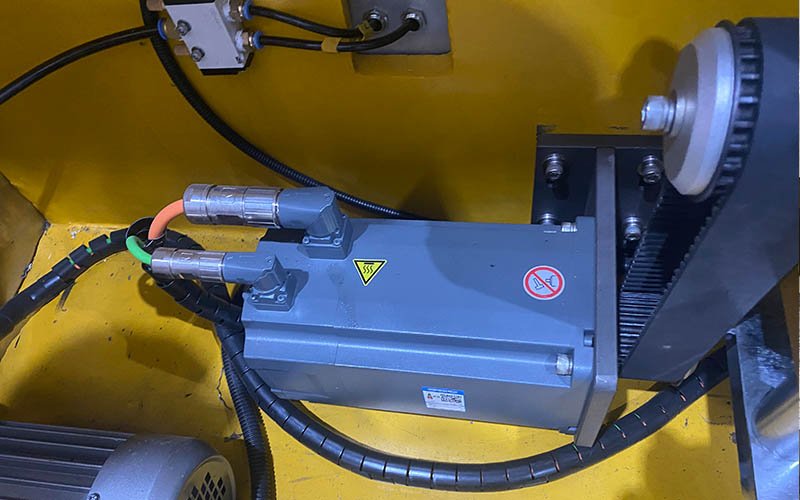
How HIJ Helps: We use world-class Siemens and Omron PLCs for rock-solid process control. Our systems allow for precise parameter setting and locking. Crucially, we provide a full, audit-ready validation package, guiding your team through the entire IQ/OQ/PQ process to prove your machine operates within specified limits.
3. Data Integrity & 21 CFR Part 11 Compliance
In the digital age, how you record and protect your production data is as important as the physical product.
- Does the control system feature secure, multi-level user access (Operator, Supervisor, Admin)?
- Does it generate un-editable, time-stamped audit trails for all actions and parameter changes?
- Are batch reports and production data stored securely and available for review?
How HIJ Helps: Our HMI and control systems are designed to be fully compliant with 21 CFR Part 11. We implement robust user access controls, secure audit trails, and comprehensive electronic batch reporting, giving you ironclad data integrity that meets the strictest FDA and WHO requirements.
4. Comprehensive Documentation & Traceability
If it isn’t documented, it didn’t happen. Auditors require proof for every component and procedure.
- Does the supplier provide material certificates for all product contact parts?
- Is the machine delivered with a complete set of documents (user manual, electrical schematics, pneumatic diagrams, spare parts list)?
- Are calibration certificates provided for all critical instruments?
How HIJ Helps: We call it our “Audit-Ready Documentation Package.” Every machine is delivered with a comprehensive binder containing every document an auditor needs to see, from material traceability certificates to detailed manuals and calibration records. We organize it for you, so you’re prepared from day one.
Beyond the Checklist: Your Partner in Compliance
Meeting GMP standards isn’t just about buying a machine that ticks these boxes; it’s about partnering with a manufacturer who understands the regulatory landscape and embeds compliance into their design and service philosophy. At HIJ Machinery, our role extends beyond manufacturing. We act as your compliance consultants, ensuring that every aspect of your packaging line is robust, defensible, and ready for any audit.
Ready for Audit Certainty?
Stop worrying about compliance and start packaging with confidence. Contact our experts to discuss your project and receive a free compliance assessment for your packaging needs.
Get Your Compliance-Ready QuoteFrequently Asked Questions
What is the main difference between GMP and cGMP?
GMP (Good Manufacturing Practices) refers to the foundational regulations. The ‘c’ in cGMP stands for ‘Current’, implying that the practices must be up-to-date with the latest industry standards and technology. Essentially, cGMP requires companies to be proactive in using modern systems and technologies to ensure quality, not just adhering to an old set of rules. HIJ machines are built to cGMP standards, incorporating modern control systems and design principles.
Can my older packaging equipment be made GMP compliant?
It can be very difficult and expensive. Older machines often lack the fundamental hygienic design (e.g., they may have dead spots, use non-compliant materials) and their control systems may not support features like audit trails required for 21 CFR Part 11. While minor upgrades are possible, achieving full cGMP compliance often requires investing in new equipment designed for it from the ground up.
How long does the validation process (IQ/OQ/PQ) typically take?
The timeline varies depending on the complexity of the machine and the customer’s internal protocols. However, by providing a comprehensive, well-organized documentation package and experienced technical support, HIJ can significantly shorten the process. Typically, IQ/OQ can be completed within a few days of installation, with PQ following once production batches are run.
What specific documents will I receive with a HIJ machine?
You will receive a complete documentation package, including: Design Qualification (DQ), Installation Qualification (IQ) and Operational Qualification (OQ) protocols, user and maintenance manuals, electrical and pneumatic diagrams, a certified spare parts list, and material certificates (e.g., for SUS 316L) for all product contact components.