Label application · Format fit · Line integration
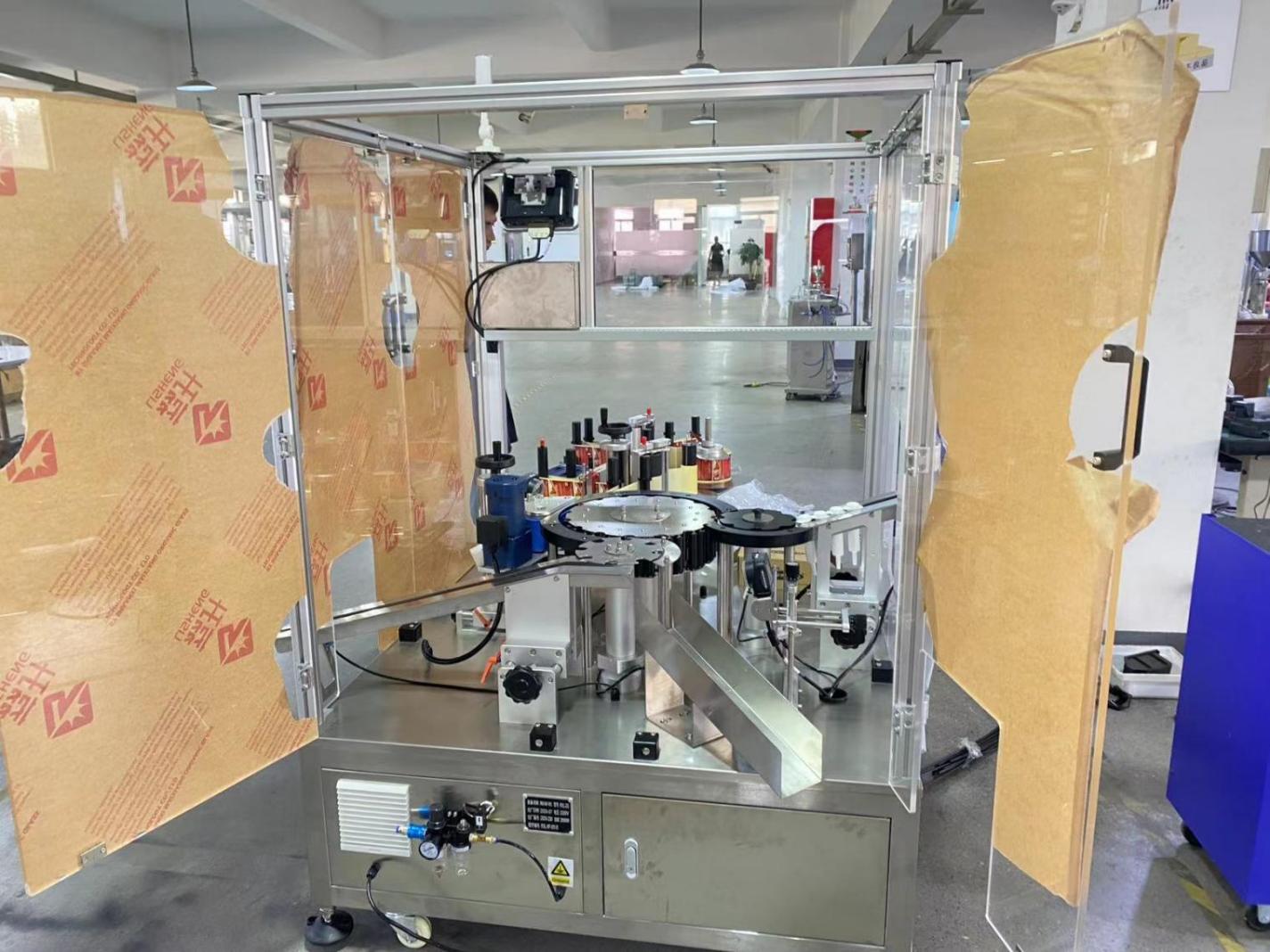
A syringe labeling machine positions a syringe and applies a label to its barrel. Select it around the finished syringe geometry, approved label layout, required inspection and sustainable line output. Filling, plunger-rod assembly, printing and label verification are separate functions unless the quotation explicitly combines them.
This guide helps packaging engineers and equipment buyers specify the downstream labeling step without losing sight of the filling line it must serve.
Specify the label position on the assembled syringe
Start with a dimensioned drawing of the syringe as it reaches the labeler. Include the barrel, finger flange, tip cap, fitted rod or other attachments, and the surfaces available for support. A nominal volume such as “5 ml” does not define the barrel diameter, handling length or labeling area.
On the label drawing, identify the wrap direction and the dimension parallel to the barrel. Mark the permitted axial position, seam or overlap, and any angular relationship to the flange or existing markings. Keep required graduations and inspection windows visible according to the approved pack design.
Axial positionWhere the label sits along the barrel, measured from an agreed physical datum.
Angular positionWhere the wrap starts around the barrel relative to features such as the flange or markings.
These are different requirements. A machine can place a label consistently along the barrel without controlling where its seam lands around the circumference. If the artwork needs a fixed angular relationship, request orientation control explicitly. Nautilus Systems’ published syringe-labeling description, for example, distinguishes axial positioning from optional radial orientation. That illustrates a specification question, not an automatic feature of the HIJ reference configuration.
Bring the real label roll, not just a PDF
The applicator must handle the actual face material, adhesive, liner and die-cut shape. Supply the roll winding direction, core diameter, maximum roll diameter, gap between labels and the print area. For transparent labels, confirm how the machine detects each label and how inspection distinguishes it from the barrel.
Ask the supplier to test placement, wrapping and adhesion using production-equivalent syringes and label stock. Include the surface condition expected after filling and handling. Wrinkling, lifted edges or a label spanning an unsuitable shape should be evaluated with the real materials before tooling is accepted.
Separate label application from print and inspection scope
“Automatic labeling” can mean applying preprinted labels, printing variable information before application, or applying a label and checking it afterward. These are not equivalent quotations. Specify each required operation and the action the line must take when that operation fails.
- PresentSupport and orient the assembled syringe.
- ApplyDispense and wrap the approved label.
- VerifyPerform the checks included in the project.
- TransferRoute accepted units and segregate rejects.
| Function | Evidence to request | Do not confuse it with |
|---|---|---|
| Label presence | A missing-label challenge detected under the agreed conditions. | Checking that the artwork or batch information is correct. |
| Print and code checking | Detection of the agreed missing, wrong or unreadable test patterns. | A sensor that only sees a label, or a camera that only records images. |
| Position and appearance | Measurements of axial position and skew; angular position, overlap and wrinkles where specified. | A general claim that the machine labels accurately. |
| Reject handling | The challenged unit reaches the reject destination, with the agreed confirmation, counts and restart behavior. | An alarm without physical segregation of the affected syringe. |
Plunger-rod insertion, backstop assembly and other syringe assembly operations also need their own scope. If they are required, ask where each operation takes place and how the assembled syringe reaches the labeler. Include those fitted components in the handling trial instead of assuming they leave the labeling process unchanged.
Read the documented HIJ labeler configuration as a starting point
The technical package for the DZA200 plastic syringe filling and capping platform includes a separate automatic syringe labeling configuration. The following values are reference limits from that package, not a universal capability range or a current fixed-price offer.
| Item | Documented value | Selection consequence |
|---|---|---|
| Syringe diameter | 8–20 mm | Confirm the barrel section being supported and labeled. |
| Syringe length | Up to 90 mm | Agree the measurement datum and which fitted components are included. |
| Label dimensions | Length 20–60 mm; height up to 80 mm | Identify wrap and axial directions on the drawing before matching these fields. |
| Label roll | Maximum outside diameter 300 mm; core diameter 76 mm; label gap at least 3 mm | Check the full roll, liner handling and winding direction. |
| Labeling speed | 60–100 pieces/minute, depending on syringe size and label length | Establish sustained accepted output with the actual format and specified inspections. |
The package lists label-presence detection, date coding and visual text checking as separately selectable functions. It does not establish automatic inclusion of barcode grading, serialization, angular orientation or reject confirmation. Request those functions explicitly if the project requires them.
Do not combine every maximum in the table into one assumed production format. Syringe length, label height and wrap length describe different geometries; the actual assembled sample determines whether there is sufficient labelable surface and handling clearance. Request a signed configuration drawing for the chosen format.
Match sustained labeling output to the filler
Compare both machines in syringes per minute, using the same product format and acceptance basis. A maximum applicator speed is not the same as accepted output from the complete station with feeding, printing, inspection and discharge operating.
Forester’s My Insight
The DZA200 reference capacity is 3,000–3,900 pieces/hour. Dividing by 60 gives a filling reference of 50–65 pieces/minute. The separate labeler reference is 60–100 pieces/minute, so comparing only the two maximum numbers hides a possible mismatch.
65 in − 60 out = 5 syringes/min accumulating
If a particular trial achieved those two sustained rates, a hypothetical 100-position empty buffer would fill in 100 ÷ 5 = 20 minutes. Those are illustrative operating assumptions, not measured line results or a supplied buffer specification.
The procurement decision is therefore to agree a tested operating point for the complete format, rather than choosing equipment solely because one nameplate says “100/min.” The labeler must also recover from the interruptions that are actually part of the workflow.
Define the stop-and-restart behavior
For an inline arrangement, agree how a full downstream conveyor slows or stops the filler, how label-roll depletion is signaled, and what happens to syringes already between stations. Check that a restart does not release an unverified unit into the accepted-product stream.
For a standalone batch labeler, define the trays or other presentation method, operator loading tasks, batch identification and separate handling of accepted and rejected syringes. It may decouple the two machines, but it adds handling that belongs in the labor and output comparison.
Record accepted units and elapsed time during the agreed trial. State whether changeovers, roll changes, loading delays and rejects are included. Otherwise, two suppliers can report the same “speed” while measuring different parts of the shift.
Use sample trials to settle the expensive questions
Choose trial formats because they challenge the application: the smallest or largest barrel, shortest usable label area, transparent stock, longest wrap, awkward flange orientation or most demanding print layout. Do not assume the format with the largest nominal syringe volume is always the hardest.
For each format, agree the sample quantity, run duration, materials, measurement method and acceptance limits before the trial. These are project inputs, not universal values to copy from a guide.
Run normal production and deliberate challenges
- Placement: measure the label from the defined datum; inspect skew, edge lift, seam and required visible markings.
- Changeover: identify tooling, recipe and label-roll changes, then inspect the first accepted units after setup.
- Detection: introduce agreed missing-label and incorrect-print samples where those functions are purchased.
- Rejection and recovery: follow each challenged syringe to its final destination and verify the restart sequence.
- Line interface: test upstream starvation, downstream blockage and a label-roll change using the agreed safe operating procedure.
Keep the trial record specific: component reference, artwork revision, label-stock reference, machine configuration, operating rate, observations and disposition. A successful run with one label material is not evidence that a later adhesive, liner or artwork change will behave identically.
Define the final hand-off. Before a labeled syringe moves into syringe blister packaging, confirm that the label, seam and fitted components clear the downstream guides and cavity. The two machines should be reviewed with the same finished syringe, not different samples.
Questions to resolve before ordering
Is a syringe labeling machine included with a syringe filler?
Not automatically. The DZA200 technical package describes a separate labeling configuration and separately selectable detection and coding functions. The quotation must identify which machines, interfaces, tooling and acceptance tests are included.
Can one labeler handle different syringe sizes?
Possibly, within the configured handling and application range. Compare the actual barrel diameter, assembled length, flange, attachments and label layout. Confirm the tooling, recipe changes and sample trials required for each format rather than relying on nominal syringe volume.
Does label detection verify the printed information?
No. Detecting that a label is present is different from checking its text, code, artwork or position. Specify each required inspection and the associated reject action, then demonstrate it with agreed challenge samples.
Is a 100-per-minute labeler enough for a 65-per-minute filler?
The maximum ratings alone do not establish compatibility. Verify sustained accepted output on the same syringe and label format, with the specified printing, inspection and handling enabled. Include interruptions, buffer capacity and stop-and-restart behavior in the line review.
Discuss labeling as part of your syringe line
Send the assembled-syringe drawing, label artwork and roll specification, the required accepted output, and the inspection functions you need. These inputs let the supplier separate base equipment, format tooling and line-integration scope in the quotation.
For the upstream platform, review the DZA200 filling and capping configuration. Labeling suitability and the final module scope are confirmed against your samples.
Discuss My Syringe Labeling RequirementsTechnical references
HIJ DZA200 technical package: separate labeler configuration, reference dimensions and output, and selectable detection/coding functions. Its historical quotation prices and commercial terms are not current offers.
Nautilus Systems: axial and radial syringe-label positioning. This manufacturer description illustrates specification choices; its capabilities are not attributed to HIJ equipment.