Corrugated case handling · Pre-purchase review
Buy a used carton erector only after the actual machine has demonstrated that it can open, square and discharge your cases with the required bottom closure. Compare its complete installed scope, recoverable controls and accepted output—not just the asking price or the speed on its nameplate.
This guide helps engineering and purchasing teams assess second-hand equipment for corrugated shipping cases. It is not a used-machine stock list, a refurbishment offer or a guide to folding-carton product loading.
1. Establish what the used-machine listing includes
A used carton erector may be advertised as a case former, box erector or case erector. Start with the process: does it pick a flat corrugated blank, open it, fold the bottom flaps and apply tape or adhesive? Where does the machine stop, and what equipment receives the empty case? A forming-only machine is not equivalent to an erector with bottom sealing, and neither automatically includes product loading or top closure.
If the terminology is unclear, compare the roles of the case erector, packer and sealer before shortlisting equipment. Confirm the exact machine and serial number in the photographs, video, quotation and sale documents. Similar model names do not establish identical configuration.
Ask the seller to distinguish an untested stored machine, an operating second-hand machine, a dealer-refurbished machine and a manufacturer-rebuilt machine. None of these descriptions replaces a written condition report. Record what was inspected, what was replaced, what remains original and who will address unresolved faults.
For example, A-B-C describes upgrades and factory refurbishment/rebuild services and asks customers to provide machine serial numbers. That is evidence of a named manufacturer's service scope, not proof that an unrelated seller's machine has received it. Verify any claimed rebuild directly with the organization named in the record.
2. Match the machine to your actual corrugated cases
Check more than three finished-case dimensions. Give the seller the approved blank drawing and representative production blanks, identifying the case style, manufacturer's joint, board construction, flute, print or coating and required opening direction. State whether the dimensions you supply are internal, external or blank dimensions; do not compare different conventions as if they were identical.
Confirm the permitted combinations of length, width and height for the installed machine. Being inside three individual catalog limits does not prove that a particular combination, flap geometry or blank can run. Include the smallest, largest and most awkward required formats in the review, rather than selecting only the seller's easiest sample.
| Review item | Evidence to request | Reason to pause |
|---|---|---|
| Blank and case style | Approved drawing, opening direction and sample blanks | The demonstration uses a different style or joint position |
| Size and changeover | Format matrix identifying settings, parts and permitted combinations | A required format depends on unquoted parts or modifications |
| Magazine presentation | Loading orientation, stack conditions and safe replenishment procedure | Trials rely on selected blanks or constant manual assistance |
| Bottom closure | Installed tape head or adhesive system and material specification | The offered closure differs from the required pack design |
| Discharge interface | Exit orientation, conveyor height, transfer gap and downstream signals | A formed case cannot enter the existing loading station correctly |
Inspect samples from ordinary production supply, including the agreed range of board condition. An unusually neat demonstration stack may conceal inconsistent opening. Define which variations the supplier is expected to handle; do not use visibly damaged or out-of-specification blanks as an undefined acceptance test.
3. Inspect opening, squaring and bottom-sealing condition
Have qualified personnel inspect the machine under the manufacturer's safe inspection procedures. Do not reach into an opening mechanism, defeat an interlock or clear a jam while movement or stored energy remains possible. A pre-purchase inspection is not permission to operate unfamiliar equipment without training.
Follow the blank from pickup to discharge
Ask the technician to review the magazine guides, blank-separation mechanism, suction components where fitted, opening motion, flap folders and case-transfer components. Look for documented damage, unusual repairs, missing guards and components adjusted to the end of their usable range. Request explanations and repair estimates for findings instead of inferring a diagnosis from appearance alone.
Inspect cases at discharge, not only while constrained inside the machine. Agree how squareness, flap position, edge damage and closure quality will be judged. Include downstream handling: a case that appears acceptable at the erector can still be unsuitable for the loading pattern or transfer arrangement.
Check the installed sealing method
For tape equipment, record the tape-head identity, specified tape and case combination, application condition and the wear parts included in the sale. For hot-melt equipment, record the adhesive unit, approved material, maintenance history and proposed operating setup. Hot adhesive and heated surfaces require the manufacturer's trained-personnel procedures; do not accept a generic temperature recommendation from a listing.
The A-B-C 400 Series documentation distinguishes tape and adhesive configurations and describes case-opening, squaring and discharge functions. It illustrates why closure and transfer configuration must be checked on the specific machine. Its model performance and features are not specifications for HIJ or for every used erector.
4. Witness a trial with a defined output and quality basis
Agree the test plan before travel or payment. Identify the machine, formats, blank supply, closure material, staffing, trial duration and accepted-case criteria. Record the machine settings and who makes adjustments. Keep rejected and manually reworked cases separate from accepted automatic output.
Request a continuous view of the blank feed, opening, closure and discharge during the witnessed run. A short edited video may confirm that a machine moves, but it cannot establish the elapsed time, interruption frequency or sustained accepted output required for your line.
- Demonstrate each agreed format. Check ordinary starts and operation after a documented changeover, not only the best-established setup.
- Observe material handling. Record double feeds, incomplete opening, flap damage and closure defects against agreed definitions.
- Include normal interruptions. State how magazine replenishment, material changes and stops are counted in the trial.
- Verify controlled recovery. Qualified personnel should demonstrate the agreed responses to downstream blockage, material shortage and restart without bypassing protections.
- Retain the results. Keep accepted-case counts, elapsed time, stop reasons, settings, sample cases and the open-item list.
Forester’s My Insight: compare accepted output, not free-running speed
Illustrative engineering calculation—not a customer result or a machine rating. Suppose a trial delivers 600 accepted cases over 40 elapsed minutes, including the stops defined in the protocol:
600 ÷ 40 = 15 accepted cases/minute.
If the downstream process requires 18 cases/minute over that same period, it needs 18 × 40 = 720 cases. The trial supplies 720 − 600 = 120 fewer cases than required. A brief faster run does not remove that shortfall.
Decide whether the limitation can be corrected and retested before purchasing. This calculation does not estimate reliability, future uptime or return on investment; it simply keeps the measured supply and required demand on the same time basis.
A seller-site trial also cannot prove every installed-line condition. Allocate the remaining acceptance checks for the destination site, including actual utilities, conveyor interfaces and downstream recovery. Record who owns each open item and when it must be closed.
5. Verify controls, support and relocation requirements
A running demonstration does not prove that the control system can be maintained after a failure. List the actual PLC, operator panel, drives, safety components and relevant software versions. Ask the manufacturer or competent support provider which components and support services remain available for that serial number.
Request the operating manual, electrical and pneumatic drawings, parts references, maintenance history and available backup records. Clarify authorized access, software licensing and the process for restoring the machine. Do not assume that possession of a cabinet or touchscreen transfers every software entitlement or engineering file.
Have the receiving site's responsible personnel review voltage, frequency, electrical protection, compressed-air requirements, access route, floor layout and maintenance clearances. Confirm the physical discharge direction and operator access before approving a layout. A machine that fits through a doorway may still leave inadequate working or service space.
Assign dismantling, packing, transport, reassembly, utility connection, training and commissioning to named parties. Specify the applicable safety and compliance review for the destination. Historical labels, an old declaration or a previous factory's acceptance record do not settle suitability after relocation or modification.
6. Compare the complete installed project cost
A low asking price is only one input. Compare alternatives against the same case formats, accepted-output requirement, closure method, support boundary and installation scope. Keep confirmed quotations separate from allowances and unresolved costs. Do not treat a blank cost line as zero.
| Category | What belongs in the comparison |
|---|---|
| Purchase scope | Machine, included accessories, change parts and documented condition |
| Repairs and adaptation | Inspection findings, missing parts, controls work and required format changes |
| Relocation | Dismantling, packing, freight, applicable import costs and site positioning |
| Line integration | Conveyors, guards, interfaces, electrical work and acceptance responsibilities |
| Startup and support | Commissioning, trial materials, training and agreed initial spare parts |
| Uncertainty | Unquoted work, unresolved faults and the consequence of a delayed startup |
Ask for a priced route to close each known gap. An equipment price plus an unspecified promise to “make it work” is not a comparable project proposal. Document support exclusions and what happens if the agreed trial or delivery condition is not met before committing.
7. Decide whether to buy, request repairs or compare a new system
Proceed when the required formats have been demonstrated, accepted output meets the agreed demand, remaining work is costed, and controls, documentation and support responsibilities are clear. Request corrective work and another trial when the gap is specific and recoverable. Pause when case compatibility, safe operation or access to essential support remains unresolved.
A standalone used erector may be appropriate when the existing loader and sealer will remain. If the project also needs loading and final closure, compare the complete workflow with a new HIJ opening, loading and sealing configuration. This is a separate equipment route, not a claim that HIJ refurbishes the second-hand machine being considered.
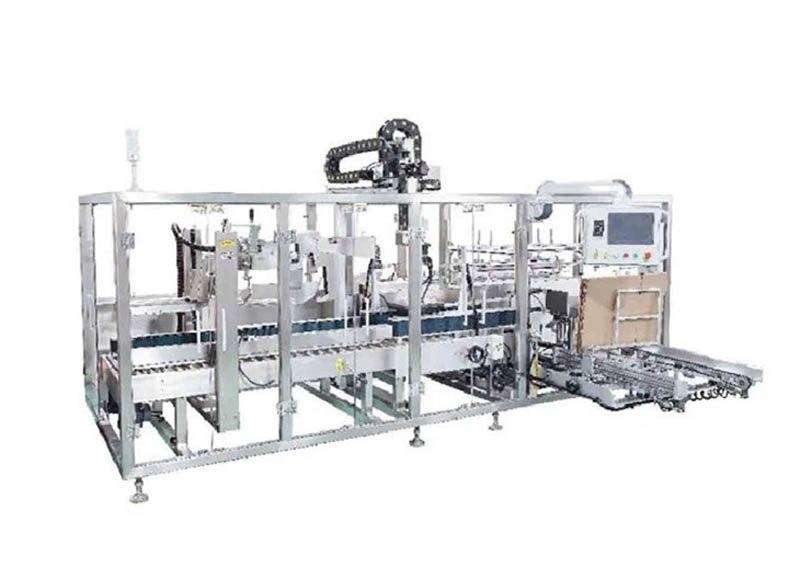
For a wider comparison, review the HIJ case-packing equipment range. Use the same case drawings, product-loading pattern, accepted-output target and site interfaces for each proposal. Compare confirmed scope rather than assuming that an integrated line and a standalone erector replace the same work.
Compare a new case-packing configuration
Send your case drawing, representative blank information, product dimensions, loading pattern, required output and line layout. Ask HIJ to define the proposed new-equipment scope and acceptance basis. This page does not advertise used inventory, trade-ins or third-party rebuilding services.
Discuss a New Case-Packing Project8. Used carton erector buying questions
What should I check before buying a used carton erector?
Confirm the machine serial number, included equipment, case style and size range, bottom-sealing method, control-system support and installation requirements. Then witness a trial with representative blanks and agreed acceptance criteria. A listing photograph or an empty-cycle video does not establish suitability.
Is a used carton erector the same as a used cartoner?
Not necessarily. This guide concerns equipment that opens corrugated shipping cases and may seal their bottoms before loading. A folding-carton cartoner normally loads products into retail cartons. Ask for a process description, blank drawing and discharge sample instead of relying on the listing name.
Will a machine handle every case inside its published size range?
Do not assume so. Check the actual blank layout, board construction, opening direction, flap arrangement, sealing method and installed change parts. Have the seller demonstrate your required formats, including the formats most likely to challenge opening or transfer.
Does refurbished mean the same as factory rebuilt?
No consistent scope can be inferred from the label alone. Request an itemized work record, component replacements, test evidence, the party responsible for the work and written support terms. Confirm any claimed manufacturer involvement directly with that manufacturer.
How should I compare the output of a second-hand case erector?
Count accepted cases delivered at the agreed discharge point and divide by the total elapsed trial time. State how stops, replenishment, rejects and changeovers are counted. Compare results with the downstream line's requirement using the same case formats and operating conditions.
Does HIJ offer used carton erectors through this page?
No. This page is a purchasing guide, not a used-stock listing or a third-party refurbishment offer. You can ask HIJ to assess a new case-packing configuration against the same case drawings, product-loading pattern, output requirement and line interfaces.