The three machines perform three sequential jobs at the end of a packaging line: a case erector opens flat corrugated blanks into square boxes, a case packer loads products into the open box, and a case sealer closes and tapes the filled box. You can buy them as separate machines, or as a single all-in-one erect-load-seal system that performs all three steps in one frame.
Procurement teams researching end-of-line automation run into these three terms immediately — and suppliers often use them loosely, which leads to buyers requesting quotes for the wrong machine entirely. The distinction matters because the three machines differ by an order of magnitude in price, footprint, and integration complexity.
This guide defines each machine, shows how they connect into a complete end-of-line sequence, and gives you a decision framework for which combination your production volume actually justifies. If sealing is your immediate bottleneck, the HIJ-600 automatic case sealing machine is the typical entry point; for the full equipment landscape, browse all case packing machines or start with our primer on what a case sealing machine is.
The Three Machines, Defined
Case Erector: Opens the Box
A case erector pulls flat corrugated blanks (KDF — knocked-down flat) from a magazine, squares them open, folds the bottom flaps, and tapes the bottom seam. The output is an empty, bottom-sealed carton standing ready for loading. Erectors are rated in cases per minute and matter most for high-volume lines where workers folding boxes by hand becomes its own bottleneck.
Case Packer: Fills the Box
A case packer collates products — bottles, cartons, pouches, blister-carton packs — into the programmed pattern and loads them into the open case. The two dominant B2B architectures are the horizontal side-push case packing machine, which pushes a collated layer of product sideways into the case, and drop/pick-and-place packers for top loading. Where higher capacity is needed, a double station case packing machine runs two loading stations in parallel.
Case Sealer: Closes the Box
A case sealer folds (on automatic models) and tapes the top flaps of the filled carton — and re-tapes the bottom on pass-through designs. It is the simplest and most affordable of the three machines, which is why most factories automate sealing first — whether the semi- or fully automatic version fits your line is covered in our dedicated comparison. The HIJ-600 seals up to 720 boxes per hour with a top-and-bottom belt drive and changes carton sizes in under a minute via hand-wheels. For heavy export cartons, a four corner sealing machine adds reinforcing tape to the corner edges after center sealing.

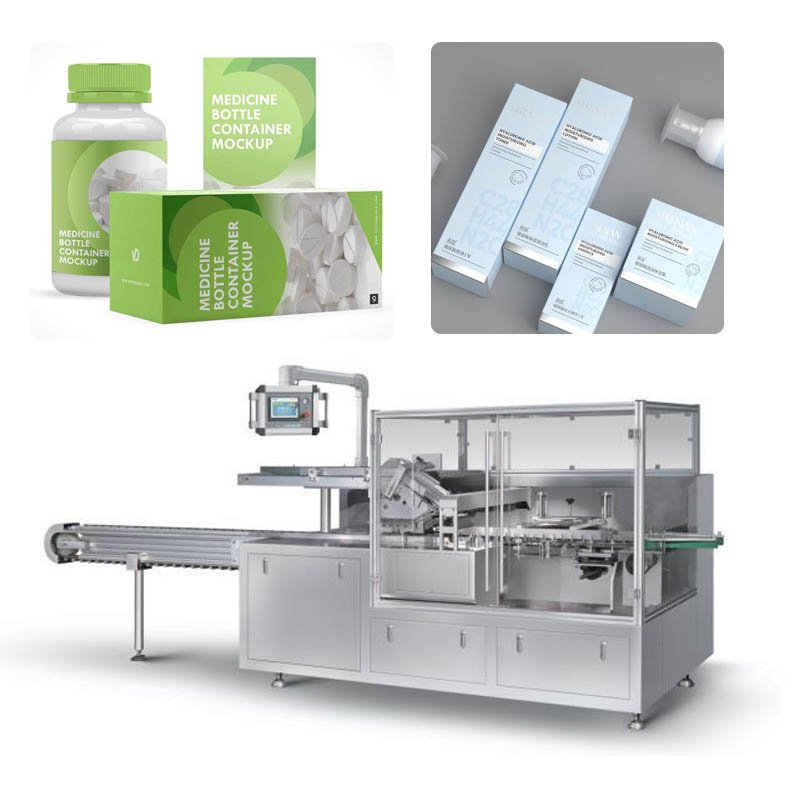
A case packer loads collated pharmaceutical products into open cases — the step between erecting and sealing.
How a Complete End-of-Line Sequence Works
- ErectThe case erector squares a flat blank, folds the bottom flaps, and tapes the bottom seam. An empty carton exits onto the conveyor.
- PackThe case packer collates products from upstream (for example, cartons coming off a cartoning machine) and loads them into the open case in the programmed pattern.
- SealThe case sealer folds the top flaps and applies centered tape to the top seam at up to 720 boxes per hour.
- Reinforce (optional)For heavy or export cartons, a four-corner edge sealer adds corner tape for stacking strength and tamper resistance.
- PalletizeSealed cases move to manual stacking, a palletizer, or strapping — ready for the warehouse or container.
Side-by-Side Comparison
| Criteria | Case Erector | Case Packer | Case Sealer |
|---|---|---|---|
| Job | Opens flat blanks into bottom-sealed boxes | Loads products into the open box | Closes and tapes the filled box |
| Input | Flat corrugated blanks (KDF) | Empty erected case + products | Filled, flaps-open case |
| Output | Empty open-top case | Filled, flaps-open case | Sealed shipping case |
| Relative investment | Medium | Highest — product handling drives complexity | Lowest — the entry point of automation |
| Complexity driver | Blank quality and magazine capacity | Product shape, collation pattern, changeover | Carton weight and size range |
| Automate first when… | Box-folding labor is the bottleneck | Loading accuracy or speed is the bottleneck | Taping labor/quality is the bottleneck (most common) |
Separate Machines or All-in-One?
Once volume justifies automating all three steps, you face a genuine architectural choice. Separate machines let you phase the investment, size each machine independently, and keep the line running if one unit stops. An all-in-one system like the opening, loading & sealing all-in-one machine erects, loads, and seals within a single frame — saving floor space, conveyor transfers, and two sets of controls, at the cost of higher upfront investment and a single point of maintenance.
The practical rule: factories below roughly 500 boxes per day rarely justify more than a standalone sealer; between 500 and 2,000 boxes per day, a sealer plus semi-automatic loading is the sweet spot; above that, the all-in-one or a fully integrated line — ideally specified as a turnkey solution so one supplier owns the integration risk — wins on total cost.
“The sequencing mistake I see most often is buying the case packer first because it is the most impressive machine, while boxes are still being folded and taped by hand on either side of it. The packer then runs at the speed of the slowest human step. My advice: automate sealing first — it is the cheapest machine and removes the most repetitive job — then erecting, and buy the packer last, when the volumes on both sides of it are already machine-paced.”
Which Do You Actually Need? A 3-Question Test
1. Where do boxes queue up on your floor? Wherever cartons pile up waiting is your bottleneck — automate that step first.
2. How many boxes per day at peak? Under 500/day: standalone sealer. 500–2,000/day: sealer + erector or semi-automatic loading. Over 2,000/day: evaluate the all-in-one or full line.
3. How stable are your SKUs? One or two carton sizes favor an integrated all-in-one; frequent size changes favor separate machines with fast hand-wheel changeover, like the HIJ-600’s under-one-minute adjustment. For the full procurement version of this test, use the 12-point buyer checklist.
Key Takeaways
- Erector opens the box, packer fills it, sealer closes it — three sequential machines, often confused in quotes and specs.
- The case sealer is the cheapest of the three and the most common first automation step; the case packer is the most expensive and complex.
- A complete end-of-line runs erect → pack → seal → (optional corner reinforcement) → palletize.
- Below ~500 boxes/day a standalone sealer usually suffices; above ~2,000/day an all-in-one erect-load-seal system typically wins on total cost.
- Automate your actual bottleneck first — usually taping — not the most impressive machine.
- For multi-machine lines, single-supplier turnkey delivery removes the integration risk between the three steps.
Not Sure Which Machine Your Line Needs First?
Tell us your daily output, carton sizes, and current bottleneck — our engineers will map the right automation sequence and quote it within 24 hours.
Get Free Turnkey QuoteFrequently Asked Questions
What is the difference between a case packer and a case sealer?
Do I need a case erector if I have a case sealer?
What is an all-in-one case packing machine?
Which machine should a factory automate first?
Can these machines come from one supplier as a complete line?
About HIJ Machinery
HIJ Machinery (legal name: Wenzhou Trustar Machinery Technology Co., Ltd), founded in 2004 in Rui’an, Wenzhou, Zhejiang, China, manufactures pharmaceutical, cosmetic, and food packaging machinery — including blister packing machines, cartoning machines, capsule filling machines, and case packing machines such as the HIJ-600 automatic case sealing machine. Equipment is CE-marked, manufactured under the ISO 9001 standard, and built cGMP-ready, with installations in more than 30 countries.
This article was written and technically reviewed by Forester Xiang, founder and chief engineer of HIJ Machinery, with 20+ years of packaging engineering experience and more than 100 pharmaceutical facility audits worldwide. Contact our engineering team for line-planning support.