The Hook: In the high-stakes world of pharmaceutical packaging, absolute barrier integrity is non-negotiable. For production facilities relying on thermoformed plastics, mastering the blister pack forming temperature is the critical dividing line between a shelf-stable, cGMP-compliant drug and a catastrophic, brand-destroying recall. As solid dose formulations become increasingly sensitive to moisture and oxidation, production managers face immense pressure to optimize their PVC thermoforming pharma processes. We are moving far beyond the era of simple “heat and press.” Today’s high-speed lines demand rigorous thermal mapping, precision-controlled thermodynamics, and airtight synchronization between material science and mechanical execution.
[🔥 Forester’s Insight: A 20-Year Engineer’s Perspective]
- The Direct Answer: Precise temperature control at the blister forming station is the absolute baseline for drug stability; even a 2°C deviation causes invisible micro-cracks or uneven polymer thinning, instantly compromising the moisture and oxygen barrier.
- The Field Experience: In my 20 years of troubleshooting packaging lines from South America to SE Asia, I’ve seen countless facilities face catastrophic drug recalls due to this exact oversight. The industry trap lies in cheap standalone blister machines equipped with generic PID controllers. They perform flawlessly during a short FAT, but suffer fatal thermal lag under continuous 24/7 production. When drug stability tests fail months later, you fall into a nightmare of multi-vendor disputes, where the film supplier and machine manufacturer endlessly blame each other.
- The Hidden Trap: Always mandate cGMP-compliant, PLC-driven contact heating with real-time thermal mapping in your URS. By partnering with HIJ for seamless turnkey integration, you completely eliminate multi-vendor finger-pointing; we deliver European-standard precision equipment with pragmatic pricing, ensuring uncompromised barrier integrity from SAT to the pharmacy shelf.
The Thermodynamics of PVC Thermoforming Pharma
To fully grasp why blister pack forming temperature is critical, we must dive into the polymer science behind PVC (Polyvinyl Chloride) and PVDC-coated films. PVC is an amorphous polymer. It does not possess a sharp melting point (Tm) like crystalline materials; instead, it undergoes a phase change passing through its Glass Transition Temperature (Tg), which typically sits around 80°C to 85°C. However, for deep-draw thermoforming in pharmaceutical applications, bringing the material just past Tg is insufficient.
To achieve optimal pliability without degrading the molecular structure, the PVC web must be heated to a precise processing window—generally between 130°C and 150°C, depending strictly on film thickness, machine speed, and cavity geometry. If the temperature is merely 2°C to 3°C too low, the material retains high internal stress. During the compressed air forming phase, it will stretch unevenly. This leads to severe geometric issues such as “webbing,” visible deformations, and critically, microscopic fissures at the base radii of the cavity. These micro-cracks drastically alter the Moisture Vapor Transmission Rate (MVTR) and Oxygen Transmission Rate (OTR), effectively rendering the blister useless.
Conversely, if the heating platens overshoot the optimal blister pack forming temperature, the PVC begins to thermally degrade. Overheated film shrinks uncontrollably upon entering the forming mold, leading to extreme wall thinning. A standard 250-micron PVC film might thin down to a fragile 25 microns at the pocket corners. Furthermore, excessive heat can cause the release of highly corrosive hydrochloric gas from the PVC, which rapidly degrades expensive custom mold tooling and compromises the cleanroom environment.
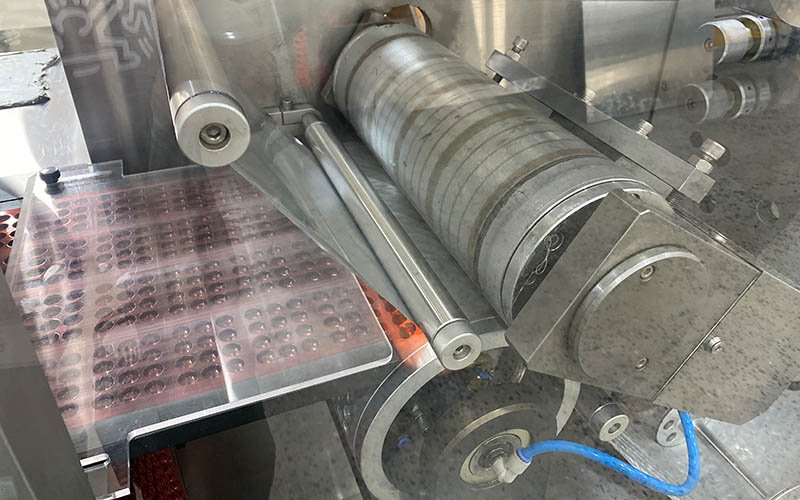
[📸 Image Suggestion: Close-up of the precision contact heating platens at the blister forming station, demonstrating the controlled thermal transfer onto the PVC web.]
The Multi-Vendor Nightmare vs. Turnkey Solutions
One of the most devastating scenarios in pharmaceutical manufacturing occurs when stability batches fail at the three-month or six-month mark. When the root cause is traced back to compromised blister cavity walls, a brutal multi-vendor dispute inevitably ensues.
- The Common Pitfall: Production managers often attempt to cut capital expenditure by purchasing a budget blister machine from one supplier and premium forming film from another. When barrier integrity fails, the machine manufacturer blames the “inconsistent thermal properties” of the PVC film. Simultaneously, the film supplier provides documentation proving their material is flawless, pointing the finger squarely at the machine’s inaccurate PID temperature controllers and thermal lag during high-speed operation. The pharmaceutical company is left trapped in the middle, hemorrhaging money through lost product and extended downtime.
- The HIJ Standard: We eliminate this risk entirely through our “Project Certainty” philosophy. By engineering machines with closed-loop, PLC-driven thermal control algorithms, we guarantee that the temperature setpoint is exactly what the film experiences, regardless of machine speed fluctuations. To explore equipment designed to end these disputes forever, review our [🔗 Internal Link: HIJ DPP-250 Pharma Blister Packaging Machine]. This system features multi-zone smart heating that actively compensates for thermal draw, ensuring consistent wall thickness distribution across every single cavity.

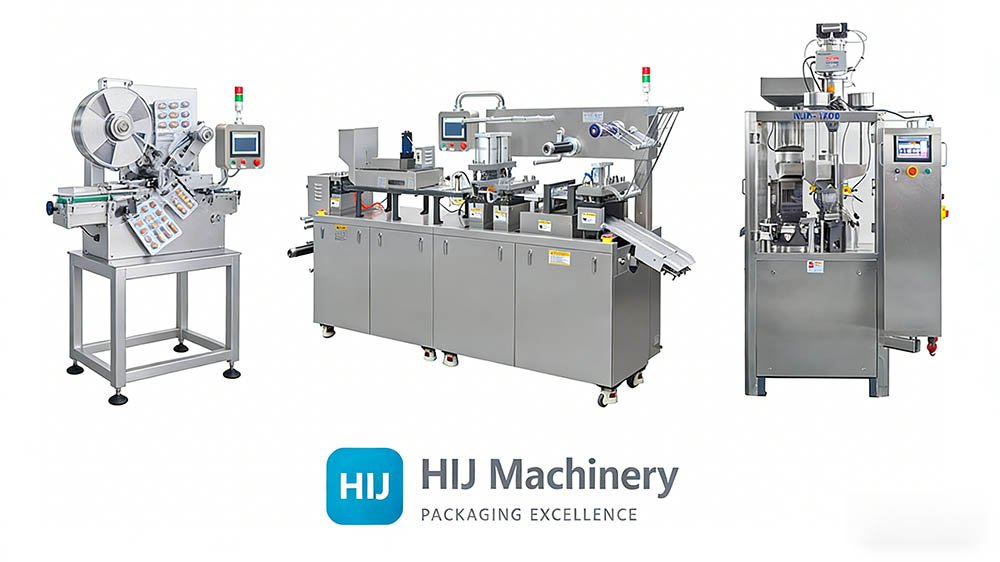
[📸 Image Suggestion: Full wide-angle shot of the HIJ DPP-250 Pharma Blister Packaging Machine, highlighting its robust cGMP build and integrated control stations.]
Advanced Sub-Technical Challenges: Plug-Assist and Cooling Dynamics
While mastering the heating phase is paramount, the thermal interaction does not stop once the PVC leaves the heating platens. For deep-cavity thermoforming (required for large capsules like size 00 or specialized geometries), relying solely on compressed air is insufficient. The machine must utilize a mechanical plug-assist system. Here, a secondary thermal challenge arises.
If the mechanical plug is significantly colder than the heated PVC web, it will prematurely chill the plastic upon physical contact. This freezes the material at the point of contact (the bottom of the blister cavity), forcing all the necessary stretching to occur along the sidewalls. The result is a blister with an overly thick base and paper-thin, easily ruptured sides. Advanced tooling designs must account for thermal neutrality during plug-assist operations.
Equally critical is the instantaneous cooling phase. Once the material is forced into the mold cavity, it must be cooled rapidly below its Tg to “lock” the polymer chains into their new geometry. If the water chiller system supplying the mold is undersized or poorly routed, the blister will retain residual heat. This causes post-mold shrinkage. A shrunk blister will not align correctly with the automated feeding station, nor will it seal properly at the knurled sealing rollers, ultimately devastating your Overall Equipment Effectiveness (OEE).
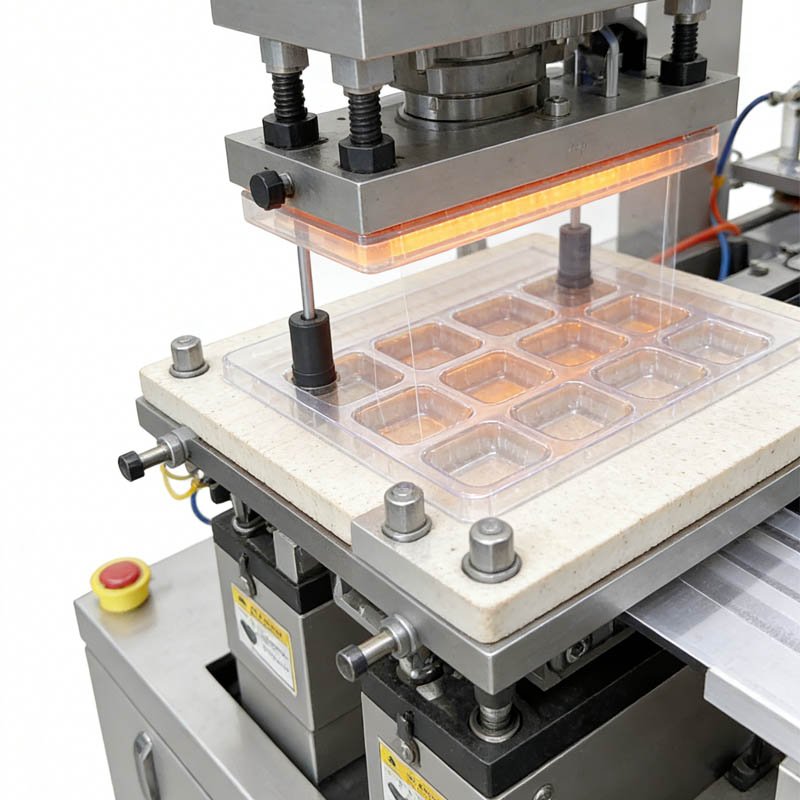
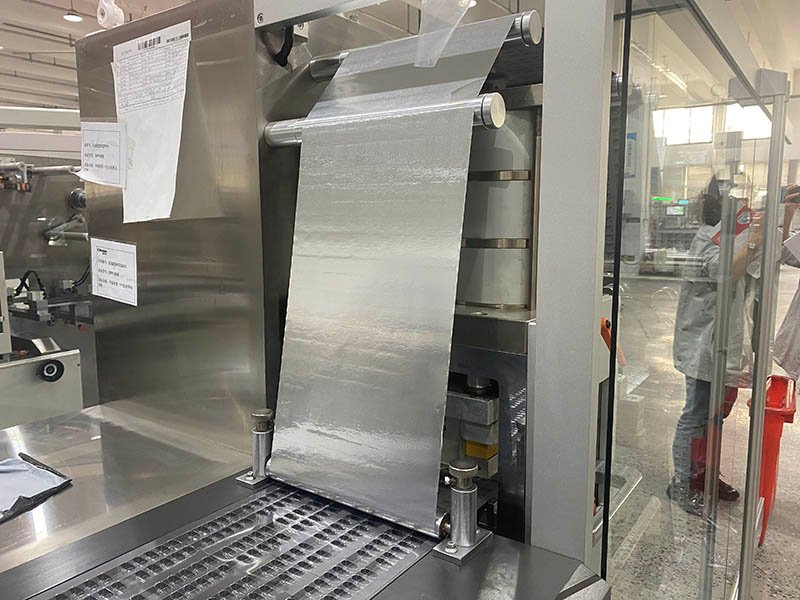
[📸 Image Suggestion: Detailed view of the PVC/PET film web transitioning seamlessly from the forming station to the tablet feeding area, indicating flawless dimensional stability.]
Frequently Asked Questions
Q1: What is the exact blister pack forming temperature for PVDC-coated PVC films compared to standard PVC?
A: PVDC (Polyvinylidene Chloride) coatings add a layer of complexity to the thermodynamics. Because PVDC provides an exponentially higher barrier against moisture and oxygen, it is heavily used for sensitive APIs. However, PVDC degrades at lower temperatures than standard PVC. Therefore, the heating platens must be carefully calibrated. The heat is typically applied to the PVC side of the laminate to protect the PVDC coating. The optimal core web temperature usually sits between 130°C and 140°C, but the thermal transfer rate must be meticulously managed by the PLC to prevent localized scorching of the barrier coating.
Q2: How does machine acceleration (cycles per minute) impact the required heating setpoints?
A: Thermodynamics relies heavily on “dwell time”—the exact duration the film spends in contact with the heating platens. If you increase the machine speed from 40 cycles per minute to 60 cycles per minute, the dwell time decreases significantly. To compensate, operators often mistakenly crank up the platen temperature. A world-class HIJ machine solves this through automated recipe management in the HMI; the PLC automatically adjusts the multi-zone PID parameters proportionally to the encoder speed feedback, ensuring identical heat absorption without operator guesswork.
Q3: How do we properly document temperature stability to meet cGMP and WHO GMP compliance?
A: In your User Requirement Specification (URS), you must mandate 21 CFR Part 11 compliant data logging. The blister machine must not only maintain the temperature but constantly log the actual platen temperatures against the setpoints. Any deviation beyond the established ±2°C threshold must trigger an automatic machine pause and log an audit trail alarm, ensuring that no out-of-spec blisters ever reach the die-cutting station.
Conclusion: Delivering Project Certainty
The blister pack forming temperature is not merely a setting on a dial; it is the thermodynamic foundation of pharmaceutical barrier integrity. Whether you are packaging standard nutraceuticals or highly hygroscopic life-saving medications, the precision of your thermoforming station dictates the survival of your product in the real world. By eliminating archaic, standalone machinery and moving towards fully integrated, intelligent packaging lines, you eradicate the variables that lead to batch failures.
At HIJ Machinery, I don’t just sell you a machine; I deliver project certainty. We ensure your equipment is robustly engineered, meticulously tested during FAT/SAT, and perfectly tuned for your specific film structures and production environments.
Stop risking your reputation on unstable thermal controls. Let our elite engineering team analyze your exact User Requirement Specification (URS) and deliver a bespoke, turnkey solution.