Blister Packing Machine for Tablets and Capsules: Complete Buyer’s Guide
The framework 20 years in the field taught us — so you can make the right machine decision the first time.
What Is a Blister Packing Machine for Tablets and Capsules?
A blister packing machine for tablets and capsules is a pharmaceutical packaging system that forms individual sealed cavities — called blisters — in a plastic or aluminum base film, places each tablet or capsule into a cavity, then seals the cavities with an aluminum foil lidding layer using heat and pressure. The result is unit-dose packaging that protects the product from moisture, oxygen, and contamination while enabling precise dispensing, tamper evidence, and batch traceability. Two principal forming technologies exist: thermoforming (PVC/PVDC film heated and vacuum-shaped) for standard drugs, and cold-forming (alu-alu laminate pressed at ambient temperature) for moisture-sensitive or light-sensitive compounds requiring maximum barrier performance. Selecting the right machine requires matching forming technology, cavity geometry, feeder type, speed, and control architecture to the specific physical characteristics of your tablet or capsule product and the regulatory environment in which it will be manufactured and sold.
Why Most Buyers Choose the Wrong Blister Machine — and How to Avoid It
Walk through any pharmaceutical equipment expo, and you’ll see rows of blister packing machines that look nearly identical from three meters away. Same stainless casing, similar touchscreens, comparable speed specs printed on the datasheet. Yet within two years of commissioning, the gap between a well-chosen machine and a poor fit is enormous — one becomes the throughput backbone of a production floor, the other a source of daily defects, changeover headaches, and compliance risk.
The reason this happens almost never comes down to build quality alone. It comes down to specification mismatch — purchasing a machine optimized for one type of product geometry or one regulatory tier, then deploying it in a context it was never designed for.
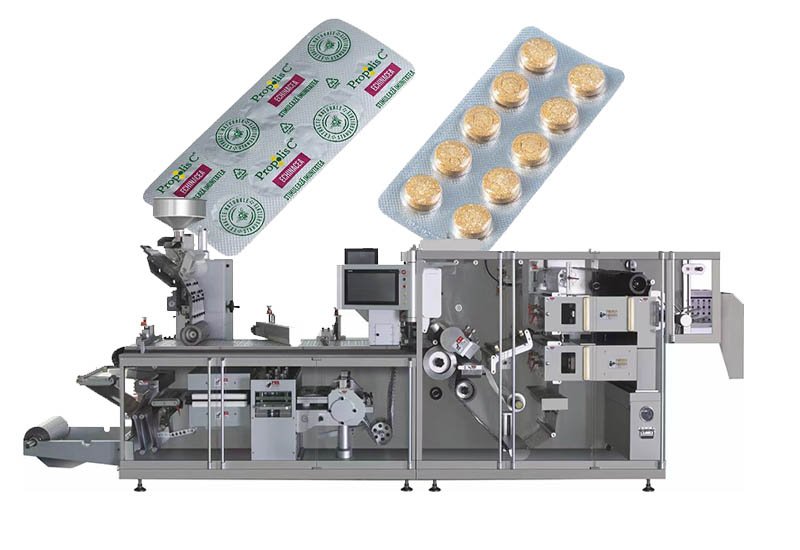
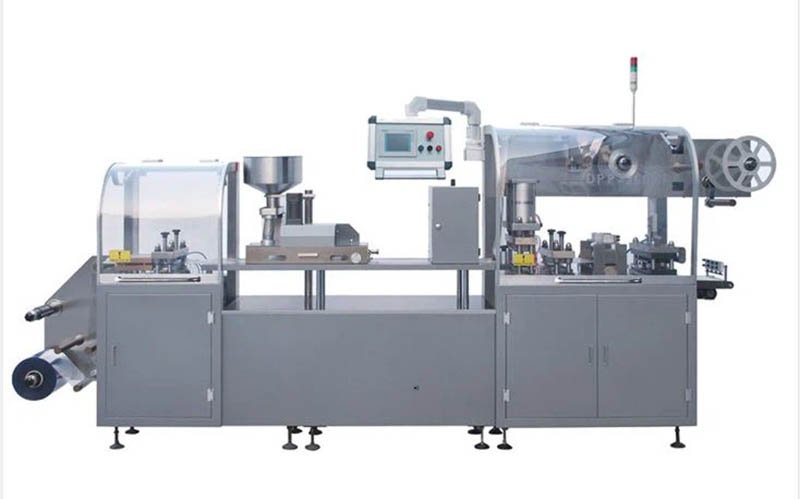
A fully automatic blister packing machine configured for tablet production — the right machine for the right product context is everything.
The three most common mismatches we see after 20 years of client engagements are:
- Product-geometry mismatch: A machine spec’d for standard round tablets placed on a line running oblong coated tablets or size-0 capsules, resulting in cavity fill failures and high rejection rates.
- Barrier-requirement underspec: A standard PVC thermoforming machine purchased for a moisture-sensitive API that genuinely needed cold-form alu-alu packaging — costing the operation a re-qualification cycle and mold tooling replacement.
- Compliance architecture gap: A machine with a basic PLC and no audit trail capability deployed in an FDA-regulated facility that later required 21 CFR Part 11 electronic records — triggering an expensive control system retrofit.
This guide exists to close those gaps before you commit to a purchase.

“Most purchasing mistakes don’t happen because buyers lack budget or ambition. They happen because buyers evaluate blister packaging equipment in isolation — focusing on speed specs or price tags — without mapping the machine back to their actual production reality: their tablet or capsule characteristics, their regulatory environment, their future SKU expansion plans. A flat-head tablet behaves completely differently in a forming station than a soft-gel capsule. An operation targeting FDA 21 CFR Part 11 compliance needs a fundamentally different control architecture than one serving a domestic market. These aren’t minor details — they’re the difference between a machine that earns its ROI in 18 months and one that becomes an expensive bottleneck.”
Thermoforming vs. Cold-Forming: Choosing the Right Technology
The single most consequential technical decision you’ll make is which forming technology your line requires. This is not a preference — it is dictated by your product’s chemical stability, regulatory labeling claims, and target markets.
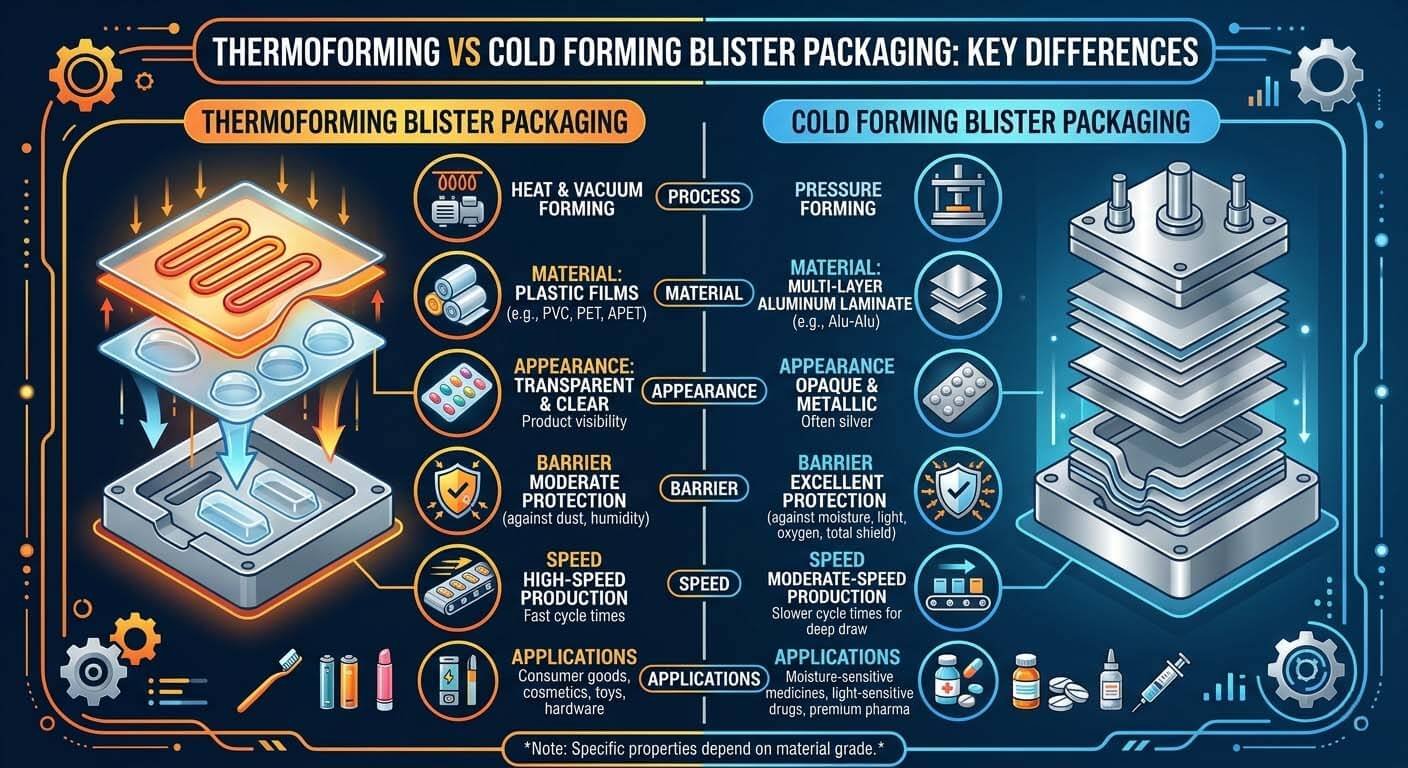
Left: thermoformed PVC/PVDC blister pack. Right: cold-formed alu-alu blister — maximum barrier, zero light transmission.
Thermoforming Blister Machines (PVC / PVDC / Aclar Film)
The thermoforming process heats a plastic base film — typically PVC, PVDC-coated PVC, or Aclar (PCTFE) — until it becomes pliable, then uses vacuum or compressed air to draw it into a forming mold, creating the pocket cavities. After product loading, aluminum foil lidding is heat-sealed over the cavities.
Thermoforming Advantages
- Lower capital cost vs. cold-form equipment
- Transparent blisters enable visual inspection
- Wide range of film options (standard to high-barrier)
- Faster cavity tooling changes
- Suitable for the majority of oral solid dosage forms
Thermoforming Limitations
- PVC film has limited moisture barrier vs. alu-alu
- Blisters transmit some UV light (even with PVDC)
- Not suitable for highly moisture-sensitive APIs
- PVDC/Aclar films carry environmental disposal concerns
Cold-Forming Blister Machines (Alu-Alu)
Cold-forming — also called alu-alu blister packaging — uses a laminate of aluminum foil, nylon, and PVC pressed into cavities at ambient temperature using high forming pressure. No heat is applied to the base film, making it ideal for thermolabile compounds, hygroscopic drugs, and products requiring the maximum possible moisture and oxygen barrier.
Cold-Form (Alu-Alu) Advantages
- Near-zero moisture vapor transmission rate (MVTR)
- Complete light and oxygen barrier
- Ideal for hygroscopic, photosensitive APIs
- Required by many tropical-climate market regulations
- Premium positioning for branded pharmaceutical products
Cold-Form Limitations
- Higher equipment and tooling cost (~25–40% premium)
- Opaque packaging eliminates visual dose inspection
- Slower forming cycle than equivalent thermoforming
- Alu-alu laminate film costs more per meter than PVC
HIJ DPH-300 Cold-Form Alu-Alu Blister Packaging Machine
Engineered for maximum barrier performance. Full GMP-compliant design, servo-driven forming station, and CE certification. Ideal for hygroscopic APIs and Zone IV climate-zone market requirements.
Explore Alu-Alu Machine SpecsTablets vs. Capsules: Why the Mechanical Differences Matter
It sounds like a detail. In practice, it’s one of the most frequently overlooked specification questions in blister machine procurement — and one of the most expensive to fix after the fact.

Capsules require dedicated cavity geometry and orientation-controlled feeding — not interchangeable with tablet configurations without tooling changes.
What Makes Tablets Easier to Blister-Pack
Round, biconvex, or flat-faced tablets have a predictable center of gravity and relatively uniform face presentation. This makes them compatible with brush-type feeders (a rotating brush sweeps tablets across the forming film, gravity-dropping them into cavities), vibratory feeders, and suction-cup vacuum pick-and-place systems. Cavity geometry is simple — a hemisphere or cylinder with modest draft angles.
The variables that require attention with tablets include: coating integrity (coated tablets are brittle at the edges), tablet hardness vs. feeder brush pressure, and the dimensional tolerance between tablet diameter and cavity internal diameter. Too loose and tablets rattle, risking coating damage; too tight and fill-station jams occur.
What Makes Capsules More Demanding
Capsules — whether gelatin or HPMC (vegetarian), standard hard-shell two-piece or soft-gel — present three specific challenges that tablets don’t:
- Orientation sensitivity: Elongated capsules tend to enter cavities at random orientations unless the feeding system actively controls orientation. An unsorted capsule sitting sideways across a cavity causes a mispack that is difficult to detect visually on fast-running lines.
- Shell fragility: Hard gelatin capsule shells are sensitive to mechanical stress and temperature variation. Excessive brush feeder pressure causes cap/body separation or surface cracking — a direct quality defect.
- Humidity dependency: Gelatin capsule shells are hygroscopic. The blister cavity must be sealed to a low WVTR standard, and the production environment must maintain controlled humidity during the filling and sealing operation.
Properly designed capsule blister packing machines address these challenges with elongated cavity molds matching the capsule body/cap profile, vibration-assisted orientation feeders or gravity chute systems, and lower-contact feeding mechanisms that minimize shell stress.
| Parameter | Tablet Configuration | Capsule Configuration |
|---|---|---|
| Primary feeder type | Brush-type / vibratory | Gravity chute / vibration-oriented |
| Cavity geometry | Hemispherical / cylindrical | Elongated capsule-profile |
| Orientation control | Not required (symmetric shape) | Required (axial orientation) |
| Shell fragility concern | Low–moderate (coating) | High (cap/body separation) |
| Humidity sensitivity | Moderate (film coat) | High (gelatin hygroscopicity) |
| Tooling changeover time | 30–60 min (forming + feeder) | 45–90 min (orientation system) |
The 7 Technical Specifications That Actually Drive Performance
Datasheets list dozens of figures. In our experience, seven specifications actually determine whether a machine performs as expected in your environment. Here’s how to read them correctly.
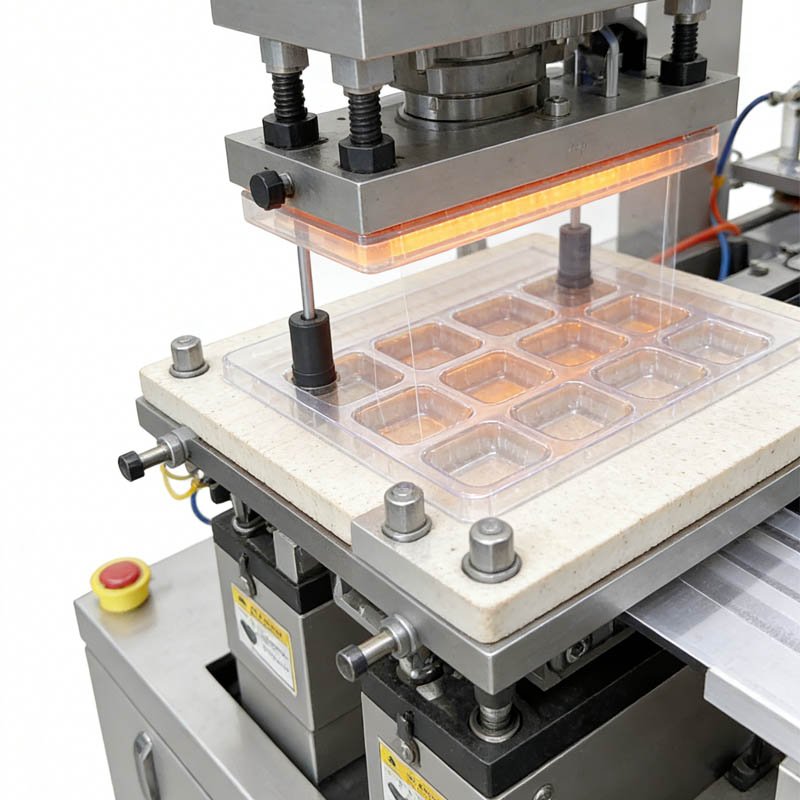
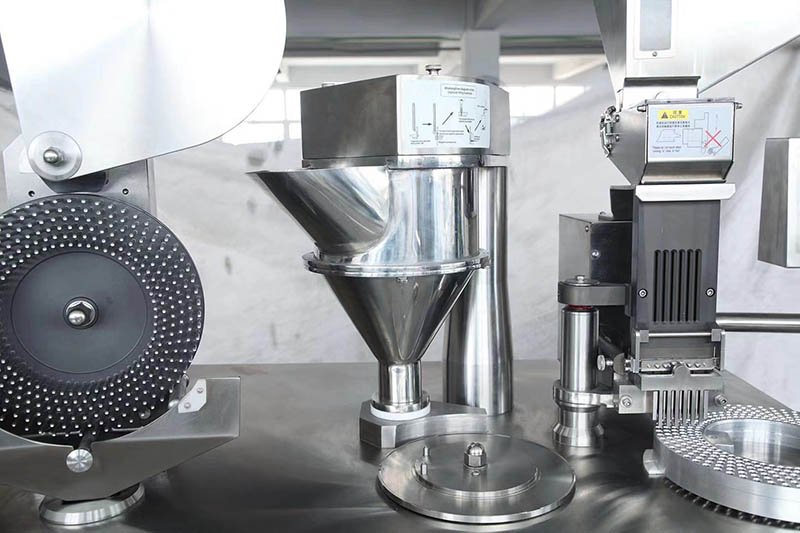
The forming station is where material properties, temperature control precision, and cavity geometry all interact — small deviations here cascade into defects downstream.
1. Forming Speed (SPM vs. BPM — Know the Difference)
Speed is quoted in Strokes Per Minute (SPM) or Blisters Per Minute (BPM). SPM refers to how many times the forming/sealing punch cycles per minute. BPM is what you actually care about — the number of completed, sealed blister sheets produced per minute. BPM = SPM × cavities per stroke. A machine at 80 SPM with 10 cavities per stroke produces 800 units per minute — not 80. Always verify cavities per forming cycle and request actual production test data at rated speed under your product conditions, not just the mechanical maximum.
2. Forming Depth and Cavity Precision
Forming depth tolerance should be within ±0.1mm across the full blister plate width. Inconsistent forming depth means some cavities are too shallow (product protrudes, causing seal failure) or too deep (product rattles inside, risking breakage). This spec matters most for unusual tablet geometries — oval, oblong, or multi-layer — and for size-0 or size-00 capsules where the cavity must hold the product without movement during the sealing press.
3. Sealing Temperature Range and Stability
Heat-seal station temperature accuracy should be ±2°C or better across the full sealing plate surface. Non-uniform temperature creates bond failures at the cooler zones and film degradation at the hotter zones. Look for independent temperature zone control with closed-loop feedback, not single-point measurement. For PVDC-coated film, sealing temperature typically runs 150–180°C; for standard PVC, 120–160°C. Validate sealing parameters against your specific lidding foil grade, not the machine’s generic specification.
4. Film Drive Accuracy (Step Accuracy)
Film advancement accuracy — how precisely the film indexes forward between each forming cycle — determines alignment between the formed cavities and the sealing die. Error accumulation over a production run creates progressive misalignment and seal quality degradation. Servo-driven film advance systems provide ±0.2mm or better step accuracy; older mechanical cam-and-clutch systems may drift to ±1.0mm or more over a shift. For product with tight label registration requirements or small cavity pitch, servo drive is not a premium option — it’s essential.
5. Reject System Sensitivity and Validation
An empty-blister detection and rejection system is only as good as its sensitivity setting and false-positive rate. Optical sensors, weight-based systems, and vision cameras each have different detection thresholds. Request the minimum detectable defect size (in mm²) and the validated rejection rate under production conditions. GMP expectations require that the reject mechanism be validated — including challenge tests demonstrating that intentionally defective packs are 100% rejected.
6. Changeover Time and Format Part Design
In a multi-SKU production environment, changeover time is a direct production efficiency variable. Best-in-class machines achieve complete format changeovers (forming mold, cavity plates, feeding guides, sealing die) in under 45 minutes using tool-free quick-release systems. Poor designs require special tooling, manual alignment procedures, and verification runs that consume 2–3 hours. If you are running five or more SKUs on one line, changeover design deserves more evaluation time than speed specification.
7. PLC Platform and Data Architecture
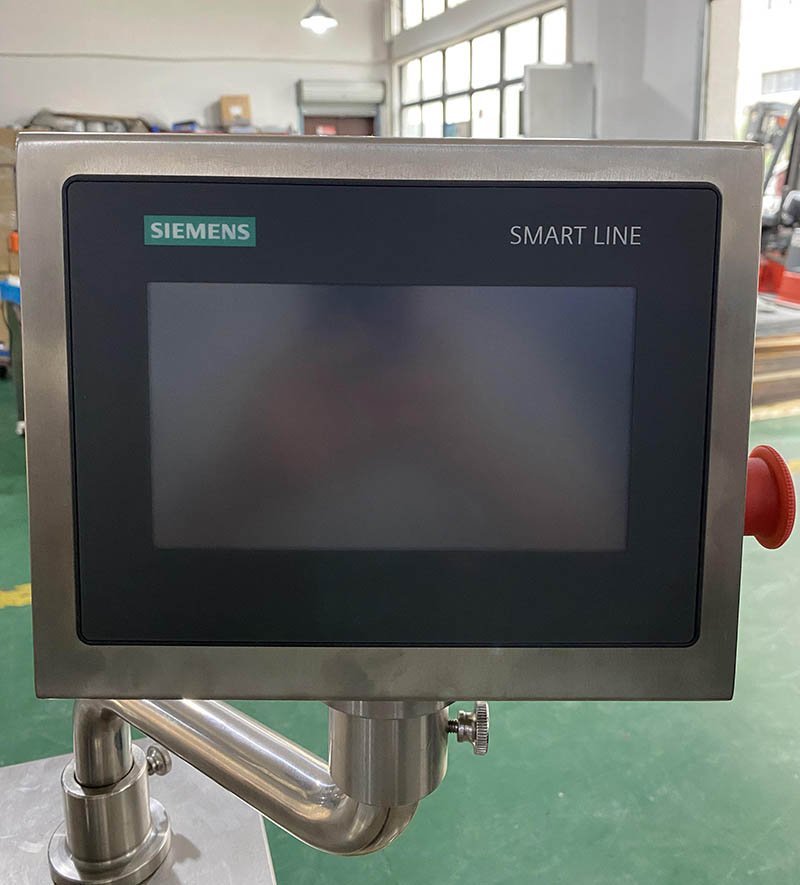
The programmable logic controller (PLC) platform determines the machine’s compliance ceiling. Siemens S7, Allen-Bradley, and Mitsubishi platforms support robust 21 CFR Part 11-compliant historian functions, encrypted audit trails, and integration with MES/ERP systems. Proprietary or unlicensed PLC platforms may meet basic GMP data logging requirements but will create obstacles when auditors request electronic batch record access or when you need to integrate the machine into a plant-wide data system. Specify the PLC brand and model in your purchase order — not just “industrial PLC.”
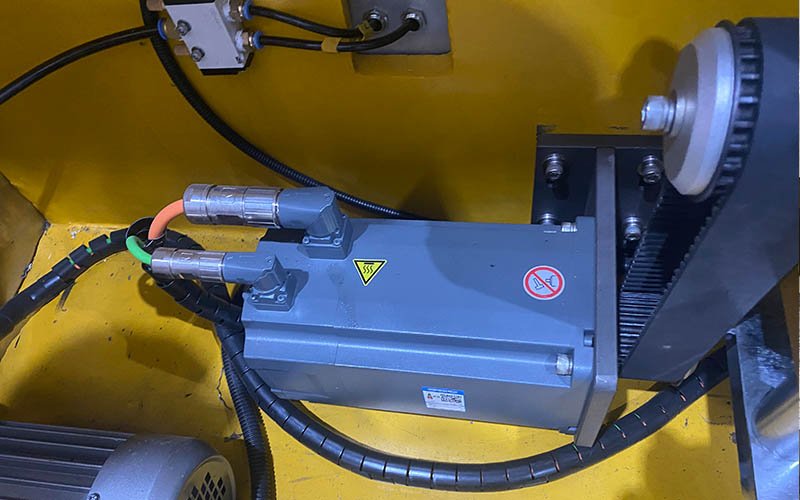
Servo-driven control systems deliver the step accuracy and data traceability that modern GMP environments demand — this is the infrastructure behind consistent output quality.
Compliance Architecture: What GMP, FDA, and CE Actually Require
Compliance isn’t a label you apply after machine selection — it’s a specification dimension that shapes every design choice from contact surface material to software architecture. Here’s how to think about it systematically.



What GMP Compliance Actually Means for Machine Design
GMP-compliant blister packaging machines share a set of structural design principles regardless of which specific regulation applies:
“When a regulatory inspector walks onto your production floor, the first thing they look at is not your product quality records — it’s whether your equipment is capable of producing reliable records at all. A machine that can’t produce an unbroken electronic batch record is a compliance liability regardless of how good your product quality is.”
— Forester, HIJ Machinery
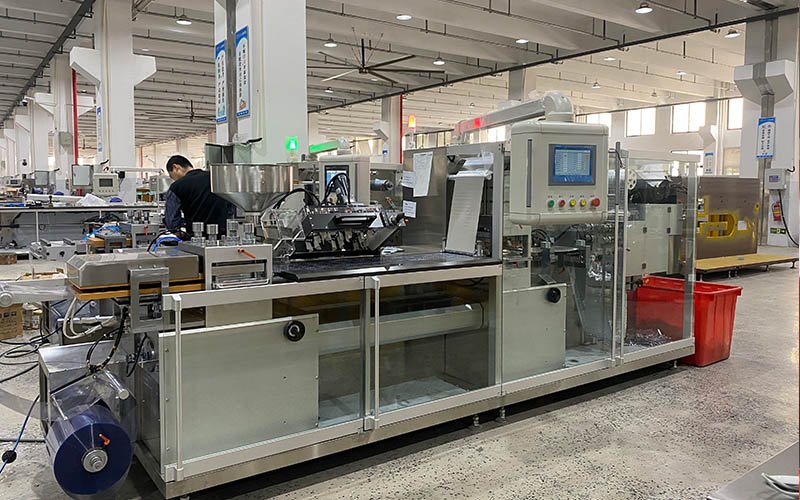
GMP-compliant structural design: smooth weld profiles, 316L stainless contact surfaces, and sloping horizontal surfaces to prevent product accumulation.
Automation Levels: Matching Machine Complexity to Production Volume
The right automation level is not the highest automation level — it’s the level that matches your current throughput requirement with room for the next three to five years of growth. Over-engineering for a clinical-stage operation is as wasteful as under-specifying for a commercial-scale GMP facility.
Semi-Automatic
- Speed: 20–40 BPM
- Manual product loading
- Automatic sealing & cutting
- Low capital investment
- Flexible for small SKU runs
- Limited compliance documentation
Fully Automatic Most Popular
- Speed: 60–300+ BPM
- Automated product feeding
- Servo-driven indexing
- Full PLC/HMI control
- Electronic batch records
- Integrated inspection & reject
High-Speed Integrated
- Speed: 300–500+ BPM
- In-line vision inspection
- MES/ERP integration
- Serialization-ready
- Predictive maintenance I/O
- Full 21 CFR Part 11 architecture
HIJ Blister Packaging Machines for Tablets and Capsules
HIJ Machinery designs and manufactures a focused range of blister packing machines built specifically for pharmaceutical tablet and capsule applications. Every machine in our line is designed from the outset to meet GMP structural requirements — not retrofitted for compliance after the fact.


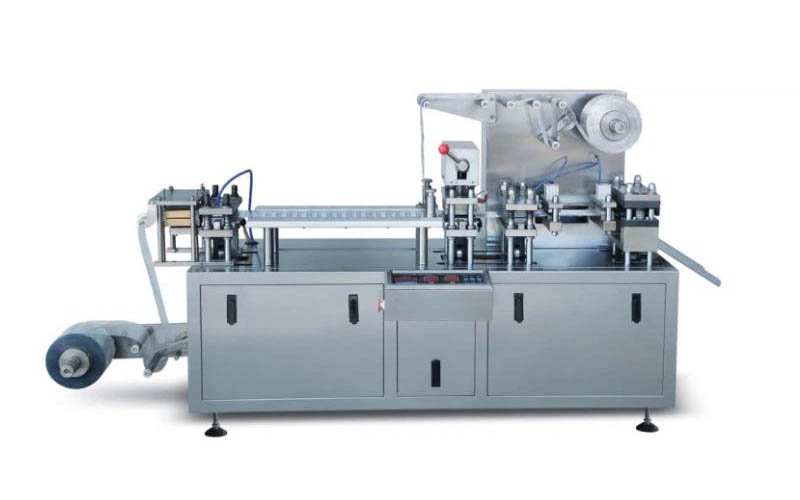
Capsule Blister Packing Machine
Orientation-controlled feeding system, elongated capsule-profile cavity molds, soft-contact feeding to protect gelatin shells.
View Capsule Machine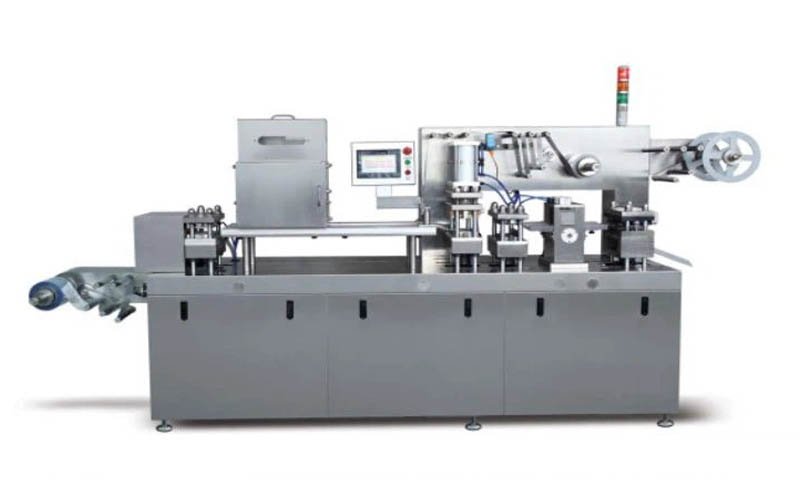
Tablet Blister Packing Machine
High-efficiency brush-type and vibration feeders, multi-cavity forming for round, oval, oblong, and shaped tablet geometries.
View Tablet Machine
The HIJ engineering team reviews machine configurations against client URS specifications before production commences — every machine is built to a specific compliance and performance brief.
Buyer’s Checklist: What to Confirm Before You Sign a Purchase Order
Use this checklist as your internal evaluation framework before committing to any blister packing machine — regardless of the supplier. These are the questions that separate a confident purchase decision from a regretful one.
Product & Process Fit
Compliance & Documentation
Service & Support
Explore HIJ’s Complete Blister Packing Machine Range
From semi-automatic R&D machines to fully integrated high-speed GMP lines — find the right configuration for your product, output, and compliance tier. Our team provides no-obligation technical consultation for every inquiry.
View All Blister MachinesReady to Find the Right Blister Machine for Your Tablets or Capsules?
Send us your product specification, production volume target, and regulatory market — and our engineering team will come back within 48 hours with a configuration recommendation, preliminary specification sheet, and indicative pricing. No sales pitch. Just answers.
20 years of pharmaceutical packaging experience · GMP & CE certified machines · Global service network
Frequently Asked Questions
What is the difference between a blister packing machine for tablets and one for capsules?
The core mechanical difference lies in the feeding system and cavity geometry. Tablets — especially round or oval flat-faced types — feed predictably through brush-type or vacuum feeders. Capsules, being cylindrical with two-piece shell construction, require gravity chutes or vibrating feeders with orientation control to prevent them from tumbling into cavities at the wrong angle. The forming mold cavity shape must also match the product’s dimensional profile precisely. A machine spec’d for tablets may produce high defect rates when running capsules without tooling changes. See our dedicated capsule blister packing machine page for detailed specifications.
How fast should a blister packing machine be for pharmaceutical tablets?
Speed is measured in strokes per minute (SPM) or blisters per minute (BPM). Semi-automatic machines typically run 20–40 BPM and suit pilot or clinical batch production. Entry-level automatic machines run 60–120 BPM, covering small-to-mid volume GMP environments. High-speed pharmaceutical production lines operate at 200–400+ BPM. The critical point is that rated speed is only meaningful at zero defect output — always request validated throughput data, not peak mechanical speed.
What film materials are compatible with pharmaceutical blister packaging machines?
The most common forming films are PVC (standard moisture barrier), PVDC-coated PVC (enhanced moisture/oxygen barrier), PCTFE/Aclar (superior barrier for sensitive drugs), and cold-form aluminum foil laminate (alu-alu, highest barrier). Lidding materials are typically aluminum foil with heat-seal lacquer coating. The forming film must match the machine’s forming system: thermoforming machines use PVC/PVDC/PCTFE films; cold-forming machines use alu-alu laminates pressed at room temperature. Learn more about our alu-alu cold-forming machine for maximum barrier applications.
Do blister packing machines for tablets need to be GMP compliant?
Yes. Any blister packing machine used in pharmaceutical tablet or capsule production must comply with GMP standards applicable in the target market — WHO GMP (global), cGMP/21 CFR (US FDA), EU GMP (European markets), or local equivalents. GMP compliance for equipment covers: contact surface materials (316L stainless steel, pharmaceutical-grade gaskets), clean-in-place design with no dead zones, validated process parameters with data logging, and traceable batch records. Operations targeting FDA 21 CFR Part 11 compliance additionally require electronic records and audit trail functionality in the PLC/HMI system.
What is the price range for a blister packing machine for tablets and capsules?
Pricing varies significantly by automation level and specification. Semi-automatic blister packing machines typically range from $8,000–$25,000. Fully automatic pharmaceutical-grade machines (60–200 BPM) range from $35,000–$120,000. High-speed GMP-compliant lines with integrated inspection, rejection, and data systems can exceed $200,000. Alu-alu (cold-form) machines command a premium of 20–40% over equivalent thermoforming models. Always evaluate total cost of ownership including tooling, spare parts availability, and service response time — not just the initial equipment price. Request a specific configuration quote for accurate pricing based on your requirements.
Can one blister packing machine handle both tablets and capsules?
Yes, with appropriate tooling changeovers. Most modern automatic blister packing machines are designed to handle multiple product types through interchangeable forming molds, feeding systems, and cavity plates. The changeover typically takes 30–90 minutes depending on machine design. When purchasing for multi-product flexibility, look for quick-change tooling systems, tool-free format parts, and a servo-driven architecture that allows recipe-based parameter switching via the HMI rather than manual mechanical re-adjustment. Our DPP-260 automatic blister packing machine is specifically designed with multi-SKU changeover efficiency in mind.
What downstream machines integrate with a blister packing line?
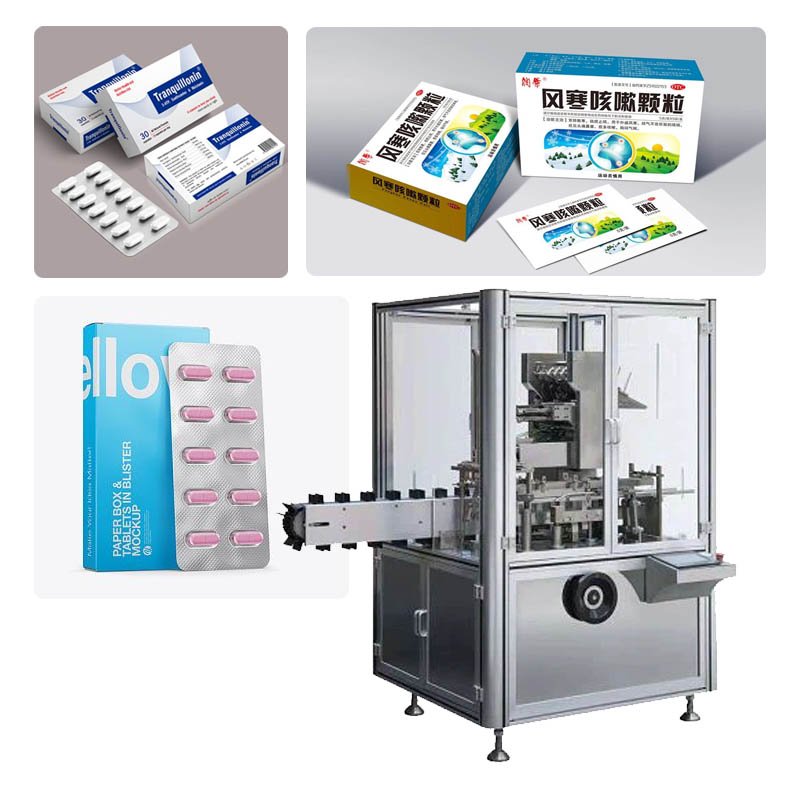
A complete pharmaceutical blister packaging line typically integrates: (1) an upstream capsule filling machine or tablet press feeding product to the blister machine; (2) the blister packing machine itself; (3) a blister cartoning machine that receives completed blister sheets and inserts them into folding cartons with package inserts; and (4) a case packing machine for secondary packaging. HIJ offers turnkey integration across this entire line — eliminating the multi-supplier coordination risk that causes most production line integration failures.
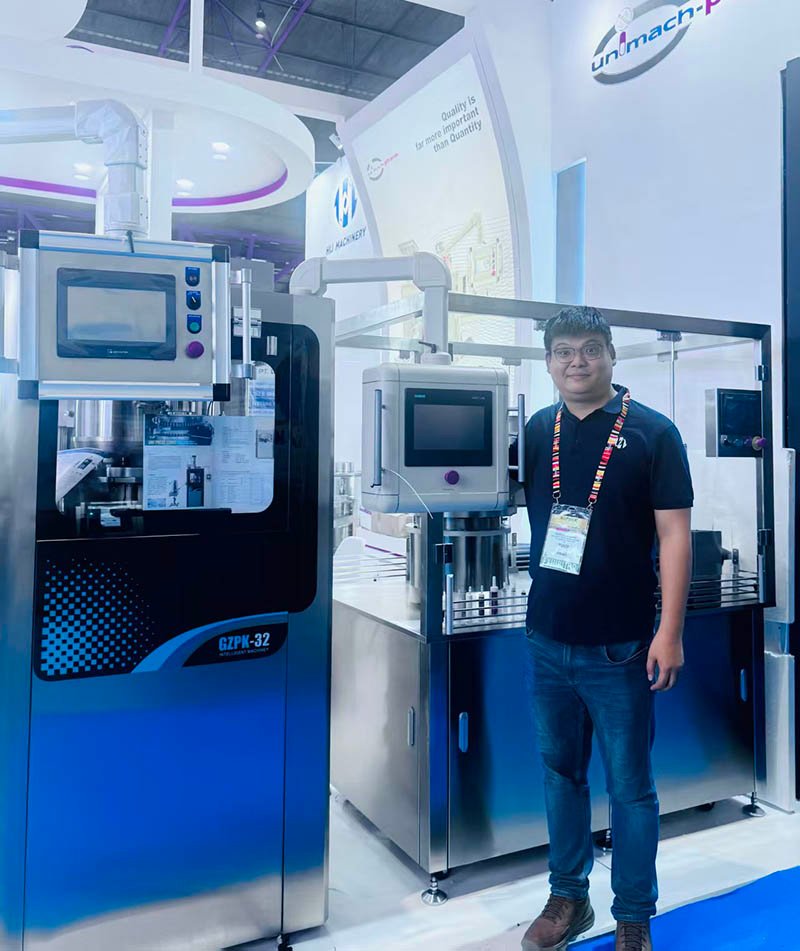
Forester has spent 20 years in pharmaceutical and packaging machinery, working directly with manufacturers across Southeast Asia, South America, Africa, and Europe. He founded HIJ Machinery to bridge the gap between European quality standards and practical, cost-accessible pharmaceutical equipment solutions. He writes from firsthand field experience, not from a desk.
Learn more about HIJ Machinery