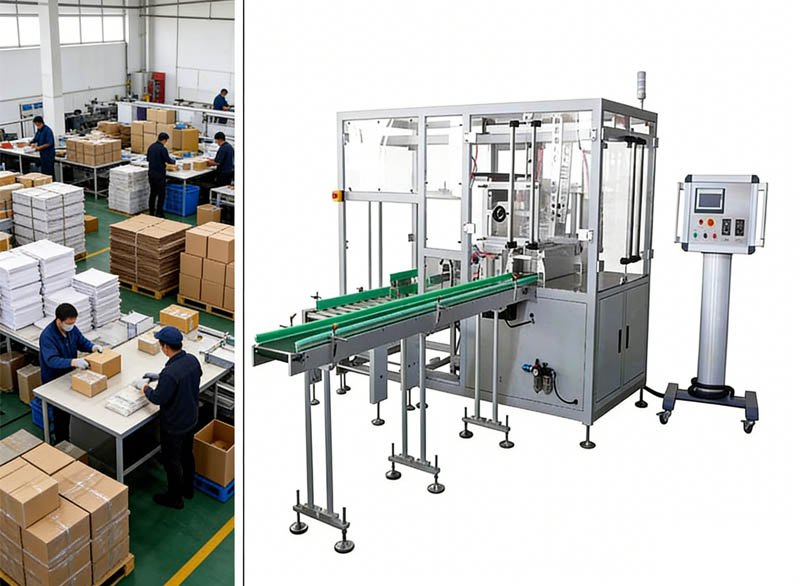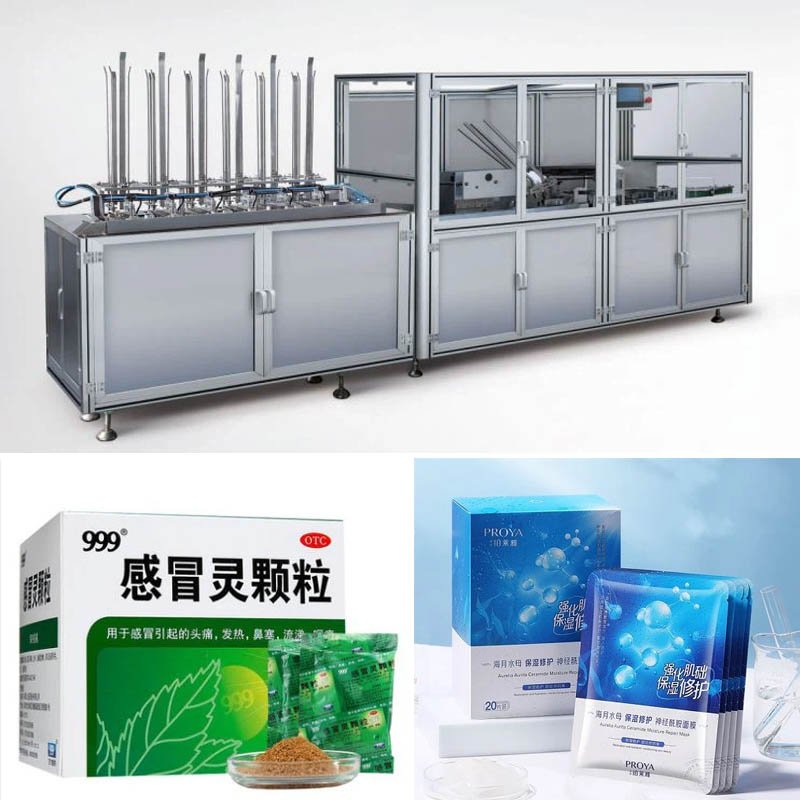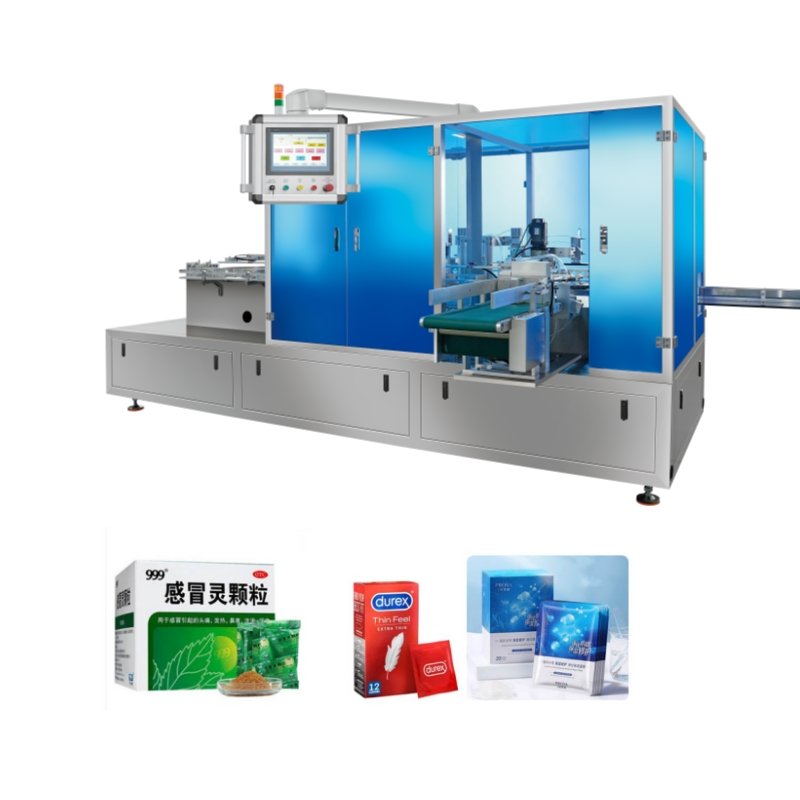
European case packing machines lead at extreme speeds, deep application libraries, and established local service networks — at a substantially higher price and longer lead time. Chinese case packers deliver comparable mid-range performance (up to ~400 cases/hour) at a fraction of the cost, with faster delivery and greater customization willingness — provided you de-risk the purchase with a written URS, a Factory Acceptance Test using your materials, international-brand components, and verified references. For most mid-speed pharmaceutical, food, and cosmetic lines, the price-performance verdict now favors well-vetted Chinese manufacturers.
Key Takeaways
- The technology gap has narrowed where it matters for mid-speed lines; the remaining European advantages are extreme speed, ecosystem maturity, and local service density.
- Chinese machines typically price at a fraction of European equivalents and ship in 8–12 weeks versus 6–12 months.
- Component convergence changed the risk math: serious Chinese builders fit Siemens-class PLCs, SMC/Festo pneumatics, and international servo brands.
- The real variable isn’t nationality — it’s the individual manufacturer. Vetting procedure beats country of origin.
- De-risking is procedural: written URS, FAT with your cartons, component brand specification, itemized commissioning, and reference calls.
Search any packaging forum and you’ll find the same argument running for a decade: European machines are over-engineered and overpriced; Chinese machines are cheap and risky. Both clichés were partially true in 2010 and both are mostly obsolete now — but not symmetrically, and not for every buyer.
As a Chinese manufacturer, we have an obvious interest in this comparison — so this article commits to naming specifically where European builders still win, and letting the de-risking procedure do the persuading. We’ll reference machines like the HIJ-PMG600 all-in-one case packing machine for concrete numbers. If you’re earlier in your research, start with case packing machine types.
What You’re Actually Paying For
The price gap between a European and Chinese case packer is not mostly steel or servos — it’s four other things: engineering man-hours amortized in high-wage economies, decades of application libraries, dense local service networks with same-week engineers, and brand insurance (nobody gets fired for buying the famous name). All four are real value. The question is whether your line needs them at their price.
Where European Machines Genuinely Win
Choose European if…
- You need extreme speed. Above roughly 25–30 cases per minute with complex collations, the top European builders operate in territory few Chinese machines have reference installations for.
- You run an exotic or unproven application. Decades of application libraries mean someone in a European R&D department has probably packed your weird product before.
- Same-week on-site service is contractual. If your operation cannot tolerate remote-first support, a manufacturer with engineers in your country is worth its premium.
- Corporate procurement mandates it. Some multinational pharma groups maintain approved-vendor lists; fighting the list costs more than the machine saves.
- Resale value matters to your finance model. Famous-brand machines hold secondary-market value better.
Where Chinese Machines Genuinely Win
Choose Chinese if…
- Your speed is mid-range. Up to ~400 cases/hour — where the overwhelming majority of pharma, food, and cosmetic lines actually operate — the performance difference has largely evaporated while the price difference has not.
- Budget buys line coverage. The same capital that buys one European case packer frequently buys a Chinese case packer plus the upstream cartoner — or an entire turnkey packaging line.
- Lead time is strategic. 8–12 weeks versus 6–12 months changes product-launch math entirely.
- You need customization. Non-standard carton envelopes, explosion-proof variants, unusual infeeds — Chinese engineering teams say yes to modifications that European builders price as bespoke projects.
- You accept remote-first support. Video diagnostics plus air-freighted spares resolves the large majority of faults; if that model fits your maintenance culture, the service premium buys little.
Side-by-Side Comparison
| Factor | European Builders | Established Chinese Builders |
|---|---|---|
| Relative price | Benchmark (highest) | Typically a fraction of European pricing |
| Lead time | Commonly 6–12 months | Commonly 8–12 weeks |
| Speed ceiling | Very high, deep references | Mid-range (~400 cases/hr class) is the sweet spot |
| Customization | Possible, priced as engineering projects | Routine — flexible envelopes, variants, integrations |
| Core components | Siemens / Allen-Bradley, Festo/SMC | Same international brands on serious builders — specify in URS |
| Service model | Local engineers, contractual response | Remote-first video support + air-freight spares + commissioning visits |
| Documentation | Mature validation-support packages | Varies by builder — require FAT protocols, material certs, drawings supporting your own DQ/IQ/OQ/PQ program |
| Resale value | Strong | Weaker secondary market |
| Risk profile | Low variance between builders | High variance — vetting the individual factory is everything |
The Component Convergence Nobody Mentions
The strongest old argument against Chinese machines — unknown components failing with no spares path — has quietly collapsed. Established Chinese builders now fit the same Siemens-class PLCs and HMIs, SMC or Festo pneumatics, and international servo and sensor brands as their European competitors, precisely so buyers can source spares locally anywhere in the world. The frame is Chinese; the parts that fail and need replacing are the same global catalog items.
This is also your easiest vetting lever: write the component brands into your URS and require the electrical BOM with the quotation. A factory that resists naming its components has answered your real question.
How to De-Risk a Chinese Case Packer Purchase
Country of origin is a weak predictor; procedure is a strong one. Five steps neutralize most of the variance:
1. Written URS to every candidate. Identical specification, identical comparison — our case packer buying guide and URS checklist gives you the template. 2. FAT with your materials, witnessed live. Your cartons, your products, rated speed, on video if you can’t fly. 3. Component brands in the contract. PLC, pneumatics, servos, sensors — named, not implied. 4. Itemized commissioning, training, and spares. Including a priced two-year spare parts list before you pay a deposit. 5. Reference calls in your region. Two customers, same industry if possible; ask specifically about post-warranty support response.
Run the full money math — machine, freight, duty, commissioning, spares — through the framework in our case packing machine price guide; the landed-cost comparison usually widens the Chinese advantage rather than narrowing it, because one integrated machine ships as one crate.
Forester’s Insight
After 100+ facility audits across 30+ countries, my honest observation is that buyers frame this as a country question when it’s a factory question. I have seen European machines running flawlessly for twenty years, and I have seen Chinese machines doing the same — usually in the same plants, bought by the same careful engineer. I have also seen bad machines from both places, bought the same way: in a hurry, on price alone, without a FAT.
The nationality of the machine predicts far less than the procedure of the buyer. A written URS, a witnessed FAT with your own cartons, named components, and two reference calls filter out weak factories on any continent. Do those five things and the remaining decision is genuinely just price, lead time, and service model — which is a decision, not a gamble.
About HIJ Machinery
HIJ Machinery (legal name: Wenzhou Trustar Machinery Technology Co., Ltd) is a packaging machinery manufacturer founded in 2004 in Rui’an, Wenzhou, Zhejiang, China, exporting pharmaceutical, cosmetic, and food packaging equipment to more than 30 countries. Engineering is led by founder and chief engineer Forester Xiang (20+ years, 100+ facility audits).
HIJ welcomes exactly the vetting this article recommends: every machine in the case packing machine range — including the HIJ-PMG600 all-in-one case packing machine — is quoted against the buyer’s URS with named components, witnessed FAT, and itemized commissioning. cGMP-ready, CE-marked designs built to ISO 9001 manufacturing standard. See why manufacturers in 30+ countries choose HIJ.
Frequently Asked Questions
Are Chinese case packing machines reliable?
Established Chinese manufacturers build machines that run reliably for many years, particularly in the mid-speed range where most production lines operate — but variance between factories is high, so reliability depends on vetting the individual builder rather than the country. The strongest predictors are international-brand core components (Siemens-class PLC, SMC or Festo pneumatics), a witnessed Factory Acceptance Test with your own cartons, itemized commissioning and spare parts terms, and reference customers you can actually call.
How much cheaper are Chinese case packers than European ones?
Chinese case packing machines typically price at a fraction of comparable European equipment — commonly enough capital difference that the same budget covers a Chinese case packer plus the upstream cartoning machine, or an entire turnkey line. The gap reflects engineering labor costs, brand premium, and service network overhead more than component or build differences, since serious Chinese builders fit the same international-brand PLCs, pneumatics, and servos. Landed-cost comparisons including freight and commissioning usually preserve most of the gap.
When is a European case packing machine worth the premium?
Four situations justify the premium: extreme speeds above roughly 25–30 cases per minute with complex collations, where European reference installations run deepest; exotic or unproven applications that benefit from decades of application libraries; operations that contractually require same-week local on-site service rather than remote-first support; and corporate procurement environments with approved-vendor lists where fighting the list costs more than the machine saves. Outside these, the price-performance case weakens quickly.
What components do good Chinese case packing machines use?
Established Chinese builders fit the same international component catalog as European machines: Siemens-class PLCs and HMIs, SMC or Festo pneumatics, international servo motors and sensor brands, and 304 stainless steel contact parts on hygienic designs. This convergence means replacement parts are sourceable locally in most countries. Buyers should still specify required component brands in the URS and require the electrical bill of materials with the quotation — a factory that resists naming components is signaling its answer.
How do I verify a Chinese packaging machine manufacturer before ordering?
Five procedural checks: send a written URS and require a line-item response against it; conduct a Factory Acceptance Test with your actual cartons and products, attended in person or by live video, before shipment; write component brands into the contract; require itemized commissioning, training, and a priced two-year spare parts list before paying a deposit; and call at least two reference customers in your region, asking specifically about post-warranty support response times. These five steps filter out weak factories more effectively than any country-level judgment.
Vet Us Exactly This Way
Send your URS — or just your carton list and speed target. We’ll respond line-by-line with named components, FAT terms, itemized commissioning, and references you can call.
Request a Line-Item Quotation