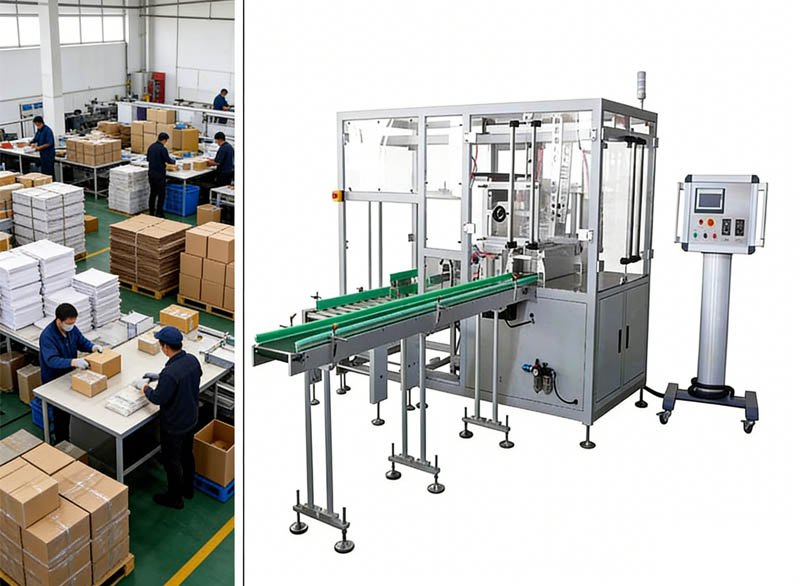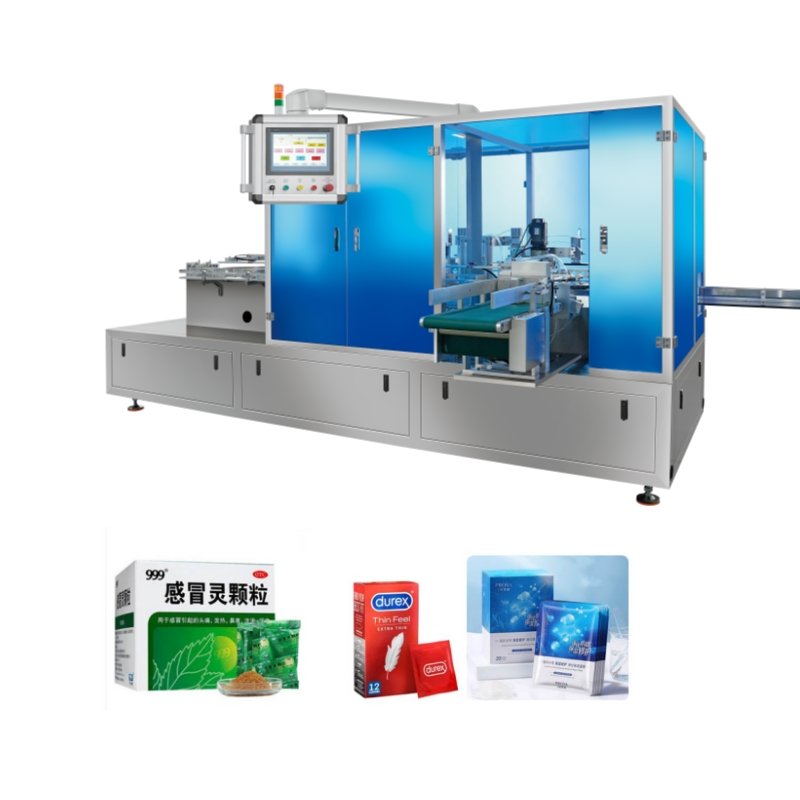
To buy the right case packing machine, work through eight decisions in order: (1) carton size envelope for the next three years, (2) product fragility and pack pattern, (3) speed with 20–30% headroom, (4) loading method, (5) sealing method, (6) materials and hygiene grade, (7) controls and utilities, (8) vendor evidence — FAT, documentation, and support. Write these into a one-page User Requirement Specification (URS) and make every supplier quote against the identical document.
Key Takeaways
- Carton envelope is decision #1 and the only unfixable one — a case outside the machine’s min–max range disqualifies it permanently.
- A written URS forces all quotations onto the same specification, exposing hidden deletions like missing pad systems or single-arm configurations.
- Speed should be sized at real demand + 20–30% headroom, not the biggest datasheet number.
- For pharma and food, specify cGMP-ready construction and food-contact compliant materials — and require documentation that supports your own validation program.
- Demand a Factory Acceptance Test with your actual cartons and products before shipment; a supplier who resists FAT is telling you something.
Buying a case packer isn’t hard because the machines are complicated — it’s hard because quotations for “the same machine” can describe completely different equipment. The fix is procedural: decide your requirements before you talk to anyone, write them down once, and make every supplier answer the same document.
This guide walks the eight decisions in the right order and ends with a copy-ready URS checklist. We’ll use the HIJ-PMG600 all-in-one case packing machine as the running example for what a complete specification looks like. New to the category? Start with case packing machine types, then come back.
The 8 Decisions, in Order
Carton Size Envelope — Your 3-Year List
List every corrugated case size you run today plus every size you might plausibly launch within three years. The machine’s min–max envelope (e.g. 300×250×200 mm to 600×500×500 mm on the HIJ-PMG600) must cover the whole list. Speed can be tuned later; the envelope cannot. Get each supplier’s written confirmation of your full list — not a datasheet range, your list.
Product Fragility & Pack Pattern
Document product dimensions, weight, and fragility, and sketch every collation pattern (e.g. 4×5 single layer, 3×4 double layer with pad between). Fragile glass and precise orientations point to robotic pick-and-place; rugged products open up cheaper drop or side-load options. If products need top/bottom protective pads, specify automatic pad insertion now — it’s rarely retrofittable.
Speed — Real Demand + 20–30% Headroom
Calculate cases per hour from your line’s actual output at peak, add 20–30% growth headroom, and stop there. Paying for double your need buys servos you’ll never use; buying exactly your current rate leaves no room for the growth that justified the machine. Cross-check the arithmetic: cases/hour × picks per case must sit within the arms’ rated cycles (12/min per arm on dual-arm machines).
Loading Method
Match method to Step 2: drop loading for rugged items at speed, side-push for layered retail cartons, robotic arms for fragile/complex/multi-SKU. If comparing an integrated machine against separate stations, read our all-in-one vs separate machines analysis — architecture changes the whole budget.
Sealing Method — Tape or Hot-Melt
Tape is economical and tool-free with printable branding; hot-melt is stronger and cleaner for export and automated palletizing, at higher machine cost but lower per-case consumable cost at volume. Board grade, climate, and pallet stacking all matter — our sealing comparison guide covers the crossover. Specify your choice in the URS; “both available” on a datasheet doesn’t mean both are in your quoted price.
Materials, Hygiene & Compliance Language
For pharmaceutical and food environments, specify: aluminum alloy or stainless frame, 304 stainless steel product-contact parts, smooth cleanable guarding, cGMP-ready construction, CE marking, and manufacture under ISO 9001 standard. For solvent or flammable products, specify the explosion-proof variant explicitly.
Critical wording note: no machine is “GMP certified” — GMP certification applies to your facility and process, not to equipment. What you should require from the supplier is a documentation package (FAT protocols, material certificates, electrical drawings) that supports your own DQ/IQ/OQ/PQ qualification and validation program. A supplier who claims their machine is “GMP certified” is either confused or overselling — both are red flags.
Controls, Utilities & Integration
State your plant’s voltage (e.g. AC380V/50Hz), compressed air spec (e.g. 0.6 MPa), available footprint, and any component-brand standards (PLC, pneumatics, servos) for spares commonality. Document the upstream machine’s discharge rate and orientation — the infeed handshake is where multi-vendor lines fail. Full-line buyers should consider quoting the case packer with the cartoning machine as one turnkey packaging line so a single vendor owns that handshake.
Vendor Evidence — FAT, Support, Spares
Require in writing: a Factory Acceptance Test with your cartons and products before shipment (with video if you can’t attend), installation and operator training scope, remote support terms, recommended two-year spare parts list with prices, and lead time with penalties. Then verify: ask for reference customers in your region, and compare quotes on the price analysis in our case packing machine price guide.
The URS Checklist (Copy This)
| URS Section | What to Specify |
|---|---|
| 1. Cartons | Full 3-year size list (L×W×H each), board grade/flute, printed or plain |
| 2. Products & patterns | Dimensions, weight, fragility; every collation pattern; pad requirements (top/bottom) |
| 3. Performance | Cases/hour required (demand + headroom); changeover time target; efficiency ≥ % |
| 4. Loading method | Drop / side-load / robotic; number of arms; buffer station yes/no |
| 5. Sealing | Tape or hot-melt (or both); tape width / glue pattern |
| 6. Construction | Frame material; 304 SS contact parts; cGMP-ready; CE-marked; ISO 9001 manufacture; explosion-proof if applicable |
| 7. Controls | PLC/HMI brand; sensors and fault display; language; data/OEE interface if needed |
| 8. Utilities & footprint | Voltage/frequency; air pressure & consumption; max footprint L×W×H; floor loading |
| 9. Integration | Upstream discharge rate/orientation; infeed conveyor scope; outfeed height |
| 10. Documentation | FAT protocol; material certs; electrical drawings; manuals — supporting buyer’s own DQ/IQ/OQ/PQ program |
| 11. Commercial | Incoterm; lead time; warranty; commissioning & training scope; spare parts kit; payment terms |
Red Flags in Quotations
- “GMP certified machine” — equipment cannot be GMP certified; correct language is cGMP-ready design with documentation supporting your validation.
- No mention of pad insertion, buffer station, or arm count — the classic silent deletions behind a low price.
- Datasheet speed quoted without your pack pattern — output depends on picks per case, not the brochure number.
- FAT “available on request” or at extra cost — testing with your materials should be standard.
- Commissioning and training listed as optional line items discovered after deposit.
- Carton envelope confirmed verbally but not against your written size list.
Forester’s Insight
The single highest-leverage hour in any case packer purchase is the hour spent writing the URS before contacting suppliers. I’ve reviewed hundreds of buyer inquiries, and the pattern is stark: buyers who send a one-page written specification receive quotations that differ by engineering and service; buyers who send “please quote your case packer, our box is about 40cm” receive quotations that differ by what each salesperson silently guessed and deleted.
Your URS doesn’t need to be perfect — it needs to be identical for every supplier. Even a rough one-pager built from the checklist above turns quotation comparison from archaeology into arithmetic, and it signals to every factory that you’re a buyer who will notice deletions. Serious manufacturers quote sharper for exactly that customer.
About HIJ Machinery
HIJ Machinery (legal name: Wenzhou Trustar Machinery Technology Co., Ltd) is a packaging machinery manufacturer founded in 2004 in Rui’an, Wenzhou, Zhejiang, China, exporting pharmaceutical, cosmetic, and food packaging equipment to more than 30 countries. Engineering is led by founder and chief engineer Forester Xiang (20+ years, 100+ facility audits).
HIJ quotes every machine in its case packing machine range — including the HIJ-PMG600 all-in-one case packing machine — against the buyer’s written URS, with FAT, documentation, commissioning, and training itemized. cGMP-ready, CE-marked designs built to ISO 9001 manufacturing standard.
Frequently Asked Questions
What is a URS for a packaging machine?
A URS (User Requirement Specification) is a written document listing everything the machine must do for your specific operation: carton sizes, products and pack patterns, speed, loading and sealing methods, construction materials, controls, utilities, documentation, and commercial terms. It is issued to every candidate supplier so all quotations answer the identical specification, and it later becomes the reference document for the Factory Acceptance Test and your own qualification program.
What should I check before buying a case packing machine?
Check eight things in order: that the carton envelope covers your full three-year size list; that the loading method suits your product’s fragility and patterns; that speed is sized at real demand plus 20–30% headroom; the sealing method; construction materials and hygiene grade; controls and utility compatibility; the upstream integration handshake; and vendor evidence — a Factory Acceptance Test with your materials, itemized commissioning and training, spare parts availability, and reference customers.
Can a case packing machine be GMP certified?
No. GMP certification applies to a manufacturing facility and its processes, not to a piece of equipment. The correct requirement for a machine is a cGMP-ready design — hygienic construction, 304 stainless steel contact parts, cleanable surfaces — plus a documentation package (FAT protocols, material certificates, drawings) that supports the buyer’s own DQ/IQ/OQ/PQ qualification and validation program. Treat any supplier claiming a “GMP certified machine” as a red flag.
What is a Factory Acceptance Test (FAT) for a case packer?
A FAT is a documented test run at the manufacturer’s factory before shipment, using your actual corrugated cases and products or verified equivalents. It verifies carton envelope coverage, pack pattern accuracy, rated speed, sealing quality, and fault handling against the URS. Buyers attend in person or by live video, and the machine ships only after the protocol passes. A supplier who resists FAT with your materials is a warning sign.
How much headroom should I add to case packer speed?
Add 20–30% above your current peak demand. Less than that leaves no room for the production growth that usually justifies the investment; much more than that pays for servo capacity and mechanical robustness you may never use. Verify the arithmetic against the loading system’s rated cycles — cases per hour multiplied by robot picks per case must fit within the arms’ cycles-per-minute rating with margin.
Want Your URS Reviewed Free?
Send us your draft specification — or just your carton list and pack patterns — and our engineers will flag gaps, confirm feasibility, and return an itemized quotation within 24 hours.
Get a Free URS Review & Quote