An automatic capsule filling machine works through a cam-driven rotary cycle: empty capsules are oriented body-down, separated from their caps by vacuum, filled with a compressed powder slug formed by tamping pins in a dosing disc, checked for faulty capsules, then rejoined, locked, and ejected — continuously and without manual handling. On HIJ’s NJP-Series capsule filling machines, this cycle produces 48,000 to 120,000 finished capsules per hour with ±2% dosing accuracy and a capsule separation rate above 99%.
Key Takeaways
- The automatic cycle has six functional stages: orienting/feeding → vacuum separation → powder dosing → faulty-capsule rejection → closing/locking → ejection and station cleaning.
- Filling weight is controlled at the dosing disc: powder bed height, tamping pressure, and disc bore volume together determine the slug weight — this is where ±2% accuracy is achieved and adjusted.
- The drive is a forged cam mechanism with a precision turntable, which is why a well-maintained machine holds its timing accuracy for years of continuous B2B production.
- Real-world output depends as much on your capsule quality and powder flow properties as on the machine’s rated speed — which is why a Factory Acceptance Test with your own product matters.
- A Siemens PLC with HMI stores recipes digitally and provides audit-trail and user-management functions that support your 21 CFR Part 11 compliance program.
In our overview of capsule filling machines, we covered the three machine classes a B2B buyer chooses between. This article goes one level deeper into the machine your production team will most likely operate at commercial scale: the fully automatic rotary capsule filler. Understanding what happens inside the guarding is not academic — it directly shapes your URS, your FAT protocol, your operator training plan, and your ability to troubleshoot weight variation on the line.
The Architecture: Intermittent Rotary Motion on a Cam Drive
An automatic capsule filler like the HIJ NJP-Series is built around a precision turntable carrying segment bores that hold the capsules, indexed by a forged cam mechanism beneath the table. The turntable advances in precise steps — at each dwell, every station performs its operation simultaneously on a different group of capsules. This parallelism is what makes 120,000 capsules per hour possible: while one segment group is being filled, another is being separated, another closed, another ejected.
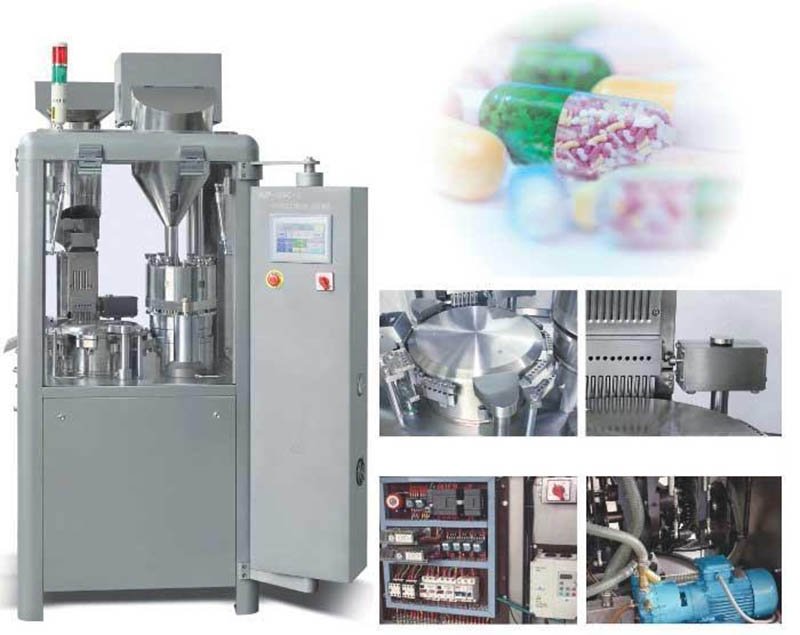
The cam drive matters to a buying team for one practical reason: timing stability. Every station’s action must land within a fraction of a second of the turntable dwell. Forged cams hold that timing under continuous load far longer than lighter mechanisms — which is why the same architecture appears on our 24/7-duty industrial capsule filling machine platform.
The Six Stages of the Automatic Filling Cycle
Stage 1 — Empty Capsule Feeding and Orienting
Empty capsules pour from the hopper into a raceway where mechanical fingers orient each capsule body-down, cap-up, before inserting it into the segment bores. Orientation is the first place cheap capsules cause trouble: dented or out-of-round shells jam the raceway and show up later as separation failures.
Stage 2 — Vacuum Separation
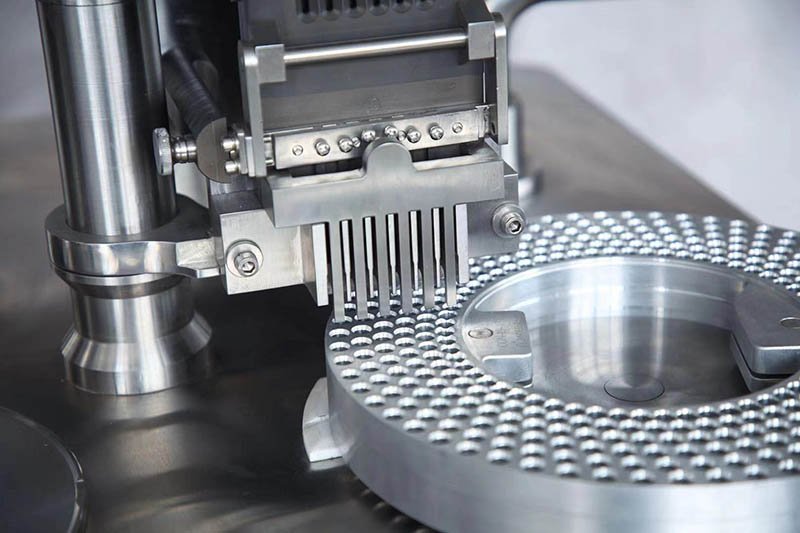
Vacuum applied from below pulls the capsule body down into the lower segment while the cap is retained in the upper segment. The NJP-Series achieves a separation rate above 99% — a figure worth writing into your FAT protocol, because every unseparated capsule is a wasted shell plus, potentially, wasted product downstream.
Stage 3 — Powder Dosing at the Tamping Station
This is the heart of the machine. A rotating dosing disc sits inside the powder hopper with a controlled powder bed above it. As the disc indexes, tamping pins compress powder into the disc bores in successive stages, building a coherent slug of precisely repeatable weight. At the transfer position, pins push the finished slug down into the waiting capsule body.
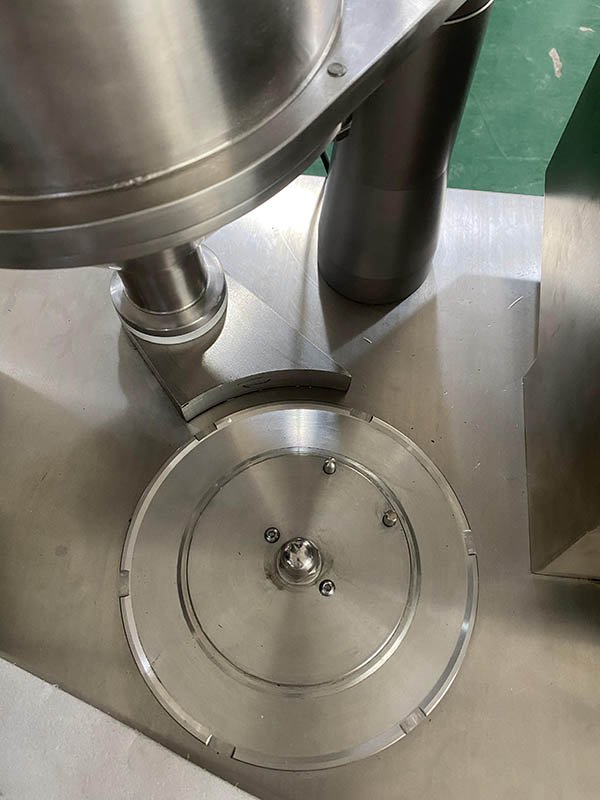
Three variables determine slug weight, and your operators will adjust exactly these when weight trends drift: powder bed height, tamping pressure, and disc bore volume (set by disc selection for the capsule size and target fill weight). For cohesive or poorly flowing materials, a dosator configuration replaces the tamping system — see our powder capsule filling machine page for how the two systems compare, or the liquid capsule filling machine for pump-dosed oils and suspensions.
Stage 4 — Faulty Capsule Rejection
Before closing, the machine detects capsules that failed to separate and rejects them from the stream. In-line rejection protects two things B2B operations care about: batch yield accounting (rejects are counted, not mixed into good product) and downstream equipment (an unseparated capsule fed to a polisher or blister line causes jams).
Stage 5 — Closing and Locking
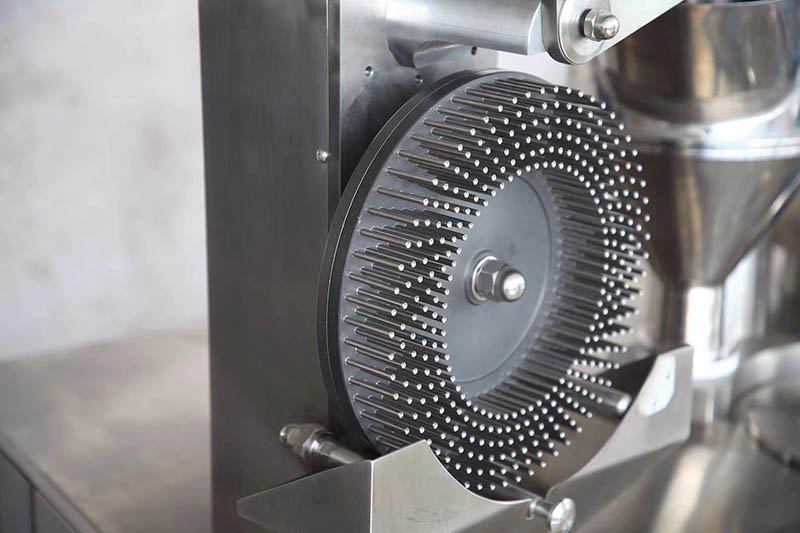
The upper and lower segments realign, and closing pins press each filled body back into its cap to the locked position. Correct locking force matters: under-locked capsules open in the polisher; over-locked capsules can dent or split. This setting is part of the recipe stored per product.
Stage 6 — Ejection and Station Cleaning
Finished capsules are ejected to the discharge chute, and the emptied segment bores are vacuum-cleaned before returning to Stage 1. The enclosed turntable and integrated dust collection keep powder contained — a design point your EHS and quality teams will appreciate during cleaning validation.
Control, Recipes, and Data: The Siemens PLC Layer
Every cycle parameter — turret speed, tamping settings, vacuum level, rejection behavior — is managed from a Siemens (or Delta) PLC through the HMI touchscreen. For a multi-product B2B operation, two functions carry the most operational value:
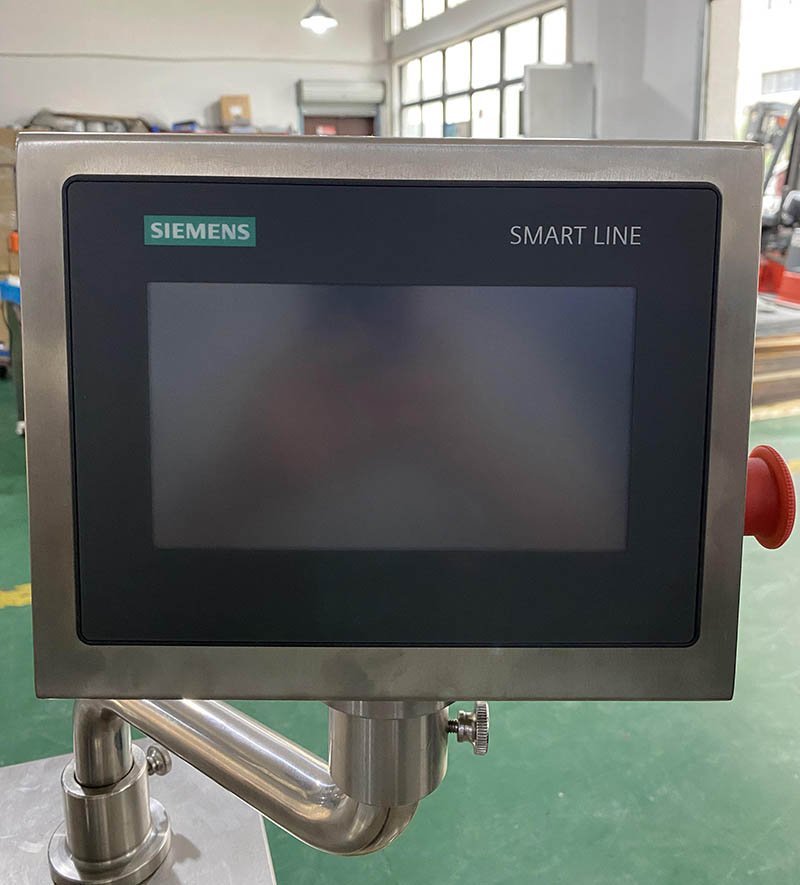
- Digital recipe storage. Every validated product setup is recalled exactly, eliminating re-calibration from scratch and reducing changeover risk between SKUs. Combined with tool-free format parts, size-only changeovers take 20–30 minutes; full product changeovers including cleaning typically take 45–60 minutes.
- Audit trail and user management. Parameter changes are logged by user and time, supporting your 21 CFR Part 11 compliance program and giving your QA team traceable answers when a deviation investigation asks “what changed, when, and by whom.”
What Actually Determines Your Real-World Output
Rated speed is a ceiling, not a promise. In practice, sustained output on any automatic capsule filler is governed by four factors — three of which are on your side of the machine:
- Capsule shell quality. Consistent dimensions and moisture content drive separation rate and jam frequency more than any machine setting.
- Powder flow properties. Bulk density, cohesion, and moisture sensitivity determine how stable the powder bed stays at speed.
- Changeover and cleaning discipline. A machine that could run 120,000 capsules per hour delivers far less if changeovers sprawl — this is operator training, not engineering.
- Machine condition. Cam lubrication, segment bore wear, and vacuum system maintenance keep timing and separation at specification year after year.
This is exactly why we run every Factory Acceptance Test with the customer’s own product and capsules: the only output number that matters is the one demonstrated with your materials.

When I commission machines on customer sites, I teach operators one habit above all others: watch the weight trend, not the weight limit. A filling line that drifts from target slowly — still inside specification — is telling you something: the powder bed is settling, humidity is shifting, or a tamping station needs attention. Teams that react to the trend adjust in thirty seconds during production. Teams that wait for an out-of-specification result stop the line, quarantine product, and open a deviation.
The machine gives you everything needed for this discipline — the HMI shows the parameters, the recipe holds the baseline. Whether your team uses that data proactively is a training decision, and it is the cheapest yield improvement available on any encapsulation line.
After the Filler: Completing the Line
Filled capsules typically pass through polishing and sorting, metal detection or checkweighing, and then primary packaging — most commonly capsule blister packing — before cartoning. Specifying the filler and downstream equipment together as one turnkey project keeps throughputs matched and puts integration responsibility with a single partner. For help sizing the filler itself against your volumes, our size selection guide walks through the capacity math.
About HIJ Machinery & This Article
HIJ Machinery (legal name: Wenzhou Trustar Machinery Technology Co., Ltd) is a pharmaceutical, nutraceutical, and food packaging machinery manufacturer founded in 2004 in Rui’an, Wenzhou, Zhejiang, China. The company builds the NJP-Series automatic capsule filling machines described in this article, along with blister packing machines, cartoning machines, and complete turnkey packaging lines exported to 30+ countries. HIJ equipment is cGMP-ready and CE-marked, manufactured under ISO 9001 manufacturing standard.
This article was written and reviewed by Forester Xiang, founder and chief engineer of HIJ Machinery, based on 20+ years of encapsulation engineering experience and 100+ pharmaceutical facility audits. All performance figures are taken from HIJ factory documentation. Contact: hijpackingmachine.com/contact-us
Frequently Asked Questions
How does an automatic capsule filling machine separate the cap from the body?
After each capsule is oriented body-down into a two-part segment bore, vacuum applied from below pulls the body into the lower segment while the cap is retained in the upper segment. The two segments then move apart, exposing the open capsule body for filling. HIJ NJP-Series machines achieve a separation rate above 99%, and capsules that fail to separate are automatically detected and rejected before the closing station.
How is the filling weight controlled on an automatic capsule filler?
Weight is set at the tamping station, where pins compress powder into the bores of a dosing disc in successive stages to form a slug of repeatable weight. Operators control three variables: powder bed height above the disc, tamping pressure, and the disc bore volume selected for the capsule size and target fill weight. Together these deliver ±2% dosing accuracy on NJP-Series machines, with all settings stored digitally per product recipe.
How many operators does an automatic capsule filling machine need?
A single trained operator typically runs an automatic capsule filler during steady-state production, monitoring the HMI, replenishing empty capsules and powder, and performing routine in-process weight checks. Additional labor is only involved during changeovers and cleaning. This is a key economic difference from semi-automatic platforms, where an operator is engaged continuously in the filling workflow itself.
What happens during a product changeover on an NJP-Series machine?
For a size-only change, operators swap the tool-free format parts — segments, dosing disc, and tamping tooling — and recall the stored recipe, which takes 20 to 30 minutes. A full product changeover adds dismantling and cleaning of all product-contact parts, sanitization, and setup of the new recipe, typically completing in 45 to 60 minutes. The 316L stainless steel contact parts disassemble without tools to support your cleaning validation.
Can an automatic capsule filling machine fill liquids or pellets?
Yes, with the appropriate dosing configuration. Liquid and oil formulations use a precision pump dosing system with anti-leakage design in place of the tamping station, while pellets and mini-tablets use dedicated counting and dispensing tooling. The rotary architecture, separation, and closing stages remain the same, so the platform choice is driven by your formulation type.
Want to See the NJP Cycle Run With Your Own Product?
Send Forester your formulation type, capsule sizes, and target output. We’ll arrange filling trials and a FAT protocol built around your materials — plus a detailed quotation, usually within 48 hours.
Get Free Turnkey Quote