Procurement guide · configuration-based budgeting
Compare prefilled syringe filling equipment by scope—not by a headline number. This guide shows which machine choices change the quotation, what buyers often omit, and how to request an itemized offer that can be compared supplier by supplier.
There is no reliable universal prefilled syringe filling machine price. Automation level, filling and stoppering method, syringe format, product properties, clean-zone interface, documentation and delivery scope all change the final amount. The useful number is the price of a defined configuration delivered under a stated Incoterm.
What determines prefilled syringe filling machine price?
The same basic equipment category can describe a compact operator-assisted filler or a fully automatic aseptic filling and stoppering system. Before comparing quotations, define the production problem each supplier is pricing.
| Price driver | What must be specified | Why it changes the quote |
|---|---|---|
| Required output | Good syringes per hour, batch size and shift pattern | Output determines head count, indexing, automation and downstream handling. |
| Product | Viscosity, foaming tendency, oxygen sensitivity and cleaning needs | Product behavior affects pump, needle, fluid path and whether vacuum processing is justified. |
| Syringe format | Barrel material, size, nest/tub configuration and component supplier | Each format can require dedicated guides, holders, needles and change parts. |
| Stoppering | Atmospheric or vacuum placement, stopper presentation and headspace target | A filling-and-stoppering machine has more stations and controls than a filler alone. |
| Aseptic interface | Open RABS, closed RABS, isolator or laminar-flow interface | Enclosure, airflow, transfer and decontamination interfaces affect engineering scope. |
| Documentation | URS response, drawings, manuals, FAT records and qualification support | Documentation must be engineered and reviewed; it is not identical across suppliers. |
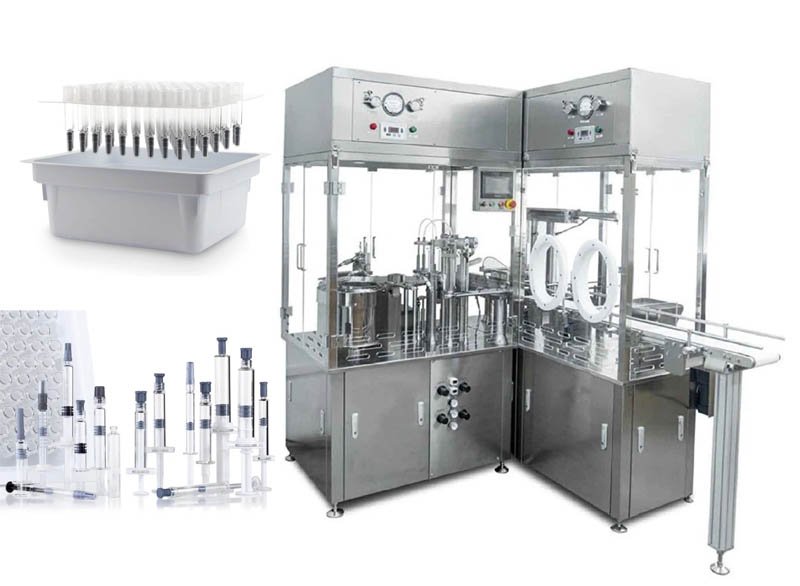
Compare investment tiers before comparing suppliers
A price guide is more useful when it separates machine classes. The descriptions below are relative investment levels, not catalogue prices. A firm figure still requires an application review.
| Equipment tier | Typical fit | Relative investment | Question to settle first |
|---|---|---|---|
| Semi-automatic syringe filler | Development, clinical supply or lower-volume work with operator handling | Entry | Which loading, filling and unloading steps remain manual? |
| Automatic atmospheric filler | Products that can be dosed without a vacuum filling step | Low–mid | How will headspace and stoppering be controlled? |
| Automatic vacuum filling and stoppering | Applications where product behavior or stopper placement makes vacuum processing valuable | Mid–high | What vacuum sequence, pump and stopper method will be demonstrated at FAT? |
| Integrated aseptic line | Higher output with automatic component handling and downstream integration | High | Where are the line boundaries and who owns each interface? |
Do not compare labels alone. Two machines described as “automatic” may have very different loading, de-lidding, filling, stoppering, discharge and data-recording scopes.
A published price example for one defined configuration
A real price is useful only when the model and included scope are visible. As of this guide’s August 2026 update, HIJ’s HIJ-GZB-100 single-head vacuum filling and stoppering machine is published from US$26,000 FOB Ningbo. The base scope includes one syringe-format set, stopper feeder, Siemens PLC/HMI and a servo-driven ceramic plunger pump.
| Published line item | Reference amount | What the buyer should confirm |
|---|---|---|
| HIJ-GZB-100 base machine | From US$26,000 | Selected syringe format, product trial, documentation scope and named FOB port. |
| Automatic denesting module | US$12,000–12,500 | Nest/tub compatibility, transfer boundary and whether clean-air protection is separate. |
| Grade A LAF hood for filler | US$2,000 | Coverage, airflow interface, monitoring provisions and site qualification responsibility. |
| LAF hood for denesting module | US$2,300 | Whether this is required for the chosen loading method and aseptic boundary. |
| Additional format mold | US$2,300 each | The exact syringe, nest and stopper combination covered by each set. |
| Additional ceramic valve assembly | US$1,800 | Product compatibility, cleaning strategy and included contact-path components. |
| Published fully configured example | Up to US$42,300 | The final combination of automation, clean-air options, formats and delivery scope. |
Treat this as a worked example, not a universal market price. Public figures can change. Request a dated, itemized quotation and verify the included configuration, Incoterm, validity period, payment terms and delivery schedule before budgeting.
How filling and stoppering choices affect cost
The filling station is selected around the product and dose—not just nominal speed. Pump type, number of filling heads, needle movement, fluid-path design and cleaning approach all influence the configuration.
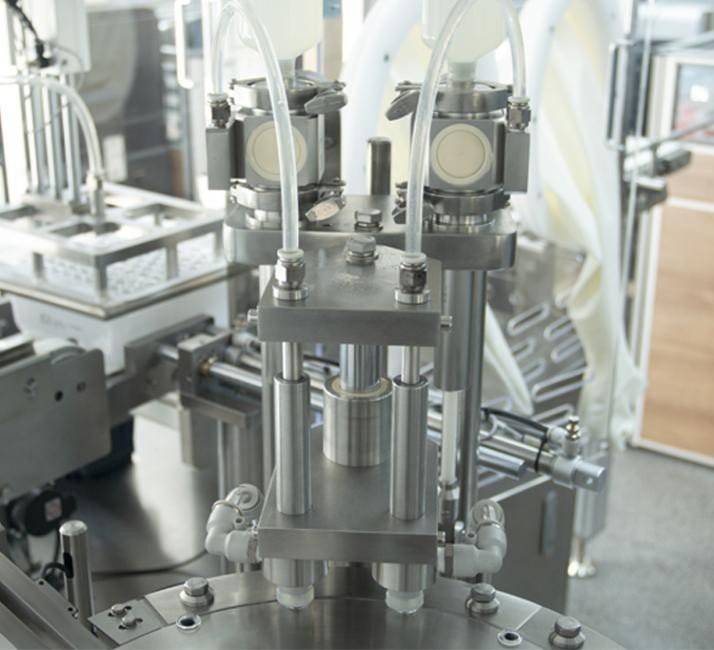
For some products, vacuum filling can help manage trapped air and headspace. For others, atmospheric dosing may be sufficient. The decision should follow product trials and acceptance criteria rather than a generic claim that one method is always better.
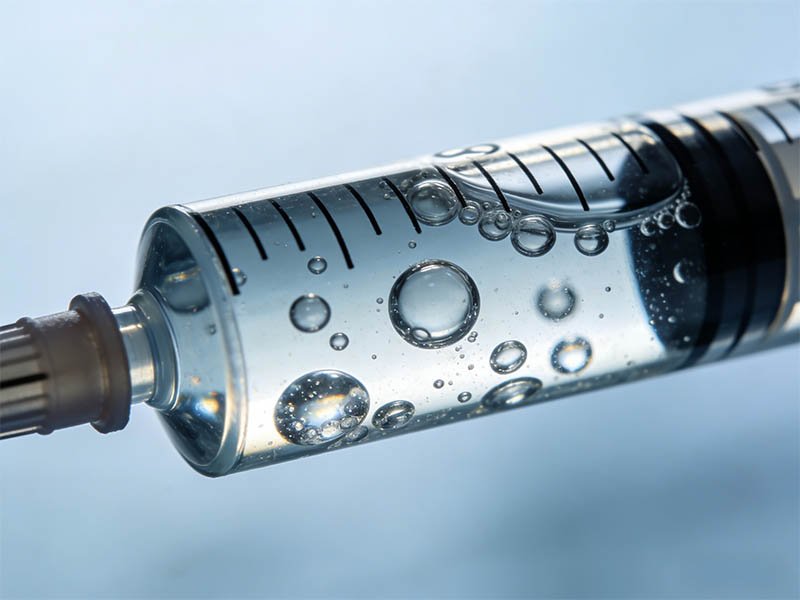
Stoppering scope matters just as much. Confirm whether the quote covers stopper feeding, placement, vacuum application, reject logic and format parts. A machine described only as a “syringe filler” may not include the same stoppering functions as a pre-filled syringe filling and stoppering machine.

Costs that may sit outside the machine price
Procurement gaps usually appear at the project boundary. Ask each bidder to mark every line as included, optional, excluded or supplied by others.
- Format parts: one complete set for every syringe, nest and stopper combination you plan to run.
- Product-contact path: pumps, tubing, needles, tanks or single-use assemblies.
- Aseptic environment: RABS/isolator or laminar-flow interface, utilities and environmental-monitoring provisions.
- Inspection and rejection: presence checks, fill-level or weight verification, stopper inspection and reject confirmation.
- Documentation: design documents, manuals, certificates for applicable materials and agreed qualification support.
- Testing: factory trials, samples, product simulant, FAT protocol and repeat-test conditions.
- Logistics and site work: packing, freight, insurance, import charges, installation, commissioning and training.
- Lifecycle support: recommended spares, wear parts, remote support and future format changes.
FOB, CIF and DAP can make identical machines look differently priced
An equipment quotation is incomplete without a named Incoterm and location. A lower FOB figure and a higher DAP figure may describe the same machine with different transport responsibilities.
| Term | Practical comparison point | Buyer should still confirm |
|---|---|---|
| FOB | Seller delivers the cleared goods on board at the named port of shipment. | Freight, insurance, import clearance, duty and inland delivery. |
| CIF | Seller arranges cost, insurance and freight to the named destination port. | Import clearance, duty and delivery beyond the port, plus the insurance scope. |
| DAP | Seller delivers to the named destination ready for unloading. | Import clearance and duties/taxes, unless another arrangement is written. |
Normalize all bids to the same delivery basis before you compare capital cost.
Eight inputs needed for an accurate quotation
Send the same RFQ package to every supplier
- Product: formulation type, viscosity range, foaming or oxygen sensitivity, and cleaning constraints.
- Dose: fill volume or range, accuracy requirement and acceptance method.
- Components: syringe, nest/tub and stopper drawings plus representative samples.
- Output: required good units per hour, batch size, shifts and expected efficiency basis.
- Process: atmospheric or vacuum filling, stoppering sequence and headspace requirements.
- Aseptic boundary: room classification and required RABS, isolator or airflow interface.
- Quality scope: inspection, data records, FAT challenge tests and qualification deliverables.
- Commercial scope: destination, Incoterm, installation, training, spares and requested delivery window.
You can use our prefilled syringe filling machine selection page to identify the relevant equipment family before sending the RFQ.
Compare total project cost, not just the purchase order
The lowest machine price can become the higher project cost when essential scope is added later. A transparent comparison sheet should include capital equipment, change parts, integration, qualification effort, transport, site services, spares and the operational cost of changeovers and rejects.
- Use the same production basis: rated speed is not the same as sustained good output.
- Ask for a format-change demonstration and list every part that must be replaced or adjusted.
- Agree on product-trial acceptance criteria before FAT, including dose, bubbles, stopper position and rejects.
- Separate required scope from future options so the initial project and expansion budget remain visible.
Frequently asked questions
How much does a prefilled syringe filling machine cost?
The price is configuration-dependent. Automation level, output, filling and stoppering method, syringe formats, aseptic interface, inspection, documentation and delivery scope all change the quotation. Request an itemized offer against a written URS rather than relying on a generic catalogue figure.
Why does a vacuum filling and stoppering machine cost more?
Vacuum processing adds chambers, pumps, sealing elements, controls and a defined stoppering sequence. Whether that investment is justified depends on the product, headspace and acceptance criteria; it should be confirmed through application review and testing.
What should be included in a supplier quotation?
The quotation should state the base machine, included formats, product-contact path, filling and stoppering functions, clean-zone interface, inspection, documentation, FAT scope, spares, site services, delivery term, exclusions and validity period.
How can buyers compare prefilled syringe filler quotations fairly?
Send the same URS and samples to each supplier, normalize the Incoterm and destination, compare included format parts and quality deliverables, and evaluate sustained good output rather than headline speed alone. Record exclusions and options in a line-by-line comparison.
Do different syringe sizes need separate change parts?
Often yes. The required parts depend on the syringe, nest, tub and stopper geometry. Provide drawings and samples for every planned format and ask the supplier to list the included change-part sets explicitly.
Request an itemized project quotation
Send your product, dose, syringe format, output target and aseptic boundary. HIJ engineers will define the machine, tooling, options, documentation and delivery scope as separate line items.
Send your RFQ inputs