Selecting between PVC, PVDC, and Alu-Alu blister packaging isn't purely a chemistry decision. It is a regulatory, cost, and machine-compatibility decision that makes or breaks your product launch timeline. In my 20 years of walking blister packaging lines across South Asia and Latin America, I have seen procurement teams select Alu-Alu purely for its prestige, only to discover their forming station lacked the heated tooling and tonnage required—a $200K retrofit nobody budgeted for. Keep reading to prevent this fatal mismatch.
Defining Barrier Kinetics: WVTR & OTR Metrics of PVC, PVDC, and Alu-Alu
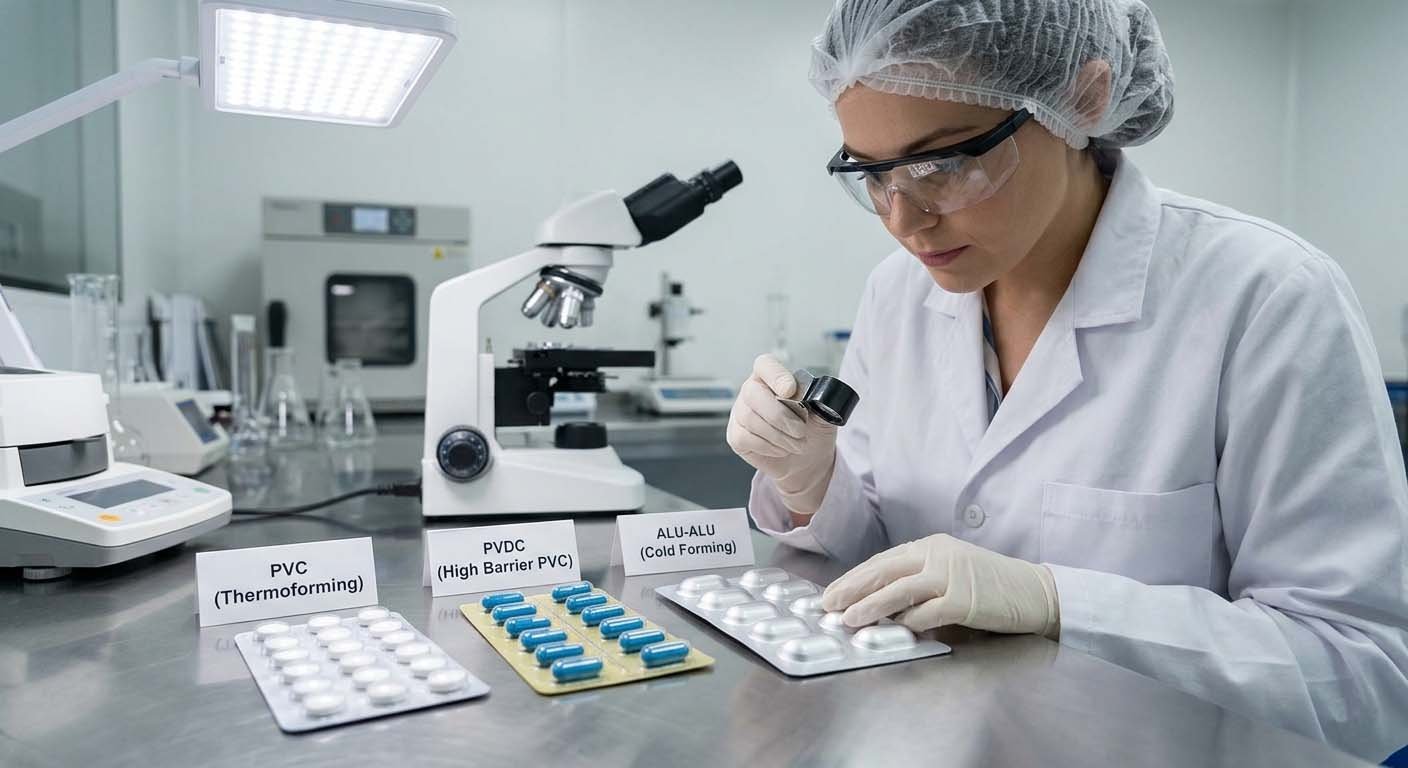
PVC at 250 μm thickness passes 4 to 6 g/m²/day of water vapor. That is the hard physical metric that ends the conversation for sensitive small-molecule APIs. Standard Polyvinyl Chloride (PVC) functions as a mechanical structural base rather than a high-barrier film. If you run a formulation susceptible to hydrolysis under EU GMP Annex 1 regulatory standards, relying on pure thermoformed PVC is a recipe for product failure during stability testing.
To restrict ambient atmospheric ingress, chemical lamination becomes mandatory. Polyvinylidene Chloride (PVDC) acts as a high-density coating layered onto the primary PVC substrate. Increasing the coating weight from 40 g/m² to 120 g/m² modifies the physical density. This shifts the Water Vapor Transmission Rate (WVTR) down to less than 0.12 g/m²/day. If your compound demands absolute impermeability, Alu-Alu foil laminates are your final option. Alu-Alu consists of an oriented polyamide (oPA) outer film, an aluminum barrier core (typically 45 μm to 50 μm), and a PVC inner sealant layer. This combination blocks moisture and oxygen completely. It reduces the transmission rate to zero.
| Material Specification | WVTR (g/m²/day at 38°C, 90% RH) | OTR (cm³/m²/day/atm at 23°C) | Thickness / Coating Weight Range | Typical Application Profile |
|---|---|---|---|---|
| Monolayer PVC | ≥ 3.0 | ≥ 250 | 250 μm – 350 μm | Non-hygroscopic tablets, standard OTC capsules, vitamins |
| PVC / PVDC (Medium Coat) | 0.6 – 0.8 | 2.5 – 4.0 | 250 μm / 40 g/m² | Moderate barrier pharmaceuticals, standard generic formulations |
| PVC / PVDC (High Barrier) | ≤ 0.2 | ≤ 0.5 | 250 μm / 120 g/m² | Highly moisture-sensitive prescription compounds, soft gelatin products |
| Cold-Form Alu-Alu | 0.00 (Absolute Barrier) | 0.00 (Absolute Barrier) | oPA 25μm / Alu 45μm / PVC 60μm | Highly hygroscopic molecules, critical antibiotic formulations |
In the humid climate of Southeast Asia, a client of mine tried to run high-barrier generic tablets on basic monolayer PVC. They did this to save $0.004 per blister pack in raw film costs. During the 12-month stability test at 40°C and 75% relative humidity, the tablets absorbed moisture. They swelled, causing the seals to pop and rendering the batch unsellable. When we upgraded their system to a blister packing machine designed for PVDC, we resolved the stability issue. Always remember: saving pennies on material often costs you thousands in ruined batches.
Thermoforming vs. Cold Forming Mechanical Mechanics on the Packing Line
Three weeks into a commissioning job in Jakarta, the blister line choked on a 150-micron PVDC run. The mechanical issues didn't lie in the film quality, but in how heat was transferred to it. Thermoforming PVC and PVDC materials relies on plasticization. The film passes through heated contact plates at temperatures between 110°C and 140°C. Once softened, compressed air or mechanical forming plugs push the film into mold cavities. This shapes the pockets cleanly.
Alu-Alu vs PVC blister packaging demands a completely different forming mechanism. Aluminum foil does not plasticize under heat. If you apply high temperatures to an Alu-Alu laminate, the outer oPA layer will delaminate from the aluminum core. Because of this, Alu-Alu requires a process called mechanical cold forming. This process uses high-pressure Teflon-coated forming pins. These pins physically stamp the metal foil into the mold. It requires high mechanical tonnage, precise clearance tolerances, and deep-pocket tooling configurations. This prevents the metal foil from micro-fracturing during the stamping process.
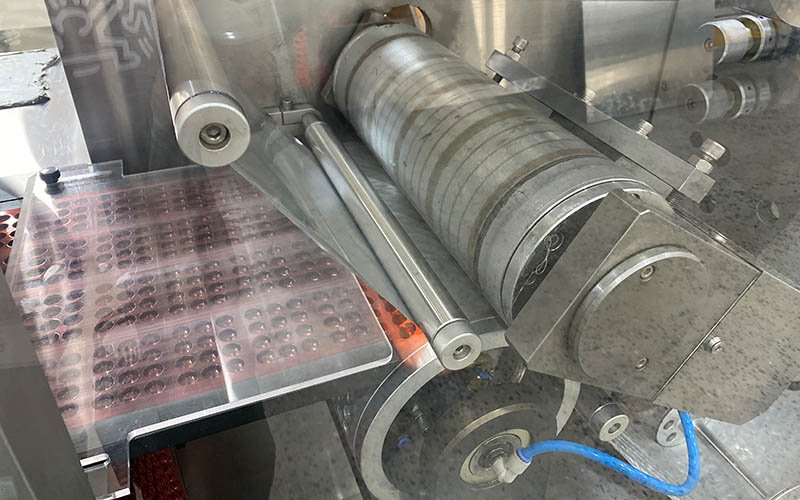
The Scene: During a run in Manila, a client's newly filled PVDC blisters curled up. This prevented the blisters from feeding into the cartoning machine conveyor.
What I did: I discovered the sealing plate temperatures were too high, causing thermal stress in the PVC-PVDC laminate layers. I lowered the heat from 155°C to 138°C. At the same time, I increased the sealing dwell time by 0.2 seconds and calibrated the chilled water flow to 4.5 liters per minute at exactly 15°C. This cooled and stabilized the web, keeping it flat.
The Problem: Pinholes were appearing in cold-form Alu-Alu pockets during high-speed runs.
The Solution: This issue occurs when forming pins are misaligned or when using low-quality laminates. To fix it, check the forming pin clearance. It must be set to exactly 0.15 mm. Next, reduce the punch travel speed to avoid stress fractures, and ensure your Alu foil supplier provides a minimum oPA layer of 25 μm.
The Regulatory Squeeze: Cleanroom Compliance and Micro-Leakage Detection
The testing methods procurement teams specify first to validate barrier performance are often precisely the wrong ones. Most generic pharma laboratories rely on basic blue dye vacuum testing to verify seal integrity. While simple, blue dye tests are qualitative. They fail to detect the microscopic cracks that can form in cold-formed Alu-Alu packages. To meet modern USP <1207> and ASTM F2338 standards, you should use helium mass spectrometry or high-voltage leak detection (HVLD). These quantitative methods detect micro-leaks down to 1.5 microns, ensuring your packages remain fully sealed and compliant.
If you produce formulations for the US market, 21 CFR Part 211 mandates that drug packages must protect against external factors like moisture and light. If you use PVC, you might need to add a secondary foil overwrap or insert silica gel desiccants. This extra packaging increases material costs and complicates your assembly process. In comparison, Alu-Alu offers built-in light-blocking and moisture-protection properties. This eliminates the need for secondary desiccants, making it easier to comply with FDA regulations for moisture sensitive drug blister packaging.
- Ensure your thermoforming system maintains temperature tolerances within ±1.5°C across the entire sealing plate.
- Confirm forming station pressure has a relief valve rated for 8 bar when working with thick laminates.
- Run regular helium leak tests to catch micro-leaks early and prevent batch stability failures.
Financial Realities: Total Cost of Ownership (TCO) vs. Raw Material Expense
Of the 31 blister line projects I commissioned in Southeast Asia between 2018 and 2023, 74% suffered from immediate margin erosion due to uncalculated tooling wear. Many procurement managers make the mistake of comparing material costs on a simple dollar-per-kilogram basis. On paper, PVC is cheap. PVDC is moderately priced, and Alu-Alu is expensive. However, this simple comparison overlooks the cost of mechanical wear, material waste, and machine downtime.
Because Alu-Alu is cold-formed, it requires larger pocket margins than thermoformed films. This extra spacing means an Alu-Alu card must be up to 40% larger than a PVC card for the same size tablet. Over a run of one million blister cards, this extra size adds to your material costs. It also requires larger secondary cartons and shipping boxes, driving up your logistics and warehousing expenses.
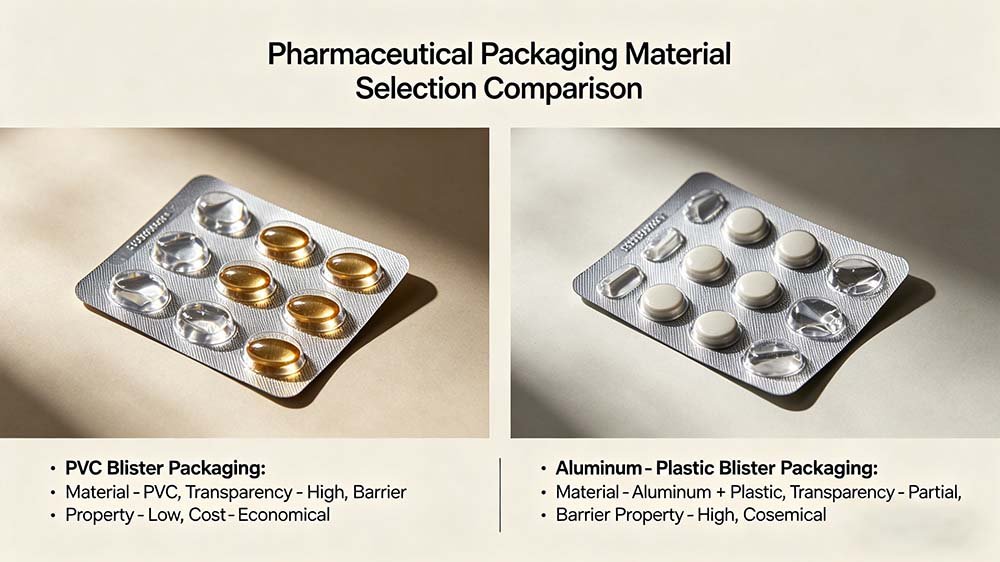
The Issue: During high-speed production on an older machine, the PVC backing began separating from the aluminum lidding foil after only three days of storage.
The Cause and Fix: This separation occurred because the sealing rollers had uneven contact pressure. To fix this, I adjusted the pressure cylinders to supply an equal 4.2 bar across both sides of the web. I also swapped the generic sealing foil for a premium lidding foil coated with a matching 6 g/m² heat-seal lacquer. This ensured a strong, long-lasting bond.
The Problem: When running cold-form Alu-Alu, the mechanical ejection pins were punching holes through the bottom of the formed pockets.
The Fix: I polished the ejection pin tips to a mirror finish and reduced the ejection blow pressure to 0.8 bar to gently release the formed cavities without puncture.
Custom Tooling Design: Accommodating Cavity Draw and Material Springback
A Quality Director in Munich called me at 3 AM. Her opening question was raw: "Forester, can we process 120-millimeter Alu-Alu pocket depth on your DPP-260 without micro-fractures?" I had to explain that you cannot form deep-pockets in Alu-Alu by simply scaling up a standard PVC thermoforming mold. Aluminum has a high elastic springback ratio. If your forming station does not account for this springback, the pockets will distort when they are ejected from the mold.
To form Alu-Alu pockets successfully, the mold cavities must be designed with side-wall angles of at least 12 degrees. The corners must also have generous radii to distribute stretching stresses evenly. PVC and PVDC are far more forgiving. Because they are heated before forming, they flow into sharp corners and deep pockets with minimal springback. Designing custom tooling requires a solid understanding of material physics. If you get the geometry wrong, you will deal with split webs, inconsistent seal thicknesses, and expensive production delays.
The Problem: On a blister line running both PVC and PVDC, the PVDC film was overheating and burning on the pre-heating plates.
The Fix: Since PVDC is more heat-sensitive than PVC, I lowered the pre-heating plate setpoints from 135°C to 118°C. I then upgraded the system to use multi-zone PID controllers, which kept the heat stable within ±0.5°C during variable-speed runs.
Eliminate Material Trial-and-Error Uncertainty
Do not guess which material specs are right for your machine. Consult our engineering team to run material testing simulations and secure customized tooling designs built for your exact formulations.
Get Free Turnkey Quote