A semi-automatic case sealer requires an operator to fold the top flaps and feed each carton; the machine then transports, tapes, and cuts — at up to 720 boxes/hour on the HIJ-600. A fully automatic case sealer also folds all four top flaps mechanically and accepts cartons directly from a conveyor with no operator. The rule of thumb: below roughly 2,000 boxes per day, semi-automatic delivers nearly all the benefit at a fraction of the investment; above that — or on conveyor-fed inline systems — fully automatic wins.
This is the single most common fork in the road for case sealer buyers, and suppliers rarely explain it honestly: the fully automatic machine is more impressive in a video, but for a large share of B2B factories the semi-automatic model is the objectively better purchase. The difference is not quality — it’s where the flap-folding labor sits and how the cartons arrive at the machine.
Below we define exactly what each type does and doesn’t automate, compare them across the eight criteria that drive the decision, and give you a volume-based framework you can apply to your own line today. For the machine referenced throughout, see the HIJ-600 automatic case sealing machine; for category basics, start with what a case sealing machine is, or browse all case packing machines.
What Each Type Actually Automates
Semi-Automatic Case Sealer
The operator folds the four top flaps by hand and pushes the carton onto the infeed. From there the machine does everything: guide rails center the box, drive belts transport it, and twin taping heads seal the top and bottom seams simultaneously — the full mechanical sequence covered in our step-by-step working principle guide. Carton size changes take under a minute via hand-wheels. One operator can comfortably keep pace with the machine’s rated 720 boxes/hour.
Fully Automatic Case Sealer
Adds two things: mechanical flap folding (plows and kicker arms close the minor and major flaps) and conveyor-fed infeed (cartons arrive spaced automatically from an upstream case packer — no human touch). Some models also add automatic size detection (random sealers). The result is true lights-out sealing, at roughly two to five times the investment.
Head-to-Head: 8 Decision Criteria
| Criteria | Semi-Automatic (e.g. HIJ-600) | Fully Automatic |
|---|---|---|
| Flap folding | Operator folds top flaps | Machine folds all four flaps |
| Infeed | Operator pushes carton onto infeed | Conveyor-fed, hands-free |
| Labor | 1 operator at the machine | 0 at the machine (supervision only) |
| Throughput | Up to 720 boxes/hour | 800–1,500+ boxes/hour |
| Typical price (FOB China) | US$2,000 – $8,000 | US$15,000 – $40,000 |
| Changeover | Hand-wheels, under 1 minute | More adjustment points; random models auto-adjust |
| Footprint & utilities | 1830 × 835 mm, single-phase 220V, mobile on casters | Longer frame + conveyors; often three-phase |
| Maintenance complexity | Minimal — mechanical taping heads only | Adds folding mechanisms, sensors, more wear points |
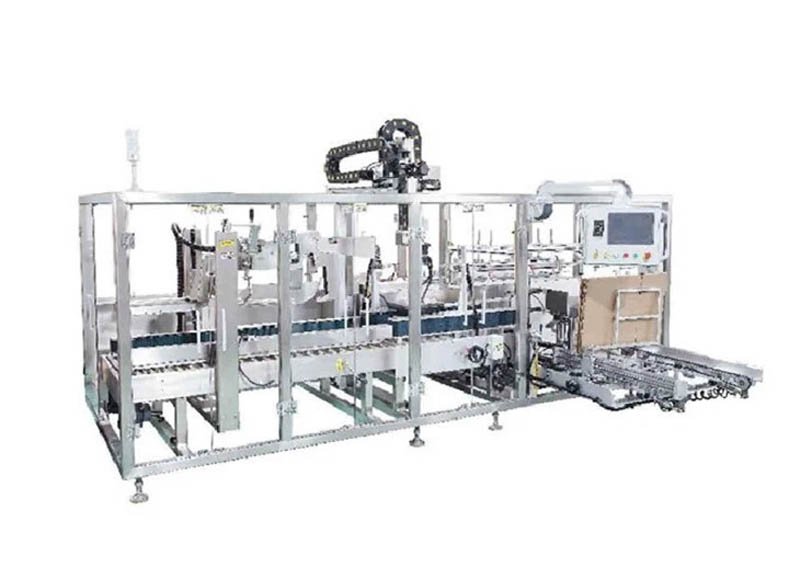
At the top of the automation ladder, sealing merges with erecting and loading into one integrated system.
The Volume-Based Decision Framework
Under 500 boxes/day: a semi-automatic sealer is unambiguous — it removes the taping bottleneck, costs the least, and the operator folding flaps is not a constraint at this volume.
500–2,000 boxes/day: still semi-automatic territory for most factories. One operator feeding the HIJ-600 handles this range within a normal shift. Spend the price difference on an upstream improvement instead — a case erector, or better product collation.
Over 2,000 boxes/day or conveyor-fed inline: fully automatic earns its price. When cartons arrive continuously from an automated case packer, a human folding flaps becomes the line’s speed limit — exactly the sequencing trap described in our case sealer vs erector vs packer guide. At the highest volumes, evaluate the all-in-one erect-load-seal machine, which absorbs the sealing step entirely.
The exception that overrides volume: if every consecutive carton is a different size (e-commerce fulfillment), a random fully automatic sealer is the right architecture regardless of daily count — hand-wheel changeover between every single box is not workable.
“Buyers regularly ask me for the fully automatic model ‘to be future-proof.’ I ask one question back: where will the cartons come from? If the answer is ‘a worker carries them over,’ the extra investment buys nothing — the machine will wait on the human either way. Buy the semi-automatic sealer now, and when a case packer eventually feeds it by conveyor, upgrade the sealer then. Machines should be purchased for the line you run, not the line you imagine.”
Total Cost Comparison, Not Just Sticker Price
The honest comparison includes labor: a semi-automatic sealer keeps one operator at the machine (~1 labor unit), while fully automatic removes it but adds sensor and folding-mechanism maintenance plus a higher spare-parts budget. At 2,000+ boxes/day the labor saving dominates and fully automatic wins on total cost within two to three years; below that volume, the operator is usually doing other line tasks between boxes anyway, and the saving is illusory. Full price breakdowns by machine type — including the hidden landed costs — are in our case sealing machine price guide.
The Upgrade Path Most Factories Actually Take
Start with a semi-automatic uniform sealer (the HIJ-600 class). When volume grows, add a case erector upstream so the operator stops folding boxes. When an automated case packer arrives, either upgrade to a fully automatic sealer or fold all three steps into an all-in-one system — ideally specified as a turnkey line so one supplier owns the speed matching. Each machine keeps its resale value within the chain, and no investment is stranded.
Key Takeaways
- Semi-automatic = operator folds flaps and feeds; machine tapes. Fully automatic = machine also folds flaps and accepts conveyor infeed.
- Under ~2,000 boxes/day, semi-automatic delivers nearly all the benefit at 2–5× lower investment; above that, fully automatic wins on labor savings.
- Constantly mixed carton sizes (e-commerce) override the volume rule — that’s random fully automatic territory.
- Fully automatic is only worth it when cartons arrive by conveyor; if a human carries boxes to the machine, the extra automation buys nothing.
- Semi-automatic machines like the HIJ-600 run on single-phase 220V with under-1-minute hand-wheel changeover and minimal maintenance.
- The proven upgrade path: semi-auto sealer → case erector → automated packer → fully automatic or all-in-one system.
Tell Us Your Daily Volume — We’ll Tell You Which Machine
Send your boxes-per-day, carton sizes, and how cartons reach the sealing station. Our engineers will recommend semi or fully automatic — with a formal quote — within 24 hours.
Get Free Turnkey QuoteFrequently Asked Questions
What is the difference between a semi-automatic and fully automatic case sealer?
Is a semi-automatic case sealer fast enough for a real production line?
How much more does a fully automatic case sealer cost?
Can I upgrade from semi-automatic to fully automatic later?
Which type is better for e-commerce with many different box sizes?
About HIJ Machinery
HIJ Machinery (legal name: Wenzhou Trustar Machinery Technology Co., Ltd), founded in 2004 in Rui’an, Wenzhou, Zhejiang, China, manufactures pharmaceutical, cosmetic, and food packaging machinery — including blister packing machines, cartoning machines, capsule filling machines, and case packing machines such as the HIJ-600 automatic case sealing machine. Equipment is CE-marked, manufactured under the ISO 9001 standard, and built cGMP-ready, with installations in more than 30 countries.
This article was written and technically reviewed by Forester Xiang, founder and chief engineer of HIJ Machinery, with 20+ years of packaging engineering experience and more than 100 pharmaceutical facility audits worldwide. Contact our engineering team for equipment selection support.