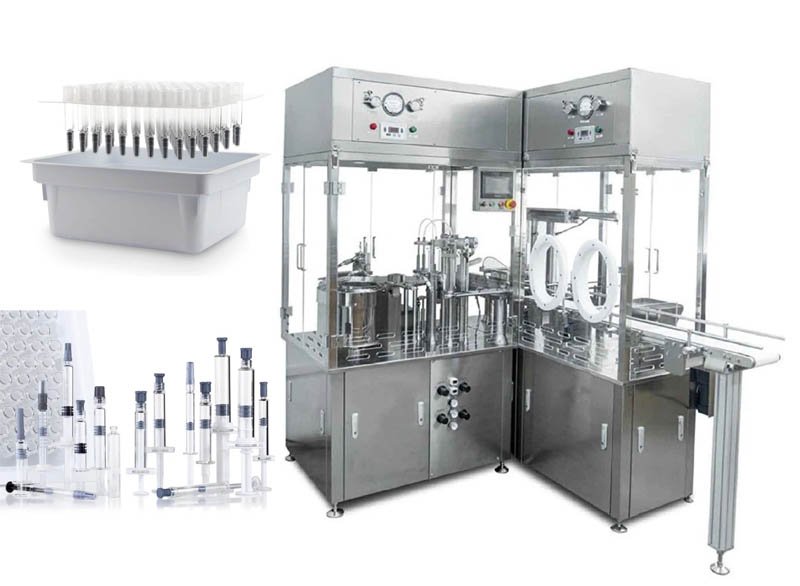
A single-head syringe filler uses one filling needle and runs about 600–800 syringes/hour. A double-head filler uses two needles and runs about 800–1,200 syringes/hour. The second needle therefore delivers roughly a 1.5× throughput gain — not 2× — because vacuum dwell, indexing and stoppering time do not halve. Even so, because CAPEX rises only ~1.35× (US$26,000 → US$35,000 FOB), the double-head machine is the cheaper machine per unit of capacity.
“Two filling needles means twice the output, so I should expect roughly double the syringes per hour.”
Two needles ≈ 1.5× output. Filling is only one station in the cycle. Vacuum dwell, turntable indexing and vacuum stoppering are shared serial steps that a second needle does not shorten.
This article is written for capacity planners, production directors and anyone preparing a capital-expenditure request for a prefilled syringe line. It uses the published specifications and FOB pricing of two real machines — the single-needle HIJ-GZB-100 and the double-needle HIJ-GZB200 — so you can substitute your own volumes and rerun the arithmetic.
Single-head vs. double-head: the specification matrix
Both machines perform vacuum filling and vacuum stoppering, use a servo-driven ceramic plunger pump, and accept the same glass and plastic SCF/RTF syringe formats. The differences are needle count, cycle output, footprint and lead time.
| Specification | HIJ-GZB-100 (single head) | HIJ-GZB200 (double head) |
|---|---|---|
| Filling needles | 1 | 2 |
| Production capacity | 600–800 pcs/hr | 800–1,200 pcs/hr |
| Base price (FOB Ningbo) | US$26,000 | US$35,000 |
| Filling accuracy | ±1–2% | ±1–2% |
| Syringe range | 0.5–20 ml glass & plastic SCF | 0.5–20 ml glass & plastic SCF |
| Total power | 2.5 kW | 3 kW |
| Compressed air | 0.6–0.7 MPa, 15 L/s | 0.55–0.75 MPa, 15 L/s |
| Dimensions (L×W×H) | 808 × 758 × 1760 mm | 1020 × 840 × 1730 mm |
| Weight | 380 kg | 400 kg |
| Lead time | 45 working days | 60 working days |
| Contact materials | AISI 316L + medical silicone | AISI 316L + medical silicone |
The number that actually matters: cost per unit of capacity
Comparing sticker prices tells you almost nothing. The meaningful metric for a capital request is US$ of CAPEX per syringe-per-hour of installed capacity. Using midpoint outputs (700/hr and 1,000/hr) and base FOB prices:
CAPEX per unit of installed capacity
Base machine price ÷ midpoint hourly output
US$26,000 ÷ 700 pcs/hr
US$35,000 ÷ 1,000 pcs/hr
(not the 2× commonly assumed)
The double-head machine buys capacity slightly cheaper per unit — but only if you actually use that capacity. Idle capacity has a cost per unit of infinity. The decision is a utilisation question, not a price question.
Where the extra capital really goes
The US$9,000 base-price delta is not the whole story. On a double-head line the options also scale, and two items are specific to the larger machine:
- Format molds cost more — roughly US$4,800 per extra mold on the GZB200 versus US$2,300 on the GZB-100, because two needle positions must be tooled.
- Ceramic valve assemblies come in pairs (about US$3,800 for a set of two), since each needle needs its own valve. Note that water-like and paste-like materials cannot share ceramic valves.
- A material defoaming barrel (15 L, about US$4,000) is commonly specified on the GZB200 for genuinely bubble-free output on viscous product.
- Automatic nest removal (~US$12,500) and laminar-flow hoods (~US$2,500 each) are priced similarly on both machines.
- Lead time extends from 45 to 60 working days — a real scheduling cost if you are building toward a validation deadline.
A representative GZB200 configuration — base machine plus defoaming barrel plus automatic nest remover — lands at US$51,500 FOB Ningbo. For the full option-by-option breakdown across both machines, see our prefilled syringe filling machine price guide.
Not sure which machine your annual volume justifies? Send us your batch size, working shifts and syringe format — we’ll run the utilisation math with you.
Request a Capacity AssessmentBreak-even: when does the second needle pay for itself?
The double-head machine earns its premium by removing production hours, not by removing scrap. If your line is capacity-constrained, every hour saved is an hour of labour, cleanroom occupancy and utilities you don’t pay for.
Worked example: 500,000 syringes per year
Illustrative model. Substitute your own loaded hourly rate — it is the single most sensitive input. Below roughly 175,000 syringes/year the single-head machine is usually the better capital decision; above it, the double-head pays back inside the first year.
Forester Xiang
Founder & Chief Engineer · 20+ years in sterile filling
I could sell more double-head machines by letting people assume two needles means two times the output. I won’t, because the customer finds out during FAT and then they don’t trust anything else I told them. Two needles gives you about one and a half times, and the reason is simple: filling is not the bottleneck — the vacuum cycle is.
You draw vacuum, you fill, you hold, you index the turntable, you stopper under vacuum. A second needle only shortens the filling step. Everything else is serial and unchanged. If you want a real doubling, you are not buying a second needle — you are buying a second machine. Sometimes that is genuinely the right answer, and I’ll say so.
Which one should you specify?
Choose single head (GZB-100)
- Annual volume below roughly 175,000 syringes
- R&D, clinical-trial material or pilot batches
- Frequent product changeovers (fewer valves & molds to clean and qualify)
- Tight cleanroom footprint (808 × 758 mm)
- Capital constrained, or you need the machine in 45 days
- Niche biologics and aesthetics with modest batch sizes
Choose double head (GZB200)
- Annual volume above roughly 175,000 syringes
- Commercial-scale or CDMO contract filling
- The line is capacity-constrained and you are adding shifts
- Long, stable production runs of one or two formats
- You have 1020 × 840 mm of cleanroom floor and 60 days of lead time
- You want the lower CAPEX per unit of installed capacity
A third option is worth naming: if you need genuine 2× redundancy — so that a single machine failure cannot stop the line — two single-head machines can be the better engineering answer than one double-head. You pay more per unit of capacity, but you buy fault tolerance and the ability to run two products in parallel. Discuss this with your QA team before you commit, since it affects your IQ/OQ/PQ validation scope.
Key Takeaways for Capital Approval
- A second filling needle delivers ≈1.5× throughput, not 2× — vacuum dwell and stoppering are serial steps that don’t halve.
- CAPEX rises only ≈1.35× (US$26,000 → US$35,000 FOB), so the double head is cheaper per syringe-per-hour of installed capacity.
- That advantage only exists if the capacity is utilised. Idle capacity destroys the ratio.
- Approximate break-even sits near 175,000 syringes/year; the dominant variable is your loaded hourly line cost.
- Budget for scaling options too: molds cost roughly 2× more and ceramic valves come in pairs.
- Lead time extends from 45 to 60 working days — plan against your validation deadline.
- If you need true redundancy, two single-head machines may beat one double-head.
Frequently asked questions
Does a double-head syringe filler really double throughput?
Which machine has the lower cost per unit of capacity?
At what annual volume does a double-head machine pay for itself?
Are the options and change parts the same price on both machines?
Would two single-head machines be better than one double-head?
Do both machines handle the same syringes and accuracy?
Single-Head vs. Double-Head Syringe Filler — Reference Data
Size the Machine to Your Actual Volume
Send us your annual syringe volume, shift pattern and syringe format. We’ll run the capacity and payback math honestly — including telling you when the single-head machine is the better buy.
Get Free Turnkey Quote