Work-cell planning · Manual loading and machine sealing
A case sealer with a packing station combines a place to prepare and load shipping cases with a defined transfer into the sealing machine. The packing surface, case support, flap handling and discharge arrangement need their own scope. A table beside a sealer does not make product loading automatic.
Start with the filled case and the operator’s complete task cycle. Then choose the transfer arrangement and prove the combined station with representative cases.
- 1. Prepare & loadSupport the case while products, dividers and paperwork are added.
- 2. Present & sealDefine who folds the flaps and how the filled case enters the sealer.
- 3. Receive & clearProvide a discharge destination and a response when it is occupied.
Define the work before choosing the table
The buyer’s problem is often the movement between packing and sealing: a filled case waits on the bench, needs another person to move it, or reaches the machine with the wrong flap condition. Write down that handoff before selecting accessories.
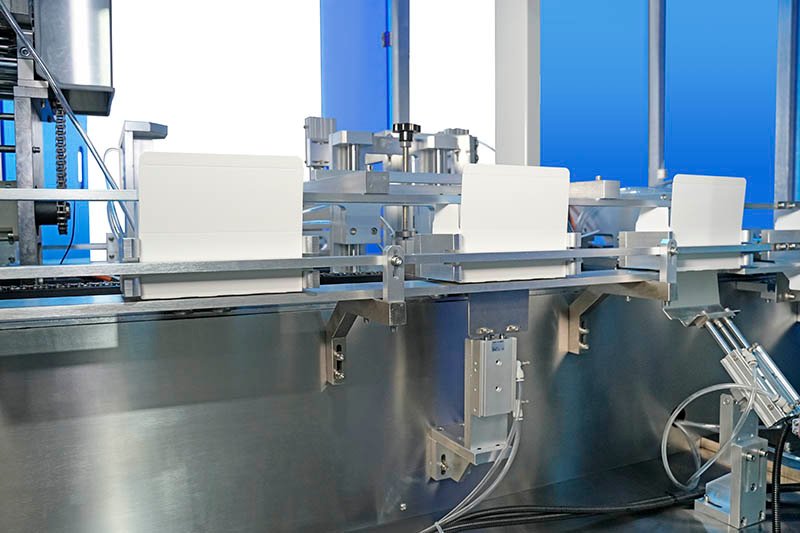
A proposed work cell might use a separate packing bench, an attached support surface or an infeed conveyor. These are different arrangements. For a manufacturer example, 3M describes an infeed/exit conveyor that can provide a packing surface before sealing on specified 3M models. That establishes a useful distinction between the sealer and its support attachment; it does not establish compatibility with HIJ equipment.
Identify whether the case arrives as a flat blank, an erected empty case or a filled case. Forming the case, securing its bottom, adding products and closing it are separate tasks. If the project requires automatic product loading, compare the broader case packing machine range rather than assuming a packing table performs that function.
Specify the result: “An operator loads a supported case and transfers it to the sealer” is a clearer requirement than “one automatic packing station.” It tells the supplier which manual work must remain practical.
Resolve each handoff on the layout
Use the same orientation and reference points on the case drawing, the workstation sketch and the sealer proposal. A machine’s overall dimensions are not the required floor space for the complete cell. Product supply, operator movement, discharge, replenishment and service access also occupy space.
| Interface | Define in the proposal | Demonstrate with the case |
|---|---|---|
| Case support | Where the empty and filled case are supported, including the bottom-flap condition. | The actual loaded case remains supported during packing and transfer. |
| Transfer geometry | Packing-surface level, sealer conveying level, orientation and the transition between them. | A representative case crosses the interface as intended, without an unplanned lift or rotation. |
| Release to infeed | Manual presentation or controlled conveyor transfer, plus the required case spacing. | The operator can release the case at the defined point and start the next task. |
| Flap condition | Who prepares the flaps and which closure functions the machine performs. | The filled case enters with the flap condition required by the proposed machine. |
| Format change | Which supports, guides and machine settings change with a different case. | The complete station changes format, not just the sealer’s width setting. |
| Discharge | Where sealed cases go and the agreed response to downstream blockage. | The test includes a controlled downstream stop and authorized restart. |
| Replenishment & access | Supply routes for products, cases, dividers and tape, plus operator and service access. | Routine tasks fit the assessed layout without occupying the intended discharge area. |
There is no universal bench height, transfer gap or clearance value for this guide. Use the proposed equipment drawings, actual case range and a site-specific task and safety assessment. Do not turn a conceptual diagram into a fabrication instruction.

Choose a layout that follows the actual work
Separate bench with a defined transfer
This arrangement separates product preparation from the sealer. State how the filled case moves between them and who performs that move. Include the move in the task study. A second surface is not useful capacity if cases wait there for a person who is already occupied.
Attached packing surface or supported infeed
Here the packing position is connected more directly to the sealer entrance. Confirm the attachment, support and loading limits for the specific proposal. The relevant case is the loaded one, including its contents and any inserts, not only the empty corrugated shell.
Conveyor-linked manual loading cell
Products or erected cases may arrive by conveyor while an operator still loads the case. Define the release condition, control responsibility and downstream response. Conveyor arrival does not establish automatic product loading, automatic flap folding or random-size adjustment. Those choices are explained separately in the semi-automatic versus fully automatic case-sealer comparison.
Before approving any option, walk through a normal cycle, a format change, replenishment and an interrupted cycle with the proposed layout. Keep access and guarding decisions with the responsible equipment and site reviewers.
Compare station output with the complete task cycle
A sealer’s quoted transport or closure rate does not measure the output of a manual packing station. Observe the repeating work from starting one case to starting the next. Include forming or receiving the case, loading, inserts, flap preparation, presentation and any recurring return movement assigned to the operator.
Illustrative worksheet: capacity margin can disappear
The following values are hypothetical, not HIJ test results or a staffing recommendation.
- Required accepted output
- 120 sealed cases in a defined 60-minute production window: 120 ÷ 60 = 2 accepted cases/minute.
- Illustrative repeating operator cycle
- 24 seconds per case: 60 ÷ 24 = 2.5 cases/minute before interruptions. This is a task-cycle calculation, not demonstrated station capacity.
- Illustrative complete-station trial
- If the trial produces 75 accepted cases in 40 elapsed minutes, its measured rate is 75 ÷ 40 = 1.875 accepted cases/minute, below the 2-case/minute requirement.
Accepted station rate = accepted sealed cases ÷ elapsed trial minutes
The operator-cycle estimate appears adequate, but the hypothetical trial does not. Examine recorded waits, replenishment, rejected cases and discharge interruptions before buying a faster sealer. Use the same time basis when comparing the requirement and the trial.
For one person carrying out sequential manual tasks, their repeating cycle is one capacity constraint. With several people or overlapping work, do not simply add every activity time or assume capacities add together. Measure the coordinated cell. Neither calculation proves a labor saving or eliminates the need for supervision and replenishment.
Run the trial from empty case to cleared discharge
Agree on the trial scope before the demonstration. A video of a prefilled case passing through a sealer does not show the loading work, the transfer or what happens after discharge.
- Use the actual case mix. Include representative loaded cases, contents, inserts, closure materials and the intended order of formats. Identify any case that needs a different handling method.
- Assign the work. State who receives or forms the case, loads it, prepares flaps, presents it, replenishes supplies and clears discharge. Record assistance during the test.
- Record elapsed time and accepted output. Define acceptance for the product and closure. Log rejects, interventions, stops and their causes rather than counting every case as accepted.
- Demonstrate normal interruptions. Include agreed replenishment, a format change if relevant, downstream stoppage and the defined restart. These checks must follow the equipment instructions and the approved test procedure.
- Retain the layout and settings. The result belongs to the tested configuration, case range, materials, task allocation and time window. Record what changes before site installation.
Acceptance targets and stop criteria belong in the project agreement. This planning guide does not replace an equipment manual, a machinery safety assessment or an authorized operating procedure.
Ask for a defined configuration, not an unnamed bundle
Send the case drawing and loaded weight range, product loading method, required accepted cases over the production window, a sketch of the available area and the intended discharge destination. Say whether cases change in batches or arrive in mixed sequence.
Request separate scope for the sealer, packing surface, supports, conveyors, controls, guarding, installation interfaces and the agreed demonstration. Mark each item included, optional, customer-supplied or excluded. Equipment supply, attachment compatibility and integration responsibilities must be confirmed for the specific proposal; no standard HIJ workstation bundle is established by this guide.
If loading itself must become automatic, evaluate the change as a different system requirement. A larger packing table is not a substitute for a defined product-loading mechanism.
Questions before specifying the workstation
Does a case sealer with a packing station load products automatically?
Not necessarily. A packing station can provide a supported place for manual loading and a transfer into the sealer. Automatic case forming, product loading, flap folding and size adjustment are separate functions that must be identified in the proposal.
Is the packing table included with the case sealer?
Do not assume it is included. Ask the supplier to identify the packing surface, supports, infeed and discharge equipment, their compatibility limits and who supplies each item. This guide does not establish a standard HIJ workstation bundle.
What dimensions should the packing station have?
Determine dimensions from the equipment drawings, loaded case range, operator tasks, product supply, discharge and service access. Use a site-specific task and safety assessment. There is no universal bench height, transfer gap or clearance specified by this guide.
How do I verify the output of the complete station?
Test the intended task allocation with representative cases and materials. Divide accepted sealed cases by elapsed trial minutes, and record waits, rejects, replenishment and interventions. Compare the result with the requirement using the same time basis, rather than relying on the sealer's quoted rate alone.
Define the packing-to-sealing handoff
Share your loaded-case details, loading method, required output and a simple layout sketch. Ask HIJ to review the sealing equipment and the proposed interface scope before requesting an itemized quotation.
Discuss My Case-Sealing Layout