Chinese Blister Machine vs European Blister Machine: Honest Comparison (2025)

Forester
Founder & CEO, HIJ Machinery Co., Ltd.
20 years in pharmaceutical and packaging machinery. Personally commissioned lines across South America, Southeast Asia, Europe and the Middle East. Built HIJ specifically to bridge the quality gap this article addresses.
Why This Question Matters More in 2025
I’ve sat across the table from hundreds of procurement managers wrestling with exactly this question, and I’ll be straight with you: there is no universal right answer — but there are very clear patterns in who gets burned and why.
I’ve watched companies overpay for European machines when their production scale simply didn’t justify it. I’ve also watched companies go cheap on Chinese equipment and spend the next two years paying for it in downtime, rejected batches, and compliance headaches. Both mistakes are expensive. Both are entirely avoidable.
The honest answer touches on everything from servo control precision and HMI reliability to change-part tolerances, documentation quality, and how fast someone picks up the phone when your line goes down at 2am. This article gives you the straight comparison I wish someone had handed my clients 15 years ago.

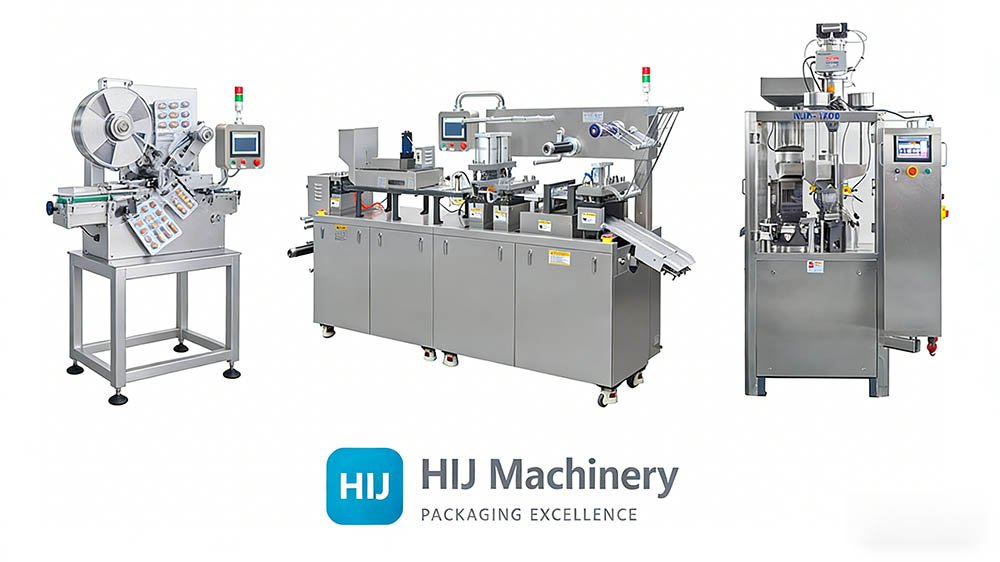
HIJ DPP-260 Automatic Blister Packing Machine — CE certified, full GMP documentation package included. View full specifications →
The Gap Is Real — Here’s Exactly Where
Acknowledging this honestly is, I think, the only way to have a credible conversation. There are categories where European machines still hold a meaningful engineering lead, and pretending otherwise doesn’t serve anyone well.
Ultra-High-Speed Performance
At the top end — machines running 800+ strokes per minute — European manufacturers like Uhlmann, Romaco Noack, and IMA still lead. The mechanical tolerances required at those speeds, accumulated engineering refinement over decades, and the servo tuning expertise embedded in their design teams represent a genuine capability gap. For 95% of buyers, those speeds are irrelevant. But if you’re running a blockbuster solid-dosage line at scale, this matters.
Complex Sterile Cold-Form (Alu-Alu) Tooling
In Class A/B cleanroom cold-forming for highly moisture-sensitive injectables, European tooling manufacturers have very deep domain expertise. The precision of the drawing die sets, the consistency of cold-form depths across millions of cycles — these are areas where experience compounds. Good Chinese manufacturers are competitive here for standard cold-form applications; truly exotic tooling geometries are still a European strength.
Regulatory Documentation for Tier-1 Markets
For FDA 21 CFR Part 11 compliance specifically — particularly the software audit trail and electronic records requirements — European manufacturers often have longer-standing documentation frameworks built into their HMI software. This is narrowing rapidly as Chinese manufacturers invest in compliant software architecture, but it’s worth auditing carefully if your target market is the US.
Where Chinese Manufacturers Have Genuinely Closed the Gap
This is the part most comparison articles get wrong — by either cheerleading for China broadly, or dismissing it with outdated assumptions. Let me be specific.
Component Quality
The most significant shift over the past decade is that serious Chinese manufacturers stopped sourcing all components domestically. A well-specified Chinese blister machine today runs on Siemens or Allen-Bradley PLCs, Omron or Keyence sensors, Festo or SMC pneumatics, and servo drive systems from established global brands. When the critical components are the same as what’s inside a European machine, the performance comparison changes fundamentally.
GMP Structural Design
Modern GMP-compliant Chinese blister machines feature 316L stainless steel product-contact surfaces, smooth weld profiles, validated cleaning procedures, and clean-room-compatible construction. The structural design language is now genuinely consistent with WHO GMP expectations. CE certification — when properly obtained, not just claimed — is achievable and increasingly standard among serious manufacturers.
Documentation and Validation Support
This was the area clients complained about most five years ago. Today, manufacturers like HIJ provide full IQ/OQ/PQ documentation packages, factory acceptance testing (FAT) protocols, and site acceptance testing (SAT) support as standard. The documentation quality gap has closed to the point where it no longer represents a meaningful obstacle for WHO GMP, cGMP, or EU GMP inspections in most cases.
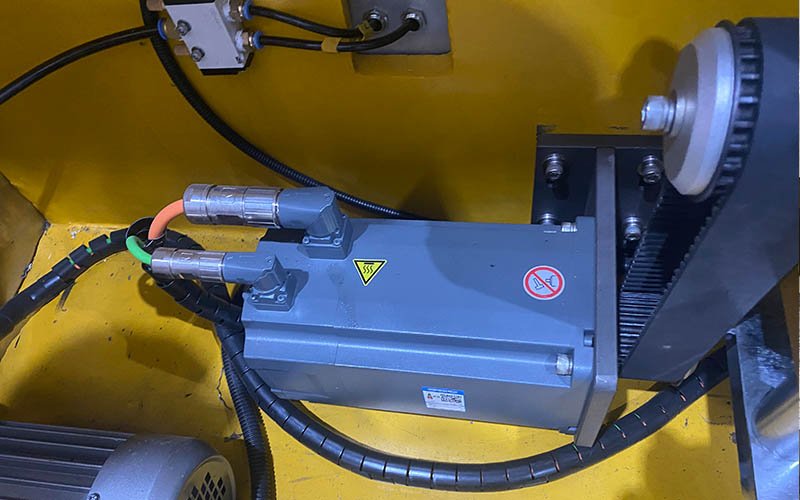
Servo motor drive system on a HIJ blister machine — using internationally-sourced components for consistent precision.
Component-by-Component Comparison
This is the table I wish existed when I started fielding these questions. It compares what you actually get inside the machine, not just the spec sheet headline numbers.
| Component / Criterion | European Machines (Top Tier) | Budget Chinese Machines | HIJ / Top-Tier Chinese |
|---|---|---|---|
| PLC Brand | Siemens / B&R | Domestic Chinese brand | Siemens / Allen-Bradley ✓ |
| Servo System | Bosch Rexroth / Beckhoff | Domestic servo (inconsistent) | Global-brand servo ✓ |
| Pneumatics | Festo / SMC | Unknown domestic | Festo / SMC ✓ |
| Sensors | Keyence / Sick | Domestic, limited accuracy | Omron / Keyence ✓ |
| HMI Interface | Highly refined, multi-language | Basic, limited language support | Refined, multi-language ◑ |
| Forming Tolerance | ±0.05–0.08mm | ±0.3–0.5mm | ±0.08–0.12mm ✓ |
| Change Part Tolerances | Very tight, long service life | Loose, wear quickly | Tight, CNC-machined ✓ |
| GMP Documentation | Comprehensive, FDA-ready | Minimal or templated | Full IQ/OQ/PQ package ✓ |
| CE Certification | Standard | Often absent or self-declared | Properly certified ✓ |
| Spare Parts Availability | Europe — long lead times ex-China | Inconsistent, sourcing unclear | Global warehouse ✓ |
| Capital Cost (comparable model) | $$$$$ | $ | $$ — $$$ |
| Ultra-high speed (>800 spm) | Yes ✓ | No ✗ | Up to ~500 spm ◑ |
| 21 CFR Part 11 HMI | Full compliance ✓ | No ✗ | Available on request ◑ |
✓ = Strong performance | ◑ = Competitive, minor gap | ✗ = Significant gap
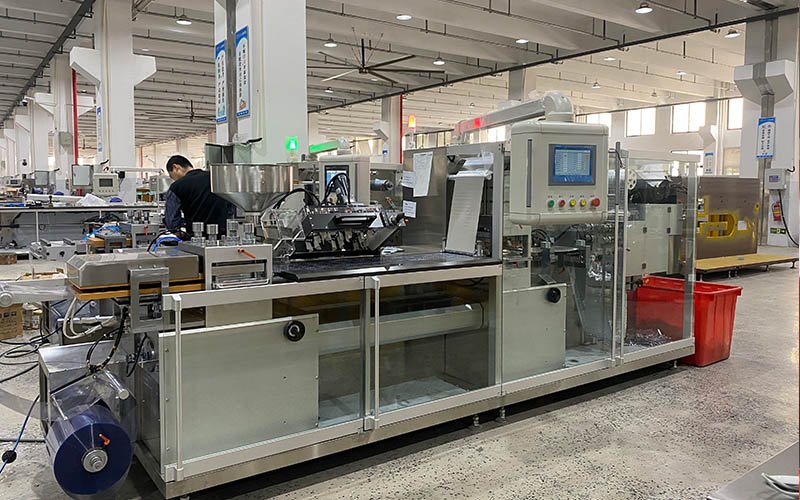
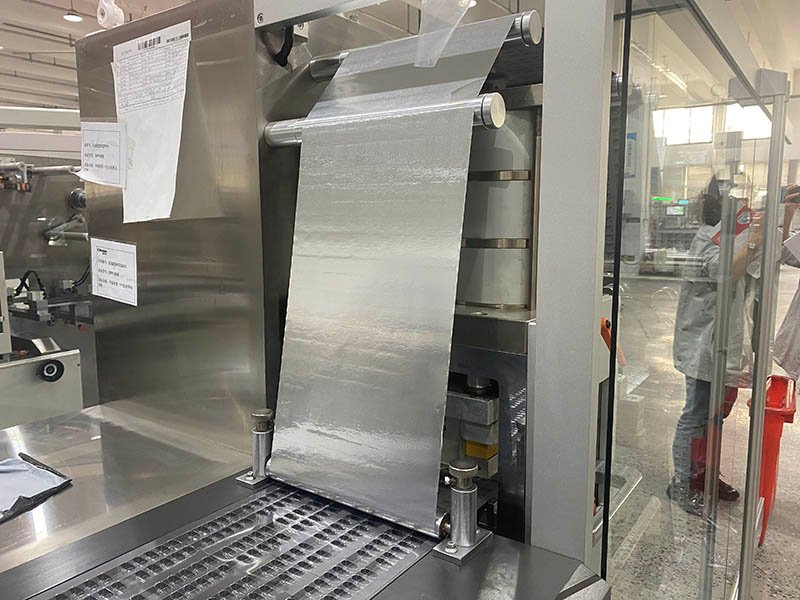
GMP-compliant structural design — 316L stainless product-contact surfaces, smooth weld profiles, cleanroom-compatible finish.
The True Cost Picture: TCO, Not Just the Price Tag
One of the most persistent mistakes I see buyers make is comparing sticker prices rather than total cost of ownership over a five-year horizon. Let me walk you through what that actually looks like.
Capital Cost
A comparable automatic blister packing machine from a top European manufacturer (Uhlmann, IMA, Romaco Noack) will typically run €180,000–€450,000+ depending on configuration. A comparable HIJ machine runs in the €55,000–€140,000 range depending on specification. That capital difference compounds — it’s money that can be deployed into additional capacity, validation costs, or simply maintaining working capital.
Validation and Installation Costs
Both machines require IQ/OQ/PQ validation. European machines often come with more mature validation documentation templates, but the actual cost of validation is largely driven by your internal resources and third-party CQV consultants — not the machine origin. Buyers who have done this exercise report comparable validation costs for well-documented Chinese machines versus European equivalents.
Spare Parts and Downtime
This is where the calculation gets nuanced. European spare parts sourced from China — which is where most are warehoused outside Europe — can have 4–8 week lead times. A properly established Chinese manufacturer with a global spare parts network can often supply identical-spec replacement components faster, simply due to geography and supply chain proximity. When your line is down, hours matter.
“The machine that costs three times more is only a better investment if the uptime difference actually justifies it. For most production profiles I’ve seen at 20,000–60,000 blisters/hour, it simply doesn’t.”
— Forester, Founder, HIJ Machinery
Service Response
European manufacturers typically rely on regional service partners outside Europe. Response times can be 2–5 business days for on-site support. Established Chinese manufacturers with direct global service teams can match or beat this. The key question to ask any manufacturer: “What’s your guaranteed response time for a line-down emergency in my region, and who physically shows up?”
Who Should Choose What: A Decision Framework
Rather than giving a blanket recommendation, here’s the honest framework I use when advising clients:
Choose a European machine if:
- Your production requires sustained speeds above 700–800 strokes per minute
- You are targeting FDA approval and need the most robust existing 21 CFR Part 11 audit trail software
- Your purchasing committee has a hard European-origin requirement (some large European pharma groups mandate this)
- You are producing highly specialized sterile injectables requiring exotic cold-form tooling geometries with decades of reference data
- Budget is genuinely not a constraint and the premium is justified by brand-risk mitigation within your organization
Choose a top-tier Chinese machine if:
- Your production is in the 5,000–500,000 blister/hour range for standard solid dosage or nutraceuticals
- You are targeting WHO GMP, EU GMP, or TGA compliance (all achievable with proper Chinese machines)
- Capital efficiency matters — you want comparable performance at significantly lower investment
- You need faster delivery timelines (Chinese manufacturers typically deliver in 8–16 weeks vs. 20–40 weeks for European)
- You want genuine customization flexibility — Chinese manufacturers are typically far more willing to configure exactly to your URS
- You are expanding capacity and running multiple lines where the capital saving is multiplied
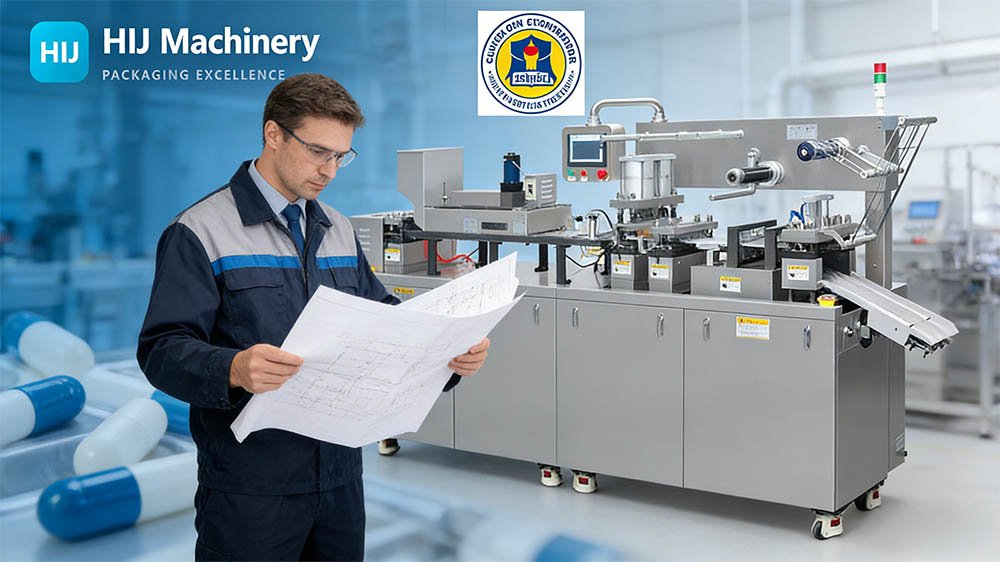
HIJ’s engineering team reviewing custom machine configuration against client URS — customization that European manufacturers rarely offer at this price point.
Spec Your Blister Machine — Zero Obligation
Tell us your production volume, product type, and target markets. We’ll tell you honestly whether a HIJ machine fits your needs — and if it doesn’t, we’ll say so.
Get Free Turnkey QuoteWhere HIJ Sits: European Standards, Chinese Efficiency
I built HIJ specifically because I understood this gap from both sides. Having commissioned machines on every continent and negotiated with both European and Chinese suppliers for two decades, I knew exactly where it was worth bridging the quality gap — and where cutting corners was simply non-negotiable.
The HIJ approach is not to copy European machines cheaply. It’s to design to European functional and compliance standards, source critical components from the same global suppliers European manufacturers use, and manufacture with the cost and responsiveness advantages that come from being based in China’s advanced manufacturing ecosystem.
What this looks like in practice on our DPP-260:
- Siemens S7 PLC with recipe management and alarm logging
- Servo-driven forming, sealing, and punch stations for consistent blister depth across the full run
- 316L stainless contact surfaces with Ra ≤ 0.4μm finish
- CE-marked (properly certified, documentation available)
- Full IQ/OQ/PQ documentation package as standard — not extra cost
- Omron photoelectric detection for empty blister rejection
- FAT protocol conducted at our facility before shipment
Browse the full specification and configuration options for our flagship DPP-260 Automatic Blister Packing Machine, or explore our complete blister packing machine range including Alu-Alu cold-form, liquid blister, and specialty configurations.
Key Component Partners in HIJ Machines




How to Evaluate Any Chinese Blister Machine Manufacturer
Whether you’re evaluating HIJ or any other Chinese manufacturer, here is the due diligence checklist I’d give to a friend making this investment:
- Request the CE certificate and underlying technical file. Not a product photo with a CE logo stamped on it — the actual certificate issued by a notified body. This is non-negotiable.
- Ask which PLC, servo, and pneumatic brands are used — and request the purchase receipts or supplier declarations. If the answer is vague, that tells you everything.
- Request a sample GMP documentation package for a previous machine of the same model. IQ/OQ/PQ templates, FAT protocol, DQ checklist. Review it for depth and accuracy.
- Ask for three references from clients in regulated markets. EU, US, Australia, Japan. Then actually call them.
- Ask about the spare parts program specifically: Where is the global warehouse? What is the guaranteed lead time for critical wear parts? Can they demonstrate stock?
- Ask who physically services machines in your region and what the guaranteed on-site response time is.
- Visit the factory if the order size warrants it. A professional operation welcomes this. Anyone who discourages it is telling you something.
At HIJ, we walk every prospect through this checklist ourselves — because we know our answers hold up, and because buyers who ask these questions make better long-term partners.
You can learn more about our certifications, quality systems, and the team behind the machines on our Why HIJ page and About HIJ page. For ongoing technical content, visit our Knowledge Hub.
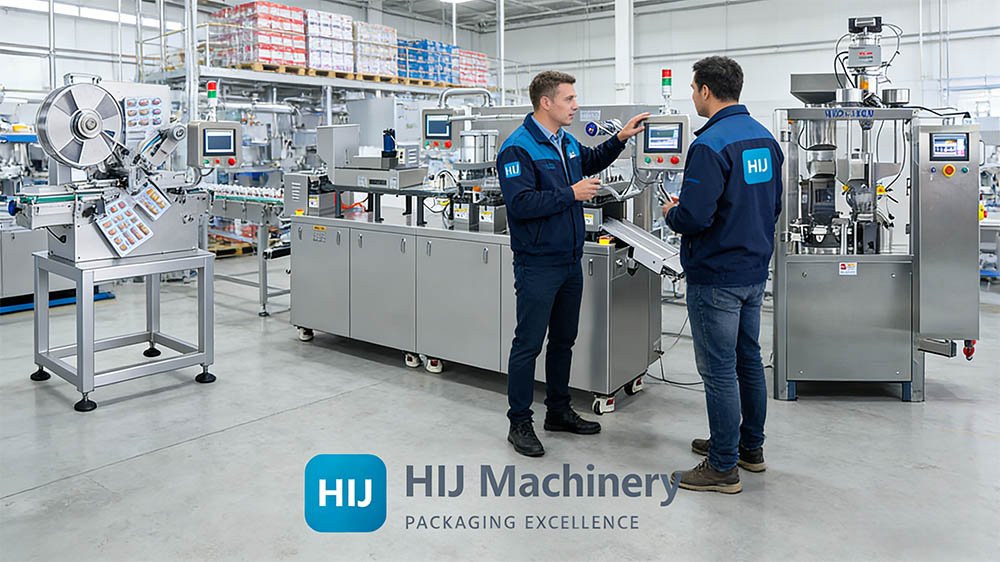
HIJ engineer conducting on-site commissioning and training at a client facility — because delivering a machine is only the beginning.
Frequently Asked Questions
Are Chinese blister machines GMP compliant?
How does the price difference between Chinese and European blister machines compare?
Which servo and PLC brands do quality Chinese blister machines use?
What is the main area where European blister machines still lead?
How do I evaluate a Chinese blister machine manufacturer before buying?
Can a Chinese blister machine pass EU GMP or WHO GMP inspection?
Ready for an Honest Conversation?
Share your production requirements, target markets, and compliance needs. Forester and the HIJ team will give you a straight answer — including if we’re not the right fit.