💬 Forester’s Insight: A 20-Year Engineer’s Perspective
Choosing a blister packaging machine is not a catalog exercise; it is an critical engineering decision that will define your packaging line’s Overall Equipment Effectiveness (OEE), compliance posture, and total cost of ownership (TCO) for the next 15 years.
In my 20 years of commissioning blister packaging lines across Brazil, Indonesia, and Egypt, I have watched procurement teams select machinery based purely on mechanical cycle speeds or initial purchase prices. It is a costly error. Many discover during the Factory Acceptance Test (FAT) that their forming stations lack validated temperature uniformity profiles, or that proprietary PLC architecture blocks integration with their current SCADA network. A cheap, un-validated machine is a multi-year liability.
This systematic guide outlines exactly how to choose blister machine configurations that protect product stability, pass strict regulatory audits, and deliver predictable production runs. Let us work through the 15-point checklist together.
1. Technical Anatomy: How to Choose Blister Machine Platforms
PVC at 250 μm thickness passes 4 to 6 grams of water vapor per square meter every day. That is the fundamental physical barrier limit that concludes basic material selection discussions. To understand how to choose blister machine architectures, engineers must first match barrier profiles to the physical properties of the active pharmaceutical ingredient (API).
I often see buyers confuse flat-die machines with rotary-drum systems. This mechanical distinction alters how materials behave under heat and pressure. Rotary systems form cavities continuously using vacuum, while flat-die mechanics utilize compressed air piston-forming profiles. This structural difference dictates the thickness distribution of your pockets. For deep-draw medical device applications, flat-die tooling is non-negotiable. It maintains the material’s mechanical strength at corners where rotary forming causes unacceptable wall thinning.

For high-barrier configurations, you will need to compare Alu-Alu vs PVC blister packaging. Cold-formed foil requires substantial mechanical force to press aluminum laminate without micro-fracturing. You must calculate the draw ratio of the pocket carefully. Deep cavities require specialized mechanical Teflon plug-assist systems to distribute material evenly. The table below outlines material behaviors across primary forming media.
| Material Type | Forming Temp Range (°C) | Shrinkage Rate (%) | WVTR (g/m²/day at 38°C, 90% RH) | Best Processing Method |
|---|---|---|---|---|
| Standard PVC (250 μm) | 120 – 140 | 0.5 – 0.8 | 3.2 – 4.5 | Thermoforming (Flat or Rotary) | PVC/PVDC (Duplex) | 125 – 145 | 0.4 – 0.6 | 0.6 – 0.8 | Thermoforming (Controlled Heat) |
| Aclar Laminate | 130 – 150 | 0.2 – 0.4 | 0.12 – 0.22 | Contact Heating, Low Pressure Blow |
| Cold-Form Foil (Alu-Alu) | Ambient (20-25) | Negligible | < 0.001 (Analytical Zero) | Cold Forming with Plug Assist |
Forester’s Field Reflection: During a commissioning run in Manila, I encountered a formulation that failed its stability test because the packaging film was overheated. The heated contact plates of a low-end blister machine were running at 155°C due to standard thermocouple drift. This warped the PVC and thinned the cavity corners to 12 μm. That is why we now build our DPP-250 thermoforming blister machine with multi-point RTD temperature sensors. They ensure consistent thermal profiles and prevent localized film degradation.
2. The 15-Point Engineering Checklist for Blister Machine Procurement
Three weeks into a challenging commissioning job in Jakarta, I watched a production supervisor attempt to run high-barrier Aclar film on a machine designed with standard heating plates. The material buckled immediately. The single thermal zone was incapable of managing the film’s structural expansion. This operational failure delayed the plant’s production launch by several weeks. To prevent these field issues, engineers should evaluate machinery against this structured, 15-point checklist before signing a purchase order.
- 1. Material Thickness Consistency: Ensure mechanical feed rollers maintain uniform tension down to ±5 μm variations to prevent web tracking errors during fast cycles.
- 2. Multi-Zone Temperature Regulation: Heating stations must feature independent, closed-loop PID controls to prevent uneven film softening.
- 3. Forming Tooling Changeover Time: Validate toolless mold replacement mechanisms to ensure complete mechanical adjustments occur in less than 20 minutes.
- 4. Sealing Mechanical Pressure Uniformity: The heat sealing plate must apply uniform force across the entire platen to prevent micro-leaks.
- 5. Integrated Vision Rejection: Check if the camera system inspects pocket contents, detects broken tablets, and triggers automated pneumatic rejection.
- 6. Mechanical Indexing Precision: Verify servo-driven planetary gears maintain indexing accuracy of ≤0.1 mm over continuous operation.
- 7. Exhaust and Air Filtration Integration: Ensure the machine frame allows quick hook-up to cleanroom dust collection systems to protect mechanical components from airborne powder.
- 8. Tooling Compatibility: Molds must support quick-swap geometries to process tablets, gelatin softgels, and standard hard capsules on a single platform.
- 9. HMI Audit Trail Logging: Check for full compliance with 21 CFR Part 11 parameters, including automated electronic signature tracking and permanent event logging.
- 10. Base Frame Cleanability: Frame must use AISI 304 or AISI 316L stainless steel with sloped surfaces to ensure quick, residue-free wipe-downs.
- 11. Energy and Utility Requirements: The unit should run within typical limits of 380V/50Hz/3-Phase power and consume less than 0.6 m³/min of clean, dry compressed air.
- 12. Mechanical Safety Shielding: Interlocked polycarbonate guards must stop all moving parts within 0.5 seconds of door opening.
- 13. Web Tension Control: Tension must adjust dynamically via analog dancer arms to handle light lidding foil without tearing.
- 14. Upstream and Downstream Sync: The control system must integrate directly with secondary cartoning lines to coordinate product transfer.
- 15. Documentation Package Completeness: Ensure the OEM supplies complete IQ, OQ, PQ templates alongside detailed material certification files.
What I did: We recalibrated the analog dancer arm’s feedback loops. We adjusted pneumatic cylinder pressure on the web feed rollers to exactly 4.2 bar, and retuned the servo motor’s PID loop to counter thermal expansion of the feed drum. This stabilized web drift to within ±0.08 mm.
3. Sealing and Mechanical Validation Under Global Standards
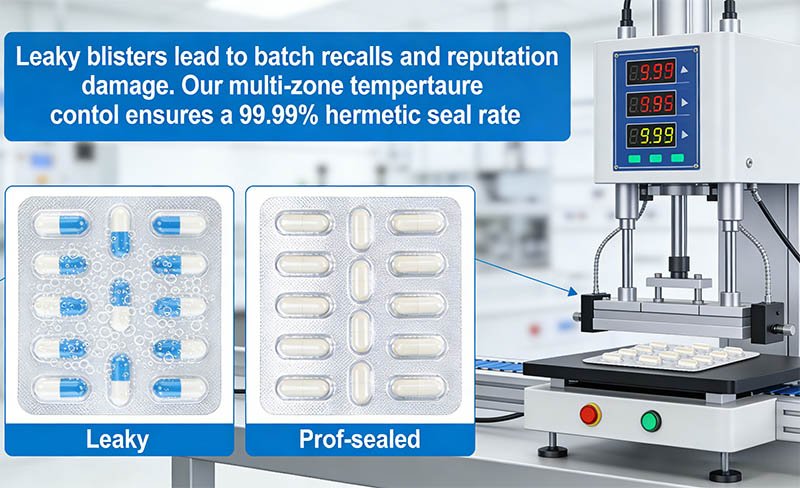
The line speed printed in bold on an OEM’s brochure is often a misleading metric to prioritize when designing a packaging system. Higher cycle rates can cause sealing failures if dwell times drop below critical thresholds. If thermal exposure is too brief, the adhesive layer on the lidding material will not cure correctly. This results in channel leaks that compromise the drug’s stability over its shelf life.
I advise engineers to evaluate the sealing station using mechanical and thermodynamic parameters. A rotary sealing system provides narrow, high-pressure contact lines, making it ideal for high-speed runs with PVC/Alu configurations. In contrast, platen sealing systems operate with flat faces under high mechanical pressure, which is necessary to ensure consistent seals on thick Alu-Alu materials. It is critical to confirm the machinery’s compliance with global standards, such as blister packaging GMP compliance guidelines, which mandate process control and validation.
Regulatory compliance is not just about keeping documentation up to date. The mechanical build of your blister line must align directly with the guidelines outlined in major global regulations:
“EU GMP Annex 1 (2022) mandates strict contamination controls and particle reduction in packaging cleanrooms, which requires blister systems to feature smooth, sloped stainless steel surfaces that prevent dust accumulation. At the same time, the FDA’s 21 CFR Part 11 requires that all electronic records, including sealing temperatures and drive velocities, are securely logged in a non-modifiable database with automated backup systems.”
📋 REGULATORY BACKBONE: EU GMP Annex 1 (2022) | 21 CFR Part 211.166 Stability | ISO 13849-1 Mechanical Safety
To comply with USP <1207> guidelines, many packaging plants now use laser-based head-space analysis or high-sensitivity vacuum decay systems. These replace traditional blue dye baths with quantitative leak testing. Your machine’s tooling design must maintain flat, defect-free seal areas to allow these inspection systems to perform accurate seal testing.
4. Total Cost of Ownership & ROI Calculations
Out of the 31 pharmaceutical blister line projects I personally commissioned between 2018 and 2025, none reached their target ROI when tooling changeover times exceeded 45 minutes. Tooling changes represent a major source of operational downtime. In plants that run multi-product packaging facilities, a slow mechanical changeover pattern can quickly erode overall equipment effectiveness.
I suggest analyzing the complete blister packaging machine price by looking beyond the initial acquisition cost. An inexpensive system that requires complex tooling alignment often results in higher labor costs and lower yield over its service life. At HIJ Machinery, we design our platforms with self-aligning mechanical tooling. This helps keep mold replacement times under 15 minutes, allowing operators to transition between different blister formats without manual tool calibration.

Resolution: We mounted mechanical dial indicators on the upper sealing plate to measure its parallelism during operation. The system revealed a 0.18 mm deflection at the rear corner of the plate. We recalibrated the mechanical compression springs to 1,200 N and installed a self-leveling platen interface. This corrected the deflection and eliminated seal variations.
Resolution: We replaced the single central heating element with a segmented heater cartridge array. This allowed us to monitor and control heating across four independent zones. This change stabilized temperatures to within ±1°C, ensuring consistent material forming during long production runs.
5. The FAT, SAT, and Cleanroom Integration Blueprint
A Quality Assurance Director from a pharmaceutical company in Cairo called me late on a Friday. She asked a simple but critical question: “Forester, why does our vacuum leak rate increase only when we run the blister line at its maximum speed?” It was a classic mechanical-thermal issue. When the machine speed was increased, the heat-sealing rollers did not have sufficient contact time to transfer the thermal energy needed to bond the adhesive layer. This caused micro-defects that only appeared during vacuum testing.
To resolve this, we modified the sealing drum control code. This allowed us to dynamically increase the sealing temperature by 4°C for every additional 10 strokes per minute. This change ensured the adhesive received consistent thermal energy across all operational speeds. This story highlights why solid blister packaging validation and structured Factory Acceptance Testing (FAT) are so important. The system must be tested under its full range of operating conditions before it leaves the assembly floor.
Cleanroom integration requires careful layout planning and strict adherence to space constraints. Modern packaging facilities must maintain clear separation between technical drive areas and the product processing zones. This design helps minimize particle contamination and simplifies maintenance access. The technical specifications below show the physical and operational parameters of our high-speed blister platforms.
Mechanical & Utility Specifications
• Power Requirement: 380V/50Hz/3-Phase, 9.5 kW
• Vacuum Source: External dry vacuum, 25 m³/hour capacity
• Air Input: 0.6 m³/min at 6.0 bar constant line pressure
• Structural Frame: Fully enclosed AISI 304 stainless steel casing
Control & Cleanroom Integration
• Control PLC: Siemens S7-1500 Controller with Profinet link
• HMI Touch Panel: 10.4-inch color screen with multilevel logins
• Particulate Standard: Complies with Class 100 (ISO 5) cleanrooms
• Dust Capture: Pre-installed vacuum shroud over cutting stations
What I did: We measured the run-out on the sealing rollers and found a 0.12 mm mechanical deviation. We replaced the standard support bearings with high-precision double-row tapered bearings. We also added a dual elastomer dampening ring to the pressure axis. This change stabilized the mechanical pressure and resolved the wrinkling issue.
Validate Your Packaging Line with Expert Engineering
Do not let minor technical issues slow down your production. Contact our senior engineering team to design custom blister machinery tailored to your exact formulation, barrier needs, and cleanroom requirements.
Get Free Turnkey QuoteFrequently Asked Questions Regarding Blister Machinery
1. How do I determine if my product requires Alu-Alu or PVC/PVDC packaging materials?
Your choice depends on the stability data of your formulation. If your drug degrades when exposed to moisture or oxygen, Alu-Alu provides an absolute barrier with a water vapor transmission rate (WVTR) of virtually zero. PVC/PVDC or Aclar films are suitable for moderately sensitive formulations, offering good moisture protection while maintaining clear product visibility.
2. What are the key validation protocols required for a pharmaceutical blister line?
You must complete a full Qualification cycle, which includes Installation Qualification (IQ), Operational Qualification (OQ), and Performance Qualification (PQ). The IQ stage verifies that the physical installation matches the design drawings. The OQ stage tests key operational limits, including high-temperature cutoff functions and web tension controls. Finally, the PQ stage uses actual materials to run three consecutive production batches, confirming that the line delivers consistent seal quality and blister integrity under normal manufacturing conditions.
3. How can I optimize tooling changeover times on high-volume production lines?
To minimize changeover downtime, select blister machines designed with toolless quick-swap mechanisms and integrated recipe managers on the HMI. These features allow operators to slot mold segments into preset alignment tracks without manual mechanical adjustments, while the PLC automatically configures operational parameters like heating temperatures and stroke lengths. This structured approach can reduce a typical changeover process from over an hour down to under 15 minutes.