A powder capsule filling machine is production equipment that automatically separates empty two-piece capsules, doses a precise weight of dry powder into each capsule body, then rejoins and locks the capsules for downstream packaging. Fully automatic models used in B2B pharmaceutical and nutraceutical manufacturing — such as the HIJ NJP series — run from 20,000 to over 150,000 capsules per hour with fill-weight accuracy of roughly ±3.5%, using either a tamping pin (dosing disc) system or a dosator system to meter the powder.
- The machine class you need is set by real daily demand, not catalog maximums — mid-volume plants typically land in the 40,000–70,000 capsules/hour band.
- Tamping pin systems tolerate poorly flowing and low bulk-density powders better than dosator systems, which favor free-flowing granulations.
- Fill accuracy, changeover time, and contact-part material (304/316L stainless) drive total cost of ownership more than purchase price.
- No capsule filler is “GMP certified” as equipment — look for cGMP-ready design plus IQ/OQ documentation support; validation is executed at your facility.
If your company is moving from outsourced encapsulation to in-house production — or replacing a semi-automatic unit that can no longer keep up with order volume — the powder capsule filling machine is the single most consequential equipment purchase on the line. It determines your throughput ceiling, your fill-weight compliance, your changeover downtime, and a large share of your audit readiness.
This guide explains what the machine actually is, the working principles behind the two dominant dosing technologies, the components that matter during a factory acceptance test, and the specifications a B2B buyer should compare before requesting quotations.
What a Powder Capsule Filling Machine Does in the Production Line
In a solid-dose production flow, the capsule filler sits between powder preparation (blending, granulation) and primary packaging (blister packing or bottle counting). Its job is deceptively simple to state and mechanically demanding to execute: take an empty hard-gelatin or vegetarian capsule, open it, put an exact weight of powder inside, close it, and do this hundreds of times per minute without damaging capsules or drifting off the target weight.
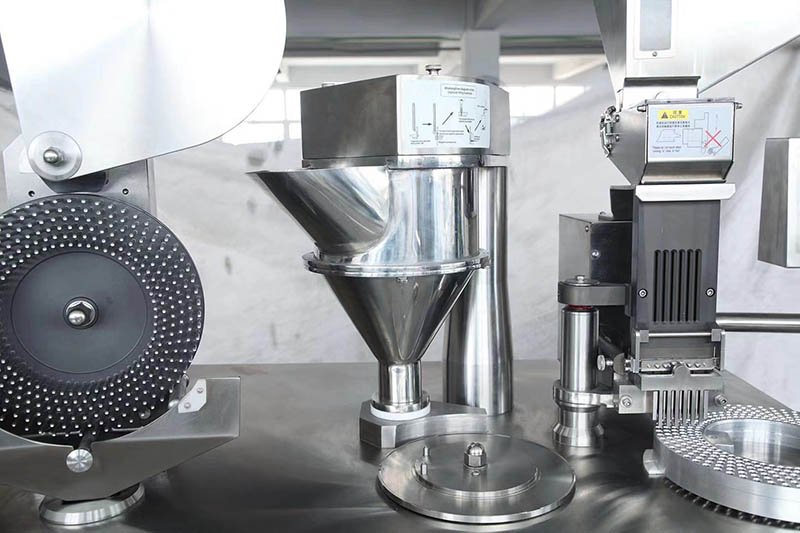
The turret of an automatic capsule filler indexes capsules through feeding, separation, dosing, locking, and ejection stations in one continuous cycle.
A fully automatic machine completes six operations per cycle: capsule orientation and feeding, vacuum separation of cap from body, powder dosing, rejection of defective capsules, locking, and ejection with die-hole cleaning. On a machine like the NJP-800C powder capsule filling machine, that full cycle repeats 800 times per minute.
Tamping Pin vs Dosator: The Two Powder Dosing Technologies
Every automatic powder capsule filler on the market uses one of two metering principles, and the choice matters more than any other specification because it determines which formulations the machine can run accurately.
Tamping Pin (Dosing Disc) System
A rotating dosing disc with multiple bores passes under a bed of powder. At each of five progressive stations, spring-loaded tamping pins compress powder into the bore, building up a stable slug layer by layer. At the transfer station, the finished slug is pushed into the waiting capsule body. Because the slug is mechanically compacted before transfer, weight accuracy stays stable even when the powder itself flows poorly — which is why tamping pin machines dominate nutraceutical, herbal, and TCM production, where low bulk-density botanical powders are the norm. The HIJ NJP series uses this system.
Dosator System
A hollow tube with an internal piston plunges into the powder bed, captures a column of powder, compresses it lightly against the piston, and carries it to the capsule for ejection. Dosators excel with free-flowing, well-granulated pharmaceutical powders and are common on very high-speed continuous-motion machines, but they are sensitive to powder cohesion and density variation — sticky or fluffy powders cause incomplete pickup and weight drift.
| Criterion | Tamping Pin / Dosing Disc | Dosator |
|---|---|---|
| Best powder types | Cohesive, low-density, herbal, probiotic, blended powders | Free-flowing granulated pharmaceutical powders |
| Fill weight range | Wide — slug height adjustable via disc thickness | Moderate — limited by dosator tube geometry |
| Sensitivity to flowability | Low — progressive compaction stabilizes density | High — poor flow causes incomplete pickup |
| Cleaning complexity | Moderate — disc and pins strip quickly | Higher — multiple dosator tubes to disassemble |
| Typical users | Nutraceutical, TCM, mid-volume pharma, CMOs | Large-scale pharma with granulation capability |
The Four Automation Levels, and Who Each Is For
“Capsule filling machine” covers everything from a bench plate to an industrial line. For B2B buyers, the practical segmentation is by automation level and hourly output:
| Level | Output Range | Labor | Typical Buyer |
|---|---|---|---|
| Manual filler | Up to ~800/hr | Fully manual | R&D labs, compounding pharmacies |
| Semi-automatic | Up to ~20,000/hr | Operator loads/transfers between steps | Startups, pilot batches, low-mix production |
| Fully automatic (intermittent motion) | 40,000–90,000/hr | One operator supervises | Mid-volume pharma, nutraceutical brands, CMOs |
| High-speed industrial (continuous/multi-bore) | 100,000–150,000+/hr | One operator + line integration | Industrial-scale plants, large CMOs |
The middle band is where most first-time industrial buyers belong. If you are producing 200,000–350,000 capsules per 8-hour shift, an intermittent-motion machine in the 48,000/hour class covers demand with headroom for growth, without the capital cost and utility requirements of an industrial line. HIJ’s semi-automatic capsule filling machine serves the tier below, and the industrial capsule filling machine range covers the tier above; the size selection guide walks through the sizing math in detail.
Core Components a Buyer Should Inspect Before Acceptance
Two machines with identical brochures can differ enormously in build quality. During factory acceptance — in person or via FAT video — these are the assemblies worth scrutinizing:
1. Dosing Station Enclosure
Open dosing stations leak powder into the room, which means API loss, operator exposure, and cross-contamination findings during audits. A fully enclosed dosing station and turret, as fitted on the NJP-800C, contains dust at the source and keeps powder bed density consistent across a shift.
2. Cam and Bearing Quality
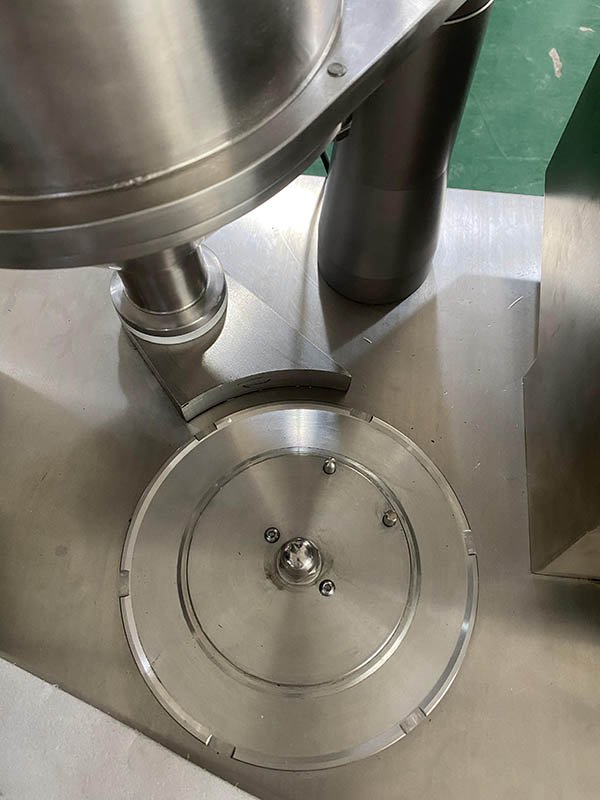
The cam mechanism drives every station’s vertical motion. Forged cams with continuous lubrication and imported linear bearings (Japanese bearings on the NJP series) hold positioning tolerance over years; cast cams with grease-only lubrication develop play, and play becomes weight variation.
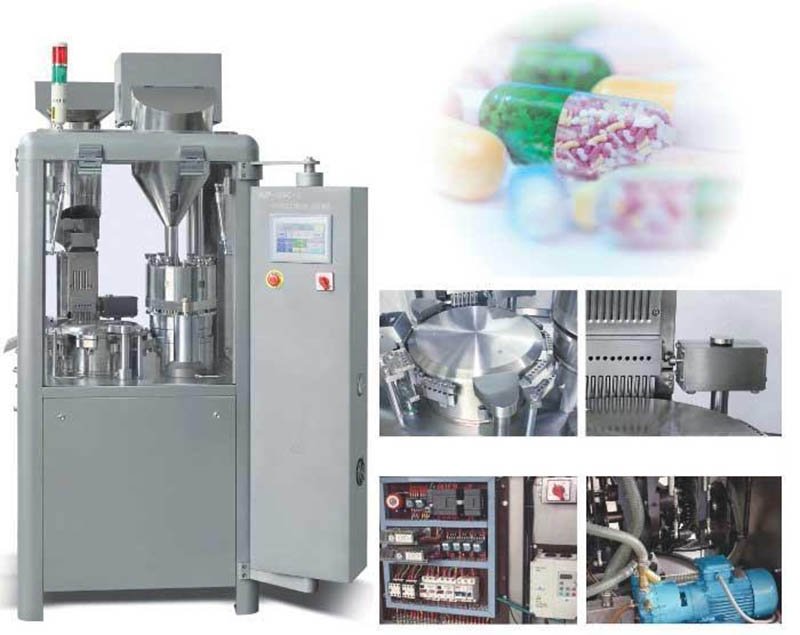
Forged cam mechanism and precision turntable — the assemblies that determine whether dosing accuracy survives year three.
3. Contact Part Material and Detachability
Every surface touching powder should be 304 stainless steel minimum (316L for corrosive actives), with quick-detachable assemblies so cleaning does not require a toolbox. Ask for material certificates — a cGMP-ready machine ships with them.
4. Control System
PLC control with a touchscreen HMI and stepless frequency-conversion speed adjustment is the baseline for a machine entering a documented quality system. It gives you repeatable setpoints, batch counting, and alarm logs — the things your QA team will ask about.
5. Rejection and Protection Logic
The machine should divert unseparated capsules before dosing, reject defects before locking, auto-pause on powder or capsule shortage, and interlock guards for operator safety. Each of these features prevents a specific, expensive failure mode.
Specifications That Actually Matter in a B2B Purchase
When comparing quotations, these six numbers predict your operating experience far better than price alone:
Rated vs sustained output. Catalog output is a maximum. Plan capacity at 85–90% of rated speed — the pace machines actually hold across a full shift with real powder.
Fill-weight accuracy. ±3.5% is the benchmark for tamping pin machines in this class. Insist that accuracy be demonstrated on your formulation during the pre-shipment test, not a free-flowing placebo chosen by the factory.
Capsule size range and changeover time. A machine covering sizes 00#–5# plus safety capsules A–E with sub-60-minute mold changes protects you as your product mix evolves.
Utilities. Confirm voltage compatibility (380V 50Hz is standard from Chinese factories; other voltages are built to order), compressed air and vacuum requirements, and noise — under 75 dBA keeps the machine inside normal industrial hygiene limits without extra enclosure.
Footprint and floor loading. An intermittent-motion machine in the 48,000/hour class occupies roughly 1 m² (the NJP-800C measures 930 × 740 mm) and weighs about 800 kg — relevant for upper-floor installations.
Documentation package. Material certificates, electrical diagrams, FAT records, spare parts list, and IQ/OQ templates. If a supplier cannot produce these before purchase, they will not appear after payment either.
Compliance: What “cGMP-Ready” Means — and What No Machine Can Claim
A recurring point of confusion in equipment procurement: machines themselves are not “GMP certified” or “FDA approved.” GMP certification applies to your manufacturing facility and processes; equipment can only be designed to make your compliance achievable. A cGMP-ready capsule filler provides sanitary-design contact parts, cleanability, enclosed powder handling, and the documentation your validation team needs to execute DQ, IQ, OQ, and PQ on site.
Reputable suppliers state this plainly. HIJ machines are CE-marked, built to ISO 9001 manufacturing standard, and ship with full IQ/OQ documentation support — while validation itself remains, correctly, your facility’s responsibility. For the process framework, see our IQ/OQ/PQ validation guide and the overview of WHO GMP and cGMP requirements for packaging equipment.
After sitting across the table from hundreds of procurement teams, I can tell you the most expensive mistake is not buying a cheap machine — it is buying the wrong size. Teams benchmark three suppliers on price per rated output, pick the biggest number, and end up running a 150,000-per-hour machine at one-third speed, where dosing systems are least stable. Size the machine to your eighteen-month demand forecast, then verify it on your own powder before shipment.
The second mistake is skipping the powder trial. A parameter table cannot tell you how your blend behaves in a dosing station. We run every machine with the customer’s formulation or a matched placebo before it leaves Wenzhou, and that single step resolves more purchase risk than any specification comparison.
What Does a Powder Capsule Filling Machine Cost?
For fully automatic intermittent-motion machines from established Chinese manufacturers, budget in broad strokes: the 48,000-capsules/hour class starts around USD 17,500 FOB in base configuration, with production-ready setups (polisher, vacuum feeder, empty capsule loader, spare molds) typically landing between USD 20,000 and 28,000. Higher-output industrial models scale up from there. Full itemized pricing for the NJP-800C — including every optional accessory — is published openly on the powder capsule filling machine product page.
Frequently Asked Questions
What is the difference between a capsule filling machine and a powder capsule filling machine?
“Capsule filling machine” is the umbrella category covering machines that fill powder, pellets, granules, tablets, or liquids into two-piece capsules. A powder capsule filling machine is the sub-type configured with a powder dosing system — tamping pin or dosator — and it is the most common configuration in pharmaceutical and nutraceutical production. Many powder machines accept optional pellet or tablet dosing units for combination fills.
Which dosing system is better for nutraceutical and herbal powders?
A tamping pin (dosing disc) system is the safer choice for nutraceutical and herbal powders. These formulations are often cohesive or low in bulk density, and the tamping system’s progressive compaction locks in slug density before transfer, keeping fill weight stable. Dosator systems perform best with free-flowing granulated powders and can drift on fluffy or sticky blends.
How many operators does an automatic powder capsule filling machine need?
One trained operator supervises a fully automatic machine — refilling powder and empty capsules, monitoring the HMI, and performing periodic weight checks. Adding an automatic empty capsule loader and vacuum powder feeder reduces intervention further, allowing one operator to cover the filler plus downstream polishing.
Can one machine fill different capsule sizes?
Yes. Automatic machines in this class handle standard sizes 00# through 5# and safety capsules A–E by swapping mold (change part) sets. Each size requires its own mold set, purchased with the machine or added later, and changeover takes under an hour for a trained operator.
How long does delivery and installation take from a Chinese factory?
Typical lead time for an intermittent-motion powder capsule filler is 25–45 days from deposit, including the pre-shipment test run with your powder and a FAT video for remote acceptance. Installation and commissioning at your site take one to three days, supported by video guidance or an on-site engineer depending on the service package.
HIJ Machinery (legal name: Wenzhou Trustar Machinery Technology Co., Ltd) is a pharmaceutical packaging machinery manufacturer founded in 2004 in Rui’an, Wenzhou, Zhejiang, China, serving B2B customers in more than 30 countries with capsule filling machines, blister packing machines, cartoning machines, and turnkey packaging lines. Equipment is CE-marked, built to ISO 9001 manufacturing standard, and designed cGMP-ready, with IQ/OQ documentation support for customer-executed validation.
This article was written and reviewed by Forester Xiang, Founder & Chief Engineer of HIJ Machinery, based on 20+ years of encapsulation engineering experience and 100+ pharmaceutical facility audits.
Send us your daily output target and powder type — our engineers reply within 24 hours with a machine recommendation and factory-direct quotation.
Get a Free Recommendation