Quick Answer
Vacuum stoppering seats the rubber plunger plug while the syringe is under vacuum, so the plug lands on the liquid without vibration friction. This avoids the mechanical shedding of sub-visible particles that friction-based plug insertion generates — a leading equipment-side cause of failed particulate-matter testing in prefilled syringe production.
For a QA or fill-finish engineer, particulate matter is where a prefilled syringe line either earns trust or loses batches. Formulation and component cleanliness get most of the attention, but the stoppering step itself is a mechanical particle source that many teams don’t design against until they’re already failing release testing. This article explains how vacuum stoppering removes that source.

Key Takeaways
- Friction plugging sheds particles from the rubber and the wetted barrel wall.
- Vacuum stoppering seats the plug friction-free, cutting the mechanical particle source.
- It also controls headspace and reduces trapped air behind the plug.
- Sub-visible particulates are a common release-test failure — and equipment is part of the cause.
- The HIJ-GZB200 integrates the stopper rod and vacuum body into one station.
Where do particulates in prefilled syringes come from?
Sub-visible and visible particulates have several origins — formulation, water, container, closure, and process. On the equipment side, the biggest controllable contributor is often the plug-insertion step:
| Source | Type | Equipment-controllable? |
|---|---|---|
| Rubber plug shedding | Elastomer particles at insertion | Yes — via seating method |
| Barrel-wall friction | Glass/silicone/product particles | Yes — via friction-free seating |
| Trapped headspace air | Air/interface artifacts | Yes — via vacuum |
| Formulation / water | Intrinsic particulates | No — upstream control |
| Container cleanliness | Wash/depyrogenation residue | No — component supplier |
The point for equipment selection: the first three rows are yours to control at the machine, and vacuum stoppering addresses all three.
How friction plugging generates particles
In conventional stoppering, the plunger stopper is pushed down the barrel and seats by friction against the wall. That friction — especially against a barrel wetted with viscous, sticky product — shears micro-particles off the elastomer surface and can drag along product residue. Vibration and mechanical contact during insertion add to the count. Because these particles are generated after the fill and inside the sealed unit, they go straight into your finished container.
How vacuum stoppering prevents it
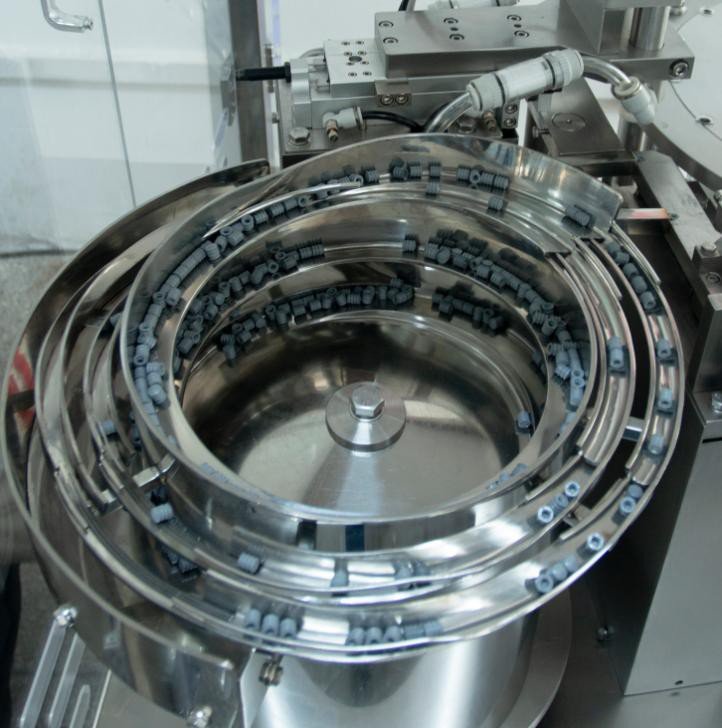
Vacuum stoppering changes the mechanism. On the HIJ-GZB200 the stopper rod and vacuum body are one integrated station, and the sequence is:
- The filled syringe indexes into the stoppering station.
- The station presses and evacuates the syringe, pulling air out of the barrel above the liquid.
- The rubber plug is placed down onto the liquid level in a controlled motion, not forced in by friction.
- Vacuum is released; the plug seats with controlled headspace and close liquid contact.
Because the plug is set onto the liquid rather than dragged down a dry-then-wetted wall, the dominant mechanical particle-generation mechanism is largely removed — and the evacuated headspace means there’s little trapped air to form an interface behind the plug.
Why this matters for release testing
Injectable products face pharmacopeial sub-visible particulate limits (for example, light-obscuration and microscopic methods described in USP and Ph. Eur.). A stoppering step that adds elastomer or product particles pushes counts toward — or over — those limits, causing batch rejections, investigations and delays. Reducing the equipment-generated fraction of the particle budget gives your formulation and components more headroom to pass.
This is an equipment contribution to your outcome, not a compliance guarantee: the machine uses a cGMP-ready, CE-marked design with AISI 316L contact parts, and HIJ provides DQ/IQ/OQ/PQ documentation, but responsibility for validation and release remains with your quality system.
“When a team calls me about a particulate failure, my first question isn’t about their formulation — it’s ‘how are you seating the plug?’ Nine times out of ten they’re forcing it in against a wetted wall and calling the particles a mystery. They’re not a mystery; they’re friction. Move to vacuum seating and you take one whole column out of your particle budget. It’s the cheapest headroom you’ll ever buy in a fill-finish line.”
Frequently asked questions
Does vacuum stoppering guarantee I pass particulate testing?
Is vacuum stoppering different from vacuum filling?
Does it also control headspace and oxygen?
Can I add vacuum stoppering to an existing atmospheric machine?
What plug types and sizes does the GZB200 handle?
Fighting particulates at the stoppering step?
Tell us your syringe format, plug geometry and product. Our engineers will configure a vacuum-stoppering setup that removes the friction-particle source from your line.
Get Free Turnkey QuoteRelated: Double-head prefilled syringe vacuum filling machine (HIJ-GZB200) · Vacuum vs atmospheric filling · Filling viscous injectables & HA · Prefilled Syringe Filling Machines hub