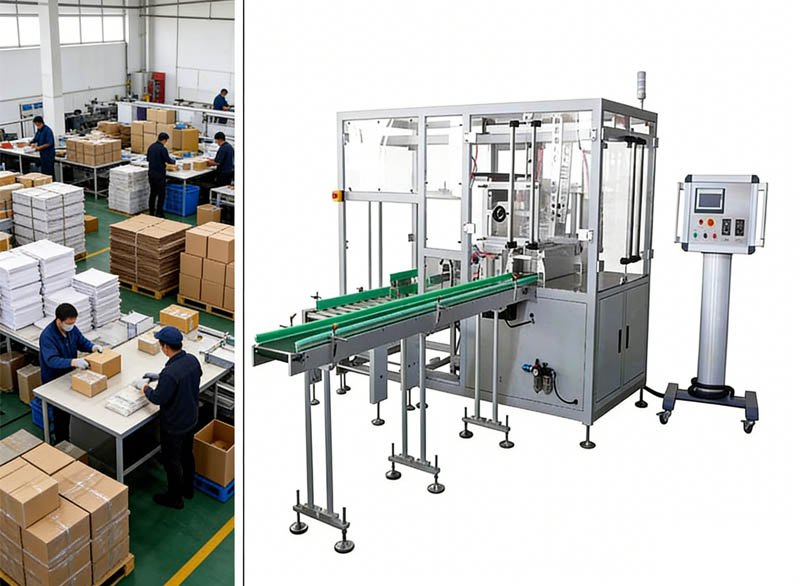
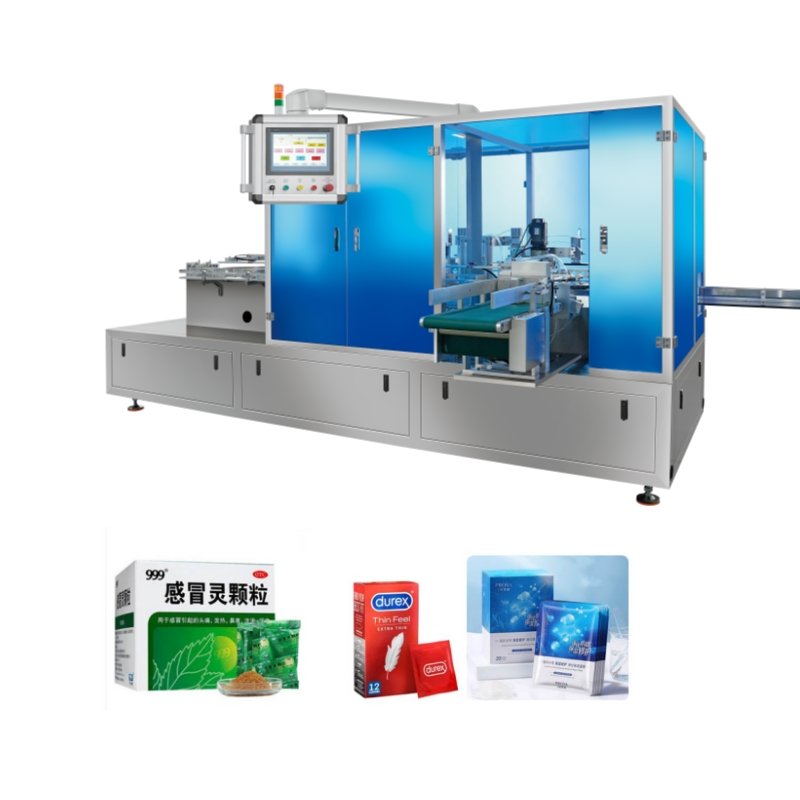
Quick answer: Validating a blister cartoning line follows four stages your facility owns and performs: DQ (the design meets your URS), IQ (the machine is installed as specified), OQ (every function — interlocks, rejection, coding, audit trail — operates across its ranges), and PQ (the line performs consistently with your real product over sustained runs). The machine vendor does not validate anything; a good vendor supplies the documentation package — FAT records, drawings, certificates, component lists — that makes each of your stages faster and defensible.
Let’s settle the ownership question first, because it decides everything downstream: no vendor can sell you a “validated machine.” Validation belongs to your facility’s quality system, runs under your protocols, and is defended by your team in front of your inspectors. What you buy from the vendor is equipment built to a cGMP-ready, CE-marked standard — and, just as importantly, the paperwork that supports your validation without months of back-and-forth.
This guide maps the four stages for an integrated blister cartoning line, splitting each into “your scope” and “what to demand from the vendor,” using the HIJ PBL-400S-400SF blister cartoning machine as the reference equipment. It assumes your URS already exists — if not, build it first from our syringe cartoning URS guide, because every stage below traces back to that document.
Key Takeaways
- Your facility owns validation — DQ, IQ, OQ and PQ run under your protocols and your quality system, always.
- The vendor’s job is the documentation package: FAT records, drawings, certificates and component lists that feed your protocols.
- FAT is not validation — but a well-designed FAT with your materials de-risks OQ enormously.
- OQ on a cartoning line lives and dies on challenge tests: seeded defects, material-removal interlock tests, audit-trail verification.
- Traceability is the thread: every OQ test should map to a URS clause; every URS clause should be tested somewhere.
The Validation Lifecycle at a Glance
Two of those boxes — FAT and SAT — are acceptance tests, not validation stages. They belong to the commercial contract, but run them with validation in mind: witnessed FAT data generated with your own materials (see the FAT checklist) can be referenced by your IQ/OQ protocols and shrink on-site testing by weeks.
Design Qualification
DQ documents that the proposed machine design satisfies your URS, clause by clause, before anything is built. For a blister cartoning line this means verifying the feeding concept for your product, the interlock philosophy, the rejection design, heat-protection at standstill, format ranges and the control platform against every requirement you wrote.
- URS-to-design traceability matrix, clause by clause
- Design review meetings with engineering & QA sign-off
- Risk assessment (e.g. FMEA) on product-contact and rejection points
- Approval of layout, P&ID and functional design spec
- Functional design specification & machine layout drawings
- Electrical component list (PLC, servos, robots, sensors, brands)
- Interlock & rejection logic description
- Materials-of-construction declaration for product-contact parts
Installation Qualification
IQ verifies the machine that arrived is the machine that was specified — installed correctly, connected to qualified utilities, with every document in hand. It is largely a checking exercise, which makes it the easiest stage to accelerate with a complete vendor package.
- Verify model, serial numbers and components against the order & DQ
- Confirm utilities: 380 V supply, compressed air, cooling water within spec
- Check installation environment, leveling and clearances
- File drawings, manuals and certificates into your document system
- As-built electrical & pneumatic drawings
- Component certificates and calibration certificates for critical instruments
- Spare parts list with laser-coded part traceability
- Installation, operation & maintenance manuals (SAT support on site)
Operational Qualification
OQ proves every function operates as intended across its operating ranges — and on a cartoning line, the functions that matter most are the ones that fire when something goes wrong. OQ is where you challenge the machine deliberately: seed defects, remove materials, attempt unauthorized logins, and document that it responds exactly as the design says. The mechanics behind each function are walked through in how a blister cartoning machine works.
- OQ protocol with acceptance criteria traced to URS clauses
- Execute challenge tests (table below) and document results
- Alarm, e-signature and audit-trail verification per your Part 11 / Annex 11 program
- Deviation handling and re-test where needed
- FAT protocol & witnessed results as the OQ baseline
- Parameter ranges and recipe documentation per format
- Technician support during SAT/OQ execution window
- Alarm list with cause, station and reset behaviour

The OQ challenge tests that matter on a blister cartoning line
| Challenge | Method | Expected response |
|---|---|---|
| Missing-product interlock | Run empty pockets / remove blister from infeed compartment | No leaflet pick, no carton suction, no push for that cycle; event logged |
| Missing-syringe rejection | Seed trays with deliberately empty pockets | 100% of seeded defects rejected into lockable bin; counts reconcile |
| Empty-carton rejection | Introduce cartons without product at discharge check | 100% force-rejected via metal-content detection |
| Consecutive-fault stop | Starve leaflet or carton feed repeatedly | Automatic stop after 3 consecutive misses; cause named on HMI |
| Material run-out | Run PVC film, foil, leaflets, cartons to empty | Interlocked stop with location shown; graceful restart |
| Heat protection at standstill | Stop line mid-production at sealing station | Sealing head lifts, cooling plate inserts automatically; product temperature unaffected |
| Access control | Attempt parameter change at operator level | Denied; three-level password enforcement; attempt logged |
| Audit trail & e-signature | Change a parameter, sign, review the log | Who/what/when/old-new value captured; record exportable |
| Coding accuracy | Sample cartons across a speed range | Batch/expiry legible, position within ±1.5 mm |
| Speed range verification | Run at minimum, nominal and maximum rated speed | All functions and detections perform at every speed point |
Performance Qualification
PQ demonstrates the qualified line performs consistently under real production conditions: your product, your materials, your operators, your SOPs, over sustained runs — typically three consecutive successful batches or extended runs per format family, with yield, rejection and breakage rates inside the limits your URS defined.
- PQ protocol with batch acceptance criteria (yield, breakage <0.1%, reconciliation)
- Sustained runs per format with trained operators under SOPs
- Statistical review of rejects, stoppages and coding quality
- Final validation report and release for commercial production
- Remote support availability during PQ runs
- Format changeover procedure documents
- Preventive-maintenance schedule feeding your ongoing control
- Warranty responsiveness terms in writing (12-month standard)
Five Pitfalls That Stall Cartoning Line Validations
- Validating against the brochure, not the URS. If the URS is thin, OQ has no acceptance criteria to trace to — the gap surfaces as protocol rewrites mid-execution.
- Treating FAT as a formality. An unwitnessed FAT with vendor samples means every test repeats on your floor, on your timeline.
- Forgetting the interfaces. The labeler handshake and buffer behaviour need OQ coverage too — they are part of the line, whoever supplied them.
- Testing the audit trail last. If e-signature workflows don’t fit your Part 11 / Annex 11 program, you want to know at DQ, not during OQ execution.
- No traceability matrix. When an auditor asks “where did you test URS 5.2?”, the answer must be a protocol reference, not a meeting.
The construction features that make a machine qualification-friendly in the first place — surface finishes, lubricant isolation, tool-free access, part traceability — are covered in cGMP requirements for cartoning machines, and apply across every model on the cartoning machines hub.

“The smoothest validation I ever supported wasn’t smooth because of the machine — it was smooth because of a QA manager who arrived at our FAT with her OQ protocol in draft. Every test we ran, she mapped to a URS clause, photographed, and filed. By the time the machine shipped, half her OQ evidence already existed as witnessed FAT data her protocols could reference.
Validation speed is decided months before the machine arrives — at the URS and the FAT. Vendors cannot validate for you, and you should walk away from any who claim they can. But the right vendor can hand you a documentation package so complete that your protocols practically fill themselves in. Ask to see that package before you sign, not after.”
— Forester Xiang, Founder & Chief Engineer, HIJ MachineryFrequently Asked Questions
Who performs DQ, IQ, OQ and PQ — the vendor or the buyer?
The buyer’s facility owns and performs all four stages under its own quality system and protocols. The vendor supplies equipment built to a cGMP-ready standard plus the documentation package — drawings, FAT records, certificates, component lists — that supports and accelerates each stage.
Is the FAT part of validation?
Formally no — FAT is a contractual acceptance test. Practically, a witnessed FAT run with your own product and materials generates data your IQ/OQ protocols can reference, which is the single biggest schedule saver in the whole lifecycle.
How long does validating a blister cartoning line take?
Typical ranges: DQ during the build (no added calendar time if run in parallel), IQ 1–2 weeks after installation, OQ 2–4 weeks including challenge testing, PQ 2–6 weeks depending on batch definitions and formats. A complete vendor documentation package and a strong FAT can compress the on-site stages substantially.
Can the vendor supply IQ/OQ protocol templates?
Many vendors, HIJ included, provide FAT protocols, parameter documentation and test records that buyers use as source material. The executed protocols, however, must be your facility’s own documents, approved through your change-control and quality system — templates inform them, they never replace them.
What does 21 CFR Part 11 mean for the cartoning machine?
Part 11 (and EU Annex 11) governs your electronic records and signatures program. The machine’s role is to provide the technical capability — audit trail, electronic signature, three-level access control on the HMI — which your facility then configures, tests during OQ and operates under its own procedures.
Get the Documentation Package Before You Commit
Ask us for the PBL-400S-400SF document list — FAT protocol, drawings, certificates, component lists — and judge for yourself how much of your IQ/OQ it will carry.
Request the Document List