
Choose the primary pack
Bottles and jars can share some handling concepts. Tubes, roll-fed ampoules and sachets use different forming or sealing routes and should not be treated as simple change parts.
Integrated cosmetic production
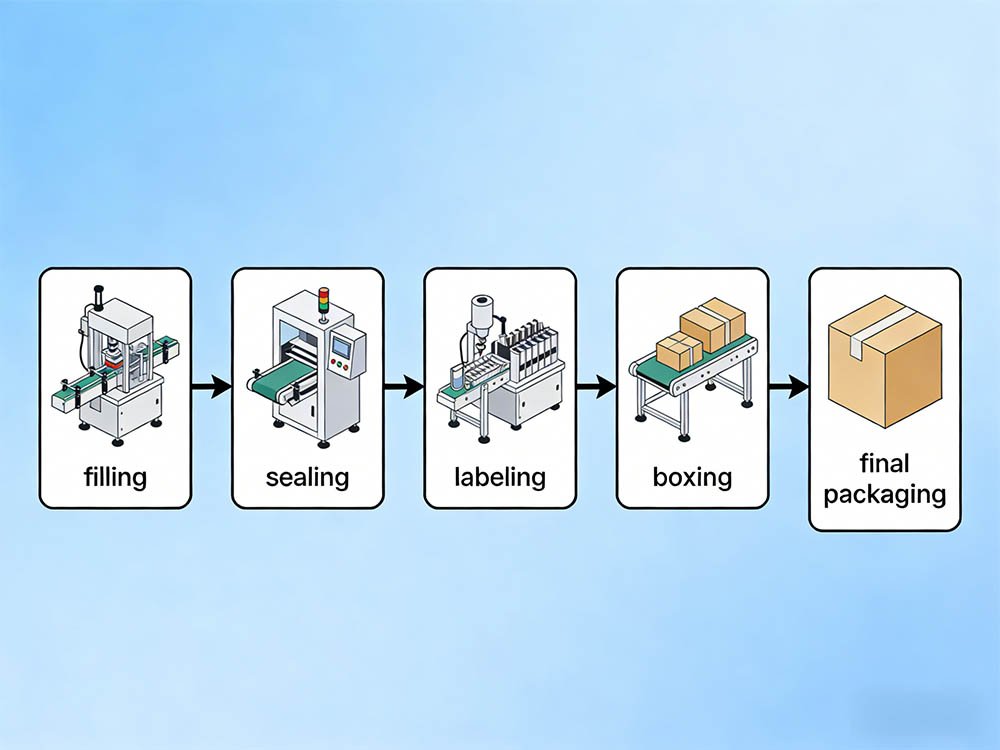
Configure container feeding, product supply, filling, closing, inspection, labeling and secondary packaging around your real formula, pack and accepted output—not around a single catalog speed.
Select a thumbnail to inspect the machine and line references at full size.
Selection boundary
An automatic cosmetic filling line is more than a filler connected to a conveyor. It is a controlled sequence that presents the container, supplies the product, doses it, applies or forms the closure, checks the result and transfers accepted packs to labeling or secondary packaging.
Bottles and jars can share some handling concepts. Tubes, roll-fed ampoules and sachets use different forming or sealing routes and should not be treated as simple change parts.
Match the hopper, pump, hose and nozzle to viscosity, foaming, stringing, particulates, temperature sensitivity and the required cleaning method.
State fill acceptance, closure or seal quality, label and code checks, reject logic and sustained accepted output before comparing proposals.
Line architecture
Each station needs a defined input, output, stop condition and recovery method. Final equipment and sequence depend on the approved product and package route.
Present bottles, jars or closures at a controlled pitch. Confirm stability, orientation, low-level alarms and manual replenishment points.
Define mixing, heating, holding, recirculation or transfer conditions before the dosing station receives the formula.
Select and trial the dosing method, product-contact path and nozzle motion against the real fill range and container opening.
Apply caps, pumps or droppers, or route the pack to its dedicated sealing process. Agree torque, position, integrity and reject criteria.
Define presence, fill, closure, code and label checks with traceable reject handling and recovery after a line stop.
Set the handoff to leafleting, cartoning, bundling or case packing and prove the complete line at the required acceptance basis.
Product and pack routes
The same “cosmetic filling line” label can hide very different equipment. Use the primary package to choose the route, then configure dosing and downstream automation around the formula.
| Project route | Products to trial | Primary machine boundary | Evidence to define |
|---|---|---|---|
| Bottles and jars | Serums, oils, lotions, creams, gels | Container feed, fill, cap or pump, label and code | Container stability, fill result, closure and label position |
| Plastic or laminate tubes | Creams, sunscreen, masks, gels | Tube load, orientation, fill, seal, trim, code and discharge | Tube drawing, seal appearance and integrity, code readability |
| Roll-fed plastic ampoules | Serums, treatments and suitable liquids | Web control, forming, dosing, sealing, coding and cutting | Material reference, cavity drawing, fill and seal tests |
| Flexible sachets | Samples, masks, gels, creams and suitable liquids | Film unwind, forming, dose, seal, register, code and cut | Film structure, seal window, leak test and opening method |
Automation boundary
“Automatic” should describe an agreed sequence, not a marketing label. Identify every operator touchpoint, buffer, inspection point and manual recovery step in the quotation.
Useful for trials, frequent product changes or lower-volume campaigns. The operator may load containers, place closures or remove finished packs while dosing or sealing remains controlled.
Connect container feeding, filling, closing, coding, inspection and labeling. Manual secondary packing may remain appropriate when SKU mix is high.
Add leafleting, cartoning, bundling or case packing when the finished pack and accepted output justify the extra interfaces and change parts.
Accepted output
A filler’s unloaded rate is not the output of the complete cosmetic packaging line. Compare suppliers using the same product, pack, operators, run duration, planned stops and acceptance rules.
= minimum of product supply, container feed, filling, closing, inspection, labeling and packing capacity × agreed acceptance rate
Controls and interfaces
Mechanical equipment can run correctly by itself and still fail as a line. The controls scope must describe every signal, buffer, alarm and recovery sequence between suppliers and stations.
FAT and changeover
Agree the sample set, duration, pass criteria, records and open-item process before FAT. The complete line should be challenged with the product and packaging conditions that matter to production.
Approved formulas, empty packs, closures, labels, cartons, cases, drawings and format identity.
Stable running, replenishment, transfers, filling, closing, coding, labeling and finished discharge.
Missing or misoriented packs, low supplies, inspection defects, blocked discharge, faults and restart.
Settings, counts, rejects, samples, alarms, deviations, actions and the final open-item list.
List each changed part, tool, recipe, adjustment and cleaning step. Measure from the last accepted pack of one SKU to the first accepted pack of the next.
Define the product-contact boundary, removal sequence, access, retained product points, cleaning method, inspection and responsibility for acceptance.
Buyer questions
It is a connected production system that coordinates product supply, container handling, filling, closing or sealing, inspection, coding, labeling and any agreed secondary packaging. The exact stations depend on the formula and finished pack.
Some bottle or jar lines can cover several formulas after trials confirm the pump, hopper, hose, nozzle, cleaning method and change parts. Very different formulations or package routes may require dedicated product paths or machines.
Usually not as simple format changes. Bottles and jars may share a filling platform, while tubes, roll-fed ampoules and sachets use different feeding, forming or sealing processes. Define the SKU matrix before choosing the machine family.
Specify sustained accepted packs per minute or per shift using the agreed product, pack, operators, run duration, planned stops and reject rules. The slowest proven stage and acceptance rate determine usable line output.
Define ready, run, fault, blocked and starved signals, accumulation logic, controlled stop and restart, reject tracking, recipe permissions and any required production-data interface.
Provide representative formulas, fill range, container and closure drawings or samples, labels and cartons, SKU matrix, required accepted output, utilities, layout, inspection needs, changeover expectations and documentation scope.
FAT should cover normal operation, fill or dose checks, closing or seal quality, coding and labeling, inspection and rejection, alarms, stop and restart, changeover and the agreed records using the approved sample set.
Expansion is possible when space, conveyor height, electrical capacity, controls handshakes, accumulation and downstream interfaces are reserved in the original design. Confirm the future boundary in the technical agreement rather than assuming compatibility.
Project inquiry
Send the six inputs below. HIJ can use them to define the equipment route, integration boundary, change parts, acceptance basis and quotation as separate line items.
Formula type, viscosity, foaming, particulates, temperature and cleaning needs.
Container, closure, tube, film or ampoule samples and drawings.
Fill range, pack sizes, closure types, labels, cartons and cases.
Required good packs per minute or shift and campaign pattern.
Utilities, room layout, upstream supply and downstream equipment.
Inspection, reject rules, FAT duration, documents and service needs.