
Cream vs Lotion vs Serum Filling Machines: Which One Does Your Cosmetic Brand Need?
The right filler isn’t the “best” one — it’s the one matched to how your product flows. Here’s how viscosity decides the hardware.
The Short Answer
Don’t start with the machine — start with how your product behaves:
- Serums (thin / watery) → peristaltic, flow-meter or gravity filling, with tight accuracy for high-value actives.
- Lotions (medium body) → piston or gear-pump filling, with foaming and drip control.
- Creams (thick / structured) → servo piston filling, often with a heated hopper and a lift-as-you-fill nozzle.
- A range that spans thin to thick → choose interchangeable nozzles and an adjustable, servo-driven dosing system over a single-purpose machine.
“Which filling machine should I buy?” is the question almost every beauty founder asks first. It’s also the wrong place to start. A filling machine doesn’t care what your product is called on the label — it cares how the liquid behaves as it moves through a nozzle. A featherlight serum, a pourable lotion and a dense, structured cream impose three fundamentally different sets of demands, and the machine that fills one beautifully can mangle another. This guide compares cream, lotion and serum filling machines the way an engineer would: by the physics of the fill.
Your formula dictates the hardware — not the other way around
The question I hear most from beauty founders is “which filling machine should I buy?” — but that’s the wrong starting point. The real question is what are you filling, and how does it behave? A serum that flows like water, a lotion with moderate body, and a thick cream that holds its shape each demand fundamentally different filling logic: piston, pump, gravity, or peristaltic. I’ve watched brands buy a machine optimized for one viscosity, then struggle for months when they expand their formulation range. The smartest move isn’t picking the “best” filler — it’s matching the machine to your product’s physics and your roadmap. If your line spans thin to thick, prioritize a system with interchangeable nozzles and adjustable fill mechanisms over a single-purpose workhorse.
Why viscosity is the deciding factor
Viscosity — a fluid’s resistance to flow — is the single most important property in choosing a filler, but it isn’t the only one. Cosmetic formulations also vary in thixotropy (whether they thin under agitation and recover at rest), shear sensitivity (whether pumping damages texture or actives), foaming tendency, and whether they carry suspended particles like exfoliants or shimmer. Each of these nudges you toward a different dosing technology.
Think of the three classic product families as points on a viscosity spectrum, each best served by a different fill mechanism:
Serum
Flows like water. Drips and dribbles easily. Needs precise, gentle dosing — and clean shut-off to stop stringing.
Lotion
Pourable but with body. Can entrain air and foam. Needs steady, repeatable volume control.
Cream
Holds its shape. Won’t gravity-feed. Needs positive displacement and often heat to move cleanly.
With that framing in mind, here’s what the right machine looks like for each.
It helps to put rough numbers on the spectrum. Viscosity is measured in centipoise (cP): water sits at about 1 cP, a thin serum or toner around 1–100 cP, a typical lotion roughly 1,000–10,000 cP, and a thick cream or body butter anywhere from 20,000 cP into the hundreds of thousands. These bands aren’t rigid rules — temperature, thixotropy and your specific emulsion all shift them — but they explain why no single nozzle and pump combination can serve the whole range gracefully. A system tuned to gently meter a 50 cP serum will struggle to push a 100,000 cP balm, and a high-torque cream piston will tend to splash a watery toner. Knowing your products’ approximate cP values before you talk to a supplier turns a vague conversation into a precise specification.
Serum filling machines (low viscosity)
Serums, essences, toners and lightweight oils flow freely, which sounds easy but creates its own problems: dripping, splashing, foaming, and “stringing” tails that contaminate the container neck. Because serums are frequently your highest-value products — packed with expensive actives in small volumes — fill accuracy matters more here than almost anywhere else. Overfilling a 30 ml serum by even a few percent across a production run is a meaningful loss of costly formulation.

The best-suited technologies are peristaltic filling (tubing-based, with no product contact with pump parts — ideal for sensitive actives and easy cleaning), flow-meter filling (measures volume as it passes, excellent for thin liquids), and time-pressure or gravity systems for very watery products. Look for anti-drip or suck-back nozzles to kill the tail at the end of each shot.
For single-dose serums, treatment shots and premium samples, an cosmetic ampoule filling machine is often the right answer — it fills and seals tiny, high-value doses with minimal exposure to air and contamination. You can also see related single-dose options like the plastic ampoule oral liquid filling and sealing machine for liquid actives.
One more reason peristaltic filling dominates the serum world deserves emphasis: cleanability and product protection. Because the product only ever touches the inside of disposable or easily-sanitised tubing, there are no pump cavities or piston seals to harbour residue, which slashes changeover cleaning time and the risk of cross-contamination between fragrances or active blends. For brands running many small serum SKUs, that hygiene advantage often outweighs the slightly slower speed of tubing-based filling. If your serums contain delicate actives — vitamin C derivatives, peptides, encapsulated ingredients — the gentle, low-shear action also helps preserve the very performance you’re paying a premium to deliver.
Lotion filling machines (medium viscosity)
Lotions, light moisturisers, conditioners and milky cleansers sit in the comfortable middle — pourable, but with enough body to hold a fill and enough air-entrainment risk to foam if handled roughly. This is the sweet spot for piston (volumetric) fillers and gear or lobe pumps, which deliver consistent, repeatable volumes shot after shot.
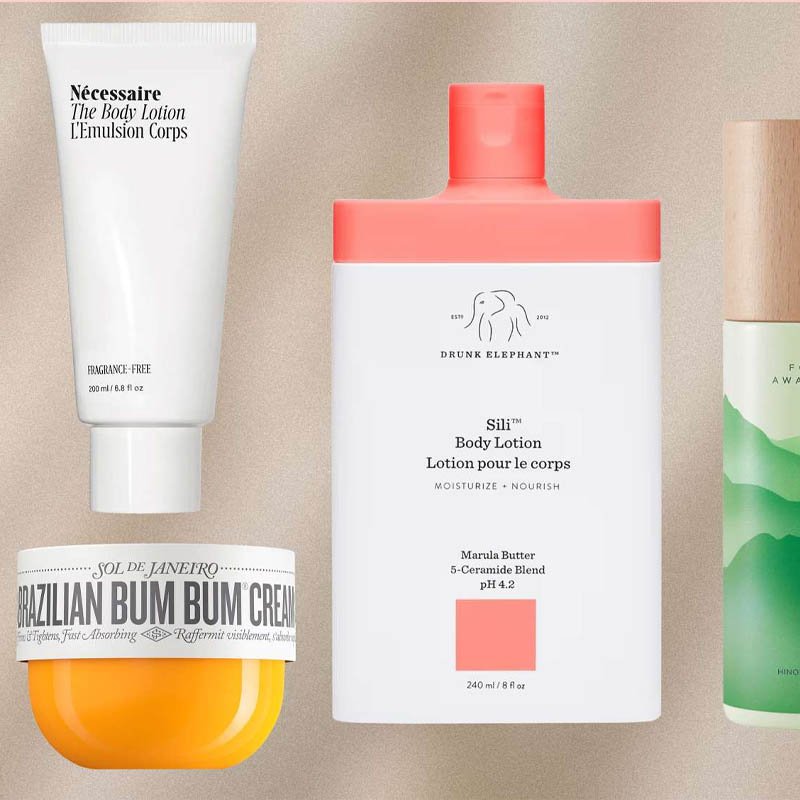
The main challenges to design around are foaming (control fill speed and use bottom-up or diving nozzles that submerge as the container fills) and clean cut-off to avoid drips on the bottle rim, which would foul a pump or cap. A piston filler with adjustable stroke handles a surprisingly wide band of lotion viscosities, which is part of why it’s the workhorse of so many cosmetic lines.
There’s a subtler consideration with lotions: emulsion stability. Many lotions are oil-in-water emulsions held together by careful formulation, and excessive shear or aggressive pumping can begin to break that structure, leading to separation or texture changes on the shelf. Gear and lobe pumps move product smoothly at controlled pressure, while a well-set piston filler avoids the repeated high-shear cycling that can stress sensitive emulsions. When you trial a lotion on a candidate machine, don’t just check fill weight — inspect the filled product for any change in viscosity, colour or feel compared with the bulk, because a machine can hit the target volume while quietly degrading the formula.
Cream filling machines (high viscosity)
Creams, body butters, balms, masks and rich moisturisers don’t flow — they hold their shape. Gravity and thin-liquid pumps simply can’t move them cleanly, so you need positive displacement: a servo-driven piston filler that physically pushes a measured volume of product into the container. For very thick or wax-based formulas, a heated hopper and jacketed product path keep the cream at a workable consistency, and a nozzle that lifts as it fills prevents air pockets and smeared rims.
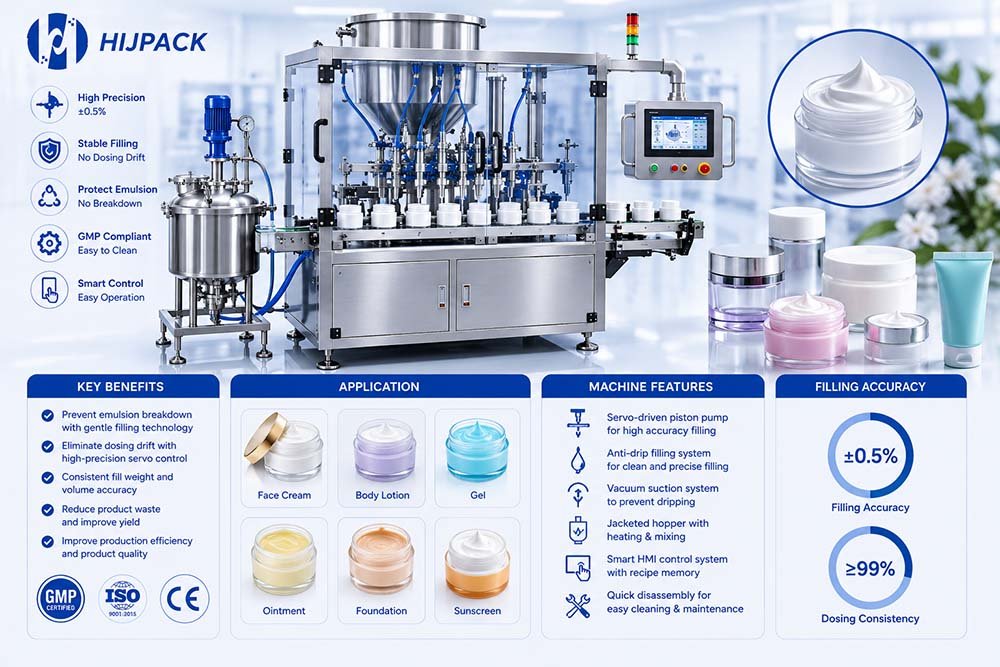
Accuracy and clean shut-off are still essential — a thick cream that “tails” can drag product across the rim and ruin the seal. A purpose-built cream filling machine is engineered around exactly these demands: high torque to move dense product, hopper agitation to prevent bridging, and a positive cut-off that leaves the nozzle clean. If your hero product is a jarred cream or a tube balm, this is the category to anchor your decision on.
The container also shapes the cream-filling setup more than it does for thinner products. A wide-mouth jar needs a nozzle that descends and lifts as it fills so the cream lays in evenly without trapping air or smearing the rim, followed by a tidy presentation surface if the product is sold “topless” under a lid. A tube, by contrast, is filled from the open base and then sealed — which means your cream filler is really one stage of a filling-and-sealing system, and the seal quality depends on a perfectly clean fill with no product creeping up the tube wall. If tubes are central to your range, look at integrated tube filling and sealing machines rather than a standalone filler, so the fill and the seal are engineered to work together.
Cream vs lotion vs serum: the comparison at a glance
| Factor | Serum | Lotion | Cream |
|---|---|---|---|
| Viscosity | Low (watery) | Medium (pourable, with body) | High (holds shape) |
| Best dosing tech | Peristaltic / flow-meter | Piston / gear pump | Servo piston (positive displacement) |
| Typical nozzle | Anti-drip / suck-back | Bottom-up / diving | Lift-as-you-fill, positive cut-off |
| Main challenge | Dripping, stringing, foaming | Foaming, rim drips | Won’t flow, air pockets, tailing |
| Often needs heat? | No | Rarely | Often (heated hopper) |
| Accuracy priority | Very high (costly actives) | High | High |
| Common container | Dropper bottle, ampoule | Pump bottle, tube | Jar, tube |
What if your range spans thin to thick?
Most growing brands don’t sell only one texture — they sell a serum and a lotion and a cream. This is exactly where the costly mistake happens: a brand buys a machine optimised for one viscosity, then fights it for months when the range expands. The fix is to choose for flexibility from the start.
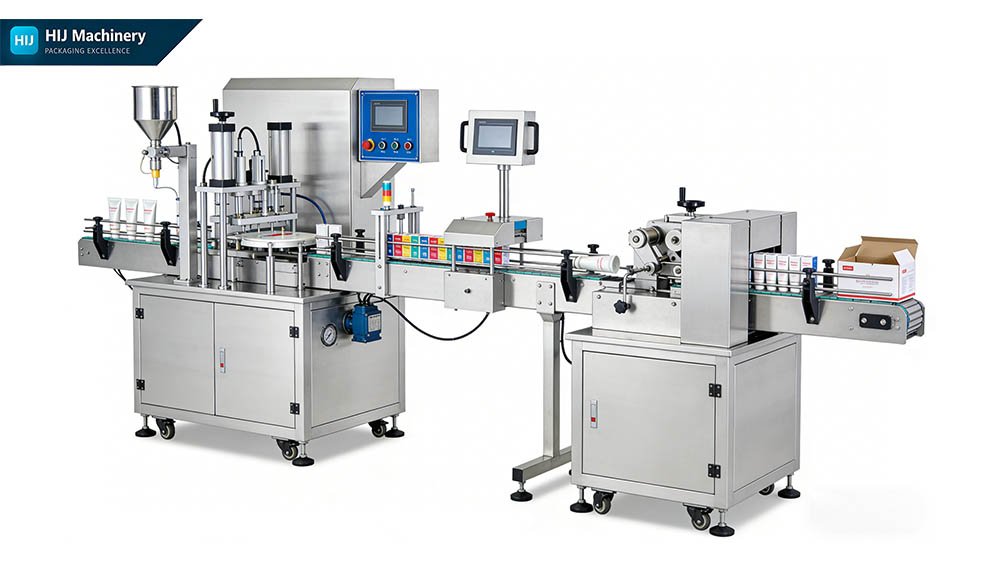
A servo-driven piston filler with interchangeable nozzles and recipe-driven controls is the most versatile single answer. Servo control lets you adjust fill volume, speed and acceleration per product; swappable nozzles match the cut-off behaviour to each texture; and stored recipes let an operator switch from serum to cream in minutes rather than hours. It costs more than a single-purpose machine, but far less than buying two or three — and it protects your roadmap. As noted, your formula range should dictate the hardware, so map every texture you sell now and plan to sell, then specify the envelope that contains all of them.
When you’re ready to build a coordinated line, the full range of cosmetic packaging machines and end-to-end turnkey solutions let you match filling to capping, labelling and cartoning machines without integration headaches.
Beyond viscosity: four more factors
Viscosity narrows the field, but four practical factors finalise the choice:
- Container and closure format. Dropper bottles, airless pumps, wide-mouth jars and tubes each need different handling and nozzle geometry. List every format before you specify.
- Fill accuracy and tolerance. Set a target (commonly ±0.5%–1% for premium products) and confirm the machine holds it across your full viscosity range during a trial with your real product.
- Hygiene and changeover. Fragrance and colour carryover ruin batches. Prioritise easy-clean product paths or CIP for liquids, and quick-change parts if you run many SKUs.
- Throughput and roadmap. Size to a realistic OEE, with headroom for the volumes you expect in two to three years — not just today’s batch.
Above all, treat a fill trial with your own product as non-negotiable before you commit. Data sheets describe how a machine performs with reference fluids, not with your specific emulsion, fragrance load, particulate content or temperature behaviour. A trial reveals the truths a spec sheet hides: whether your serum strings, whether your lotion foams at line speed, whether your cream bridges in the hopper, and whether the machine holds its accuracy across every texture you plan to run. Send real product, watch the fill on every format, weigh the output, and inspect the filled units for any change versus the bulk. The brands that skip this step are the ones that spend their first three months in production fighting the machine instead of shipping orders.
Tell us what you’re filling — we’ll match the machine
Send us your products and viscosities and our engineers will recommend the right dosing system, run a fill trial, and spec a line built for your full range.
A 60-second chooser
- Is your product watery and free-flowing? → Serum filler: peristaltic or flow-meter, anti-drip nozzle. Consider a cosmetic ampoule filling machine for single doses.
- Does it pour but have body? → Lotion filler: piston or gear pump, diving nozzle for foam control.
- Does it hold its shape? → Cream filling machine: servo piston, heated hopper if thick, positive cut-off.
- Do you sell more than one of the above? → Servo piston platform with interchangeable nozzles and stored recipes.
Frequently asked questions
Can one machine fill cream, lotion and serum?
Often yes — a servo-driven piston filler with interchangeable nozzles and adjustable stroke handles a wide viscosity band, from thin lotions to thick creams. Very watery serums sometimes fill more accurately on a dedicated peristaltic or flow-meter system. If your range is broad, prioritise an adjustable, recipe-driven platform and confirm performance with a multi-product fill trial.
What’s the difference between a piston filler and a peristaltic filler?
A piston filler uses positive displacement — a cylinder draws in a precise volume and pushes it out — which excels with medium-to-thick products like lotions and creams. A peristaltic filler squeezes product through flexible tubing, so the product never touches pump parts; this suits thin, sensitive or sterile liquids like serums and is very easy to clean. The right choice depends on viscosity and how shear- or contamination-sensitive your formula is.
Why does my thin serum drip and string during filling?
Low-viscosity products keep flowing after the dose ends. The fix is a nozzle with anti-drip or suck-back action that pulls the product back at cut-off, plus controlled fill speed to limit splashing and foaming. Flow-meter and peristaltic systems paired with a positive shut-off nozzle handle this well.
Do thick creams need a heated filling machine?
Not always, but very thick, wax-based or temperature-sensitive creams and balms fill far more cleanly with a heated, jacketed hopper and product path that keep the formula at a workable consistency. A servo piston filler with hopper agitation and a lift-as-you-fill nozzle prevents bridging, air pockets and rim smearing.
How accurate should a cosmetic filling machine be?
Premium liquid and cream fillers commonly hold tolerances around ±0.5% to ±1%, tightest on servo-driven systems with closed-loop feedback and optional check-weighing. For high-value serums, better accuracy pays for itself quickly by cutting product giveaway. Always verify the figure across your full viscosity and speed range with your own product.
Should I buy a single-purpose filler or a flexible one?
If you’ll only ever run one texture and format at high volume, a single-purpose machine is efficient and cost-effective. If your range spans thin to thick — or will within a few years — a flexible servo platform with interchangeable nozzles costs more upfront but avoids buying two or three machines. Let your three-year product roadmap decide.
Match the machine to the physics, not the marketing
Cream, lotion and serum aren’t really three products to a filling machine — they’re three points on a viscosity curve, each asking for a different dosing logic. Start by characterising how your formulas behave, map every texture you sell now and plan to sell, and let that envelope choose the hardware. Buy a serum-only machine and you’ll fight every cream; buy a flexible servo platform and you’ll grow into it. The smartest brands don’t pick the “best” filler — they pick the one that fits their product’s physics and their roadmap.
When you’re ready to translate this into a real specification, explore the full range of cosmetic packaging machines, or compare the cream filling machine and cosmetic ampoule filling machine directly.