Get Quote
Manual vs Automatic Cosmetic Filling Machines

About Forester

As the founder of HIJ Machinery (Wenzhou) and a former R&D engineer, Forester Xiang combines deep technical knowledge with 20+ years of global market experience. Having personally audited 100+ pharmaceutical factories across 30+ countries, he provides clients not just a machine, but a complete, compliant, profitable pharmaceutical packaging solution.

Choosing between a manual, semi-automatic and automatic cosmetic filling machine comes down to one thing: your stage. Here’s how they compare on output, accuracy, cost and labour — and which fits an indie brand versus a scaling one.

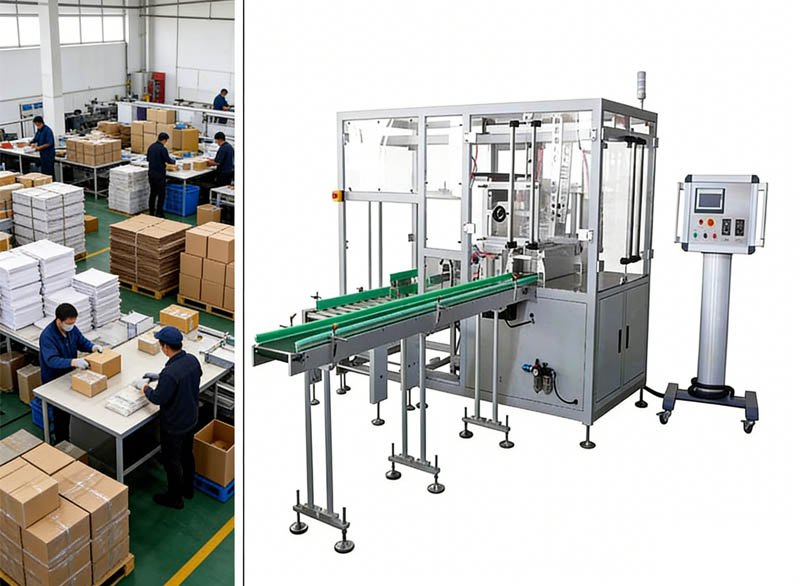
Manual vs automatic cosmetic filling machine comparison - HIJ filling line
From hand-filling to fully automatic lines — the right choice depends on your volume and budget.

Manual vs Automatic Cosmetic Filling Machine: The Short Answer

A manual cosmetic filling machine is operator-driven and best for very small batches, samples and R&D; a semi-automatic machine speeds up filling while an operator loads containers; and an automatic cosmetic filling machine fills, and often seals, with minimal human input for consistent high-volume output. As a rule of thumb: choose manual to start, semi-automatic to scale, and automatic once labour and consistency become your bottleneck.

The Three Types Explained

Manual filling machine

The operator triggers each fill (foot pedal or button) and handles every container by hand. Lowest upfront cost, smallest footprint, but output and fill consistency depend on the operator. Ideal for startups, sampling, lab batches and very low volumes.

Semi-automatic filling machine

The machine doses automatically, but the operator still places and removes containers. A big jump in speed and repeatability over manual, at a moderate price. Ideal for growing indie brands with steady but not high volume.

Automatic filling machine

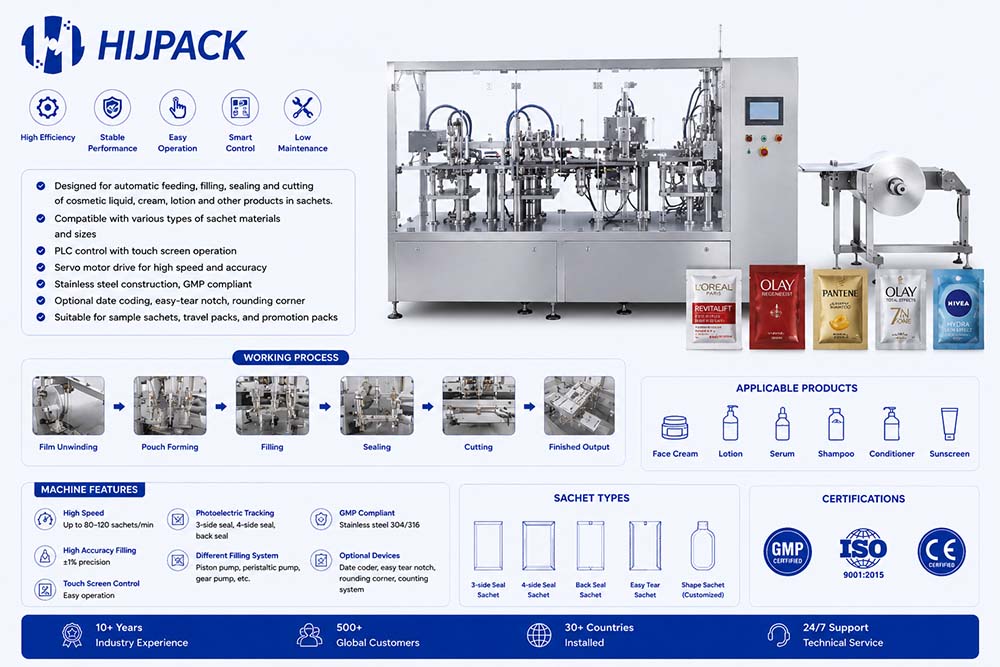
Containers are fed, filled, and often capped and sealed automatically with servo-controlled dosing. Highest output and the tightest, most repeatable accuracy, with the lowest labour cost per unit. Ideal for scaling brands and contract manufacturers.

Side-by-Side Comparison

CriteriaManualSemi-automaticAutomatic
OutputLowMediumHigh
Fill consistencyOperator-dependentGoodBest (±0.5% servo)
Labour per unitHighMediumLow
Upfront costLowestModerateHighest
ChangeoverSimpleSimple–moderateRecipe-based, fast
Seals / caps too?NoOptionalYes (integrated)
GMP documentationBasicGoodFull (IQ/OQ/PQ)
Best forSamples, R&D, startupsScaling indie brandsVolume & contract mfg
★ My Insight — Forester

Most brands overbuy or underbuy at exactly the wrong moment. Don’t buy automatic for a product you’re still reformulating — you’ll pay for capacity you can’t use. And don’t cling to manual once you’re shipping daily — your labour cost quietly overtakes the price of a semi-auto within months. Match the machine to your next 12 months, not your last.

How to Decide

  • Output under a few hundred units/day, still testing formulas? → Manual. Keep capital free while you find product-market fit.
  • Steady daily orders, one or two hero SKUs? → Semi-automatic. Big consistency and speed gain for modest cost.
  • Growing volume, retail/export, audits looming? → Automatic. Consistency, throughput and GMP documentation pay back fast.
  • Many SKUs, thin margins on labour? → Automatic with fast recipe-based changeover.

Bottom line: There’s no “best” type — only the right fit for your stage. Start manual, move to semi-auto as orders stabilise, and go automatic when labour and consistency cap your growth. Compare specific machines in our cosmetic filling machine range, or see a fully automatic cosmetic filling line.
Frequently Asked Questions

What is a manual cosmetic filling machine?
A manual cosmetic filling machine is an operator-driven filler where a person triggers each dose and handles every container by hand. It has the lowest upfront cost and is best for samples, R&D and very low-volume production.
Is an automatic cosmetic filling machine more accurate than a manual one?
Generally yes. Automatic machines use servo-controlled dosing for consistent, repeatable fills (around ±0.5%), while manual fill accuracy depends on the operator. For tight fill-weight control and audits, automatic is the safer choice.
When should I upgrade from manual to automatic?
Upgrade when labour cost per unit, fill inconsistency, or order volume start limiting growth — often once you’re shipping daily across multiple SKUs. A semi-automatic machine is a common intermediate step before full automation.
How much more does an automatic cosmetic filling machine cost?
Automatic machines have a higher upfront cost than manual or semi-automatic units, but a much lower labour cost per unit. Pricing depends on output, container and integration, so each is quoted individually. Share your requirements for a tailored quote.
Can one machine handle creams, lotions and liquids?
Yes, with the right dosing system matched to viscosity. Whether manual, semi or automatic, HIJ specifies the pump for your product — thin serums to thick creams — so fills stay clean and accurate.

Get Help Choosing the Right Filler

Need a Technical Opinion?

Don’t guess. Tell me your material and speed requirements, and I’ll configure the exact HIJ specification for you.

Chat With Forester

2026 Product Catalog

Download the full technical specs for our B-F, K-S, and P-J series presses.

Download PDF

You Might Also Find Helpful

Automatic multi-purpose cartoning machine by HIJPACK with sample pharmaceutical medicine bottles, supplement boxes, and cosmetic hyaluronic acid skincare carton packaging.
HIJPACK versatile automatic cartoning system designed for secondary packaging efficiency across pharmaceutical, nutraceutical, and cosmetic industries.

Chinese vs European Cartoning Machines: The B2B Buyer’s Comparison

Quick Answer For production speeds of 10–200 cartons per minute — where most pharmaceutical, food and cosmetic plants operate —…
Read Article ->
Automatic multi-purpose cartoning machine by HIJPACK with sample pharmaceutical medicine bottles, supplement boxes, and cosmetic hyaluronic acid skincare carton packaging.
HIJPACK versatile automatic cartoning system designed for secondary packaging efficiency across pharmaceutical, nutraceutical, and cosmetic industries.

8 Best Cartoning Machine Manufacturers in 2026 (Honest Comparison)

Quick Answer The leading cartoning machine manufacturers fall into two camps. European premium builders — Marchesini Group and IMA (Italy),…
Read Article ->

How to Choose a Cartoning Machine: The 7-Step Buyer’s Framework

Quick Answer To choose a cartoning machine, match seven factors in this order: product format (flat products need a horizontal…
Read Article ->
Fully automatic capsule filling machine model NJP-1200 made of pharmaceutical-grade stainless steel with gelatin capsule close-ups.
Industrial fully automatic capsule filler provides precise high-speed powder and pellet dosing under a compliant sealed safety enclosure.

Chinese vs European Capsule Filling Machines: An Honest Comparison for B2B Buyers

Quick Answer The honest answer: the country of origin is no longer the deciding variable — the individual manufacturer is.…
Read Article ->

Capsule Filling Machine Validation: A Practical DQ/IQ/OQ/PQ Guide for B2B Buyers

Quick Answer Validation of a capsule filling machine is a four-stage qualification executed by the buyer — Design Qualification (DQ),…
Read Article ->

Tamping Pin vs Dosator: Choosing the Right Capsule Dosing System for Your Powder

Quick Answer Tamping pin systems compress powder into the bores of a rotating dosing disc in successive stages, forming a…
Read Article ->

Let's Design Your Production Line

Share your requirements and I'll personally craft a solution that maximizes your efficiency and profitability.