📌 The Direct Answer
Obtain an itemized quote covering material and seal requirements, controls and record functions and cleaning and qualification responsibilities for the proposed configuration.
That gap is not just materials. Record cleaning and qualification responsibilities during the agreed project review or product trial, and assess the evidence against the acceptance criteria.
⚡ Quick Answer
Obtain an itemized quote covering material and seal requirements, cleaning responsibilities, qualification tests and supporting records for the proposed configuration.

Calculate costs and operating results from project-specific inputs, matched scope and stated assumptions.
What Tablet Blister Tooling Actually Costs: The Numbers Nobody Puts in One Place
Obtain an itemized quote covering material and seal requirements, qualification tests and records and quotation inclusions and cost assumptions for the proposed configuration.
Obtain an itemized quote covering material and seal requirements and quotation inclusions and cost assumptions for the proposed configuration.
▼ Entry Tier
Obtain an itemized quote covering quotation inclusions and cost assumptions for the proposed configuration.
6061 aluminum forming die, standard cavity layout, limited documentation. Suitable for R&D, pilot batches, non-regulated markets.
◆ Mid Tier
Obtain an itemized quote covering quotation inclusions and cost assumptions for the proposed configuration.
Hardened aluminum or tool-grade steel, basic dimensional report, limited material cert. Most common in WHO GMP markets.
▲ Validated Tier
Obtain an itemized quote covering quotation inclusions and cost assumptions for the proposed configuration.
Hardened 1.2379 stainless or equivalent, full dimensional report, material cert, FAT protocol, forming cycle validation. Confirm cleaning and qualification responsibilities against the applicable project requirements and document the supplier and customer responsibilities.
These ranges assume a standard 4×5 or 4×6 cavity tablet blister format on a flat-die machine. Roller-die tooling, larger cavity counts, deep-draw formats for thick tablets, or Alu-Alu cold-form tooling all carry separate price structures — covered in the sections below.
The Five Variables That Drive Tablet Blister Tooling Cost (And Which One Teams Get Wrong Most Often)
Tooling cost for a tablet blister packing machine is not a fixed function of cavity count. That’s the number teams look at first. It’s the wrong variable to lead with.
The five real cost drivers, in rough order of impact:
1. Forming System: Flat-Die vs. Roller-Die
Flat-die (reciprocating) tooling is simpler to machine and easier to validate. Obtain an itemized quote covering material and seal requirements, closure acceptance criteria and quotation inclusions and cost assumptions for the proposed configuration. Obtain an itemized quote covering closure acceptance criteria and quotation inclusions and cost assumptions for the proposed configuration. Roller-die machines run faster, but the tooling cost reflects the precision machining required to maintain consistent pocket geometry at speeds above 300 blisters/minute .
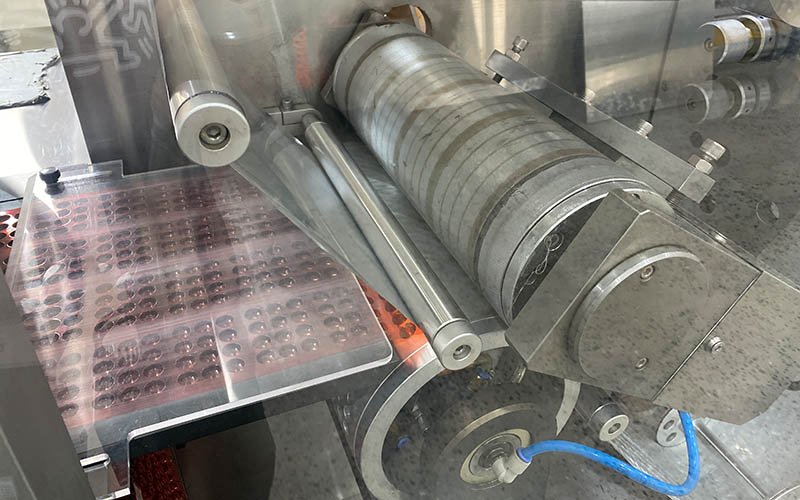
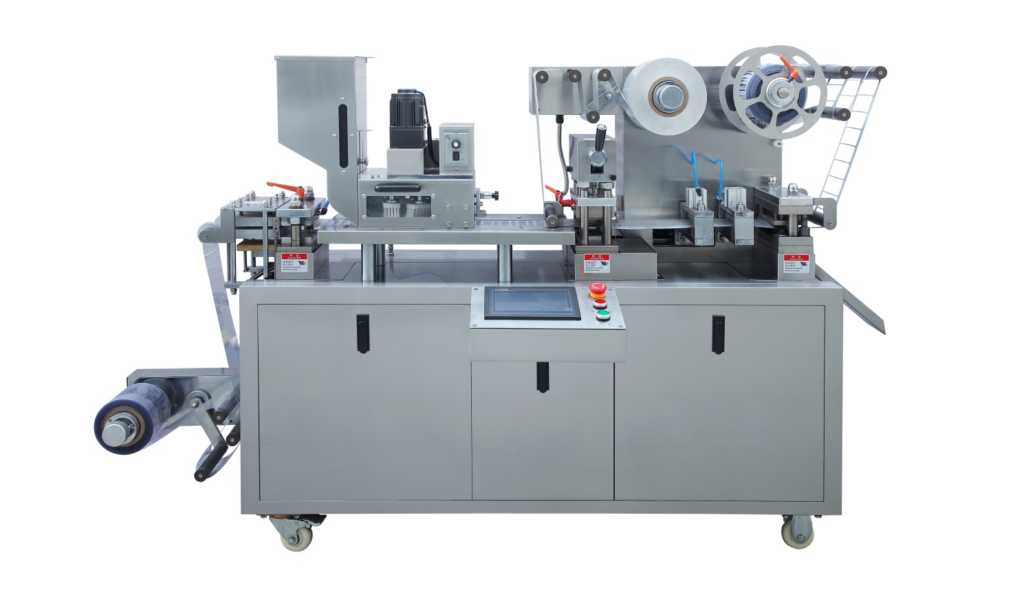
Flat-die blister forming station with heating plate — the most common tooling configuration for tablet blister packing in WHO GMP and FDA markets.
2. Material Grade: Aluminum vs. Hardened Steel
Standard 6061 aluminum is the most common forming die material in entry-tier tooling. Machinability is high, cost is low, and for low-to-medium volume applications it performs adequately. The problem: aluminum tooling wears measurably faster in continuous production above 150 blisters/minute, and the wear directly affects pocket geometry — which means blister depth, tablet seating, and seal integrity all drift over time. For FDA-regulated lines or any line running 3 shifts, the tooling change interval on aluminum sets can compress from 18 months to under 9 months, erasing the upfront cost saving entirely.
Tool steel (typically 1.2379 or equivalent) or hardened stainless costs 2–3× more at purchase but maintains dimensional tolerances through 3–5× the production cycles. Over a 36-month operating window, the total cost of ownership for steel tooling is consistently lower in high-volume pharma production.
3. Cavity Count and Pocket Geometry Complexity
Provide the tablet dimensions, shape, cavity arrangement and required formats for the tooling quote. Itemize forming, sealing and cutting parts, and agree drawings, materials, change parts and acceptance checks for each format.
4. GMP Documentation Package
This is where budget tooling saves money on paper and loses it in practice. A documented tooling set from a cGMP-aligned supplier includes: material certificate (with heat lot traceability), dimensional inspection report (pocket depth, width, length tolerances typically ± 0.05mm ), surface finish report (Ra value for contact surfaces), and where applicable, a FAT protocol confirming forming cycle performance at specified temperature and dwell time. Obtain an itemized quote covering cleaning and qualification responsibilities, quotation inclusions and cost assumptions and the sterile-process boundary for the proposed configuration. Without it, your line cannot pass IQ documentation review.
5. OEM vs. Third-Party Sourcing
Third-party tooling is rarely a problem on the machine spec sheet. It becomes a problem during SAT — Site Acceptance Testing — when forming temperature, dwell time, and pocket depth interact in ways that weren’t captured in the third-party supplier’s machining spec. Record controls and record functions and service scope during the agreed project review or product trial, and assess the evidence against the acceptance criteria. Obtain an itemized quote covering quotation inclusions and cost assumptions for the proposed configuration. Not a theoretical risk.
The Procurement Victory That Wasn’t: A Project in Kuala Lumpur
A QA director in Kuala Lumpur called me in early 2022. Obtain an itemized quote covering quotation inclusions and cost assumptions for the proposed configuration. It went into the quarterly cost-reduction report.tablet blister packing machine
The problem arrived at their WHO GMP audit preparation. The auditor asked for material certificates and dimensional reports for all contact-part tooling. None existed. The local machining house had no ISO 17025-accredited inspection process. The tooling had to be re-sourced, re-installed, and re-validated. Obtain an itemized quote covering accepted-output units, qualification tests and records and quotation inclusions and cost assumptions for the proposed configuration.
That conversation took about 40 minutes. I’m still not sure I convinced them the tooling sourcing decision was the root cause — their instinct was to blame the auditor’s interpretation. But the numbers were what they were.
Obtain an itemized quote covering material and seal requirements and quotation inclusions and cost assumptions for the proposed configuration.
— Forester Xiang, HIJ Machinery
Tablet Blister Tooling Cost Comparison: All Variables in One Table
Tablet blister tooling cost varies significantly by forming system, material grade, documentation scope, and supply source — this table maps the full decision matrix for pharma procurement teams.
| Tooling Variable | Budget Option | Mid-Grade Option | Validated / OEM Option |
|---|---|---|---|
| Forming System | Flat-die, aluminum 6061 | Flat-die, hardened aluminum | Flat-die or roller-die, tool steel / hardened stainless |
| Forming Die Cost | Quote the budget-option die against the specified cavity and drawing. | Quote the mid-grade die against the same format and acceptance criteria. | Quote the proposed OEM die and required records without assuming validation status. |
| Sealing Plate Cost | Confirm seal or closure acceptance criteria and itemized equipment, tooling and delivery scope in an itemized quote. | Confirm seal or closure acceptance criteria and itemized equipment, tooling and delivery scope in an itemized quote. | Confirm seal or closure acceptance criteria and itemized equipment, tooling and delivery scope in an itemized quote. |
| Punch / Cut Die Cost | Confirm itemized equipment, tooling and delivery scope in an itemized quote. | Confirm itemized equipment, tooling and delivery scope in an itemized quote. | Confirm itemized equipment, tooling and delivery scope in an itemized quote. |
| Full Set Total (est.) | Total the quoted components and exclusions for the budget option. | Total the same tooling scope for the mid-grade option. | Total the agreed OEM tooling scope, records and acceptance activities. |
| Material Certificate | ✕ Rarely included | ✓ Basic / on request | ✓ ISO-accredited, full traceability |
| Dimensional Inspection Report | ✕ Not included | ✓ Partial | ✓ Full, to ±0.05mm tolerance |
| FAT Protocol | ✕ Not available | − Optional at extra cost | ✓ Standard with OEM sets |
| OEM Warranty Coverage | ✕ Typically voids OEM warranty | − Depends on OEM approval | ✓ Full OEM warranty maintained |
| Expected Tooling Life | 6 – 12 months (high-volume) | 12 – 24 months | 24 – 48 months |
| Audit-Ready (FDA / WHO GMP) | ✕ Not without rework | − Partial — gap-fill required | ✓ Yes, from day one |
| Best For | R&D, pilot, non-regulated markets | WHO GMP markets, mid-volume production | FDA-regulated, EU GMP, high-volume 3-shift lines |
Punch Die and Cut-Die Tooling: The Component Teams Forget to Budget
Obtain an itemized quote covering closure acceptance criteria and quotation inclusions and cost assumptions for the proposed configuration.
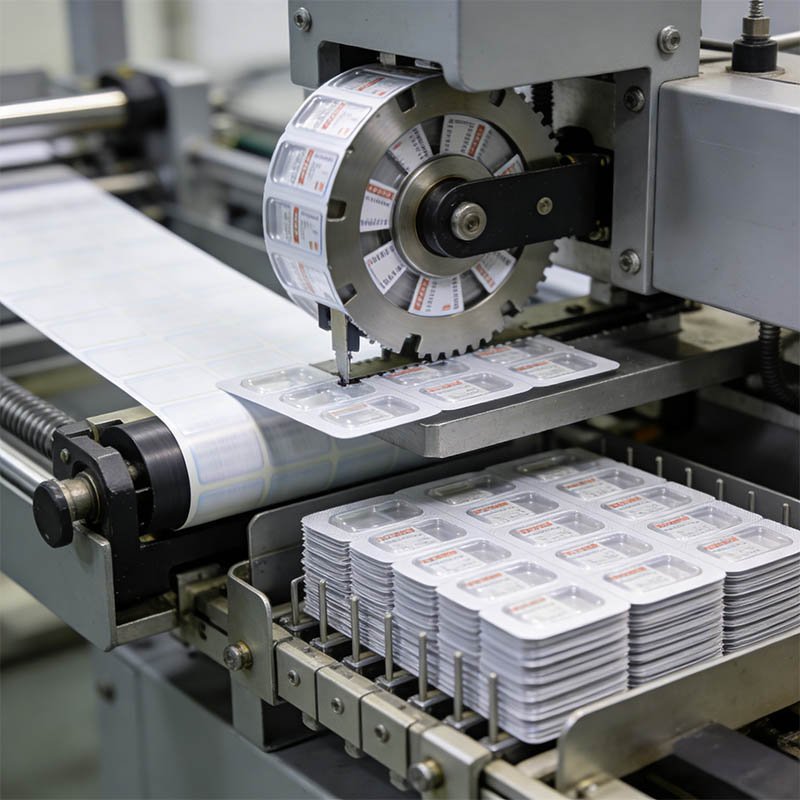
Obtain an itemized quote covering quotation inclusions and cost assumptions for the proposed configuration.
The punch die controls blister card geometry and edge quality. A worn or mismatched punch produces micro-tears at card edges — which fail USP <1207> container closure integrity testing at 60 mbar dye-ingress. That failure is a stability risk, not just an aesthetic one. For moisture-sensitive APIs, edge integrity is your last defense after the forming film and seal.
⚠️ Tooling Budget Diagnostic: Three Gaps That Appear After PO Signature
SYMPTOM: Punch die not in original tooling quote
Cause: Supplier quoted only forming die + sealing plate as “tooling set.” Punch/cut die treated as separate line item, often from a different supplier.
Fix: Require a three-component quote (forming die + sealing plate + punch die) with part numbers, material grade, and documentation scope specified for each component before PO signature.
SYMPTOM: Tooling arrives without material certificates
Cause: Third-party machining house did not maintain ISO 17025-accredited inspection records. Material cert was not in the scope of work on the original purchase order.
Fix: Add “ISO-accredited material certificate and dimensional inspection report per tooling component” as a delivery condition in the PO. No cert, no payment.
SYMPTOM: OEM refuses to cover tooling-related failures under warranty
Cause: Third-party tooling used on the machine. Forming temperature profiles and dwell settings were calibrated for OEM tooling dimensions; third-party sets vary by ±0.1–0.3mm, causing seal inconsistency that the OEM correctly attributes to the non-approved tooling.
Fix: Verify OEM’s approved tooling supplier list before sourcing. If using third-party tooling, obtain written OEM approval and a separate extended service agreement covering tooling-related failures.
Cold-Form Alu-Alu Tooling: Why It Costs 3× More and When It’s Worth It
Obtain an itemized quote covering material and seal requirements and quotation inclusions and cost assumptions for the proposed configuration. Three times the price of standard PVC thermoform tooling. The reason is the forming mechanism itself: cold-forming aluminum foil requires significantly higher cavity-wall precision than PVC thermoforming, because the foil deforms plastically without heat — any dimensional deviation in the forming die translates directly into foil tearing, pinhole formation, or incomplete pocket filling.
Record material and seal requirements during the agreed project review or product trial, and assess the evidence against the acceptance criteria. In every case, the initial forming die tolerance spec was ±0.03mm — tighter than standard thermoform tooling by a factor of 1.7× . That tolerance requirement drives machining time up by 35–50% compared to equivalent PVC tooling, accounting for most of the price premium.
When is the cost justified? When your API requires moisture vapor transmission below 0.5 g/m²/day and your product is destined for Zone IVb markets (30°C/75% RH, like much of South and Southeast Asia). Standard PVC at 250μm passes 4–6 g/m²/day. Cold-form Alu-Alu reduces that to 0.02–0.5 g/m²/day. For a hygroscopic API with 0.8% w/w moisture uptake specification, that’s not a nice-to-have — it’s the difference between compliant shelf life and a failed stability dossier.
💡 Forester’s Insight
The Alu-Alu Tooling Decision Belongs in Your API Moisture Spec Review, Not Your Procurement Meeting
I won’t tell you the Alu-Alu decision is straightforward. It involves your API profile, target markets, validation timeline, and sometimes your regulatory dossier reviewer’s interpretation of ICH Q1A(R2) for your specific Zone classification. What I will say: teams that make the forming material decision at procurement — based on tooling cost — rather than at formulation review, often get it wrong in expensive directions. The tooling cost is recoverable. The stability data gap it creates 12 months later is not. For a complete picture of how forming material connects to total packaging line investment, see our guide on tablet blister packing machine cost breakdown.
Multi-Format Tooling Strategy: What to Budget When You Run More Than One Product
Most pharma lines don’t run a single tablet format. They run 3–8 product codes on the same blister machine, each requiring a dedicated tooling set. That reality rarely appears in initial capital budgets.
Obtain an itemized quote covering closure acceptance criteria, quotation inclusions and cost assumptions and service scope for the proposed configuration.
Obtain an itemized quote covering quotation inclusions and cost assumptions for the proposed configuration. This number typically lands in the project budget after the machine purchase order is already signed. It shouldn’t. For teams doing total cost modeling before machine selection, our complete breakdown of tablet blister packing line cost — machine, tooling, and validation covers the full picture.tablet blister packing line cost — machine, tooling, and validation

Calculate costs and operating results from project-specific inputs, matched scope and stated assumptions.
What Every Tooling PO Must Specify: A Procurement Checklist for Pharma Lines
Eight things that must be in writing before your tooling purchase order is signed. Record the product, pack and test requirements during the agreed project review or product trial, and assess the evidence against the acceptance criteria.
- Material grade specified: State the exact alloy or grade — e.g., “6061-T6 aluminum” or “1.2379 tool steel hardened to 60–62 HRC.” “Stainless steel” is not a specification.
- ISO-accredited material certificate: Required for all contact surfaces. Specify that the cert must include heat lot number traceable to the raw material batch.
- Dimensional inspection report: Pocket depth, width, and length to ±0.05mm or tighter. Report must be signed by a qualified inspector, not self-certified by the machining house.
- Surface finish report for contact surfaces: Ra value specified (typically Ra 0.4–0.8 μm for forming cavity walls).
- FAT protocol scope defined: Specify whether FAT includes forming cycle validation at defined temperature and dwell time, or only dimensional check. “FAT included” without scope is meaningless.
- OEM compatibility confirmed in writing: If sourcing outside the machine OEM, obtain written confirmation from the machine manufacturer that the tooling set is approved and will not void the machine warranty.
- Three-component scope defined: Forming die, sealing plate, and punch/cut die must each appear as separate line items with individual pricing, material specs, and documentation requirements.
- Lead time and delivery conditions: Validated tooling from precision machining houses requires 6–12 weeks typically. Budget tooling ships in 2–4 weeks. The lead time difference tells you a lot about the machining process behind the price.
⚙️ Regulatory References for Tooling Documentation
- 21 CFR Part 211.68: Requires equipment used in drug manufacturing to be of appropriate design and material — contact-part tooling must have traceable material documentation.
- EU GMP Annex 1 (2022): Equipment qualification documentation (IQ) must cover tooling components for blister lines.
- WHO TRS 992 Annex 3: Material qualification for packaging contact parts required in dossier supporting documents.
- USP <1207>: Container closure integrity testing applies to the finished blister card — tooling dimensional accuracy directly affects CCIT compliance.
Engineering Review: Evidence and Investigation
Record the product, pack and test requirements during the agreed project review or product trial, and assess the evidence against the acceptance criteria. These three appear on at least two separate projects each in my records — two in Southeast Asia, one in the Middle East.
🔧 Field Failure Diagnostic: Tablet Blister Tooling
FAILURE: Seal leakers detected at Month 6 stability
Root cause in both documented cases: sealing plate surface flatness degraded below ±0.08mm tolerance after 8 months of production. Budget aluminum sealing plates showed measurable creep deformation at sealing temperature (160–200°C). Seal integrity was maintained in IQ/OQ/PQ but failed in routine production stability samples. By the time Month 6 data came in, 14 production batches were in quarantine pending investigation.
Fix: Specify minimum hardness for sealing plate material. Tool steel or hardened stainless maintains flatness through extended thermal cycling. Check sealing plate flatness quarterly as part of PM schedule.
FAILURE: Blister card edge micro-tears causing CCIT failures
Punch die wear. Both cases involved third-party punch dies at approximately 10 months use on a 2-shift operation running PVC/Aluminum at 200 blisters/minute. Cutting edge radius increased from approximately 0.05mm to 0.18mm, producing micro-tears at card periphery. USP <1207> dye-ingress test at 60 mbar detected failures in 4% of cards sampled.
Calculate costs and operating results from project-specific inputs, matched scope and stated assumptions. Replace when edge radius exceeds 0.10mm. Keep at least one spare validated punch die set in inventory.
FAILURE: Forming pocket dimensions out of spec after one year
Dimensional creep in 6061 aluminum forming die running deep-draw format (pocket depth >9mm) at continuous 3-shift operation. Pocket depth grew by 0.15mm over 12 months — outside the ±0.05mm tolerance. Tablet seating depth changed, affecting the headspace above the tablet, which in turn affected the foil draw ratio and seal quality at the pocket rim.
Fix: For deep-draw formats or 3-shift operations, specify tool steel forming die minimum. Include forming die dimensional re-verification in 12-month PM scope using calibrated CMM measurement, not manual gauge.
Tablet Blister Tooling Cost: Frequently Asked Questions
❓ How much does a single tablet blister tooling set cost?
Obtain an itemized quote covering material and seal requirements, closure acceptance criteria and qualification tests and records for the proposed configuration.
❓ Is OEM tooling always more expensive than third-party?
OEM tooling is typically 30–80% more expensive at purchase than third-party alternatives. However, OEM tooling is designed and validated to the machine’s specific forming temperature profiles, dwell times, and dimensional tolerances. Third-party tooling that deviates by even 0.1–0.3mm from these specs can cause seal inconsistencies and void the machine OEM’s warranty — converting the upfront cost saving into a significantly larger post-installation cost. Whether that trade-off makes sense depends on your regulatory environment, volume, and the third-party supplier’s documentation capabilities.
❓ What documentation does FDA require for blister tooling?
Under 21 CFR Part 211.68, contact-part tooling used in drug manufacturing must have traceable material documentation. In practice, FDA investigators reviewing IQ documentation for blister lines expect material certificates (with heat lot traceability), dimensional inspection reports for all contact surfaces, and surface finish data for cavity walls. FAT protocols covering forming cycle performance at specified temperature and dwell time are also commonly requested. Tooling without these documents will create IQ deficiency citations that delay line qualification and product registration timelines.
❓ How long does tablet blister tooling last?
Budget aluminum tooling lasts 6–12 months in high-volume production (2–3 shifts). Hardened steel or validated stainless tooling typically runs 24–48 months under the same conditions. The most common failure mode is dimensional creep in forming pockets and cutting-edge wear in punch dies — both of which cause gradual quality drift rather than sudden failure, making them harder to catch without systematic PM inspection.
❓ What is the difference between forming die, sealing plate, and punch die cost?
Obtain an itemized quote covering closure acceptance criteria and quotation inclusions and cost assumptions for the proposed configuration.
❓ Does Alu-Alu cold-form tooling cost more than PVC tooling?
Yes. Obtain an itemized quote covering material and seal requirements and quotation inclusions and cost assumptions for the proposed configuration. The premium reflects tighter dimensional tolerances required for cold forming aluminum foil (±0.03mm vs. ±0.05mm for PVC tooling) and longer machining cycle times. The cost is justified for APIs requiring moisture vapor transmission below 0.5 g/m²/day and for products destined for high-humidity Zone IVb markets.
❓ Can I use the same tooling set for tablets and capsules?
No. Tablets and capsules require different cavity geometry — pocket shape, depth, and width are specific to the product form. Attempting to run capsules through tablet-configured tooling results in incomplete seating, excess headspace, and seal integrity failures. Some machines support a dual-format tooling concept where forming dies are interchangeable within the same machine frame, but these are separate tooling sets — not shared.
❓ Should tooling cost be included in the blister machine capital budget?
Obtain an itemized quote covering controls and record functions, quotation inclusions and cost assumptions and service scope for the proposed configuration.tablet blister packing machine cost breakdown
Get a Validated Tooling Quote for Your Tablet Format
Every HIJ blister tooling set ships with material certificate, dimensional inspection report, and FAT documentation as standard — protecting your audit readiness from day one. Tell us your tablet dimensions, target market, and compliance standard, and we’ll spec the right tooling tier for your production requirements.