Blister Packaging Line URS: Turnkey vs Multi-Vendor Integration
A blister packer, cartoner and case packer do not become a qualified line because their nameplate speeds match. Your purchase decision depends on interface ownership, sustained output, buffer behavior, reject traceability and one agreed FAT protocol.
Start with the line boundary, not the machine list
Your URS should state where the line begins, where it ends and which system owns each product record. A pharmaceutical blister packaging line may include forming, product feeding, inspection, sealing, coding, punching, transfer, leaflet insertion, cartoning, aggregation and case packing. Each additional interface creates a new stop condition and a new data owner.
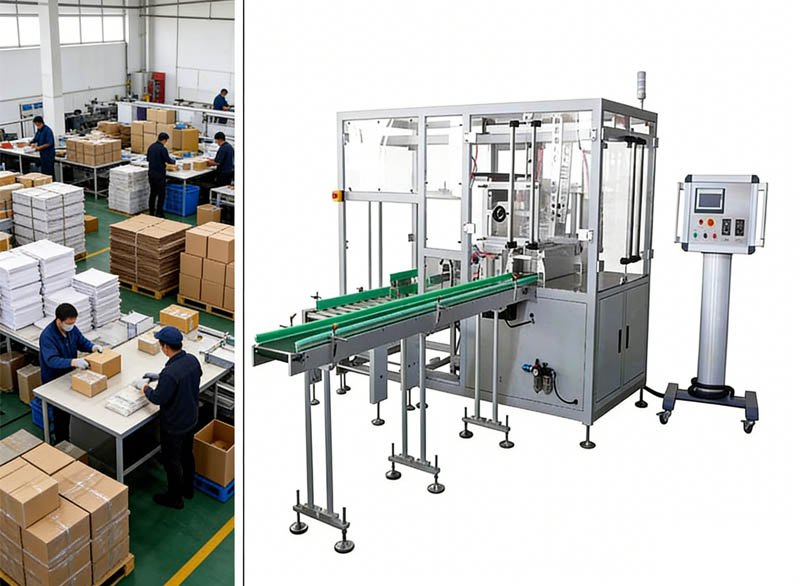
The highlighted buffer/transfer section is where many projects fail. It is not “just a conveyor.” It establishes pitch, orientation, accumulation, back-pressure, product identity and recovery after an emergency stop. If no supplier owns this interface, the buyer owns it.
Use sustained line output—not the fastest nameplate
A blister machine specification may show cycles per minute, while a cartoner shows cartons per minute and the production plan uses tablets or syringes per hour. These units are not interchangeable.
The run factor and yield must come from your agreed FAT or production evidence; they are not generic constants. For the blister machine output calculation method, convert every machine to the same accepted-unit basis before comparing suppliers.
Forester’s My Insight: a 300-carton/min machine does not create a 300-carton/min line
One verified HIJ PBL-400S/400SF project specification defines an incoming product requirement of 8,000 pieces per hour and lists a cartoning section capable of up to 300 cartons per minute. At one piece per blister and one blister per carton, the incoming product rate is only 133.3 pieces per minute before losses.
The line cannot be accepted at 300 saleable cartons per minute under that format. The higher cartoner rating provides headroom; it is not the integrated line commitment. Put the accepted product format, units per blister, blisters per carton and measurement point on the same FAT page.

Turnkey versus multi-vendor: assign the engineering work
| Decision point | Single turnkey supplier | Multiple equipment suppliers | Your URS must name |
|---|---|---|---|
| Mechanical interfaces | Usually designed under one line layout | Buyer or integrator reconciles height, pitch, guards and access | Drawing owner and tolerance approval |
| PLC handshakes | One control architecture can simplify testing | Protocol and signal mapping must be exchanged early | Interface control document owner |
| Performance test | Integrated FAT can be included in one contract | Standalone FATs do not prove full-line output | Final test location and responsible integrator |
| Change control | One supplier coordinates equipment-side changes | Buyer assesses effects across vendor boundaries | Approval workflow and version control |
| Service response | One escalation route can reduce diagnosis ambiguity | Specialists may be stronger within individual modules | First responder and remote-access rules |
| Commercial leverage | Broader scope under one negotiation | Component pricing and supplier choice stay separable | Scope exclusions and warranty boundaries |
A multi-vendor line is not automatically risky. It becomes risky when nobody is contracted to integrate it. A turnkey line is not automatically safe. It becomes defensible when the contract contains measurable interface and performance obligations.
Seven interface clauses your URS should contain
- Common operating modes: auto, manual, jog, cleaning and maintenance
- Upstream blocked and downstream starved signals with timing limits
- Emergency-stop zones and the approved restart sequence
- Product identity and reject tracking across every transfer
- Buffer capacity, usable range and the interruption it must absorb
- Common time source, batch data and alarm/event ownership
- Physical interfaces: height, pitch, guarding, utilities and access
Specify the buffer by event
Do not request “a buffer conveyor” without stating the event it must cover. In the verified PBL project, the infeed track includes a buffer intended to avoid a line stop during upstream label replacement. The same project requires carton and leaflet storage exceeding ten minutes of production. These are two different buffers: one holds product flow; the other holds consumables.
Add the maximum permitted residence time, contact restrictions and full/empty detection. Oversized accumulation can create product damage or traceability problems; undersized accumulation simply moves the stop upstream.
Write product-first interlocks
The verified PBL specification uses product-first logic: without product, the system does not pick a leaflet, does not pick a carton and does not push the load. It also defines detection and rejection for missing products, empty cartons and missing leaflets. Your line logic should describe the same cause-and-effect relationships in testable language.
Make the FAT prove the line—not a demonstration run
EU GMP Annex 15 states that the manufacturer should identify validation work needed to demonstrate control of critical operations and use a risk-based approach to determine scope. The European Commission’s EudraLex Volume 4 lists Annex 15 as the qualification and validation framework. The FDA process-validation guidance likewise places validation in a lifecycle approach. Neither source turns a vendor FAT into the buyer’s completed process validation.
| FAT challenge | Evidence to record | Acceptance basis |
|---|---|---|
| Sustained run at the contracted format | Accepted output, run time, stops, rejects and first-pass yield | URS measurement point and agreed test protocol |
| Downstream blocked | Buffer fills, upstream response, no uncontrolled product damage | Cause-and-effect matrix |
| Upstream starved | Downstream controlled stop and correct no-product/no-carton logic | Interface control document |
| Missing product, leaflet or carton | Detection, reject, confirmation and reconciliation record | Challenge-set protocol |
| Emergency stop and restart | Product state, batch data, rejects and recovery sequence | Risk assessment and approved SOP concept |
| Communication loss | Safe machine states, alarm, data preservation and recovery | PLC/network failure matrix |
| Format change | Parts, settings, time, verification and line clearance | Approved format recipe and changeover procedure |
Use the blister packaging machine FAT checklist as a machine-level starting point, then add the line-interface challenges above. For validation scheduling, review the blister packaging line validation timeline.
What to send suppliers before requesting a quotation
- Product and format matrix: dimensions, tolerances, cavities, products per blister, blisters per carton and carton grouping.
- Accepted-output requirement: units, measurement point, run duration, yield and planned operating pattern.
- Line boundary drawing: upstream and downstream equipment, existing machines, access, utilities and room constraints.
- Inspection and reject philosophy: defect list, reject ownership, confirmation and batch reconciliation.
- Control and data requirements: PLC standards, user access, audit trail requirements where applicable, recipe ownership and network rules.
- Qualification deliverables: design review, FAT/SAT, manuals, drawings, certificates applicable to the contracted equipment, and support for your DQ/IQ/OQ/PQ process.
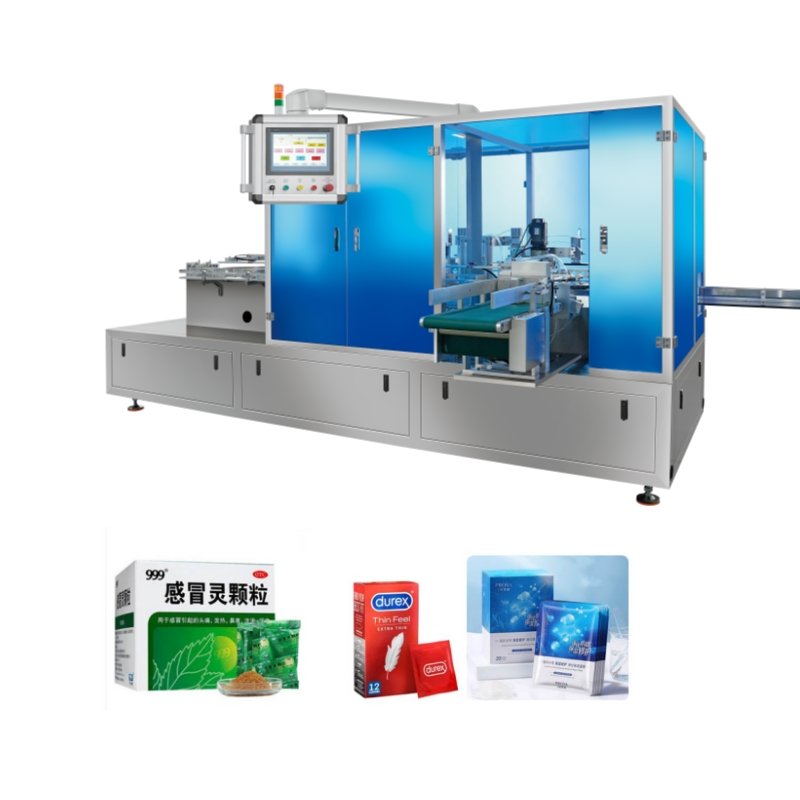
For machine selection and available blister formats, start with the blister packing machine portfolio. If the line scope includes leaflet insertion and secondary packaging, compare the required interface with the blister cartoning machine. The correct architecture may be a fully integrated line, a new blister machine connected to your existing cartoner, or several machines under a separate integrator.
Frequently asked questions
Can a new blister machine be integrated with our existing cartoner?
Yes, if the mechanical pitch, transfer height, control signals, speed range, buffer behavior, guarding and reject strategy are documented. The quotation should include an interface audit and state which party owns integrated testing.
How should we calculate the required blister packaging line speed?
Convert every module to the same accepted-unit basis. Use the product format, cavities per cycle, blisters per carton, sustained run factor and first-pass yield. The lowest resulting capacity is the line bottleneck.
What is the most important document in a multi-vendor project?
The interface control document is critical. It should define physical interfaces, operating modes, signal lists, starved and blocked states, reject ownership, data exchange and recovery sequences.
Does an integrated FAT replace IQ, OQ and PQ at our plant?
No. FAT provides supplier-site evidence against the agreed protocol. Your company remains responsible for its risk-based qualification and process-validation strategy, including site installation, operation and performance evidence.
What should a turnkey blister line quotation include?
It should identify the complete scope, exclusions, layout, format parts, utilities, interfaces, accepted-output test, inspection and rejection functions, FAT/SAT support, documentation, installation, training and warranty boundaries.
Send your line boundary and output requirement
HIJ can review your format matrix, existing equipment, buffer events and FAT measurement point before preparing a blister packaging line layout and quotation.
Request Line Layout & QuotationTechnical basis
- European Commission — EudraLex Volume 4, including Annex 15 Qualification and Validation
- FDA — Process Validation: General Principles and Practices
- HIJ verified project basis: PBL-400S/400SF Blister Cartoning Machine specification and DPH-380B blister machine specification. Project-specific figures are not universal machine guarantees.