Tropical-climate blister packaging guide
Blister packaging for a hot, humid market cannot be selected from a climate label alone. The relevant exposure may begin in the packaging room, continue through a warehouse and sea shipment, and end in a distribution channel where temperature and humidity change repeatedly.
A defensible project therefore connects the drug product, forming and lidding materials, finished-pack geometry, sealing process, route to market and stability program. This guide shows which question belongs to each part of that chain—and what a packaging-machine trial can and cannot prove.

Scope boundary: this is a project-definition guide, not a universal material ranking or a stability protocol. Product owners and qualified specialists must establish the applicable regulatory strategy, test conditions, methods and acceptance criteria for the specific drug product and market.
Start with exposure
Define the real heat and humidity journey before choosing a blister
The packaging room is only one part of the journey. A controlled production area may feed an uncontrolled dispatch zone. Cases may wait at a port, travel in a container, move through regional warehouses and arrive at pharmacies or homes with different levels of environmental control. The secondary carton, shipping case, pallet wrap and use of conditioned transport can also change the exposure seen by the blister.
Build the profile with supply-chain, quality, regulatory and packaging-development teams. Use measured or justified conditions for the intended markets. Record duration as well as peaks, because a short excursion and a sustained exposure are not the same design problem. Note repeated hot-to-cool or humid-to-dry cycles, since cycling can reveal different weaknesses from a single steady condition.
| Journey stage | Evidence to define | Packaging question |
|---|---|---|
| Material receipt and storage | Approved material specification, release status, storage and conditioning instructions. | Can the web be stored and brought to line without moisture, curl or handling changes outside the approved state? |
| Packaging room | Expected operating envelope, monitoring locations, actual records and intervention rules. | Can product and webs be handled, formed, filled and sealed consistently at the site? |
| Warehouse and dispatch | Dwell time, seasonal variation, secondary packaging and controls. | What exposure begins before transport, and does the shipping configuration reduce or trap it? |
| Transport | Route, mode, duration, transfer points, credible excursions and data from representative lanes. | Could heat, humidity, vibration, compression or cycling act together? |
| Market and patient use | Labelled storage, distribution practice, pack opening pattern and intended shelf life. | Does the proposed container-closure system support the product through its intended use? |
ICH Q1A(R2) describes stability testing as evidence of how product quality changes over time under environmental factors including temperature, humidity and light, and it connects that evidence to shelf life and recommended storage conditions. It does not turn one generic climate value into an automatic blister-material decision.
Moisture pathways
Trace how water vapour can reach the product
Moisture protection is a system property. Water vapour may pass through the forming web, through or around the lidding construction, or through a discontinuity created during forming, sealing, cutting, handling or distribution. The relevant path depends on the pack design and the condition of the finished blister.
Useful diagnostic question: is the concern gradual transmission through an intact pack, or a discrete integrity defect? Those mechanisms require different evidence. A barrier value does not detect a channel, and a seal-strength result does not quantify moisture transmission through the complete pack.
Evidence map
Separate material barrier, seal quality and product stability
Confusion usually starts when one test result is asked to answer several questions. A material transmission method characterizes a specimen under specified conditions. A seal test measures a property of the seal. A package-integrity method looks for a defined type of defect. Stability testing evaluates the drug product in its proposed container closure over time. These results can support one decision, but they are not interchangeable.
| Evidence | What it can answer | What it does not prove alone |
|---|---|---|
| Material construction and supplier data | Identity, layers, thickness or mass, relevant properties and stated test conditions. | Finished-pack shelf life, seal continuity or machine compatibility. |
| WVTR test such as ASTM F1249 | Water-vapour transmission of applicable film or sheeting under agreed test conditions. | Performance of every cavity geometry, seal or damaged pack. |
| Seal-strength test such as ASTM F88/F88M | Force required to separate a seal strip and the observed failure mode under the selected technique. | Moisture barrier, absence of all leaks or drug-product stability. |
| Package-integrity method | The defect or leak characteristic covered by the selected validated method. | Every possible failure mechanism or long-term product quality. |
| Stability study | Product quality over time in the proposed container closure under the approved study design. | Routine line control unless results are translated into material, process and pack specifications. |
| Machine trial or FAT | Whether agreed materials and format can be processed and inspected under the written protocol. | Commercial shelf life or all site, transport and market conditions. |
ASTM F1249 states that the method determines water-vapour transmission through applicable flexible barrier materials and that purchaser and seller should agree on sampling, standardization, test conditions and acceptance criteria when using the data as a referee method. This is why two values cannot be compared responsibly without their conditions and specimen details.
Likewise, ASTM F88/F88M covers seal-strength measurement and recognizes its use in process validation and control. The method and specimen orientation must be applied consistently. The maximum force is not a complete description of pack integrity, so record the relevant force result and failure mode defined by the pack specification.
Material selection
Compare blister material families without treating them as a league table
Thermoform polymer webs, coated or laminated barrier constructions and cold-form foil laminates offer different combinations of visibility, formability, barrier, pack size, opening behaviour, inspection options, tooling demands and supply-chain constraints. No family is automatically correct for every moisture-sensitive product or humid market.
Thermoform and coated-barrier constructions
Transparent thermoform packs can support product visibility and familiar inspection methods. The usable draw and local thickness distribution depend on the specific web, heating, forming geometry and process. Coatings or additional layers may improve the required barrier property, but the approved construction—not a generic material name—must be tied to the stability and machine evidence.
Cold-form foil laminate
Cold-form constructions are considered when a different barrier profile is required. Their forming mechanics, cavity footprint, pinhole risk, web handling, visual inspection strategy and product presentation differ from thermoforming. A proposed cold-form cavity should be reviewed against the actual product, card size, material specification and tooling before capacity or yield is promised.
Trade-offs that belong in the decision
- product sensitivity to moisture, oxygen and light;
- required shelf life and labelled storage conditions;
- cavity dimensions, draw, exposed area and card footprint;
- forming and lidding compatibility, opening force and child-resistance needs where applicable;
- inspection method, print area, traceability and reject strategy;
- material availability, change control, recycling route and market requirements; and
- evidence from development, transport assessment and stability studies.
For a broader breakdown of web constructions, use the blister packaging materials guide. To compare forming processes rather than climate claims, review thermoforming versus cold forming and the Alu-Alu versus PVC-Alu comparison.
Process control
Control material condition, forming and sealing at the actual site
A material that worked in development can behave differently if storage, conditioning, room environment or line handling changes. The site procedure should define how released rolls move from storage to the line, how long they may remain exposed, how opened rolls are identified and protected, and what happens after an environmental deviation.
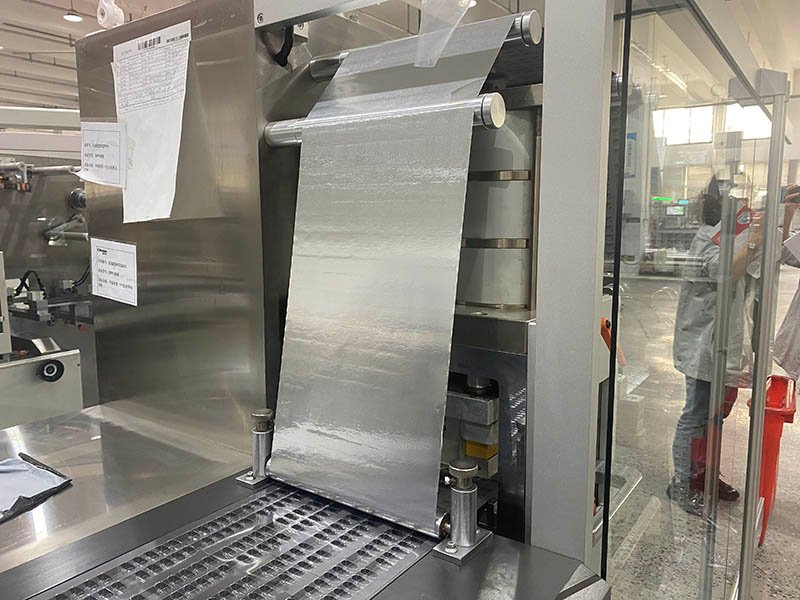
At the machine, verify material identity and direction, correct tooling and recipe, web tracking, tension, heating or forming inputs, cooling, lidding path and seal-surface condition. Compare controller values with the calibrated measurements required by the process. A displayed setpoint is an instruction to the system; it is not automatically proof of the condition experienced by the web.
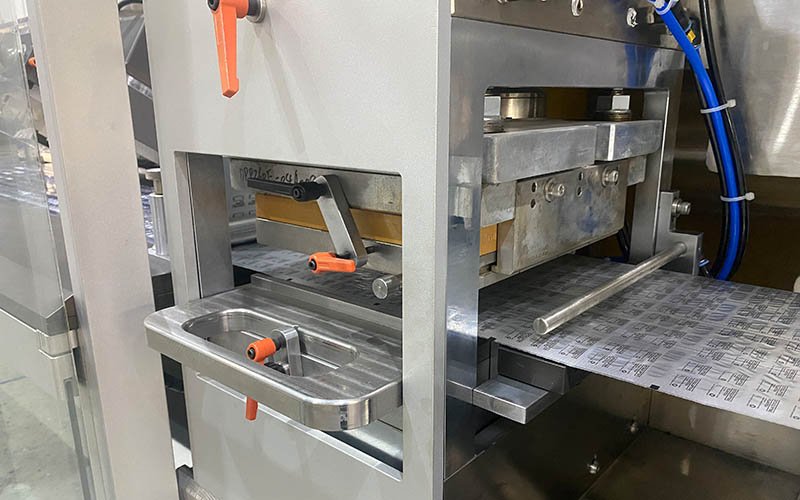
Define how start-up, a planned stop, an unplanned stop and restart are handled. Web remaining near a heated station may see a different history from steady production. The protocol should state which material is removed, how the line is cleared, where sampling begins after restart and how affected output is identified.
Do not publish or copy a universal sealing temperature, pressure, dwell or room-humidity limit. The safe operating window depends on the approved materials, coating, tool, machine design, index time, product and test results. Use supplier guidance as an input, then establish and control the product-specific process.
Distribution and storage
Test the pack that will travel, not an ideal laboratory sample
The evaluated configuration should represent the commercial blister, secondary carton, leaflet where applicable, shipping case and handling pattern. Distribution risks can combine: heat may change material behaviour, humidity may affect paperboard or product sensitivity, and vibration or compression may expose a mechanically weak cavity or seal.
- Map the lane. Identify manufacturing, storage, transport, transfer and market stages, including seasonal and route variations.
- Define the commercial configuration. Record blister count, carton, case, dividers, pallet pattern and any environmental protection used in practice.
- Select justified conditioning and distribution challenges. Use applicable procedures and specialists to connect the study to the real route and product risk.
- Inspect at meaningful points. Include visual condition, dimensions, seal or integrity evidence, print readability and product tests required by the protocol.
- Connect findings to stability. If the distribution challenge changes the package, assess its effect on the proposed container closure and stability program.
A shipping study and a stability study answer different questions. Distribution work evaluates the selected transport and handling challenge; stability work supports product quality over time. When both matter, define the sequence and sample history so the evidence represents the commercial journey.
Qualification boundary
Know what FAT, SAT and validation can—and cannot—establish
A factory acceptance test can show how the agreed machine configuration processes identified product, materials and format under a written protocol at the supplier’s site. It can record stops, interventions, good output, rejects and selected pack results. It cannot reproduce an entire shelf life or silently transfer responsibility for the drug product’s container-closure strategy.
Site acceptance should address installation context, utilities, interfaces, safety and operation at the buyer’s facility according to the agreed scope. If the production room or material-conditioning practice differs from the factory trial, record and assess the difference rather than treating the two runs as equivalent.

DQ, IQ, OQ and PQ terminology should be tied to the buyer’s quality system and validation plan. Equipment documentation can support that work, but equipment alone does not validate the product, packaging process or facility. The DQ, IQ, OQ and PQ blister packaging guide explains the handoffs in more detail.
21 CFR 211.130 requires written procedures designed to assure correct labels, labelling and packaging materials are used and includes line clearance, inspection, identification and control measures. For a humid-market project, this reinforces the need to define controlled materials, documented line status and acceptance evidence instead of relying on an informal trial.
RFQ and URS
Give the machine supplier the inputs that change the design
A supplier can review feasibility only against the information provided. “For tropical countries” is not enough to choose a web, specify tooling or guarantee output. Give controlled inputs early, identify what is provisional, and define who owns every missing decision.
| Input | What to provide | Why it changes the project |
|---|---|---|
| Drug product | Dimensions, presentation, handling characteristics, sensitivity summary and representative samples under an agreed confidentiality process. | Changes feeding, cavity, contact surfaces and packaging risk. |
| Approved materials | Full forming and lidding specifications, supplier data, roll details, coating side and storage/conditioning instructions. | Changes web handling, forming, sealing, tooling and test plan. |
| Pack definition | Controlled drawing, cavity layout, seal land, opening features, print and code areas, card and secondary-pack requirements. | Defines tooling, registration, inspection and cut configuration. |
| Exposure and stability | Target markets, labelled storage, commercial route, required shelf life and approved development or stability assumptions. | Connects material and pack decisions to product evidence. |
| Facility | Room envelope, utilities, cleaning approach, material flow and upstream/downstream interfaces. | Changes machine options, controls, access and site acceptance. |
| Accepted output | Finished packs per time, packs per index, planned run time, reject definition and operating factor. | Prevents a nominal machine speed from being mistaken for good commercial output. |
| Inspection and records | Required checks, sampling, data, audit trail, reject tracking, reports and document language. | Defines controls, interfaces and acceptance records. |
| Acceptance protocol | Product and material quantities, run states, stops, tests, acceptance criteria, responsibilities and deviation handling. | Makes the quotation and FAT outcome measurable. |
When a material is not yet approved, ask for a development configuration and list the decisions that remain open. Do not allow an early machine quote to become accidental approval of the product’s final container closure.
Investigation
Respond to heat- or humidity-related warning signs with evidence
Possible warning signs include web curl, tracking changes, forming variation, lidding wrinkles, local seal defects, delamination, print or code changes, pocket deformation, product softening or discoloration, and a shift in an approved integrity or stability result. None of these symptoms proves humidity is the root cause.
Do not release a batch because the blister “looks better” after an adjustment. Visual appearance, machine alarms and laboratory results each contribute different evidence. The approved specification and quality decision govern disposition.
Reference boundary
Use each standard for the question it actually covers
The following primary references define useful boundaries. The applicable editions, methods and regulatory expectations must be confirmed for the product, market and quality system.
Questions from project teams
Tropical-climate blister packaging FAQ
What is the best blister material for a hot and humid climate?
There is no universal best material. Choose the container-closure system from the product’s moisture, oxygen and light sensitivity, required shelf life, intended markets, commercial distribution, cavity design, opening needs, approved test evidence and machine feasibility.
Does a low WVTR value guarantee blister-pack shelf life?
No. A WVTR value characterizes the tested material under stated conditions. Shelf life also depends on the product, formed geometry, exposed area, lidding construction, seal, defects, secondary packaging, storage and stability evidence for the proposed container closure.
Is cold-form Alu-Alu always required for tropical markets?
No. Cold form is one material and process option with particular barrier, forming, footprint, inspection and presentation trade-offs. The correct choice must be justified for the specific product and pack rather than by geography alone.
Can a blister machine FAT prove performance in tropical distribution?
A FAT can test agreed machine functions, materials, format, run states and pack checks under its protocol. It does not simulate the full commercial distribution journey or establish product shelf life. Those require separate, product-specific evidence.
Should sealing temperature be increased when humidity rises?
Not as a universal response. First verify material condition, web path, contamination, tool condition, actual process measurements and the approved window. Any change must be authorized and confirmed with the required pack tests.
What information should be sent with a humid-market blister RFQ?
Send product details and samples, full forming and lidding specifications, a controlled blister drawing, target markets and distribution profile, facility conditions, required output, inspection needs, documentation scope and a proposed acceptance protocol.
What is the difference between seal strength and package integrity?
Seal strength measures the force associated with separating a prepared seal specimen under a defined technique. Package integrity evaluates a specified defect or leak characteristic. One result should not be used as a substitute for the other without a justified method and acceptance strategy.
Who is responsible for validating the blister package?
The drug-product owner controls the product, regulatory strategy, quality system and validation decisions. Material, machine and test suppliers can provide specifications, trials and documents within an agreed scope, but equipment purchase alone does not validate the product package or facility.
Define the product, materials and exposure before discussing the machine
Share controlled inputs so the blister-machine review can focus on forming, sealing, inspection, tooling, output and acceptance evidence without turning an unverified climate assumption into a promise.
About this guide: prepared for packaging development, engineering, quality, regulatory, procurement and operations teams. It supports project definition and supplier discussion; it does not replace product-specific stability, compatibility, distribution, integrity or regulatory work.