Cartoning process guide
How Does a Cartoning Machine Work? 6-Step Process
Follow a folding carton through opening, feeding, loading, closing and discharge. This guide explains the working principle, the controls between stations and the questions a real product trial should answer.
A cartoning machine opens or forms a folding carton, presents the product, loads it through the selected opening, closes the carton and transfers it downstream. A configured line may also feed leaflets, print or inspect codes, and reject nonconforming packs. Carton, product and insert movement must be synchronized so each pack reaches the correct station in the correct condition.
What is a cartoning machine?
A cartoner, also called a cartoning machine, puts a product or a defined product group into a folding carton. In common pharmaceutical, food and cosmetic applications, that carton surrounds an already packaged product: a blister card, sealed sachet, capped bottle or filled tube. This is usually secondary packaging. The machine does not replace the upstream filling, sealing or primary-pack integrity checks.
The word cartoning describes the operation. Cartoning equipment can refer to an integrated machine or to separate forming, loading and closing modules. A pre-glued carton sleeve opened from a magazine is one common format; top-load cartons, trays and wraparound sleeves can require a different forming and loading sequence. Syntegon’s published portfolio illustrates those separate and integrated architectures.[1]

| Equipment | Typical task | What to clarify |
|---|---|---|
| Cartoning machine | Load product into a folding carton and complete the specified carton operations. | Product orientation, grouping, carton drawing, inserts and closure. |
| Carton or case erector | Form an empty container for a later loading operation. | Whether “carton” means a retail folding carton or a corrugated shipping case. |
| Case packer | Group finished packs into an outer shipping case. | Case count, grouping pattern and transfer from the cartoner. |
| Case sealer | Close a filled shipping case with the specified sealing method. | Case geometry, flap condition and tape or adhesive requirements. |
On small screens, swipe the table horizontally to see all columns.
When a search or quotation says “carton machine,” ask what container enters and what finished pack leaves. That simple boundary prevents a folding-carton project from being quoted as a shipping-case project.
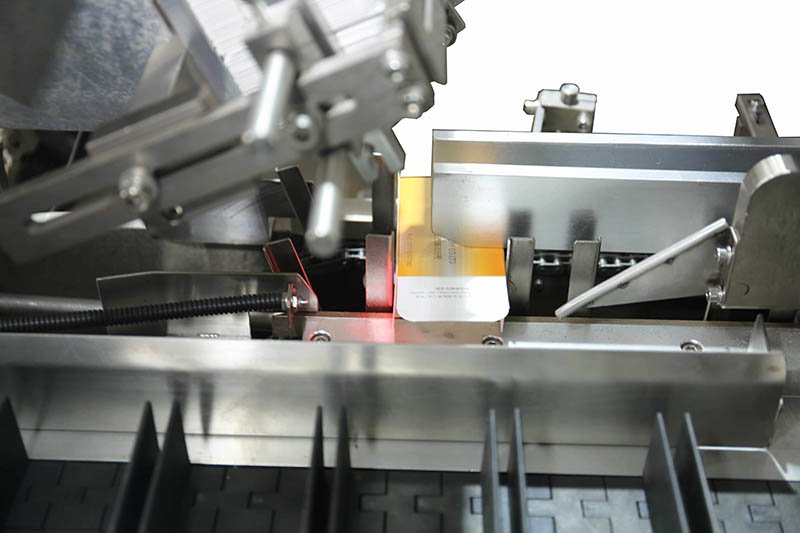
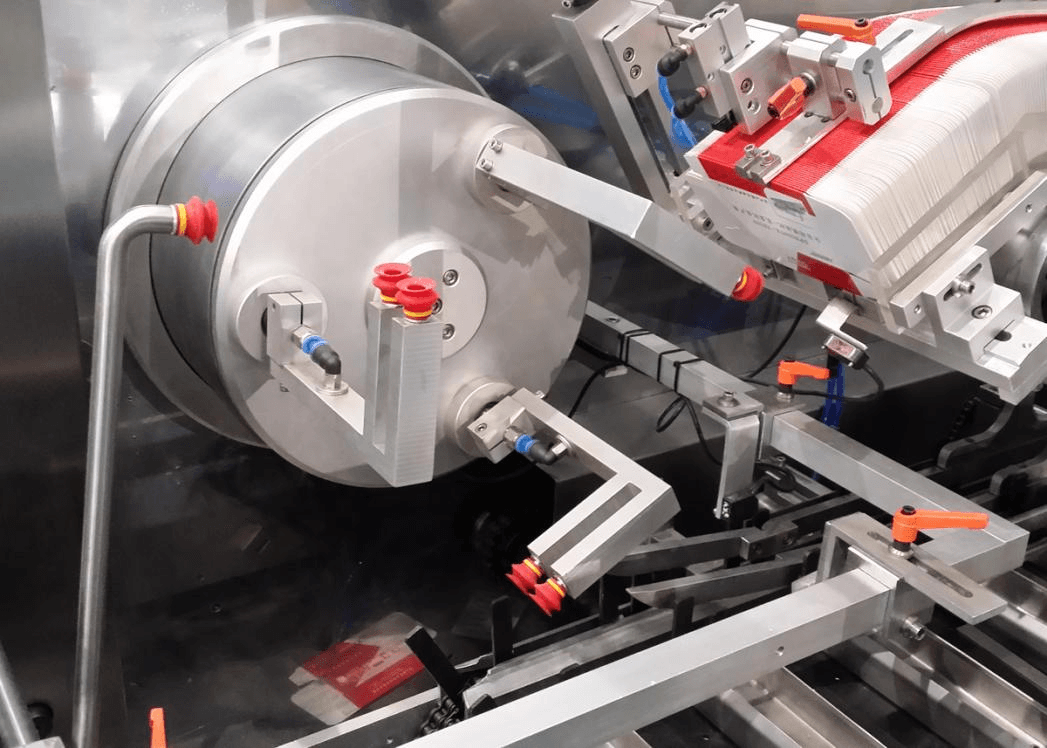
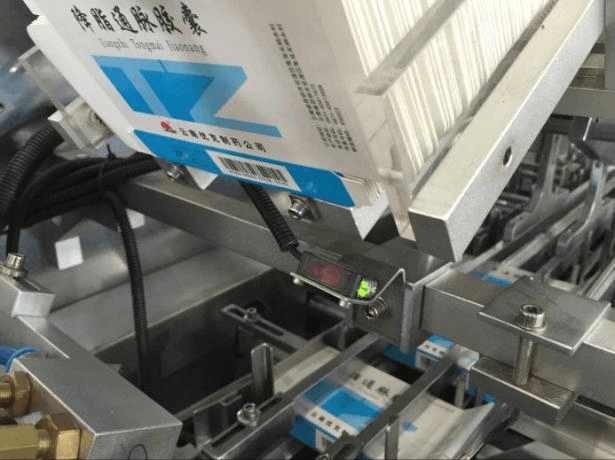
Explore the cartoning stations in photographs
Select a thumbnail to change the large photograph above it. These references show different mechanisms; they illustrate the process rather than prove an accepted configuration or output.
How a cartoning machine works: the six-step process
The sequence below describes a common end-load machine using pre-glued carton sleeves. Some operations run in parallel: product preparation and leaflet folding can happen while another carton advances. Coding and inspection positions also vary by layout.
-
Pick and open the carton
A magazine holds the flat sleeves. A pickup mechanism separates a sleeve, opens it along the creases and places it into a supported transport position. Guides or carriers hold the carton geometry for loading. Board stiffness, crease quality, storage condition, magazine pressure and vacuum pickup all affect how consistently this happens.
Trial question: does the carton remain square and accessible with the smallest, largest and most difficult approved format? Test actual production blanks rather than a single hand-selected sample.
-
Orient, count and time the product
The infeed delivers the right product group to the loading position. A bottle feeder may space upright bottles; a blister infeed may count and stack cards; a sachet system may collate flexible packs. Manual loading is another valid configuration. The important requirement is controlled presentation at the point where the cartoner receives the product.
Trial question: what happens during a gap, double presentation, unstable bottle or incomplete group? Specify the response and the recovery sequence. See the cartoner infeed systems guide for feeder-specific checks.
-
Fold and stage the leaflet, when required
If the pack contains an instruction leaflet, the folder prepares the approved fold pattern and presents the insert for loading. Some projects use pre-folded inserts, multiple pieces or no leaflet. Insert feeding is a defined part of the pack specification, not a function to assume from the machine name.
Trial question: can the system feed the actual paper, folded thickness and printed format consistently? Define how a missing or incorrect insert is detected, where that check occurs and what the machine should do. Read the leaflet folding and insertion explanation.
-
Transfer the product into the open carton
In a typical horizontal arrangement, guides and a pusher transfer the product through an open carton end. The carton support, product path and insert position have to align during that transfer. In a top-load arrangement, a product or group enters from above and may be placed by a different loading mechanism.
Trial question: can the product enter without damaging its primary pack, scuffing the carton or catching a flap? Include the most difficult approved combination of product dimensions, carton clearance and insert thickness. A carton that looks closed is not evidence that its contents are undamaged.
-
Apply the specified code and close the carton
A configured printing station can apply batch, date or other required information at an accessible point in the process. A separate inspection device is needed if the project requires code verification. Closing guides then fold the flaps for a tuck closure or present them for an adhesive closure, depending on the approved carton design.
Trial question: is the code readable and in the correct location, and does the closure remain acceptable with the real board and pack? Hot-melt glue is a closure method; it does not by itself establish a tested tamper-evidence system. Confirm any security feature separately. Compare tuck-in and hot-melt carton closing.
-
Track, reject and discharge according to the specification
Configured sensors and inspections identify defined nonconformities. The controls associate a fault with a transport position or pack and execute the agreed action: inhibit an operation, stop the machine or remove that carton at the reject point. Good cartons pass to the next agreed interface.
Trial question: when a known defect is deliberately introduced under an approved test procedure, does the correct pack leave the good stream? Check the detection, tracking and reject result together. An actuator moving is not sufficient evidence that the intended carton was removed.
A control system synchronizes drives, sensors and machine states. It cannot confirm an attribute that the agreed sensing or inspection system does not measure. Define each check and fault response before accepting a general “automatic rejection” claim.
Loading direction and motion describe different choices
Horizontal versus vertical describes the loading arrangement in common cartoner terminology. Intermittent versus continuous describes transport motion. Those choices are related through the design, but one label does not specify the other. Product stability and the required loading window matter more than a universal speed cutoff.
| Choice | Working principle | What to examine |
|---|---|---|
| Horizontal / end-load | Product travels through an open carton end. | Guided transfer, flap clearance, stack stability and insert position. |
| Vertical / top-load | Product enters through the top opening. | Orientation, placement control, carton support and closing sequence. |
| Intermittent motion | Carton transport indexes between positions and pauses during part of the cycle. | Available dwell time, product transfer and restart behavior. |
| Continuous motion | Carton transport keeps moving through the working sequence. | Synchronization of the moving carton, feeder and loading mechanism. |
On small screens, swipe the table horizontally to see all columns.
Manufacturers publish both intermittent and continuous cartoners, including different format and application ranges.[2] Use the horizontal vs vertical guide for product-path selection and the motion comparison and timing calculator for the loading window. Neither choice guarantees the accepted output of a specific pack.
How does the machine detect an incomplete carton?
There is no single inspection that proves every carton is complete. Presence sensing, code reading, vision and weight checks measure different attributes. A bottle-present signal does not prove that its label is correct. A readable carton code does not prove that the required leaflet is inside. Select checks from the pack risks and verify the installed detection limits.
1 · Detect
Name the fault and the device that can detect it. Agree the test sample, timing and detection limit.
2 · Track
Keep the fault associated with the correct carton through the intervening transport positions.
3 · Act
Execute the specified inhibit, stop or reject response without treating the wrong carton as the fault.
4 · Confirm
Verify the physical outcome and any agreed reject, bin-full or device-failure response.
Marchesini’s MA 200–202 description includes product–carton–leaflet cross-control, illustrating how checks can be part of a particular configured architecture.[3] It is not proof that every cartoner contains the same devices. Put your own detection and rejection requirements into the FAT checklist and confirm the included equipment in the quotation.
Machine speed is different from good-carton output
A nominal cycle or carton rate describes machine capacity under its stated conditions. A production result also depends on feeding, inserts, carton material, rejects, stops and format changes. Compare quotations against the same product and carton combination, with the same time boundary and the same definition of an accepted pack.
If 2,250 accepted cartons leave the line during a 30-minute test, the elapsed-window average is 2,250 ÷ 30 = 75 good cartons/min. If only 25 of those minutes were running time, the running-time average is 90 good cartons/min. Those two figures describe the same run with different denominators.
These are illustrative numbers, not HIJ performance results. Record rejects and stopped time separately. Do not compare a running-time rate with an elapsed-window rate as though they were the same measurement.
For annual capacity planning, the end-load cartoning guide includes a calculator that distinguishes those two rate bases. For a working-principle demonstration, first verify whether the machine produces the intended pack consistently; then measure output over the agreed duration.
What should a product trial prove?
Send representative product samples, carton drawings and blanks, insert specifications, required output, closure and coding requirements, and the upstream delivery pattern. Include the smallest, largest and most difficult approved combinations. If the product can arrive in several orientations, show that variation instead of presenting only an ideal sample.
- Opening: the real carton feeds, opens and stays supported.
- Presentation: the correct count and orientation reach the loading position.
- Insertion: the product and any required insert enter without unacceptable damage.
- Closure and code: both meet the agreed pack criteria, including any separately specified inspection.
- Fault behavior: approved challenge samples produce the intended stop, inhibit or rejection result.
- Changeover and recovery: operators can change the format and resume production using the agreed procedure.
- Output: accepted cartons are measured over a defined duration, with rejects and stops recorded.
Observation should take place through the intended guarded access and according to the supplier’s safe test procedure. Adjustments, maintenance and jam clearance belong in the approved machine procedures; the production sequence above is not an instruction to reach into a running machine.
Frequently asked questions about cartoning
What is a cartoner?
A cartoner is a machine that loads a product or defined product group into a folding carton and completes the specified carton operations. In many applications it provides secondary packaging around a blister, bottle, tube or sealed sachet.
How does a cartoning machine work, in short?
A common end-load sequence opens the carton, presents the product, prepares any required insert, loads the pack, closes the carton and transfers it downstream. Coding, inspection and rejection are included where specified, and some preparation steps run in parallel.
Do all cartoning machines insert leaflets?
No. Leaflet handling depends on the pack specification and supplied configuration. Projects may use a folder, pre-folded insert feeding, multiple inserts or no leaflet. Confirm the size, paper, fold pattern and inspection requirements.
Does automatic rejection mean every defect is detected?
No. Rejection acts on faults identified by the installed sensing and inspection system. Define each detectable fault, its tracking, the required response and the confirmation test. A reject mechanism alone does not establish complete inspection.
Is a horizontal cartoner always a continuous-motion machine?
No. Loading direction and transport motion describe different choices. A horizontal end-load cartoner may use intermittent or continuous motion. Verify the product path, loading window and synchronization in the proposed design.
What is the difference between a cartoner and a case packer?
A cartoner loads products into folding cartons. A case packer typically groups finished packs into an outer shipping case. Confirm the container material and input/output boundary because suppliers may use the word carton differently.
Does hot-melt closing automatically make a carton tamper-evident?
No. Hot-melt adhesive is a closure method. A tamper-evidence requirement needs a defined pack design, acceptance criteria and testing; a security label or another feature may also be specified.
How should cartoning output be measured?
Count accepted cartons over an agreed test duration using named product, carton and insert combinations. State whether the denominator is running time or the whole elapsed window, and record rejects and stops separately.
Sources and further reading
- Syntegon: cartoning machine portfolio — forming, closing, top-load, end-load and wraparound architectures.
- Serpa: cartoner portfolio — examples of loading and motion variants.
- Marchesini: MA 200–202 — one published continuous-motion horizontal architecture with product–carton–leaflet cross-control.