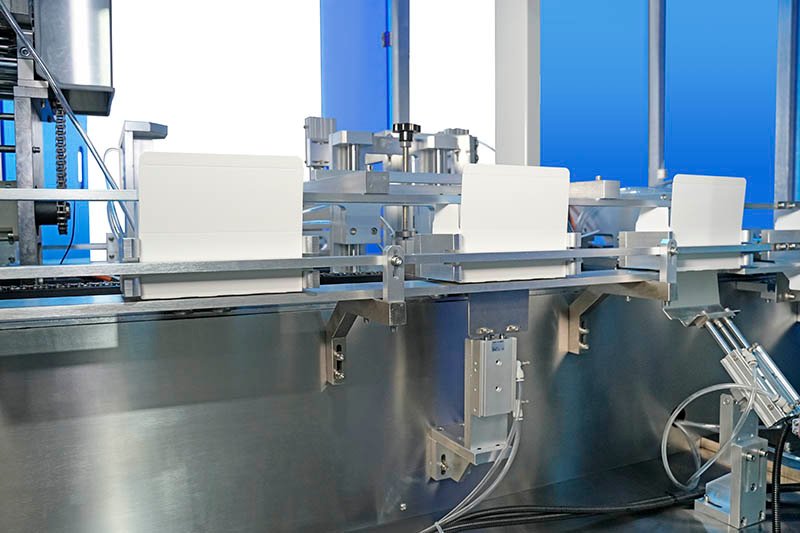
BD and SCHOTT both supply ready-to-fill prefillable syringes, but a shared nest-and-tub concept does not prove that their barrels, nests, closures or machine change parts are interchangeable. Compatibility must be released against the exact supplier family, part number, drawing revision and production samples.

Are BD and SCHOTT syringe nests directly interchangeable?
Do not assume they are. BD uses SCF terminology for products supplied Sterile, Clean and ready to Fill. SCHOTT commonly describes its prefillable syringes as ready-to-use or RTU. Both suppliers offer nested presentations, but the commercial families can differ in barrel geometry, flange position, tip or needle system, closure, nest count, pitch, tub construction and dimensional tolerances.
An equipment platform can be engineered for approved BD and SCHOTT component sets when the required change parts and recipes are included. That is different from saying every BD syringe will run with every SCHOTT tooling set. Compatibility is a project-specific engineering conclusion, not a brand-level promise.
Same terminology?
No. SCF is BD terminology; RTU/RTF are broader supplier descriptions. Use exact commercial references.
Same presentation?
Possibly similar, but nest, tub, lid, liner and handling dimensions still require comparison.
Same tooling?
Only after controlled drawings, interface dimensions and samples confirm that sharing is acceptable.
Define compatibility at every machine interface
“The syringe fits the machine” is too vague for a URS or quotation. Compatibility must be broken into the interfaces that actually touch or control the syringe presentation.
| Interface | Data to compare | Possible impact |
|---|---|---|
| Bag, tub and lid | Outer dimensions, lid construction, liner and opening method | Manual or automatic opening boundary, guides and transfer fixtures |
| Nest | Count, pitch, pocket geometry, orientation and datum locations | Nest support, lifting, indexing and fill-head alignment |
| Syringe barrel | Material, outside geometry, length under flange and tolerances | Guides, comb plate, transfer, filling position and inspection |
| Tip or needle | Staked needle, luer configuration, shield or cap geometry | Clearance, damage prevention, orientation and downstream handling |
| Stopper | Part number, diameter, ribs, coating and insertion requirements | Feeder, track, insertion tooling, position recipe and inspection |
| Product path | Dose range, formulation behavior and contact compatibility | Pump, valve, needle, recipe, recovery and cleaning method |
| Downstream system | Plunger rod, backstop, safety device, labeling or blister interface | Discharge orientation, accumulation and additional change parts |

Separate presentation compatibility from process suitability
A component may be physically loadable yet still be unsuitable for the intended product or closure process. Machine handling, drug-container compatibility, stopper performance, container-closure integrity and device integration are related but separate assessments.
HIJ can define equipment interfaces and demonstrate agreed machine functions. The customer and its component suppliers retain responsibility for product compatibility, stability conclusions, site qualification, process validation and batch release.
Standardized presentation does not mean identical presentation
Industry-standard nest-and-tub concepts reduce the amount of custom engineering needed to introduce ready-to-fill containers. They do not erase supplier-specific product families or dimensional tolerances. The useful question is not whether both products are standard, but whether the exact interfaces used by the ordered equipment fall within one proven tooling window.
This distinction matters when a project begins with one supplier and adds a second source later. Dual sourcing can improve supply resilience, yet it also introduces drawing comparison, sample trials, change parts, recipe control and qualification impact. Treat second-source readiness as a named project requirement rather than an informal expectation.
Compare commercial families, not supplier names alone
Both companies offer more than one syringe family. A brand comparison becomes useful only after the exact family, configuration and drawing revision are named.
BD project inputs
- Exact BD platform and commercial part number
- Nominal volume and barrel configuration
- Staked-needle or luer presentation
- Flange, shield or cap configuration
- Nest/tub reference and closure set
- Controlled drawings and representative samples
SCHOTT project inputs
- Exact syriQ or TOPPAC family and part number
- Glass or polymer container material
- Siliconized or silicone-free product family, where relevant
- Tip, needle, shield or cap configuration
- Nest/tub reference and closure set
- Controlled drawings and representative samples
Use three compatibility statuses
Confirmed shared tooling: controlled dimensions and trials show the same change parts can be used.
Same machine, different change parts: the platform supports both formats, but guides, nest handling, stopper tooling or recipes differ.
Engineering review required: the presentation lies outside the ordered scope or lacks controlled data and samples.

Send controlled data before requesting shared tooling
A supplier brochure can support initial discussion, but tooling should be released from controlled documents and production-representative components.
Identify the component
Supplier, commercial family, part number, material and drawing revision.
Define the barrel
Nominal volume, working dose range, barrel geometry, flange and tip or needle arrangement.
Define nest and tub
Nest count, pitch, pocket geometry, tub dimensions, lid, liner and presentation state.
Define the closure
Stopper part number, geometry, coating, insertion position and acceptance criteria.
Define the product path
Every product, dose, viscosity behavior, temperature range, cleaning need and contact-material constraint.
Provide samples
Production-representative syringes, nests, tubs and closures from the intended supplier and revision.
Add operational requirements
- Required accepted output and campaign pattern
- Component-transfer and opening boundary
- Fill-result and stopper-position measurement methods
- Inspection and rejection requirements
- Required format-changeover controls
- Downstream assembly or packaging interfaces
- Utilities, environment and documentation scope
Plan samples by purpose
Use drawing samples for early dimensional review, handling samples for dry-cycle and station trials, and production-representative component lots for FAT. Include complete nests, tubs, lids, liners and closures—not loose barrels alone. Record the supplier lot and drawing revision used for every test so the result remains auditable.
If the intended second source is not available during machine manufacture, define what can be proven now and what remains an open compatibility item. Quote future tooling conditionally instead of approving it from catalogue dimensions.
Prove compatibility through drawings, samples and station trials
The safest workflow narrows uncertainty in stages. Begin with documents, confirm with physical samples, then challenge the complete sequence under defined test conditions.
Drawing review
Map each supplier dimension to the machine datum it affects. Identify what can be shared and what requires a new part.
Bench fit check
Confirm nest support, guide clearance, stopper feeding and container protection with representative components.
Integrated trial
Run loading, filling, closure placement, inspection, rejection and discharge as one controlled sequence.
Build a supplier-format tooling matrix
Use one row for every approved supplier family and one column for each machine station. Record the required nest support, guides, transfer parts, filling needle, product path, stopper tooling, inspection recipe and downstream parts.
Where a part is shared, cite the drawing comparison or trial that supports sharing. Where it differs, give the change-part identifier. This matrix becomes the basis for quotation, storage, training and future change control.
Link every measurement to a decision
A long dimensional report is not useful unless it shows which values control machine fit. Mark each interface as shared, adjustable, dedicated or outside scope. For an adjustable interface, record the permitted range and controlled setup method. For dedicated tooling, record the part number, storage location and verification step.
After the trial, update the matrix with actual observations: loading stability, container contact, fill-needle alignment, stopper presentation, reject behavior and recovery after stops. The final release should state the tested component revision and any conditions attached to compatibility.

Test every approved supplier-format combination
If both BD and SCHOTT formats are included in the purchased scope, FAT should show the required changeover and acceptance evidence for each nominated commercial component set.
Before the run
- Verify component and change-part identifiers
- Verify installed hardware and product path
- Select the controlled recipe
- Confirm sample quantity and test method
During the run
- Observe loading, positioning and container contact
- Measure fill result by the agreed method
- Check closure position and visible defects
- Challenge stops, restarts, alarms and rejects
After the run
- Record accepted output and rejects
- Inspect tooling and containers for damage
- Capture deviations and open items
- Approve or revise the compatibility matrix
At the customer site
- Repeat site-specific installation and operating checks
- Execute customer qualification and validation plans
- Maintain supplier revisions through change control
- Retain batch-release ownership in the quality system

Define acceptance before testing
Agree sample quantity, run duration, fill-result method, stopper-position limits, defect definitions and the allowed open-item process before FAT starts. A smooth demonstration with one convenient component lot does not establish compatibility across every supplier family.
Factory evidence supports equipment acceptance. It does not replace the customer’s drug-container compatibility studies, site qualification, process validation or stability program.
Carry compatibility into change control
Compatibility is not permanent when inputs change. A new supplier site, part number, barrel drawing, closure coating, nest revision or presentation method should trigger a documented impact review. Compare the revised attribute with the interface matrix, then decide whether document review alone is sufficient or whether fit checks, station trials or site qualification must be repeated.
Keep a controlled list of approved combinations rather than a broad statement such as “BD and SCHOTT compatible.” The list should name the commercial family, revision, closure set, change parts, recipe and evidence reference.
Match the confirmed format portfolio to the equipment route
First define whether the project uses nested glass syringes with stoppering or plastic syringes with capping. Then define accepted output, product path, supplier formats, inspection and downstream scope.
Nested syringe filling and stoppering
Review the single- and double-head vacuum filling and stoppering platforms only after the approved nest, syringe and stopper sets are known.
Plastic syringe filling and capping
Use the plastic-syringe route when the component presentation and closure process require filling followed by cap feeding and placement.
Keep future compatibility conditional
A machine platform may accept additional formats later, but a future supplier or component family remains an engineering option until drawings, samples, change parts and qualification impact are reviewed. State launch formats explicitly and separate them from untested future possibilities.
For a broader explanation of format portfolios, tooling ownership and changeover economics, use the SCF/RTF format planning guide.
BD and SCHOTT syringe compatibility FAQ
Use these answers to prepare the engineering review; final compatibility still depends on controlled data and samples.
Are BD and SCHOTT prefilled syringe nests interchangeable?
What does BD SCF mean?
Does the same nominal syringe volume mean the same machine tooling?
Can one filling machine run both BD and SCHOTT syringes?
What documents are needed to confirm compatibility?
Does physical fit prove drug-container compatibility?
What should FAT test for each supplier format?
What should be included in a compatibility quotation request?
Turn supplier names into a controlled compatibility matrix
Share the exact BD, SCHOTT or other supplier references, drawings, samples, products and output target. HIJ can map the machine route, shared parts, dedicated change parts and FAT boundary.