Quick answer: In 2026, European blister cartoning machines (Uhlmann, Marchesini, IMA, Romaco) still lead on ultra-high-speed performance, global service networks and decades of big-pharma track record. Chinese machines have closed the component gap — top-tier lines now run the same Siemens PLCs, Yamaha robots, GUK folders and SICK sensors — and win decisively on price (typically 40–60% of the European quote), lead time and customisation flexibility. The honest question is no longer “which is better” but “which gaps matter for your product, market and support situation.”
We build blister cartoning machines in China, so read this with that declared. Precisely because of it, we have sat across the table from hundreds of buyers weighing our quote against a European one — and the comparison that actually helps them is never “China good, Europe expensive.” It is a gap-by-gap analysis: where Europe still genuinely leads, where the gap has closed, and where the advantage now runs the other way. Here is that analysis, using our integrated PBL-400S-400SF blister cartoning machine as the Chinese reference point.
Key Takeaways
- Judge machines by their component list, not their passport — the electrical cabinet tells you more than the brochure.
- Europe still leads on service network density, resale value and 400+ cpm ultra-high-speed applications.
- The gap has closed on components, motion control, CE compliance and audit-trail HMIs.
- China leads on price (40–60% of European quotes), lead time (~120 vs 9–14+ months) and engineering flexibility.
- The right choice is a buyer profile question: regulated market exposure, support geography and capital constraints decide it.
The 2026 Landscape in One Table
| Dimension | European machines | Top-tier Chinese machines |
|---|---|---|
| Typical price (integrated syringe line) | Reference point (often €1.5–3M class) | 40–60% of the comparable European quote |
| Lead time | Commonly 9–14+ months | Commonly 100–150 days after drawings |
| Core components | Siemens/B&R control, European robotics | Same Siemens PLCs and servos, Yamaha robots, GUK folders, SICK/P+F sensing on premium builds |
| Max proven speeds | 400+ cartons/min flagship cartoners | Up to ~300 cartons/min |
| Service network | Dense in EU/US, global subsidiaries | Remote-first support, technician dispatch, growing regional agents |
| Documentation for validation | Mature, standardised packages | Now routinely supplied; quality varies by vendor — audit it |
| Customisation willingness | Configurable within platform | High — custom feeders, layouts and format sets are the norm |
| Resale value | Strong secondary market | Weaker secondary market |
Three Gaps That Are Real
Service density where you operate
If your plant is in Germany, New Jersey or Basel, a European OEM can have an engineer on your floor tomorrow. Chinese vendors serve those regions remotely-first, with dispatch measured in days plus visas. For plants in Asia, Africa, the Middle East and Latin America the calculus often reverses — but be honest about your geography before you weight this factor.
Ultra-high-speed and deep track record
At 400+ cartons/min continuous motion, and in audit rooms where a machine’s 30-year installed base is itself a comfort factor, European flagships remain the safer call. Chinese integrated lines are proven in the 150–300 cartons/min class — which covers the overwhelming majority of real-world requirements, but not all of them.
Resale and financing familiarity
European machines hold value in a liquid second-hand market, and Western lenders know how to collateralise them. A Chinese line is a use-it-for-its-life asset. If your business model involves reselling equipment in five years, price this in.
Where the Machines Have Converged
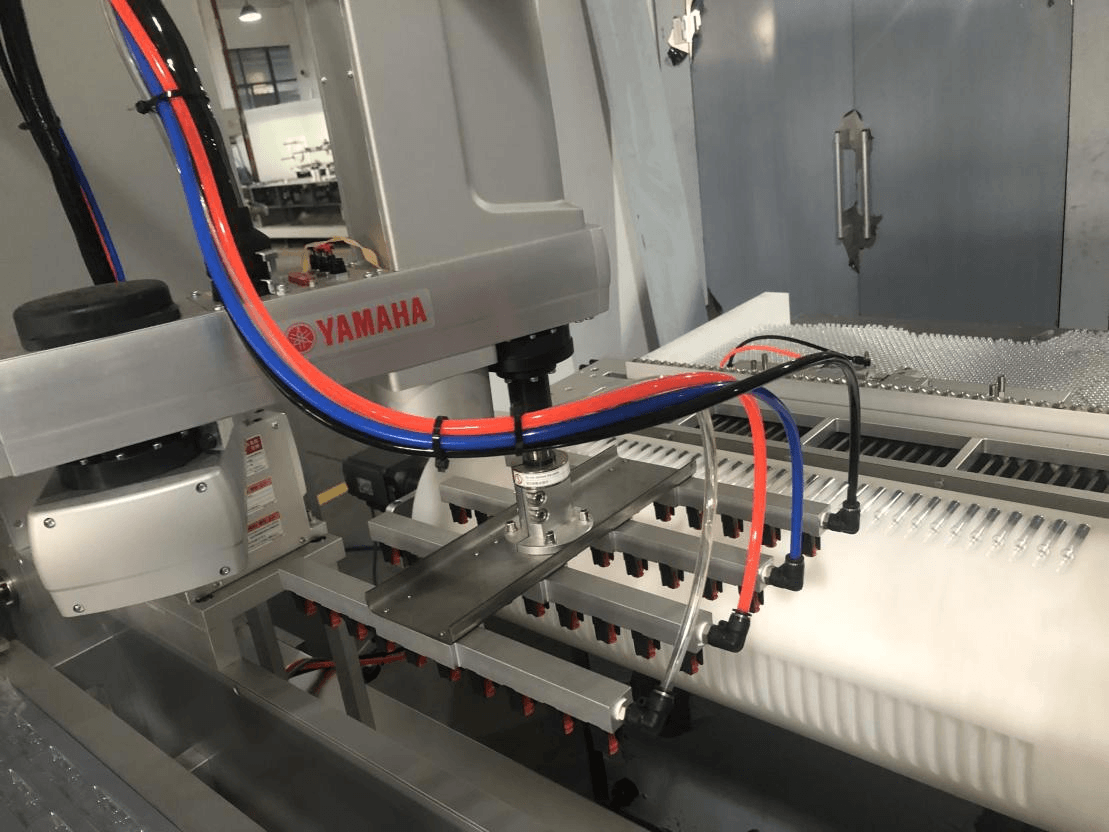
Open the electrical cabinet of a premium Chinese line and a European one, and you will struggle to tell them apart: Siemens CPU1516T-class motion PLCs, SINAMICS servo drives, SICK and Pepperl+Fuchs sensing, Schneider switchgear. On the PBL-400S-400SF, over 90% of electrical components are imported brands, the leaflet folder is a German GUK C91 and the loading robots are Yamaha — the identical folder and comparable robotics you would find on the European quote.
The same convergence holds for CE marking, cGMP-ready construction (anodised surfaces, tool-free covers, lubricant isolation), audit-trail HMIs with electronic signature, and 100% rejection interlocks. These stopped being differentiators around the early 2020s; today they are simply the spec sheet of any serious vendor from either continent. What still varies — on both continents — is execution quality, which is why we tell buyers to evaluate the manufacturer, not the flag.
Three Advantages With Numbers Attached
Price: 40–60% of the European quote
At matched specification — same PLC family, same robot class, same folder — the Chinese quotation typically lands at 40–60% of the European one. The saving is structural (engineering labour costs, factory overheads), not a component-quality discount, precisely because the components are now shared. Full planning bands are in our blister cartoning machine price guide.
Lead time: months, not years
Configured integrated lines routinely ship 100–150 days after deposit and approved drawings, against 9–14+ months for European order books. For a product launch, that difference is revenue. The realistic timeline — including what can still go wrong — is documented in the China lead-time reality check.
Engineering flexibility
Custom syringe feeders, a labeler docking interface, an unusual tray layout, dual-format tooling — Chinese engineering teams say yes to modifications that platform-based European OEMs price prohibitively or decline. For non-standard products, this is frequently the deciding factor, and it should be exercised through a rigorous URS: our syringe cartoning URS guide shows exactly what to pin down.
Which Should You Buy?
Buy European if…
You run 400+ cartons/min, your plants sit inside dense EU/US service territory, your auditors weight installed-base history heavily, or resale value is part of your capital model — and the 2–2.5× price premium and year-plus lead time fit your budget and timeline.
Buy top-tier Chinese if…
Your requirement sits at or below ~300 cartons/min, you need the line in production within two quarters, capital efficiency matters, your product needs custom engineering, or your plant is in a region where neither OEM has an engineer next door anyway. Specify the component list explicitly and audit the vendor — the same diligence you would apply to any supplier.
The parallel analysis for the primary-packaging side is in our Chinese vs European blister packing machine comparison, and every HIJ configuration in this class is listed on the cartoning machines hub.

“I have walked European packaging factories and I will say it plainly: their machines earned their reputation, and their engineers taught this whole industry — including us — what a pharmaceutical machine should be. Anyone selling Chinese equipment by calling European machines overpriced is telling you about their insecurity, not their product.
We don’t win orders by talking Europe down; we win them when the buyer’s spreadsheet does the talking — same Siemens cabinet, same GUK folder, 120 days instead of a year, at half the capital. Where that math works for the buyer, we win. Where it doesn’t — very high speed, doorstep service in Frankfurt — I tell them to buy European. That honesty costs me a few orders and earns me the rest.”
— Forester Xiang, Founder & Chief Engineer, HIJ MachineryFrequently Asked Questions
Are Chinese blister cartoning machines GMP compliant?
No machine from any country is “GMP certified” — GMP applies to your manufacturing process. Top-tier Chinese machines are built cGMP-ready and CE-marked, with the construction features and documentation that support your facility’s own validation, exactly as European machines are. Audit the specific vendor’s execution.
How much cheaper is a Chinese blister cartoning machine really?
At matched component specification, typically 40–60% of the European quote for integrated lines, with the gap narrower on simple cartoners. Always compare configured quotations line by line — an unmatched spec makes any percentage meaningless.
Do Chinese machines use the same components as European ones?
Premium builds do: Siemens motion PLCs and servos, Yamaha robots, German GUK leaflet folders, SICK and Pepperl+Fuchs sensors. Demand the electrical configuration list with the quotation — it is the single most revealing document in the comparison.
What about after-sales support from China?
Expect remote-first support (video diagnostics, HMI remote access), courier spare parts, and technician dispatch measured in days rather than hours. Buyers in Europe/US should weight this honestly; buyers in Asia, Africa, MENA and Latin America often find the support gap smaller than expected, since European OEMs also serve those regions remotely.
Can a Chinese machine pass an FDA or EU inspection?
Inspections assess your facility and processes, not the machine’s origin. Plants worldwide run Chinese-built packaging equipment within FDA- and EU-inspected operations; what matters is your qualification of the equipment and the documentation supporting it — which is your validation program’s job, supported by the vendor’s package.
Put Our Quote Next to the European One
Send us the European quotation’s spec sheet — component list included. We’ll configure a PBL-400S-400SF against it line by line, and tell you honestly where we match, where we don’t, and what the difference costs.
Get a Matched-Spec Quote