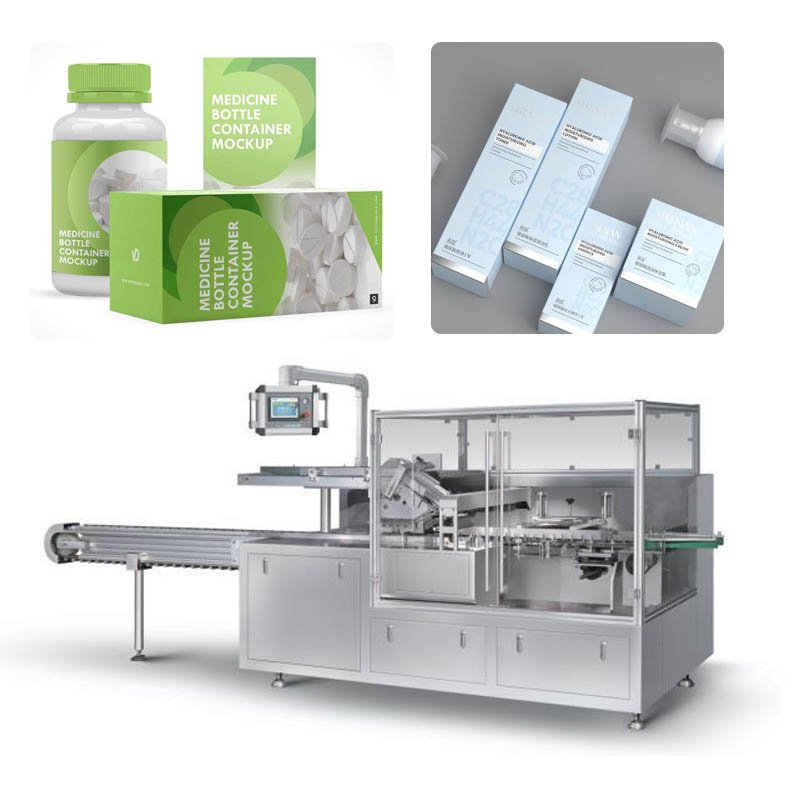
An automatic case sealer works in five stages: the filled carton enters the infeed and is centered by guide rails; drive belts grip and transport it at constant speed; the top flaps are folded (by the operator on semi-automatic models, mechanically on fully automatic ones); two taping heads apply pressure-sensitive tape to the top and bottom seams simultaneously, wipe it down, and cut it; and the sealed carton discharges. On a machine like the HIJ-600, this full cycle repeats up to 720 times per hour.
Case sealers look almost too simple from the outside — a box goes in open, comes out taped. But the difference between a sealer that runs for a decade and one that jams weekly comes down to how well each internal stage is engineered: the belt grip, the taping-head spring tension, the blade geometry. Understanding the working principle is the fastest way to evaluate any machine on a supplier’s quote.
This article walks through the complete working sequence stage by stage, explains what happens inside the taping head, and compares the two drive architectures that determine whether a sealer can handle your heaviest cartons. For the machine specifications behind the examples, see the HIJ-600 automatic case sealing machine; for the category basics, start with what a case sealing machine is, or browse all case packing machines.
The Main Components of an Automatic Case Sealer
Infeed and guide rails. Adjustable side rails center each carton before it reaches the belts, so tape always lands on the seam.
Drive belts. Motor-driven belts grip and transport the carton at constant speed through the sealing section — the heart of the machine, covered in detail below.
Taping heads. Two identical spring-loaded taping units — one above, one below — apply, press, and cut the tape. Heads are the highest-wear assembly and should be removable for bench maintenance.
Height and width adjustment. Hand-wheels raise the upper drive/taping assembly and set rail width to each carton size. On the HIJ-600 a full size change takes under one minute, with no tools.
Frame and casters. A welded steel frame keeps everything rigid at speed; four heavy-duty casters make the machine repositionable between lines.
Step-by-Step: How the Sealing Cycle Works
- Infeed and centeringThe operator or upstream conveyor pushes the filled carton onto the infeed. The side guide rails center it, ensuring the top and bottom seams line up with the taping heads.
- Flap closingOn semi-automatic machines, the operator folds the four top flaps by hand as the box enters. Fully automatic models fold minor and major flaps mechanically with plows and kicker arms.
- Belt engagementThe drive belts grip the carton and pull it forward at constant speed. From this point the machine controls the box completely — consistent speed is what produces a consistent seal.
- Tape applicationAs the leading edge strikes the taping head’s front roller, the head pivots and lays tape onto the front panel, along the full seam, and down the trailing panel — top and bottom simultaneously.
- Wipe-down and cuttingSpring-loaded wipe rollers press the tape firmly onto the corrugated surface for full adhesion, and the blade cuts the tape cleanly at the trailing edge, leaving the leading tab ready for the next box.
- DischargeThe sealed carton exits onto the outfeed — ready for labeling, corner reinforcement, or palletizing. Total cycle time on the HIJ-600: as fast as 5 seconds per box at rated speed.
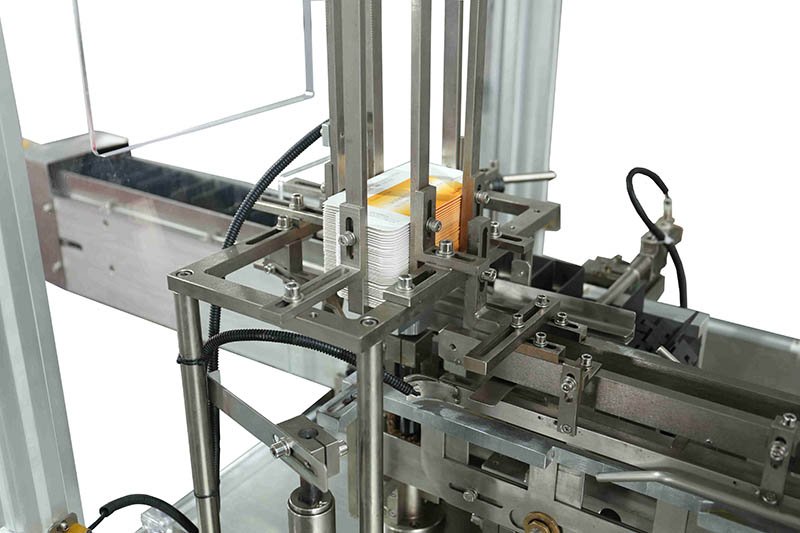
Constant belt speed is what produces the identical, centered seal on every carton.
Inside the Taping Head
The taping head is a purely mechanical cartridge — no motors, no sensors — which is exactly why tape sealing is so reliable. A tape roll mounts on a friction-controlled mandrel; the application roller presents the adhesive side to the approaching box; the box’s own forward motion unrolls the tape; wipe rollers press it down; and a guarded spring-return blade cuts it at the trailing edge. Because the box powers the head, tape tension self-regulates with box speed. The only routine service items are the blade (replace when cuts turn ragged) and the springs (check tension monthly) — details covered under our service & support program.
Top-and-Bottom Belt Drive vs Side Belt Drive
Drive architecture is the single most important specification on any case sealer quote, because it determines which cartons the machine can actually control:
| Criteria | Side belt drive | Top-and-bottom belt drive (HIJ-600) |
|---|---|---|
| Grip surface | Carton side walls | Carton top and bottom faces |
| Heavy cartons | Can slip — box lags, tape lands off-center | Full-weight grip; box cannot slip or skew |
| Tall / narrow cartons | Unstable, prone to tipping | Held flat between belts, fully stable |
| Short cartons | Good — belts reach low boxes easily | Good within the height envelope (200–600 mm on the HIJ-600) |
| Best for | Light, uniform, low-profile boxes | Heavy, tall, or unevenly filled industrial cartons |
“When a customer reports skewed tape, nine times out of ten the machine is fine — the guide rails were opened wide ‘to make feeding easier,’ so boxes enter crooked and the belts faithfully seal them crooked. Set the rails to the carton width plus a few millimeters of clearance, no more. A case sealer can only seal as straight as the box enters.”
Changeover: Adjusting to a New Carton Size
On a hand-wheel machine like the HIJ-600 the procedure takes under a minute: place a sample of the new carton on the infeed, lower the upper assembly with the height hand-wheel until the top belts contact the box, set the side rails to the carton width with light clearance, and run one test box to confirm the tape is centered. No tools, no technician — which is why uniform sealers suit lines running several carton sizes per day. (If every consecutive box is a different size, a random sealer or an all-in-one system is the better architecture — see the full semi vs fully automatic comparison — see our end-of-line machine comparison.)
What Keeps the Seal Quality Consistent
Three factors, all mechanical: constant belt speed (identical tape tension on every box), spring-loaded wipe-down (full adhesive contact regardless of minor corrugated surface variation), and correct tape width — 48 mm for standard cases, 60 or 72 mm for wider seams or heavier boxes. For export cartons that will be stacked high in containers, center-seam tape alone may not be enough; a four corner sealing machine downstream adds edge reinforcement. And if you’re weighing what this level of automation costs, our case sealing machine price guide breaks down 2026 figures by machine type.
Key Takeaways
- The sealing cycle has five stages: infeed/centering → flap closing → belt transport → simultaneous top & bottom taping → wipe-down, cut, and discharge.
- The taping head is fully mechanical and powered by the box’s own motion — the core reason tape sealers are so reliable and low-maintenance.
- Drive architecture is the key spec: top-and-bottom belts control heavy, tall, or uneven cartons that side belts let slip.
- Hand-wheel changeover on the HIJ-600 takes under one minute; constant belt speed is what makes every seal identical.
- Most “machine problems” are setup problems — guide rails set too wide are the #1 cause of skewed tape.
- Routine maintenance is minimal: blade replacement, spring-tension checks, and belt inspection.
Want to See the HIJ-600 Sealing Your Own Cartons?
Send us your carton dimensions — we’ll run a test video with comparable boxes and send it with a formal quotation within 24 hours.
Get Free Turnkey QuoteFrequently Asked Questions
Does an automatic case sealer fold the flaps too?
How does the machine cut the tape?
Why does tape sometimes land off-center or skewed?
How fast does an automatic case sealer run?
What maintenance does a case sealing machine need?
About HIJ Machinery
HIJ Machinery (legal name: Wenzhou Trustar Machinery Technology Co., Ltd), founded in 2004 in Rui’an, Wenzhou, Zhejiang, China, manufactures pharmaceutical, cosmetic, and food packaging machinery — including blister packing machines, cartoning machines, capsule filling machines, and case packing machines such as the HIJ-600 automatic case sealing machine. Equipment is CE-marked, manufactured under the ISO 9001 standard, and built cGMP-ready, with installations in more than 30 countries.
This article was written and technically reviewed by Forester Xiang, founder and chief engineer of HIJ Machinery, with 20+ years of packaging engineering experience and more than 100 pharmaceutical facility audits worldwide. Contact our engineering team for technical support.